Friday, 7 July 2006

F1 hybrids: what every gardener should know

Sweet corn Swift F1 ... plenty of hybrid vigour here

I've been prompted to write a big post about F1 hybrids after reading an article about them in Seed News, the Heritage Seed Library's newsletter, which suggests that gardeners should avoid buying them but only scratches the surface in explaining why.

Personally, I tend to shy away from buying F1 hybrid seeds. But I don't boycott them. If I think an F1 hybrid is genuinely superior to a non-hybrid then I will buy it. They are not inherently bad. But most gardeners are blissfully unaware of how seed companies exploit F1 hybrids to maximise their profits, and the long term ecological harm that results from it.

Looking through mainstream seed catalogues these days there's no shortage of F1 hybrids on offer. We all know what an F1 hybrid is, right? It's a cross between two different plants which creates something new and exciting. The crosses have to be done under controlled conditions, sometimes by hand, which makes F1 hybrid seed more expensive to produce than normal (open-pollinated) seed. This is nearly always reflected in the price. But that seems fair enough for something that's bigger, brighter and more exciting. Doesn't it?

I'm not so sure. The price hike is often very substantial. The seed companies sometimes hide this very efficiently by pricing the packets only a little higher than the non-hybrids but with a much reduced quantity of seed inside. A packet of T&M tomato seeds, for example, may contain as many as 100 seeds or as few as 6 (see example below).

A well known fact about F1 hybrids is that they don't come true from seed. All the gardening books warn you about this. If you save seed from your beautiful hybrid plants and sow them yourself next year, the results will generally be crap. They will revert to a motley mixture of feeble and substandard plants which may look nothing like the plant you took them from. Which means if you want to grow more of your treasured variety you have to go back and buy it again next year. Another reason seed companies luuuurve you to buy F1 hybrids.

And another problem. To maximise their potential, F1 hybrids are often reliant on intensive culture based around chemicals. The seed company will happily sell you some fertiliser gunk to make them grow bigger, and then some pesticide gunk to kill off anything that's tempted to have a nibble. But without these chemical props they often do very badly. I think this little-known issue is a factor in putting people off organic gardening, because they try 'going organic' with F1 seeds and then get disappointed when they get stunted plants mangled by pests.

F1 hybrids are usually very uniform, i.e. all the plants turn out the same. This is often marketed as being an advantage, but it isn't really. Not unless you're a commercial grower and you're planning to sell your produce to a big supermarket chain. For gardeners there's more benefit in growing open-pollinated plants which have a healthily diverse genepool with natural pest and disease resistance, show a few interesting variations from time to time, and from which seed can be saved for free.

So are F1 hybrids superior to open-pollinated varieties or not? That depends ... not just on how you grow it but on what it is. If it's sweetcorn then yes yes, go for an F1, they're way better. If it's tomatoes, then F1 hybrids are probably a waste of money. The reasons for this are slightly complicated, but here goes.

It's all to do with the way different types of plants reproduce and how they like to shake up their genes. There are two basic types: inbreeders and outbreeders. Inbreeders, which include tomatoes, peas, lettuces and French beans, have enclosed flowers which almost always self-pollinate. No bees needed. The offspring is genetically almost identical to the parents, and they're quite happy with that arrangement. Outbreeders, on the other hand, chuck their pollen far and wide in the hope of mixing up the genepool as much as possible. Sweetcorn, carrots, onions, beets and brassicas are all outbreeders. They rely on being pollinated by other plants of the same species. Otherwise within a few generations they start to suffer.

This brings us to the phenomenon of hybrid vigour. If you cross two different varieties of an outbreeding plant, the offspring may well turn out bigger, better and faster-growing than either of the parents. This is exactly what an F1 hybrid is: the term stands for 'first filial' generation and refers to a direct cross between two separate varieties. If you then cross the F1 generation with itself you get an F2 generation, and so on. But the hybrid vigour is not passed on. It's for one generation only.

The opposite of hybrid vigour is inbreeding depression. If you cross two outbreeding plants of the same variety, or it self-pollinates, the offspring can turn out weaker and slower-growing than either parent, and it gets worse with each subsequent generation. (This has major implications for people who save their own seed and I'll cover it in more detail soon in another post.)

Hybrid vigour and inbreeding depression only affect outbreeding plants. Inbreeders can inbreed to kingdom come and not show any ill-effects. But by the same token they don't show any extra vigour when you hybridise them. This is an important point. Because it means there's no special advantage in buying F1 hybrids of these plants.

Let's give an example. The back cover of this year's Thompson & Morgan catalogue has a lovely photo of their new and exclusive F1 hybrid tomato Harlequin (although the cynical graphic designer in me says "hmm, they've montaged that picture in Photoshop to make it look like it produces massive trusses of fruit", but that's a separate issue). While it looks like, and probably is, a very fine tomato, the fact that it's an F1 is neither here nor there. It won't be any more vigorous than any other tomato, because tomatoes don't display hybrid vigour. But it is more expensive. A packet of Harlequin will set you back £2.89 for 8 seeds! Compare that with the open-pollinated old fave Alicante from the same catalogue, which retails at £1.69 for 100 seeds. So Alicante seeds work out at 1.69 pence each, while Harlequin seeds cost 36.13 pence each. Ewww.

In the absence of any hybrid vigour, paying twenty-one times as much for hybrid seed is a bit pointless. Unless you really like the variety, in which case fair enough, buy it. And then save the seed. Because the usual don't-sow-seeds-from-F1-hybrids rule doesn't apply to tomatoes, as they're inbreeders. Just as they don't display hybrid vigour, they also don't display inbreeding depression, so you can inbreed them all you like. It's my guess that if you grew some Harlequin and sowed the seeds from it, at least some of the offspring would breed true. After a few generations of roguing out any that don't look right you will probably end up with an open-pollinated version which you can carry on growing forever without buying more seed.

I'm not slagging off Thompson & Morgan here (I buy from them myself and they've always given me excellent service) ... I'm just trying to explain why some of the things they offer are much better value for money than others. Tomatoes are very profitable to sell as F1 hybrids because they are relatively easy to hand-pollinate and each pollination produces a large amount of seed. And if you keep going back to buy more year after year because you think you can't save the seed then they make even more profit.

There's more to this though than being ripped off. F1 hybrids are replacing open-pollinated varieties in the catalogues to such an extent that many reliable old favourites are becoming unavailable and this is seriously compromising the genepool which has been built up over centuries. Despite all the "NEW!" stuff that appears year after year, the range of varieties available is dwindling. This gives seed companies increasing control over what we grow in our gardens, and enables them to streamline their lists to the core varieties which maximise their profit margins and thwart the sustainable practice of seed saving. Meanwhile both our gardening heritage and the potential for future plant evolution are being lost at a rapid rate.

There has been a stealthy and active increase in the development of seeds which are only viable for one generation, as seed companies seek out ways to keep you coming back to buy more. The obvious headline grabber has been Monsanto's insidious "terminator" technology which has genetically engineered plants to produce sterile seed. But it's happening on a much more subtle level too. I bought some Calendula seeds a couple of years back ... normally something you only have to do once because they self-seed liberally. But then I read on the back of the seed packet that this variety had been bred to be "self cleaning – no dead heading required". The flowers just fall off as soon as they've gone over. That's supposed to make me think "woohoo, that'll save me some time and getting my fingers all sticky!" But wait a minute. Isn't there something fundamentally wrong with a plant which aborts its own flowers? Do I really want this in my garden?

Going beyond the realms of the domestic garden for a moment, there are serious issues with the introduction of hybrid seed in developing countries. What started off as aid has in some cases increased hardship and crop failure among some of the world's most vulnerable people. Big seed companies donate hybrid seed in vast amounts to community projects, which makes them look 'ethical'. In most cases this involves replacing the locally grown varieties which have been saved and replanted in these communities for generations. Once they have been given the hybrid seed, farmers are locked into a cycle of buying the pesticides and fertilisers to go with them, which are cripplingly expensive as well as unhealthy. The hybrid seed is not optimised for the local growing conditions and often does badly. Shockingly, many farming communities who have received well-intentioned charitable aid in this way are now worse off than they were before.

So, to sum up ... I don't think there's any need to completely avoid F1 hybrids. It's just a matter of being a savvy consumer and being aware of the wider issues. Work out the price per seed before you buy them and decide if it's worth it. Buy from a seed company which has a sustainable rather than a profit-driven ethos. Celebrate diversity. Save your own seed. Make your own hybrids.

Tuesday, 4 July 2006

Today in the garden ... purple pods


Last night's dinner included some of the Edzell Blue potatoes and red-flowered broad beans. I tried baking the potatoes this time but this obviously isn't one of Edzell Blue's strong points. They have too much dry matter in them and go very floury, and the flavour isn't very inspiring. The skins go extremely crispy and leathery and take a lot of chewing. Some people like their jacket potatoes that way ... but I've had a lot better. When I discover which cooking method does suit this beautiful but fickle spud I'll let you know. The red-flowered broad beans, on the other hand, are the best I've ever tasted. They have slightly smaller beans than the modern varieties I've grown in the past, but they taste fantastic with no bitterness in them at all and only need to be lightly steamed. The plants are more blackfly-resistant than any I've ever grown, which in practice means higher yields. I got my seeds from W Robinson & Son and they may in fact be the only supplier of this variety, although I've also seen it doing the rounds on the HSL seed swap. Highly recommended.

Apple Taynton Codlin coming along a treat

The fruit garden is going like the clappers ... most things are ready to harvest now. I have more raspberries than I can possibly use for anything, mainly because the bushes I inherited as part of the garden are a crappy type which all ripen in one enormous simultaneous glut. The flavour isn't much to write home about either. I'm intending to replace them with Autumn Bliss which is massively better and definitely my raspberry of choice. The only fruit failure so far this year is my miniature peach tree, which has taken umbrage at something and dropped all its fruits in disgust. Bloody temperamental thing. Meanwhile my single solitary apple is swelling nicely.

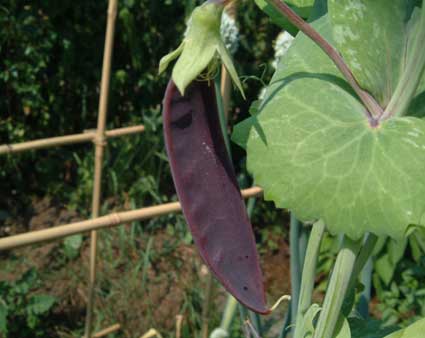
Well, here's the evidence. Mr Bethell's Purple Podded has purple pods.
How about that then. Purple podded peas. They start off green when the flower first dies off but within a day of exposure to the sun they go this shiny purple-maroon colour. Another thing I really like about this variety is that the sepals on the flower buds are speckled with maroon, especially while they're in the bud stage. It's very pretty. And with the flowers changing colour all the time I'm wishing I planted it closer to the house where I could stare at it more. Mine bears some of its flowers upsidedown; I'm not sure what that's all about. I'm not finding it to be quite as vigorous as Alderman, but that's hardly surprising. I suspect Alderman has been hybridised with a triffid.
Pollinations done today (it's technically too hot for it, but the others I did the other day seem to have taken all right):

Champion of England: one bud pollinated with Mr Bethell's Purple Podded
Mr Bethell's Purple Podded: two buds pollinated with Champion of England
Alderman: three buds pollinated with Mr Bethell's Purple Podded; two with Champion of England

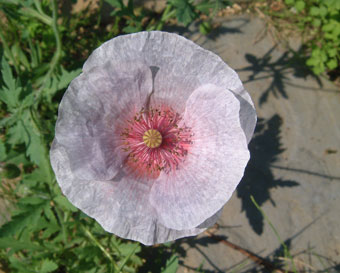
Another nice poppy showed up today ... a lavender-grey one with a pink centre. Once again it's a self-seeded Mother of Pearl.

I thought it was time I posted a picture of one of the vegetable plots, because they look lovely at the moment with everything growing away like mad. But you'll soon see why most of the photographs I post are tightly-cropped close-ups ... it's so you can't see what a scruffbag muddle everything is actually in. I dug this veg bed out of the lawn last year, so this is only its second season. That's my excuse and I'm sticking with it.

From left to right: tomato Pink Jester; climbing bean Mrs Fortune's (on wigwam); pea Champion of England (on other wigwam); sweetcorn Swift (F1); onion Hysam; garlic Music. There's also some Mascara lettuce and Cheltenham Green Top beetroot in the foreground and Red Duke of York and Fortyfold potatoes behind and God knows what else.

Sunday, 2 July 2006

Bean update

Buds and flowers on Trionfo Violetto climbing bean

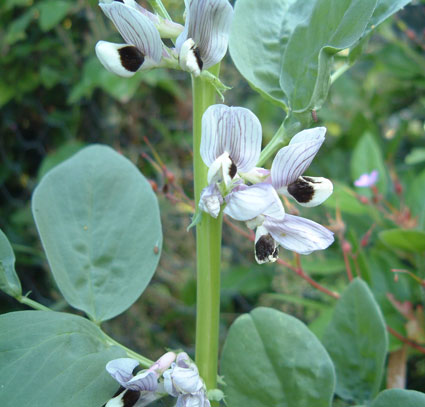
Just as all the other broad beans are being harvested, the late-sown Martock broad beans have come into flower. This is the really antique variety which is reputed to have been around since the 13th century. I'm only growing four plants, and they're all standing very upright and not branching at all. But as is often the case with these very old varieties with a well shuffled genepool, they all have slightly different flowers. They are all white with black blotches and purply-mauve at the base, but there's variability in how much purple they have and whether it's on the whole flower or upper parts only. Two have strong purple veining running through the petals while the other two are just white.

At this point I'd like to state my view that this variability is a very good thing. We've been conditioned into thinking that we want plants to come out consistently identical and to do exactly what it says on the tin. Not surprising really, when uniformity is one of the three traits a vegetable variety is required to have before it can be included on the National List, and the seed companies want you to choose uniform varieties because they tend to be F1 hybrids and they can charge more for those. From an ecological point of view though, the variability between plants is a sign of a healthy genepool with lots of sub-lines being preserved and reshuffled, which is important for long term biodiversity. I also think, personally, that the element of surprise ... not knowing exactly what the plant is going to come up with ... is one of the great joys of gardening.

Flowers on Martock broad bean. This one has lovely purple-black veining in the petals.

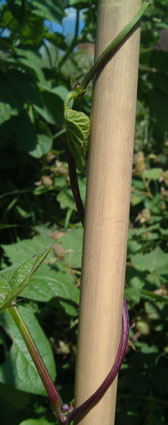
Kew Blue is claiming the distinction of being the most gorgeous plant in the bean plot, which is quite an achievement when I'm also growing Trionfo Violetto, which would normally win hands down. It's not as refined as Trionfo ... it has slightly gnarled and asymmetrical leaves which give it a kind of lopsided scruffiness, but its colour is so deep and vibrant it almost glows. It looks shinier, healthier and more vigorous than the other beans. The leaves are the richest green and the stems are a velvety purple. The stems are chunky. The leaf stalks fade gracefully from purple to green but some of the smaller petioles are almost black. It's a very striking looking plant. And it hasn't even flowered yet. I still have that pleasure to come.

Not to be outdone by a better looking rival, Trionfo Violetto produced the first pod of the season. I found it lurking in the undergrowth at the bottom of the plants. Yup, there's just the one.

Not really enough for a meal, but it's the thought that counts.

Of course it's possible that the superiority of the Kew Blue is down to the soil it's growing in ... I think it may have had more manure dug into it than the other bean plots, and manure is the thing that makes the biggest difference to plant performance, in my experience. I'll only find out for sure by growing it for a few more seasons. But for a variety that got off to an unimpressively sluggish start it's now looking very dapper.

Mrs Fortune's, it has to be said, is not a looker, poor dear. The leaves are very tidy and symmetrical, but they sag at night and have a rather anaemic pale green colour. The first flower buds are now forming and they're a boring green with a half-arsed splosh of mauve. Not one for the ornamental borders. But no doubt it has other qualities, and it's certainly growing well. No bother at all from pests.

Ha, things change very fast in the garden. In the time it's taken me to write up this blog post, a couple of the flowers have opened and they do have a nice dark pink colour on the inside.

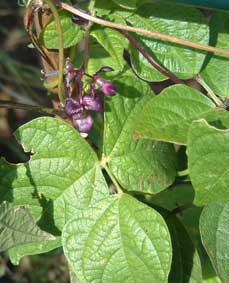
It seems that the summer solstice is the cue for all the beans to flower, because my runner beans have also started to produce buds. There's a lot of red-colouring in the heritage variety Black Magic, including the leaf veins, which look lovely against the light.

Runner bean Black Magic from the Heritage Seed Library

Incidentally my neighbour had a crop failure with his runners (the damp weather in late May seems to have rotted the seeds) so he bought some plants that were on offer down at B&Q, and they're a variety called White Emergo which has white flowers and seeds. What will happen if that cross-pollinates with my Black Magic is anybody's guess. Skewbald beans!

Saturday, 1 July 2006

Poppy gallery

Somme poppies: collected from a French trench 10 years ago and seen here growing with wheat

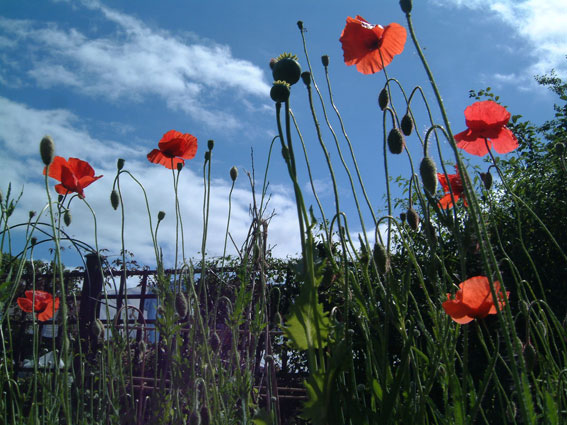
As today is the 90th anniversary of the Battle of the Somme, an event I've delved into all too deeply in the course of my researches a few years ago, I'm posting up some pictures of the poppies which are growing in the garden at the moment. Starting with a photo of the French landrace (wild stock) I collected on the Somme, from the ditches of the British front line in the village of Serre, which was part of the Somme battlefield. I've already blogged the story of how I found them. I've had a 'thing' about poppies ever since.

And having looked through so many images of the First World War, it was quite weird today how the TV pictures of defeated England footballers with their slumped and heavy limbs looked uncannily like the photos of the soldiers who came off the fields of the Somme. You could read quite a few levels of symbolism into England's misfortunes and mistakes.

All these pictures have been taken in the last couple of days.

Opium poppy (Papaver somniferum) grown from seed I collected on a disused railway line near Cheltenham station


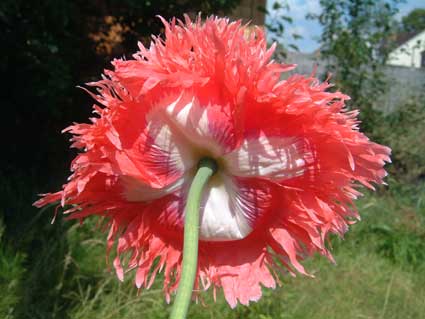
This frilly-headed opium poppy with a white base appeared out of nowhere: it's a lacinatum-type and not quite like any of the other poppies in the garden. I might save some seeds from it to plant next year but I may not get another one like it because poppies are promiscuous outbreeders and it's likely to have cross-pollinated with all the slightly less interesting flowers surrounding it. Ha.


These three pictures are all of self-seeded field poppies (Papaver rhoeas) from the variety Mother of Pearl. The flowers often have rays of colour running through them that look like fine stripes.

Friday, 30 June 2006

How to hybridise garden peas

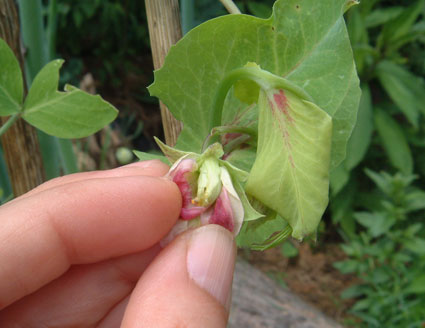
Two Alderman buds. The top one has reached the very latest stage where emasculation is possible (indeed this one turned out to be shedding some pollen already). The lower bud is just reaching the optimum stage for use as a pollen donor.

This is where the fun really starts, although most gardeners never venture into the world of hybridisation and breeding. DIY hybridising used to be common practice, and many of the best garden vegetables were originally bred by amateurs. But as commercial seed production has completely dominated what we've grown in our gardens over the last 60 years, and saddled us with same-old same-old commercial strains which are optimised for farmers and not gardeners, there are vast areas of potential for developing new and far more interesting varieties. The lost art of amateur plant breeding is way overdue for a revival. And peas are an ideal place to start.

Hand-pollinating peas is not difficult, although it can be fiddly and you have to know what you're doing. But it's a simple enough skill to acquire.

As I said in my other pea-post, I'm experimenting with a hybrid between Alderman, a tall, voluptuous variety with huge and very sweet peas, and Mr Bethell's Purple Podded whose culinary qualities I don't yet know but which produces beautiful pink flowers and purple pods.

I've done my homework on this and what I'm mainly interested in is a dominant gene called A, which is responsible for the production of anthocyanin in peas. Anthocyanin is what provides the purple, red and blue colouring in vegetables, and it also has nutritional value. Given the high proportion of purple colour in its leaves, stems, pods and flowers, it's extremely likely that Mr Bethell's Purple Podded is endowed with the A gene. By the same token I'm assuming that Alderman doesn't carry the A gene, unless there's some other reason why it isn't being expressed, because the plants show no trace of purple. Therefore (and this is pure guesswork) I would expect a cross between the two varieties to yield mostly plants with purple colouring, and the same for about three-quarters of the subsequent generation, because those will have inherited the dominant A gene. I can then select the ones I want and inbreed them for a couple of years to stabilise their characteristics. That's the theory anyway.

I might find that a hybrid between these two varieties results in a simple sharing out of the attributes of the two parents. The ideal would be to have the large succulent flavoursome peas of Alderman with the attractive colouration of Mr Bethell's Purple Podded, and as the colour should be dominant in all the offspring I might get lucky. But there's a complication which makes it a lot more interesting. Although the A gene enables anthocyanin production, it doesn't control where the anthocyanin is distributed. It's nothing more than a gateway for the production of purple colour. There are various other genes which control whether the purple is expressed in the pods, the leaf axils, the flowers, the seeds, or elsewhere. Some may be dominant and some recessive. And I have no idea what configuration of these genes Alderman might have, because without the presence of A those genetic traits are unexpressed. By introducing the A gene into Alderman I'm giving it the ability to produce purple colour but I'm also allowing all those hidden genes to express themselves and I may get some surprise results in which bits of the plant actually go purple. That's all part of the fun.

Let me stress that you don't need to do any genetic research before you make a hybrid. I just do it because I'm a nerd. You can choose your parent plants randomly or intuitively and just see what comes out. Even when you do take the trouble to research the effects of particular genes there always seem to be surprises in the results, because it's largely guesswork at the best of times.

OK, that's the theoretical basis for my hybrid. If you were bored stiff reading all that then don't worry, the practical bit is coming up.

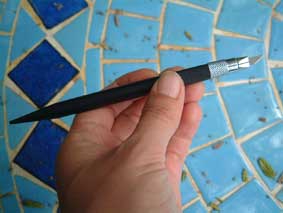
To make a hybrid, you have to bypass Nature's usual mechanism and pollinate the flowers by hand. You don't need any specialised tools, but I've found the ideal implement in my art box. I'm originally a graphic designer by trade and although I've been doing it all on Apple Macs for the last 14 years I still feel the need to keep an old-fashioned artist's scalpel on my desk. This one is ideal, because I can use one end for slicing open the flower and the other end to poke petals apart and transfer pollen very precisely. Being plastic, the body of the scalpel has a slight static charge (especially when rubbed) which helps the pollen to cling to it.

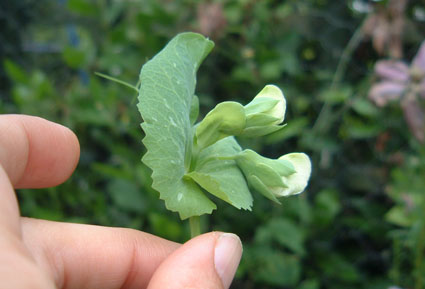
Peas are rampantly self-fertile and shed their pollen at quite an early stage in the flower's development. That means you have to do a hand-pollination very early on in the bud stage. If you leave it until the bud is almost ready to open it will already have self-pollinated and you won't get your hybrid. On the other hand, if you do it too early the female stigma may not have developed enough to be receptive. The ideal stage of bud development varies with the weather, variety and time of year, but as a general rule you should use buds which are only just starting to show the tips of their petals (see photo). Sorry a lot of my illustrative photos are rubbish. I really need three hands to photograph the pollination technique properly, so I'll get my friend Caroline to help me do some better snaps at some point.

This Alderman bud hardly looks like a bud at all ... the petals haven't even begun to emerge from the sepals. But it's just about at the right stage for hand-pollination.

The first step is to pull off (or at least pull right back) the sepals, which are those green leafy bits around the outside of the bud. With those out of the way, the bud comprises a double layer of petals. Gently fold the two layers right back and hold them in that position, but don't remove them. This will reveal the flower's inner sanctum, known as the keel, which is a sealed petal-bag containing all the reproductive bits. At this stage you will see why it is that bees don't get a look in with pea flowers. Under normal circumstances they're completely inaccessible.

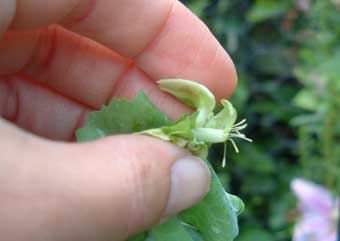
Being very careful not to cut too deeply, slice open the keel and remove or peel back as much of it as you can. Inside you will find ten stamens (that's the little stalks with yellow blobby bits on the end) and a style, which is the extra long stalky bit. Depending on how far developed the bud is, the stamens may have grown right to the end of the style or they may be a couple of milimetres shorter. Shorter is better, because it's less likely that any pollen will have reached the stigma, which is the receptive spot on the very tip of the style. Still with me? Good.

If the yellow blobby bits (anthers) have started to release pollen, even in small amounts, it's too late to do the cross. Try again with another bud at a slightly earlier stage of development.

Here the keel has been cut open and you can see the anthers (yellow blobs) inside.

Before you do anything else, you need to emasculate the flower with either scalpel or fingernails (sorry boys, I know it makes your eyes water just thinking about it). Or to put it in layman's terms, you have to whip off all the yellow blobby bits. They usually pop off quite readily when gently scraped with a scalpel blade. Make sure you remove all of them.

The emasculated bud. Those frilly bits are the stamens after the anthers have been removed.

What you're left with is the female reproductive part of the flower, i.e. the style. The receptive part (stigma) is right at the very end (not to be confused with the little bristly bit just below the tip). That's the bit you need to pollinate. So now all you need is pollen.

On whichever variety you are using as the 'father', you'll need to find a suitable bud as a pollen donor. The exact development stage is not as crucial as it is for the 'mother' bud; as long as the pollen is fresh it will do the job. Fresh pea pollen is deep yellow and quite moist-looking. If it's pale and dusty it's past its best. The bud should be mature but not fully open ... the stage where the petals have grown out beyond the green sepals is ideal.

This is the 'dad', Mr Bethell's Purple Podded with the keel slit open to access the fresh pollen. This bud is more mature than the 'mother' bud and easier to work with.

Peel back the outer petals to expose the keel and make a small slit in it near the end. If you then poke the end of the scalpel into it (you can also use a paintbrush or a pen top) you should be able to collect as much pollen as you need. If you do it carefully you won't even damage the flower ... it will already have self-pollinated anyway and the pod should still develop as normal.

You're now ready to make the hybrid cross. Go back to the bud you just emasculated and dab the pollen over the stigma. You will see the yellow powder sticking to it if you've got it right. Then close the bud by folding the outer petals back into their original position, covering up the stigma. With most plants it's necessary to seal up (or stick a bag over) the bud to prevent pollen-carrying insects getting inside and spoiling your crosses, but with peas that isn't necessary because the bees aren't interested in them. It's only necessary to lightly close the bud to help prevent the stigma from drying out.

Lastly but most importantly, label the buds you've pollinated. Otherwise they'll end up in your shepherd's pie by mistake, and then you'll be sorry. You don't need anything elaborate. All I did with mine was twist a piece of green pipecleaner around all the buds I pollinated with Mr Bethell's Purple Podded, and tie a piece of brown string around the ones pollinated with Champion of England.

And that's it. It's a lot less complicated than it sounds. The ideal time to do crosses is when the weather is cool, but it's not essential. This morning I did seven hand-pollinations on Alderman buds: five using Mr Bethell's Purple Podded as the pollen father and two using Champion of England. And the results will be thoroughly blogged, even if it turns out to be a total f*** up. :)

Thursday, 29 June 2006

A mega-post about peas

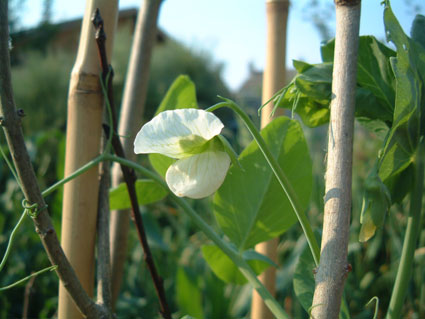
Large flowers are a feature of the Alderman pea

I was expecting Alderman to be tall, but I no longer have anything long enough to measure it with. It's exceeded all expectations, including those stated on the seed packet. It reached about 8ft before starting to droop a tiny bit at the top, which is quite impressive because its support cage is only just over 4ft high. The top halves of the plants are standing up on their own.

"What the heck did you put on them?" I hear you ask.

Uh, some of this.


And lots of this.


And a few grass cuttings as a mulch.

Alderman is wonderful. I've grown peas many times before and I've never had anything like this. All my previous crops have been standard varieties. Growing tall Victorian types for the first time I've found them to be superior on just about every level. Although they're meant to be shelling peas they are just as good if you pick them when they're still flat and eat them as mangetout (they remain stringless until quite a late stage) so they are effectively a dual-purpose pea. The pods grow at a height that makes them easy to pick (well away from the soil and the slugs) and they keep cropping prolifically for several weeks, producing an average of nine very large peas per pod. The flavour is absolutely bloody out of this world. Even the mature pods taste good eaten raw, straight off the plant, if you peel off the fibrous layer on the inside. The plants are fast-growing and untroubled by pests, so they're particularly well suited to organic culture.


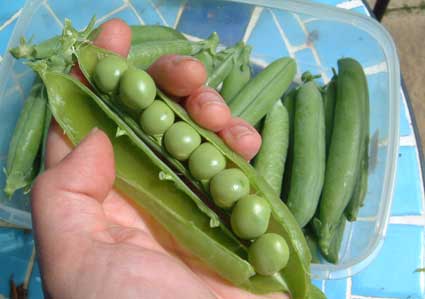
As I mentioned in a previous post, the variety was introduced by Laxton's in 1891 and was developed from another old variety called Duke of Albany (now rescued from apparent extinction by the HDRA). One observation I've made ... some sources of information suggest that Alderman bears its pods in pairs. Mine have all been produced singly. Not that I'm complaining, because the yields are very generous. The photo above shows one day's harvest (35-40 pods) from my plants, which occupy an area of land only 2ft by 5ft. As you can see, the mature peas are so huge they're trying to squish each other out of the pod. And even when they reach this size they remain exquisitely sweet. If you pick them younger they taste unbelievable.

Another reason to grow tall peas. You can see the developing peas inside the pods when the sun shines through them. No more harvesting big fat succulent pods only to find that the peas inside are the size of pimples.


Alderman is one of the most readily available of the heritage peas. That doesn't mean you'll find it in the average garden centre, unfortunately, but you can certainly get it from The Organic Gardening Catalogue.

The other two varieties of pea I'm growing this year are harder to find. I got my seeds from the magnificent and ever-bountiful Heritage Seed Library.

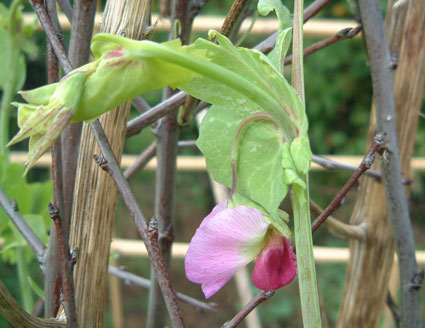
I think it's fairly safe to say that Mr Bethell's Purple Podded is one of the less well known pea varieties. A Google search yielded only three hits, two of which were for this blog. So there you go. I have the distinction of being the world's greatest contributor of web information on this variety. And so I proudly present this photo showing the exotic colouring in the leaves, stems and flowers.


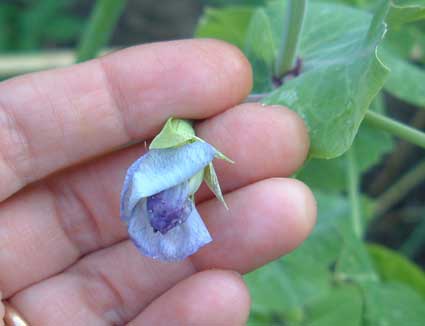
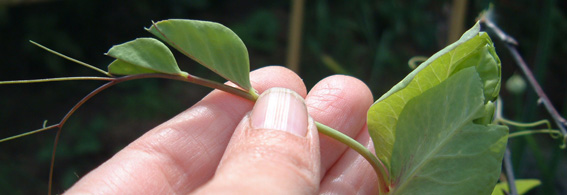
The leaves are a pale and rather flat olive green, quite different from other peas I've grown. The purple-maroon colouring is strongest in the leaf axils and in some of the stems and tendrils. Some of the leaves are also flushed or streaked with maroon. Flowers are pink with a darker cerise petal below. They start off very pale pink and darken as they mature, eventually turning blue when they've gone over.

The flowers go through constant colour changes, finally turning blue

Almost nothing seems to be known about it. The HSL catalogue just says it originates from the north of England. Presumably it was named after the person who donated it to the Heritage Seed Library, or the last person who was known to grow it. It's one of several purple peas offered by the HSL but as I've never grown them before I'm not sure how they compare.

Beautiful and colourful though it is, I'm slightly nervous because purple-podded peas have a reputation for being inedible unless you snaffle them up as mangetout. We'll see.

Champion of England (below), originally introduced in 1843 as Fairbeard's Champion of England was much prized throughout the 19th century for its superior vigour and flavour, and became very popular in Canada and the US too. It was bred by William Fairbeard, a nurseryman in Teynham, Kent, who was a highly respected pea specialist of his day. Indeed Charles Darwin wrote to him in 1855 asking for information about cross-pollination and inherited traits in pea varieties, as part of his research for Natural Selection. Darwin had obviously spotted that most plants decline in vigour if they're inbred for too many generations but that peas are one of the few plants that don't suffer from this phenomenon. Even today it's not completely understood, but it's known to be a genetic function, the opposite of hybrid vigour, and is called inbreeding depression. Peas don't succumb to inbreeding depression because they're natural inbreeders, designed to self-pollinate. Their flowers are fully enclosed and pollen is shed directly onto the stigma before the buds have even opened. So even when two varieties are grown together they are unlikely to mingle. Fairbeard told Darwin that accidental cross-pollination between pea varieties was so rare that he didn't take any special precautions to stop it, which confirmed what Darwin had noticed in his own garden. Several decades later peas played a crucial part in the discovery of genetics.


Fairbeard introduced several other acclaimed pea varieties which have slipped into obscurity or extinction. It's taken me two years even to find a source of Champion of England seeds and there's limited information available online. So I'll be sure to post plenty of information and pictures of mine as it matures. At the moment it's just beginning to develop its first flower buds.

Now that all three pea varieties are at the flowering stage I'm going to experiment with some hybridisation. The fact that peas don't naturally hybridise makes it all the more fun (and easier to keep control of). Wouldn't it be nice to cross Alderman with the Purple Podded to see what happens? Pink-flowered Alderman? Purple pods with bigger sweeter peas? To do this I'll have to hand pollinate a few buds. Watch this space.

Sunday, 25 June 2006

Today in the garden ... and elsewhere

Mr Bethell's Purple Podded pea, aka Mr Bethell's Purple Tendrils

Well, this is a first. I went out to a garden centre ... my favourite one, in fact ... and came away empty handed. I can't think of a single occasion in my whole life when I've done that. But there was absolutely nothing I wanted.

And on the way home I stopped off at a racing stables on Cleeve Hill where they have bags of well-rotted horse manure on offer at the roadside for a quid each. That's something I do need. But even when I'm shopping for shit I have standards, and having worked with horses during my childhood I know decent dung when I see it. Frankly their crap was crap. It was a mixture of newspaper and manure, but mostly newspaper, compacted, claggy and hardly rotted at all. You couldn't put it straight on the garden in that state. Not only that, the bags were two-thirds empty and you barely got more than a shovelful for your quid. A complete rip off. There was even a sign up asking people to bring the bags back afterwards. Bloody cheek.

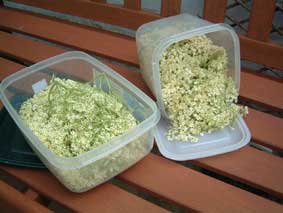
I've also been out collecting elderflower to make another batch of cordial. Doing a bucketload this time. This involved pillaging the hedgerow up on Prestbury Hill which, like most of Gloucestershire, has an abundance of elder. I came across some interesting wildflowers along the way, including some beautiful sainfoin (never seen that on the hill before) and an uncommon subspecies of poppy with smaller orangey-red flowers.

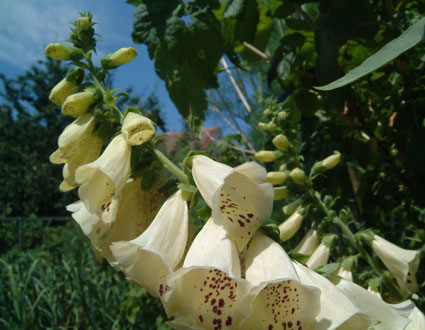
I grew this foxglove Primrose Carousel from seed

Back in the garden, the fruit is going into full-scale glut mode. Blackcurrants, tayberries, raspberries and strawberries are all ripe and begging to be picked (and the birds are certainly obliging). Gooseberries and whitecurrants are not far behind.

Meanwhile I've been starting off more tomatoes. Yes, I know it's technically a bit late for sowing them now. But in my experience, tomatoes just sulk in their pots up until the summer solstice and then go completely nuts. It doesn't matter whether you sowed them in February and nursed them on a windowsill or whether you left it till June and stuck them in at the last minute. They all seem to perform about the same in the end. As I have an obsessive-compulsive unusual-vegetable-seeking disorder I was unable to stop myself from buying some exotically striped Green Tiger tomatoes on a recent visit to Marks & Sparks and planting a couple of its seeds. The fruits are very striking indeed with their skins streaked in dark red and green and their flesh a very luscious crimson. The flavour is not absolutely to my taste but it's pleasant enough. So I'll see how that does. I'm also having to resow one of my American tomatoes, Isis Candy, since something has managed to snap the stem on the one seedling I had. The whole of the veg garden has put on a surge in the last few days, helped along by some nice sploshy rain. Climbing French beans are going like the clappers ... this is Kew Blue in the picture.

Wednesday, 21 June 2006

Midsummer!


It's that time of year again. Driven indoors by the stench of burning flesh as everybody in the neighbourhood dredges out their barbecues. I've been vegetarian for 15 years and the smell of roasting meat really turns my stomach. And just to add insult to injury it sets off my asthma.

I steeled myself for the unavoidable and denuded the Tewkesbury Baron apple tree of 10 out of its 12 apples, before they get too plump and shiny and untouchable. The tree didn't want to let go of them either, which made it harder. But it had to be done. I ate one. It was disgusting. But I was still delighted with it.

The other vegetables are doing well though and some things are now ready to harvest. Climbing French bean Mrs Fortune's (right) is working its way up the bamboo poles. Runner bean Black Magic is already at the top of its 7ft poles. The red-flowered broad beans are just producing the first mature pods, and although they are now being pestered by blackfly it's a fairly light infestation compared to other varieties. Pea Alderman is around 8ft high and yielding very generously ... the peas are so sweet it would be a crime to cook them, so I just stuff myself with them every day straight from the plant. Pods an' all. (Even when they're way past the mangetout stage, the pods are very edible if you peel away the hard starchy membrane on the inside and just eat the outer part.)

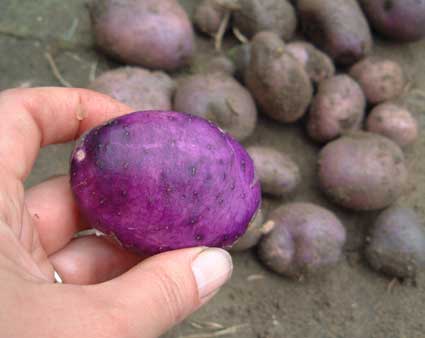
I'm also starting to harvest potatoes. I dug up a few plants of Edzell Blue, primarily because I've completely run out of growing space and needed to clear something to make room for other things. They are pretty much ready anyway, because they don't grow very big compared to modern spuds. As you can see in the photo, they are a beautiful colour and scrub up a treat. I cooked these as new potatoes, and very tasty they were too. Unfortunately they aren't ideal for boiling ... they lose their colour (they just end up a murky brown colour and the water goes dark green) and they also readily disintegrate, but you can't have everything.

Freshly harvested Edzell Blue potatoes, which look especially nice when they're scrubbed up

It may be time to declare a crop failure on the Grando Violetto broad beans though. They've been so badly afflicted by blackfly they've stopped growing altogether. They have a few pods which are developing OK but not much of a yield. Unless I pretend I was growing them as a green manure all along. Yes, that's it. I only wanted the nice nitrogen nodules on their roots. Blub.

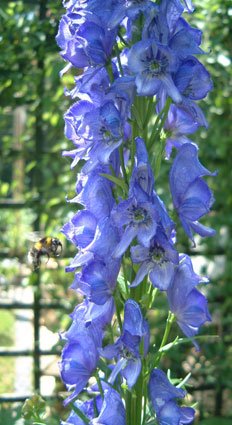
The wild part of the garden is coming along nicely. Look at this lovely monkshood flower spike (Aconitum napellus) with a bee just poised to shove its proboscis in there. It's highly poisonous but the bees love it. Having a wildlife-friendly garden has its downside though. I started work on a path I've been making between the fruit and veg plots, and had to move the polythene sheet I'd put down to kill off the lawn. I peeled it back very carefully, because there are usually slow worms under polythene sheets in this garden. They adore polythene. Sure enough, I uncovered an elaborate nursery of baby slow worms. There were four of them just under one corner. Very cute they were, only about 4 inches long. The dried up lawn had formed a layer of matting over the earth and they were sitting curled up in little round hollows underneath. They all poked their little faces up through the straw when I disturbed them. So it doesn't look like I'll be building my path now until the autumn. And neither can I walk on the polythene. Which means the only way I can access the fruit bushes for the rest of this season is by trampling over the vegetable plot and wading knee-deep through potato plants. Ah well, nothing I can do about it.

I saw a couple of ants attacking a ladybird today. I didn't know they did that. The ants were going ballistic but the ladybird seemed only mildly bothered.


And finally, I came across this mutant poppy, which has two flower heads on one stalk (although it actually seems to be two stalks fused together). Since taking this photo it has flowered, and the buds opened at different times. I have found a few other examples of this in other poppies around the garden so I assume it's just something that poppies do from time to time.

Monday, 12 June 2006

Today in the garden ...

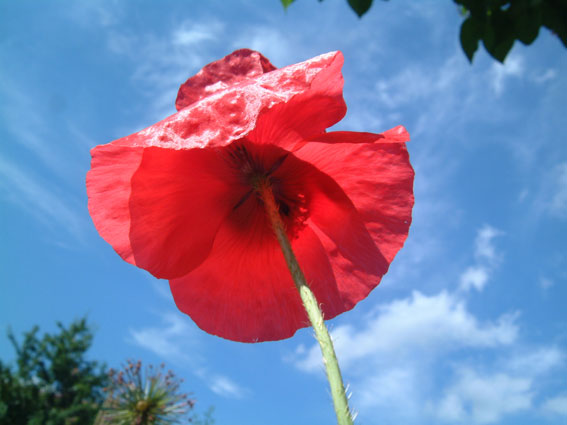
Self-seeded field poppy (Papaver rhoeas). This is the same flower that was shown as a bud on my June 2nd post.

The sky exploded early this morning (well, not quite, but it sounded like it) and resulted in a ferocious deluge. It saves me watering the garden this morning, a job which was becoming a twice-a-day necessity in the recent heatwave, but I wish I hadn't left the cushion out on the garden bench. Oops. Soggy arse for the next person who sits on that.

The rain smacked the heads off all the remaining oriental poppies, so no more pollen-diving fun for the bees. They did very well this year though because they mainly flowered during the dry spell. At its peak the orange Allegro poppies had 19 flowers at once, all of them the size of my hand. They may only last a couple of weeks but they are stunning. And just as they are going over, the annual poppies are coming out (see above). You never know what colours you're going to get with annual poppies, which is one of the reasons I love them.

No sooner had I written that when one last bud of oriental poppy Princess Victoria Louise came out. And so did a whole load of brown butterflies. I even managed to photograph them together.


And there's no shortage of frogs now. As I was walking down the garden path this morning something landed with a great splack right in front of me. A very knobbly frog with a green head and a black back. Thought it was a toad at first, but it wasn't quite that knobbly.

I know it's getting a bit late for sowing stuff now, but I've just had some tomato seeds through the post from America. Unusual varieties which you can't get over here. Two of them are marbled and striped in red and yellow, the other supposely looks like black cherries. They sent me a freebie packet too. Bless.

I have this nerdy obsession with seeking out the unusual ... can't just go down the garden centre and buy normal stuff like everyone else. It cost me more in postage than for the seeds themselves, but I don't care. I'll have the only marbled and black cherry tomatoes in Cheltenham.

I do have a minor concern about buying seeds from America though ... there is such widespread use of GM material in the US, most of it unlabelled, I wonder how much stuff over there gets accidentally cross-pollinated. I don't have any means of testing for it and I assume the risk of GM contamination is small, especially with tomatoes since they're natural inbreeders (i.e. they usually self-pollinate). But if anyone knows anything about this issue I'd be grateful to know.


The Alderman pea is still going nuts. Advertised in the Organic Gardening Catalogue as reaching a height of 5ft, mine is now just over 7ft. And those tendrils are still reaching for the sky. I'll be posting another pea-specific report shortly.

My climbing French beans are all coming along nicely now, having benefited from the clement weather. It's actually not the cold which devastates these plants, it's the wind. During late May it was very breezy and my newly planted Trionfo Violetto and Meraviglia di Venezia (which I'm growing together over an arch) suffered a lot of damage to their leaves, and in their weakened state fell prey to slugs. I wasn't sure whether they'd make it or not but in the last week they've made a miraculous recovery, have grown beyond sluggy reach and look very green and lush. Trionfo Violetto is already in flower (right). Then there's the two varieties I got from the Heritage Seed Library. Kew Blue is now recovered from the shock of finding itself planted out in the real world and is starting to shoot upwards. I'm growing it in a small clearing in a potato patch, and as the potatoes continually encroach it does get a little shady and claustrophobic. But it's also very sheltered, and that has kept the leaves lush and pristine green ... in contrast to Mrs Fortune's, which I planted in a sunny open site and whose leaves have been rattled and flapped and baked to parchment (although it's still thriving well enough). I was also afraid the Kew Blue might be eaten by snails down in the moist verdant undergrowth but they've been largely untouched and most of the snails I've been finding there are just broken shells. I assume that means the moist verdant undergrowth is populated by hungry frogs and slow worms.

Climbing French bean Kew Blue sitting in a mulch of horse manure and grass cuttings. See how the colour of the leaf stalk graduates from purple to green.

I've been experimenting with very basic CSS coding on my blog template and have discovered how to highlight the plant variety names in my posts in a separate colour (without having to go through and code them all individually ... how cool is that?) So now people who google in here looking for information on specific varieties should find it easier to spot the ones they want. Let me know if it looks weird in your browser or the colour annoys you.