Showing posts with label Onions. Show all posts

Friday, 8 June 2007

Today in the garden ... bean planting

Well, you saw how lovely the Salmon Flowered pea looked last week. This is what it looked like three days later. Whoooo!

My blog has now clocked up over 10,000 visitors, almost exactly a year to the day since I set up the site meter. When I first started this blog it only got two or three hits a day, so it's grown massively over the last year. My continued and grateful thanks to everyone who keeps coming back here, and to those who are kind enough to leave comments. I appreciate all of them and it really makes me feel the blog is well worth the time I spend on it!

Today I've been busy planting out the latest batches of French beans.

Dwarf French beans (that's bush beans to my American friends) are outside my experience because I've never really grown them successfully before. Climbing French beans (pole beans) are another matter ... I've had many a good crop from those. There's not actually any difference between them other than that one type climbs up poles and the other doesn't. In the past I've favoured the climbing type because the yields are much higher for the amount of land occupied, and I used to have serious issues with growing space (I still do, but that's my own fault for buying too many seeds). But this year I'm trying out several varieties of the shortie type. What they lack in yield they make up for in earliness. Apparently.

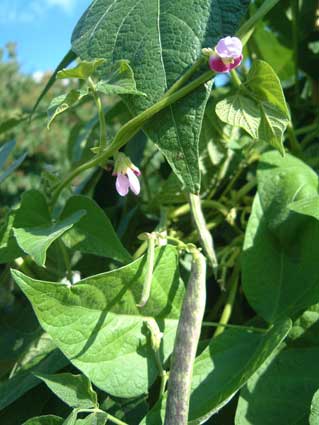
Dwarf French bean Early Warwick, a 19th century variety now very rare and hard to get hold of. The flowers start off creamy yellow (right) when they first open and then turn pale pinky lilac (left).

I have had some problems with the beans this year, notably an outbreak of halo blight. This is a rather nasty bacterial disease made all the more nasty by being one of the very few diseases which is seed-borne, and which can therefore be transmitted to the next generation as soon as the poor things germinate. It affects French beans and runners. It starts off innocuously enough ... just a few spots of yellow on the leaves. But they get bigger, the leaves go more yellow, and soon turn into brown patches with watery blotches. It spreads very rapidly, dissolving the leaves into a soggy brown mess. And if it gets onto the stems the plants die very quickly. It's not nice.

When I looked up halo blight in The Vegetable Expert it said "lift and destroy diseased plants". Well bugger that. My bean varieties have been painstakingly collected and are mostly rare heritage varieties, some of which I was only able to obtain in tiny quantities. The disposable "chuck it out and buy another" culture doesn't work for me. So I picked off the worst affected leaves, and isolated the least affected plants from the really sick ones, and each day went back and picked off any new blight patches ... tearing off parts of the leaves where necessary. Halo blight spreads rapidly in warm wet conditions, so I took care not to get the leaves wet, and certainly not to let water run off the leaves and into the soil. Within a couple of weeks the majority of plants had recovered. A few died, and I put those in the dustbin rather than the compost. But certainly the plants made a valiant effort to fight off the disease and I'm so glad I didn't destroy them. Tsk. Pesky gardening books.

Another little tip I can give about beans of all kinds is not to worry too much if the first few flowers drop off without setting pods. It seems to be one of those things beans do. After a short while they usually get their act together and start setting pods normally, but the first few eagerly-awaited flowers usually just wither and drop off. C'est la vie.

Another thing that's just about survived against the odds is my onion crop. I sowed the seed last autumn and the plants were looking very promising. But they now have irreparably bent tops as a result of having been sat on by the kitten too many times. Yes I know, but he is a very large kitten and he sits down very hard. Anyway, despite the crushed foliage they are managing to form bulbs. This one is an Italian red (obviously) variety called Cipolla di Genova.

Friday, 25 August 2006

A seed saver's guide


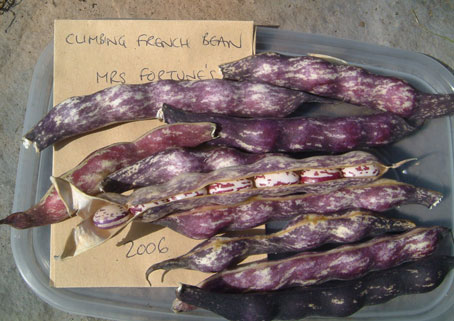
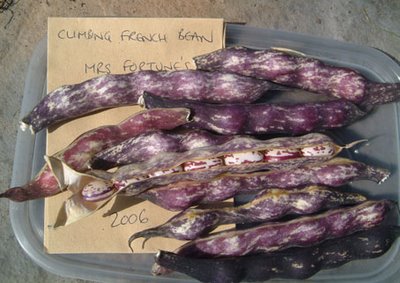
Since we're getting into that time of year again, I thought it might be useful to put together a quick and simple guide to vegetable seed saving, since this sort of info is rarely found in gardening books. Most things can be home-saved, and it not only saves money but helps to maintain long-term biodiversity. As more and more traditional open-pollinated varieties disappear from the catalogues to be replaced by overpriced and overhyped hybrids, you could find yourself looking after a variety that's no longer available and helping to keep it from extinction. Like the lovely maroon and white beans shown above, an heirloom variety which is unavailable to buy.

When you save seed from year to year though, things can get more complicated. If you've read my post about F1 hybrids you may remember that plants fall into two basic types when it comes to reproducing. Inbreeders are happy to self-pollinate to kingdom come and show no ill-effects from it. Seed from a single plant, or even a single pod, can be enough to keep the variety going. Outbreeders are designed to cross-pollinate with other plants and need lots of genetic diversity. Without it they succumb to inbreeding depression ... within a few generations they start to lose their health and vigour. To avoid this you need to save seed from a number of plants, not just one or two. They will also often cross-pollinate with other compatible plants growing nearby so if you want to keep a variety true from seed you may need to isolate them from other similar crops.

So isn't it more hassle than it's worth to save seed from outbreeding crops? Not really, no. Because over the years you'll be selecting seed from the plants which grow best in your garden, and will gradually develop your own sub-strain which is optimised for your growing conditions. For this reason home-saved seed often does better than the stuff you buy (in America, commercial seed may have originated in a different zone with very different conditions ... while most seed sold in the UK is not produced in the UK at all).

F1 hybrid plants sometimes produce sterile seed, or no seed at all. And when they do produce viable seed it doesn't come true to type. The usual advice is not to save seed from F1 hybrids. If you're interested in plant breeding though, or just enjoy the element of surprise, you can ignore that advice. The resulting plants may turn out nothing like the parents, and may initially be inferior, but you'll have all sorts of brand new and possibly unique genetic combinations to choose from, and you're a step closer to producing a new open-pollinated variety.

Storage of seed is a whole subject in itself, but for year-to-year seed saving (as opposed to long-term storage) you can just dry them out as much as you can and store them in paper envelopes. I usually place each envelope inside a self-seal bag too.

OK, here we go:

Beans, French
Leave the pods on the vines for as long as possible, until they are dry or at least until they start to change colour. Then harvest them and dry them out further indoors. To hasten drying you can split the pods open, but try to leave the beans attached. When the pods are dry and brittle, shell out the beans.

Pollination issues: Strongly inbreeding and self-pollinating, so you can save seed from a small number of plants and grow different varieties close together with no problems.

Beans, Runner
Same method as for French beans.

Pollination issues: A rampant cross-pollinator, so keeping varieties true to type is almost impossible on allotments and where neighbours are growing them. If you need to keep them pure, hand-pollinate and bag up individual flower clusters to keep the bees out. If you're not bothered by a bit of genetic diversity though, don't worry about it.

Beetroot and chard
Beets and chards are biennial and normally go to seed in their second year. The seeds grow on long straggly spikes and take ages to mature. You can pick them off individually as they turn brown, or wait until they're nearly all brown, cut the whole spikes and run a gloved hand along them.

Pollination issues: Strongly outbreeding ... grow at least 16 plants to keep a healthy diversity. Beetroot, chard and leaf beet will all cross-pollinate with each other! To avoid this, grow only one type for seed at any one time. The pollen can travel up to five miles, so if purity is essential you'll need to bag up individual flower spikes.

Brassicas
Not the easiest to save for seed. Most flower in the second season. The long thin seed pods fall to bits very readily when they're ripe, and are likely to be ransacked by birds. The easiest solution is to cut the flower stalks as soon as they reach maturity and hang them upsidedown indoors with a paper bag over them to catch the little round seeds as they fall from the pods.

Pollination issues: Strongly outbreeding ... most can't self-pollinate and are prone to inbreeding depression. You really need to grow around 20 plants, if you have the space. They also cross-pollinate like mad, so isolation is needed to keep varieties true.

Garlic
Garlic is a plant that no longer bothers to set seed in the conventional sense. It's normally propagated by dividing and replanting the cloves. Save healthy bulbs from the regular harvest and leave them intact until planting time (autumn).

If you allow garlic to flower it will produce a huge number of bulbils in the flower head instead of seed. These are essentially miniature cloves and can be saved for planting. They take two years to produce full-size bulbs, but have the advantage that they're less likely to carry diseases. Cross-pollination is not an issue because the bulbils are produced asexually and are therefore genetically identical to the parent plant.

Lettuce
Seeds produce little white tufts, like thistles, when they're mature. They tend to mature at different times, so collect them regularly as they ripen. Allow them to dry indoors until very brittle then rub off and remove the fluffy tufts.

Pollination issues: Inbreeding. Seed can be saved from just one or two plants. They don't usually cross-pollinate, but to be on the safe side grow different varieties a few feet apart.

Onions and leeks
Flowering in the second year, onions and leeks produce beautiful spherical seedheads. Allow them to ripen until the seed capsules start to go pale and papery (they will probably all mature at different times), then cut the flower head and hang it upsidedown in a paper bag in a dry place.

Pollination issues: Strongly outbreeding, and need plenty of pollination partners ... try to grow at least 16 plants. Onions and leeks will readily cross-pollinate with others of their own type but not with each other, though onions may cross with shallots. To maintain pure varieties grow only one type for seed at any one time (you can still grow other varieties for eating, since those won't be flowering).

Peas
Same as for beans really; allow the pods to dry for as long as possible on the plant and shell them out when the pods are brown and crisp.

Pollination issues: Strongly inbreeding, so there are no problems with saving seed from just a few pods, and they're unlikely to cross-pollinate even when grown close together.

Potatoes
To save tubers for next year's crop, select them at harvest time and keep them in a cool, dark, frost-free place over winter. Select only firm and healthy tubers, which ideally should be about the size of a hen's egg. Leave them in a bright sunny place for a few days before storing them, which helps to toughen the skins and keep them dormant. Check them from time to time over the winter and chuck out any that are going soft or mouldy.

Some potato varieties will set top fruit which contain true seeds, and these can be saved too. If your plants have produced "apples", collect them when they're just starting to soften and are ready to drop from the plant. Process them in the same way as tomatoes (though the stinky fermentation process shouldn't be necessary ... just wash them thoroughly in a sieve to remove the pulp).

Pollination issues: Potato flowers cross-pollinate fairly readily, but in practice so few of them produce viable pollen it's unlikely to be an issue. Even when self-pollinated though, they will not come true from seed (because they have a slightly eccentric arrangement of chromosomes). Each one you plant will be effectively a new variety. Conversely, plants grown from tubers are genetically identical to the parent plant.

Squash (pumpkins, marrows etc)
The seeds are so huge you can't miss 'em. It's usually best to leave the fruits to ripen for a few weeks after harvest before collecting the seeds, or just leave them until you're cutting them up for eating. Wash the seeds to remove bits of pulp and fibre, then spread them out on a plate to dry thoroughly.

Pollination issues: Outbreeding, and will cross-pollinate with any other squash of the same species. Unlike most outbreeders though, it's not prone to inbreeding depression ... so you can get away with saving seed from just a few plants ... 6 or so will do.

Sweetcorn
Saving seed from sweetcorn is not really practical unless you have room to grow a lot of it!

Leave the cob (ear) on the plant for as long as possible or harvest when it's mature and bring it indoors to dry. When it's completely dry, the kernels can be removed by rubbing two cobs together.

Pollination issues: Extremely outbreeding! More prone to inbreeding depression than just about any other vegetable, and even sowing just one generation of inbred plants can result in an inferior crop. To be sure of maintaining health and vigour you need to grow and keep seeds from about 200 plants. Gulp.

Sweetcorn is wind-pollinated and produces stupendous amounts of pollen which is then cast to the four winds. To keep a variety pure it needs to be isolated from other varieties by some considerable distance.

Tomatoes
The 'proper' way to save tomato seeds is to scrape the seeds (including the gooey gel stuff) from ripe fruits into a small container, maybe add a tiny splosh of water, and leave it to ferment for a few days. During this time it will produce a crust of disgusting mould and a stench which could put you off tomatoes for life. When all the gel has dissolved away, rinse the seeds thoroughly in a sieve under running water and then leave them to dry for several days. Stir them around regularly to prevent them sticking together.

An alternative and much less stinky method is to scrape the seeds out onto a sheet of kitchen roll, spread them out to separate them and leave them to dry. The gel acts as a glue and sticks them to the sheet. I've heard this method criticised because the gel also acts as a germination inhibitor ... but in my experience the seeds germinate fine, even after several years.

Pollination issues: Strongly inbreeding. Saving a single fruit is enough, although more is better. Cross-pollination can happen but usually doesn't. If you want to be sure of pure varieties, isolate the plants from other types as far as you can.

Sunday, 13 August 2006

Today in the garden ... pollination fun

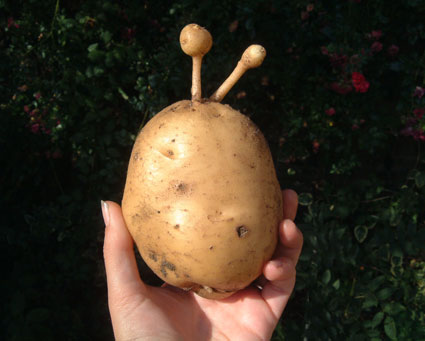
Evidence that Marfona potatoes have been infiltrated by aliens?

I've just harvested the remainder of the Marfona potatoes, having let them mature to baking size, and bloody delicious they are too, especially with a bit of melted cheese on them. In addition to some whopping spuds there were lots of baby new potatoes just starting to form (some of which I've planted up as they're too good to waste) plus a few more ripe potato apples for seed. They're very generous plants.

Alan Romans in his Potato Book describes Marfona laconically as "the slug's favourite". And he ain't kidding. I've found tubers which are completely hollowed out, and I'll certainly spare you the sight of the ones that have been adopted as community housing for woodlice. But ... invertebrates love Marfona for the same reason I do – it's the moistest and waxiest of baking spuds and the flavour is gorgeous. I wouldn't be without it, however many I have to toss into the compost bucket with a cry of "eeeuuurgh!"


I learned to string onions yesterday, thanks to Greenmantle and the instructions he put up on his blog. I'm quite pleased with that. They're Hysam onions and probably the best I've grown yet.

I've been doing a lot of hybridising this week, trying to get the knack of hand-pollinating tomatoes (success!) and French beans (urgh!) so that I can write up the instructions here. I've never pollinated tomatoes before so I wanted to try it out first before writing it up to be sure I was doing it right. And the first couple of lots I did all fell off without turning into tomatoes, which shows how much I know about it. But I think I've now found what I was doing wrong, so I'll post the instructions here shortly. I hope this stuff is of interest to some of you out there. I would love to think I've encouraged people to have a go at hand-pollination and amateur plant breeding because I think it's really important, and it's a lot of fun. It's a great shame that the vast majority of gardening books don't even mention it ... while at the other end of the scale much of the useful practical information is buried in academic papers and you need a degree in biology just to work out what the hell they're on about. Most of what I know came from Carol Deppe's book and from getting out there with a scalpel and trying it for myself. I'm still learning all the time. I'm just pollination crazy and I'll hybridise anything that's biologically possible just for the hell of it.

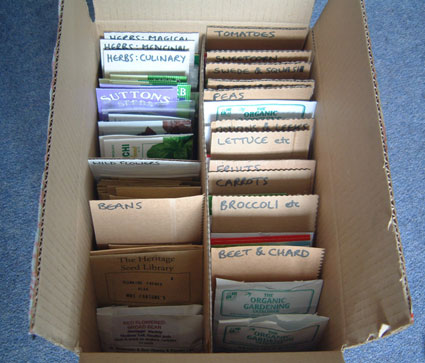
I also love seeds and we're now getting into seed collecting season, which is one of my favourite times of year. I already have stuff drying on window sills all around the house, and am getting through huge numbers of little manila envelopes. I try to be disciplined about labelling things these days. I'm the most disorganised person in the whole of the west country, so nobody was more surprised than me when I suddenly created this boxed filing system one day last year on a momentary whim, after years of distributing my seed packets round every cupboard in the house and tucking them into bookcases.

Monday, 7 August 2006

Today in the garden ... harvest time

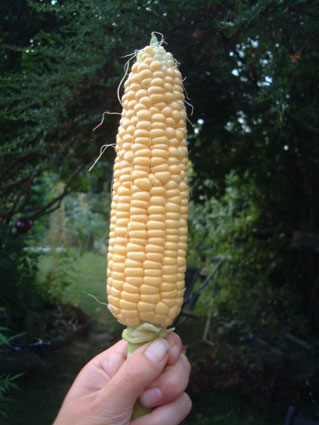
Just showing off my Swift F1 sweetcorn, which is as big as any supermarket cob and far tastier. Not bad for a crop which supposedly doesn't appreciate the British climate

I've had a lot of catching up to do after my time away ... lots of weeding, deadheading and propping up things that have collapsed under the weight of their own abundance.

You may remember I've been ripening up a potato apple I found on one of my Marfona plants. Well, it's about as mature as it's going to get so it's time to extract the seeds from it.

There's precious little information out there about raising new potato plants from seed because not many people do it ... but it's basically the same as for tomatoes. The advantage of growing potatoes from seed is that they are likely to be free from any virus (unlike tubers, which store viruses very efficiently!) and it's also a voyage of discovery because every seed is potentially a new variety, with no two being quite the same.

Just slice open the ripe potato apple (it's ripe when it just starts to go soft) and scrape the seeds out into a container of water. Any seeds that float are not viable and can be got rid of. Wash the sinkers to remove all the pulpy goo (a sieve or tea-strainer is probably the best way to do it) then spread them out to dry thoroughly.

As they're not hardy, I'll have to wait until the spring before I can sow them.

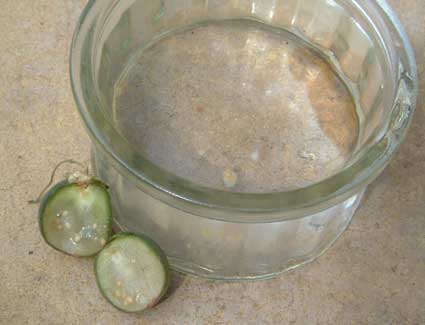
Marfona potato apple: it looks like a tomato from the outside ... and it's not dissimilar on the inside too. The seeds look like small tomato seeds and are easy to extract in a jar of water.

At last, one of my F1 hybrid experimental peas has germinated! I'm so relieved. It was one of the ones I sowed fresh from the pod into high quality coir and vermiculite. I've also got another batch started off in bog-roll tubes as per my usual method, and I'll see what happens to those. These are ones which I'd allowed to dry out before sowing them ... I want to see whether that makes a difference.

At this time of year lots of stuff is ready to harvest. I pulled up the Hysam onions today as it's been a couple of weeks since their foliage flopped over, so they're about ready.

Hysam onions drying in the sunshine

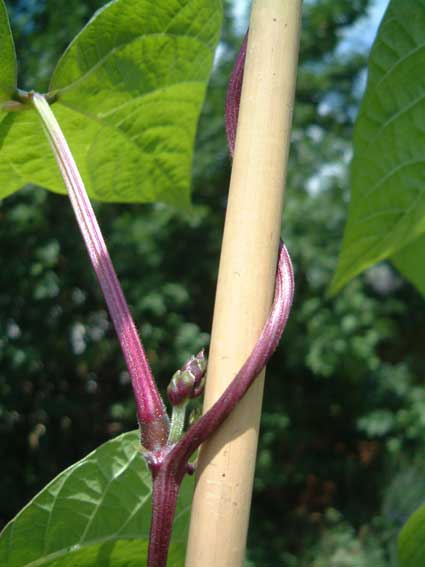
I've got more French beans than I know what to do with, and I've started to let Mrs Fortune's develop mature beans rather than keeping on picking the young pods. The plants have rather cheekily lashed themselves around some adjacent bamboo frames, having outgrown their own (7ft) supports, and are trying to take over the garden by stealth. I now have funny little blue-streaky pods growing among the tomatoes ...

Mrs Fortune's climbing bean is hard to beat if you want high yields and rampant vigour

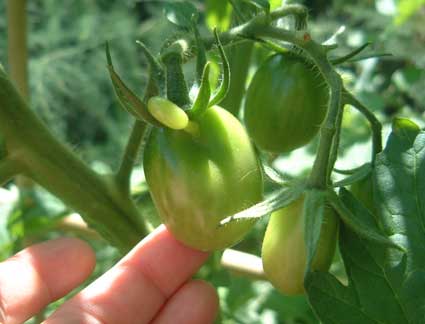
And there's more weirdness among the tomatoes. I notice one of the developing fruits on Black Plum has a strange appendage growing out of it. Not sure if it's trying to grow into a spare tomato or what. Anybody else had something like this?

Black Plum also has the distinction of being the healthiest and most rampant of all the tomato varieties I'm growing ... it's already over the top of the bamboo frame I made for it way back when. At the other end of the spectrum, my Pink Jester plants are looking very straggly and distorted and two of the three plants have elongated fruits which are not true to type. I dunno why that is, because they're from the same batch of seed I've sown for the last few years. They're oddly elongated with pointy tips, like peppers. Very curious.

Strange knobbly sticky-outy bit on a Black Plum tomato ... hmmm!

Monday, 10 July 2006

Today in the garden ... a lot of bluster

A poppy from the Somme growing with wheat in my wild garden

The recent rains may not have done any damage but the wind has been ferocious over the weekend and that has caused some havoc. A huge branch came down off a mature lilac tree in the middle of the garden. Fortunately it fell onto the lawn and didn't wreck anything (or anyone) in the process. It might actually be a blessing because it should let more light through into the borders behind it (which have become so shady almost nothing will grow there) and the bottom half of the branch itself is thick, 5ft long and perfectly straight ... a veritable pole, which is bound to come in useful for something if I strip the leafy bits off and dry it out.

Unfortunately the strong winds did some damage to my beloved Alderman pea plants, which is entirely my own fault because they weren't supported properly. I'm hoping they'll survive long enough to provide me with my experimental hybrids and a few more opportunities to stuff my face with their bounty. I did the second stage of the pea pollinations, i.e. re-pollinating the ones I did yesterday. Or four of them, anyway. I couldn't find the other one. Despite my use of very eye-catching gold braid tied around the buds some of them seem to just vanish into the greenery never to be seen again. Even the purple-podded pea has a gold-braid missing, and I know exactly where I put them all (there are only eight plants, so they have nowhere to hide). I'm beginning to suspect the faeries come out and untie them during the night.

Climbing bean Kew Blue has some of the nicest colouring of any vegetable in the garden

In the bean garden, Kew Blue has started flowering. The buds are a rich purple but open up into a slightly scruffy pink-mauve flower. No pods yet either ... the first few flowers have fallen off without setting. That seems to be normal though for most beans. While they're actively growing the plants seem to focus all their energies on surging upwards. Trionfo Violetto, whose flowers are a similar colour but more elegantly presented, has started to set pods now. The Meraviglia di Venezia (both these varieties are from Seeds of Italy) is growing faster and has reached the top of the arch but has not flowered yet (it's a late maturing variety).


The blackcurrants are yielding some excellent fruit at the moment. There are three main bushes in the garden and I think there's at least two different varieties there, as they taste noticeably different. I've no idea what varieties they are, mind. All I know about them is that they have been here since 1967, because the old lady who owned the house before us told me she brought them here from her previous garden (on the west side of Cheltenham). So they are over 40 years old. And one of them in particular has the scrummiest berries I've ever tasted, really strong and complex in flavour (but then I have weird tastes because I like sharp-flavoured fruits much more than sweet ones). I don't think they'd been pruned for 40 years either, judging by the state they were in when I moved here, but they have regenerated successfully from the rather drastic remedial action I took on them. They were literally bearing their feeble yields on the tips of 5ft long horizontal branches which were dry and dead and clattered together like old bones ... they gave me the creeps as well as taking up an entire border on their own. I had to take the risk of killing them by cutting them right down to the original stem (or trunk, rather) and fortunately they decided to survive and resprout, and are now fruiting, albeit in smallish amounts at the moment, on healthy new branches. I've taken cuttings too.


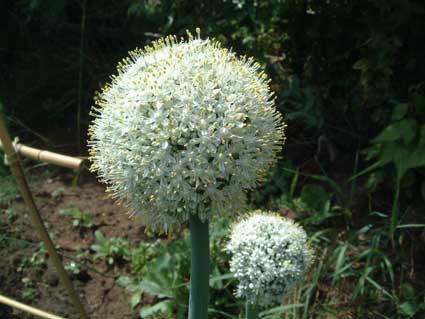
Something else that's nice at the moment is these onion flowers. I've been growing them for seed and have been surprised at how beautiful they are ... as lovely as the drumstick ornamental onions like Allium giganteum, only white. This variety is Jet Set, which originally came from Chase Organics. I've got 20 or so plants here but I'm only going to keep the best six. The others are being grown solely as pollen providers. This is because onions are outbreeders (see my post on F1 hybrids if you want an explanation of why this matters) and need to spread their genepool more widely. If I just grew the six plants there is a higher risk that their offspring would be feeble and pathetic due to inbreeding depression. They are pollinated by insects of various kinds ... flies, moths, hoverflies ... who just seem to land on the flower heads and stand around for a bit, then fly off somewhere else. But it obviously works. A couple of days ago I was out there in the twilight watching a moth giving one of the flower heads a good trampling. Although it was just walking around, it was beating its wings so fast I could only see them as a ghostlike blur.