Showing posts with label Broad (fava) beans. Show all posts

Friday, 2 February 2007

Heritage vegetable review
Broad bean: Red-flowered


Age: 18th century
Background: Also called "Crimson-flowered". Rescued and revived by the Heritage Seed Library.
My supplier: W Robinson & Son
Pros: gorgeous flower colour, gorgeous scent, good blackfly resistance, lovely flavour
Cons: none that I noticed

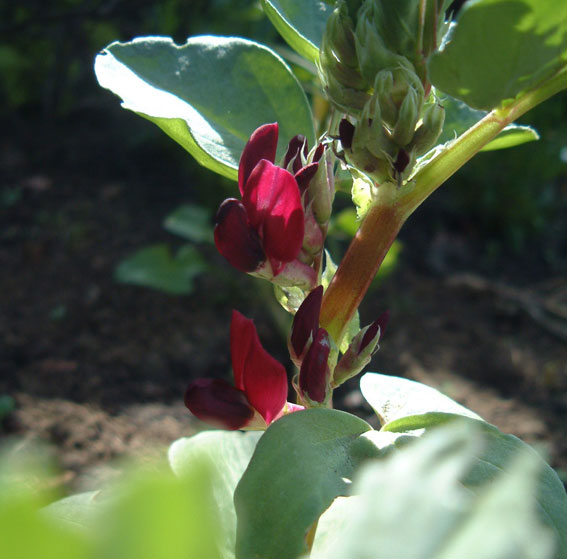
This has to be my favourite broad bean ever ... the old and un-named red-flowered or crimson-flowered variety. I love it. The flowers are the most beautiful colours and glow in the sunlight.

Clearly others love it too because it's had a surge of popularity in recent years. There are still only a handful of suppliers selling it but it's been busily doing the rounds at seed swaps, so it's not too difficult to find these days.

Very simple descriptive names like "Crimson-flowered" ("Early long purple", "Tall white" etc) are often an indication of a variety's age, because it wasn't really until the Victorian era that romantic names like "Lazy Housewife" and "Egyptian Turnip-Rooted" became de rigeur. Red-flowered broad beans were described in seed lists in the late 18th century, and what we have today is either the same one or a close variant of it. The variety seems to have come close to dying out, until an elderly lady from Kent donated it to the Heritage Seed Library in 1978. It had been grown by her market-gardener father, who was given the seeds during his childhood years a century earlier.

It's a smaller and more dainty plant than a conventional broad bean and grows to about 3ft with three red-tinged stems which usually stay up without support, at least until the podding stage. Leaves are a bright greyish green and fairly rounded. The pods are small and grow almost vertically, and the beans are pale green and about two-thirds the size of a modern type.

But they are very abundant, so yields are good overall. And the flavour and texture are fantastic. It has a slight firmness and mealiness in the texture which you wouldn't find in most varieties today but it's a nice kind of mealiness. And the flavour is sweet and lovely without any trace of bitterness. The beans cook to a nice bright green colour and only need to be lightly steamed.

The real wow-factor of this variety though is definitely its flowers. The crimson colour is so deep, voluptuous and translucent, and on spring days when the flowers are backlit by bright sunlight low on the horizon they can leave you staring at them for minutes on end in drop-jawed wonderment (they did me, anyway). And one of the unsung blessings of broad beans is that their flowers have a lovely scent. Red-flowered has the most incredibly beautiful smell ... and I speak as someone who finds a lot of flower scents headachey and nose-curdling. It's just delicate and lovely, and it stops you in your tracks as you walk up the garden path. The bees love it too and I noticed they were chewing their way through the base of the flowers to get inside them.


Other than a bit of nibbling by bean or vine weevils, who give the leaves frilly edges by eating little notches all the way round, the plants seemed fairly resistant to everything, pest-wise. And most significantly, only mildly bothered by blackfly.

Blackfly is the ubiquitous and inevitable pest of broad beans. For those who don't use sprays, the end of the broad bean season is often brought about when the plants (and pods) are so encrusted with solid black you can't even get hold of them to harvest them any more. So when I first grew this variety in 2005 and found it was completely untroubled by blackfly until the last week or two of the season, I was quite excited. I grew it again in 2006 and the same thing happened ... no blackfly at all until very late, and even then just a smattering (though there was some variation in infestation between plants ... I saved seed from the ones which stayed cleanest, which also happened to be the reddest-flowered).

As far as I'm concerned, this alone makes it priceless in the garden. I've lost so many broad bean crops to blackfly, which are quite disgusting things when they build up to critical mass, and the usual organic methods (pinching the tips and hosing the blackfly off) have limited impact. So to find a variety that just gets on and grows untroubled, looking immaculate right up until harvest time, is quite a coup.

The 'proper' colour for the flowers is a deep wine red with darker burgundy underneath, which fade slightly with age to a deep carmine. But there's been a lot of variability among the ones I've grown and I don't know if it's just me. In 2005 I grew six, and no two were the same. Colours, markings and combinations varied from pale pink, dark cerise, burgundy red, charcoal grey with a pink flush, or pale pink and black bi-coloured. I'm wondering whether the seed I've got has been accidentally cross-pollinated with a 'normal' black and white flowered bean, or whether they naturally have that much variation. They were all gorgeous, but I saved seed mainly from the deepest red ones.

In 2006 I grew 12 plants, mainly from my own seeds, but topped up the numbers with two from the original seed packet. I now don't know which ones were originals and which were mine, but I can guess: there were 10 normal deep red-flowered plants and two pink and black oddities. Broad beans do cross very readily so it would be no surprise if an open-pollinated variety like this had picked up a few stray genes from a neighbouring crop. It'll probably do it some good, too. And as long as I select the best red ones for seed each year the variability should soon disappear.

There is another old-ish broad bean with red flowers, Red Epicure ... but it's quite different, larger and with chestnut-brown seeds.

Thursday, 20 July 2006

Today in the garden ... heritage vegetable taste tests!

One of my hand-pollinated buds on Mr Bethell's Purple Podded, wearing some gold braid as a marker. This one was crossed with Alderman a few days earlier. I've found that if you leave the sepals intact when you do the pollination jiggery-pokery the flower will open as normal (as this one has). Tearing off the sepals makes the petals dry up and the flower dies off without opening. It's just a cosmetic matter, but I like to make the most of me flow'rs ...

Apart from the broad beans, which were from W Robinson & Son, all these vegetables came from the Heritage Seed Library.

I've been watching the progress of Mr Bethell's Purple Podded with great interest, as you'll have noticed, and overall I'm quite impressed with it.

It doesn't seem to like the really hot weather ... the lower leaves have died off considerably during the last couple of days. It's also stopped flowering now, but that's probably because I've allowed some of the pods to reach full maturity (this crop is mainly for seed production ... the Heritage Seed Library issues its pea seeds in packs of 10, which is not really enough for a proper food crop but does allow you to build your own stash of home-saved seed, which is kinda the point really).

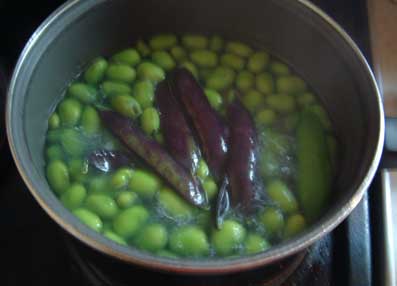
Stewing up some purple pods with the last of the red-flowered broad beans

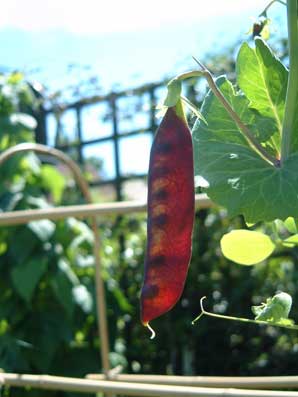
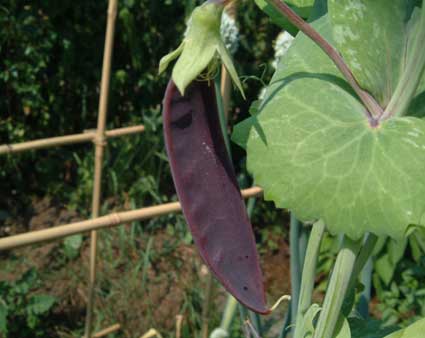
There's enough there to provide a tantalising taster anyway. I'm finding that the pods are lovely as mangetout if you use them when they're small; once the peas start to swell inside they go a bit stringy. They are a beautiful maroon-purple (translucent in sunlight) but lose some of their colour when they're cooked ... still retaining enough to make them a show-stealer at dinner. The flavour is not outstanding when they're larger but if you use them young they're very sweet indeed.


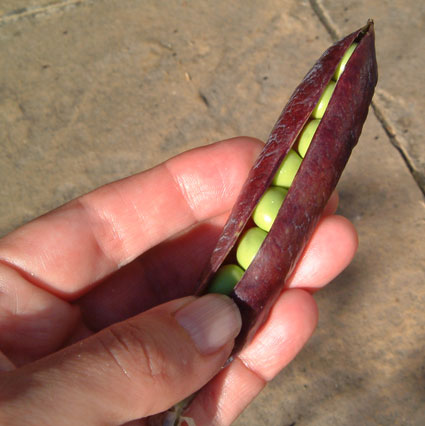
And here's what you get when the peas are fully grown ... as you can see, they're bright green. They're also larger than I expected, having just seen the ones at the Rococo Garden which looked miniscule by comparison. These are as large and green as a conventional culinary pea. I harvested these when they were past their best for eating, because I'm planning to save them for next year's seed, but I tried a couple (raw). They have a distinctive and unusual flavour, I'll say that for them. Kind of slightly nutty and mealy, and not massively pea-like, but still sweet and pleasant. Something quite old and earthy about them, but I mean that in a nice way. They don't have the exquisite flavour of Alderman, but then Alderman is an altogether superior pea on every level and I bow down before it.


I'm beginning to think my destiny here is to run some larger scale and more scientifically rigorous trials of purple-podded peas. The thing is, they've only just started appearing commercially in the last couple of years and are still something of a novelty ... so most of the ones you come across in catalogues are just called Purple Podded (the only named variety I've seen is Ezetha's Krombek Blauwschok). But the big differences between mine and the one in the Rococo Garden clearly shows they aren't all the same variety. Some are advertised as having purple flowers, others pink, others bicoloured. Mine have large sweet peas while the Heligan vegetable book describes their purple-podded peas as "virtually inedible". So I'm going to buy up a selection of purple-podded varieties from anywhere I can find them and grow them all together next year for comparison. See how similar or different they really are.

I also had the pleasure of briefly sampling Champion of England both in pea and mangetout form. Both were sweet and yummy eaten raw. I only have four plants though, so I'm having to keep most of the peas for sowing next year.

Grando Violetto needs to reach full size before the beautiful colour develops

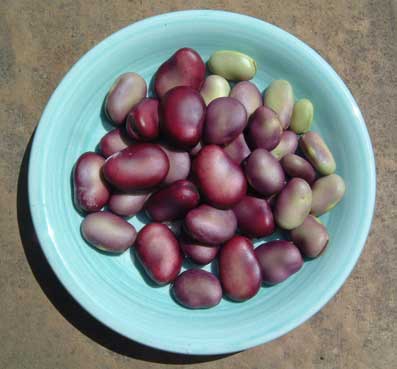
Remember I put my Grando Violetto broad beans down as a crop failure? Well, this is what I salvaged from the blackfly encrusted stumps I finally slung in the organic recycling bag. Not bad from only four plants, and I'd had a couple of meals' worth off them already. They taste very nice indeed, and have a pleasantly sturdy texture a bit like butter beans. But this one isn't on my favourites list I'm afraid. The beautiful purple colour in the beans doesn't develop until they're fully mature and therefore past their prime for eating, so you really have to eat them while they're green and look like any other broad bean. Though you can dry them ... which turns them a lovely velvety purple black colour. The plants have no blackfly resistance at all, which makes them less than ideal for organic conditions.

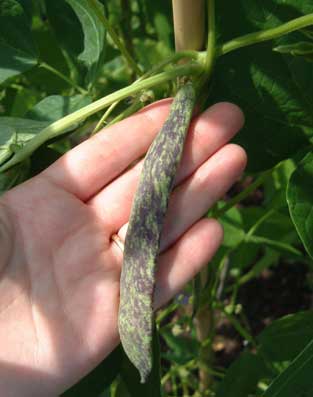
Moving on to the climbing beans ... ooh look! Mrs Fortune's, which I had branded the ugly duckling, has produced pods with mottled blue streaks!

They're a proper blue too, and colour up best in sunlight ... very decorative indeed.

They start to go a bit knobbly as the beans develop, some pods are wider or knobblier than others, and most have a little curved 'tail' at the bottom. It's also a high yielder. The pods seem to form almost as quickly as you can pick them. So we had some for tea, cooked as 'green beans'.

Before I go any further I should point out that some climbing beans are optimised for eating whole as young pods and others are best left to mature as dried beans. If a variety is good for one usage it's generally less good for the other. I think Mrs Fortune's is bred for dried beans, not for eating fresh.

So ... it isn't perfect. The colour vanishes completely on cooking, even with just a light steaming. *sniff*. The pods have a slight roughness to them after cooking, but a very soft texture when you eat them. The flavour is ... um ... not bad. A bit nondescript really.

Kew Blue on the other hand is meant as a pods-an'-all fresh bean, and it's very swish. Mine is now starting to set pods in great numbers, and they're dead straight (when young at least), velvety and very slender. They're a dark purple colour with a flush of green in the younger pods. They look much more elegant than the pods on my other purple bean, Trionfo Violetto, and I have to say they trump it for taste too. I had some steamed this evening, and they were sweet and lovely. Very fine indeed. The colour changes to dark green after cooking, and they have a very nice texture. I think I can recommend this variety if you want beautiful plants and super-tasty pods ... it looks to me to be the best of the climbing beans I've grown. As far as I know it's only available from the Heritage Seed Library.

Next up ... spud reviews.

Tuesday, 4 July 2006

Today in the garden ... purple pods


Last night's dinner included some of the Edzell Blue potatoes and red-flowered broad beans. I tried baking the potatoes this time but this obviously isn't one of Edzell Blue's strong points. They have too much dry matter in them and go very floury, and the flavour isn't very inspiring. The skins go extremely crispy and leathery and take a lot of chewing. Some people like their jacket potatoes that way ... but I've had a lot better. When I discover which cooking method does suit this beautiful but fickle spud I'll let you know. The red-flowered broad beans, on the other hand, are the best I've ever tasted. They have slightly smaller beans than the modern varieties I've grown in the past, but they taste fantastic with no bitterness in them at all and only need to be lightly steamed. The plants are more blackfly-resistant than any I've ever grown, which in practice means higher yields. I got my seeds from W Robinson & Son and they may in fact be the only supplier of this variety, although I've also seen it doing the rounds on the HSL seed swap. Highly recommended.

Apple Taynton Codlin coming along a treat

The fruit garden is going like the clappers ... most things are ready to harvest now. I have more raspberries than I can possibly use for anything, mainly because the bushes I inherited as part of the garden are a crappy type which all ripen in one enormous simultaneous glut. The flavour isn't much to write home about either. I'm intending to replace them with Autumn Bliss which is massively better and definitely my raspberry of choice. The only fruit failure so far this year is my miniature peach tree, which has taken umbrage at something and dropped all its fruits in disgust. Bloody temperamental thing. Meanwhile my single solitary apple is swelling nicely.

Well, here's the evidence. Mr Bethell's Purple Podded has purple pods.

How about that then. Purple podded peas. They start off green when the flower first dies off but within a day of exposure to the sun they go this shiny purple-maroon colour. Another thing I really like about this variety is that the sepals on the flower buds are speckled with maroon, especially while they're in the bud stage. It's very pretty. And with the flowers changing colour all the time I'm wishing I planted it closer to the house where I could stare at it more. Mine bears some of its flowers upsidedown; I'm not sure what that's all about. I'm not finding it to be quite as vigorous as Alderman, but that's hardly surprising. I suspect Alderman has been hybridised with a triffid.

Pollinations done today (it's technically too hot for it, but the others I did the other day seem to have taken all right):

Champion of England: one bud pollinated with Mr Bethell's Purple Podded
Mr Bethell's Purple Podded: two buds pollinated with Champion of England
Alderman: three buds pollinated with Mr Bethell's Purple Podded; two with Champion of England

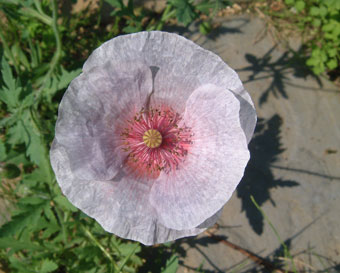
Another nice poppy showed up today ... a lavender-grey one with a pink centre. Once again it's a self-seeded Mother of Pearl.

I thought it was time I posted a picture of one of the vegetable plots, because they look lovely at the moment with everything growing away like mad. But you'll soon see why most of the photographs I post are tightly-cropped close-ups ... it's so you can't see what a scruffbag muddle everything is actually in. I dug this veg bed out of the lawn last year, so this is only its second season. That's my excuse and I'm sticking with it.

From left to right: tomato Pink Jester; climbing bean Mrs Fortune's (on wigwam); pea Champion of England (on other wigwam); sweetcorn Swift (F1); onion Hysam; garlic Music. There's also some Mascara lettuce and Cheltenham Green Top beetroot in the foreground and Red Duke of York and Fortyfold potatoes behind and God knows what else.

Sunday, 2 July 2006

Bean update

Buds and flowers on Trionfo Violetto climbing bean

Just as all the other broad beans are being harvested, the late-sown Martock broad beans have come into flower. This is the really antique variety which is reputed to have been around since the 13th century. I'm only growing four plants, and they're all standing very upright and not branching at all. But as is often the case with these very old varieties with a well shuffled genepool, they all have slightly different flowers. They are all white with black blotches and purply-mauve at the base, but there's variability in how much purple they have and whether it's on the whole flower or upper parts only. Two have strong purple veining running through the petals while the other two are just white.

At this point I'd like to state my view that this variability is a very good thing. We've been conditioned into thinking that we want plants to come out consistently identical and to do exactly what it says on the tin. Not surprising really, when uniformity is one of the three traits a vegetable variety is required to have before it can be included on the National List, and the seed companies want you to choose uniform varieties because they tend to be F1 hybrids and they can charge more for those. From an ecological point of view though, the variability between plants is a sign of a healthy genepool with lots of sub-lines being preserved and reshuffled, which is important for long term biodiversity. I also think, personally, that the element of surprise ... not knowing exactly what the plant is going to come up with ... is one of the great joys of gardening.

Flowers on Martock broad bean. This one has lovely purple-black veining in the petals.

Kew Blue is claiming the distinction of being the most gorgeous plant in the bean plot, which is quite an achievement when I'm also growing Trionfo Violetto, which would normally win hands down. It's not as refined as Trionfo ... it has slightly gnarled and asymmetrical leaves which give it a kind of lopsided scruffiness, but its colour is so deep and vibrant it almost glows. It looks shinier, healthier and more vigorous than the other beans. The leaves are the richest green and the stems are a velvety purple. The stems are chunky. The leaf stalks fade gracefully from purple to green but some of the smaller petioles are almost black. It's a very striking looking plant. And it hasn't even flowered yet. I still have that pleasure to come.

Not to be outdone by a better looking rival, Trionfo Violetto produced the first pod of the season. I found it lurking in the undergrowth at the bottom of the plants. Yup, there's just the one.

Not really enough for a meal, but it's the thought that counts.

Of course it's possible that the superiority of the Kew Blue is down to the soil it's growing in ... I think it may have had more manure dug into it than the other bean plots, and manure is the thing that makes the biggest difference to plant performance, in my experience. I'll only find out for sure by growing it for a few more seasons. But for a variety that got off to an unimpressively sluggish start it's now looking very dapper.

Mrs Fortune's, it has to be said, is not a looker, poor dear. The leaves are very tidy and symmetrical, but they sag at night and have a rather anaemic pale green colour. The first flower buds are now forming and they're a boring green with a half-arsed splosh of mauve. Not one for the ornamental borders. But no doubt it has other qualities, and it's certainly growing well. No bother at all from pests.

Ha, things change very fast in the garden. In the time it's taken me to write up this blog post, a couple of the flowers have opened and they do have a nice dark pink colour on the inside.

It seems that the summer solstice is the cue for all the beans to flower, because my runner beans have also started to produce buds. There's a lot of red-colouring in the heritage variety Black Magic, including the leaf veins, which look lovely against the light.

Runner bean Black Magic from the Heritage Seed Library

Incidentally my neighbour had a crop failure with his runners (the damp weather in late May seems to have rotted the seeds) so he bought some plants that were on offer down at B&Q, and they're a variety called White Emergo which has white flowers and seeds. What will happen if that cross-pollinates with my Black Magic is anybody's guess. Skewbald beans!

Sunday, 11 June 2006

Today in the garden ...


Well, my elderflower cordial was a success. Husband glugging the stuff like there's no tomorrow. I need to go and get a bucket from the homebrew shop so that I can make it in bigger quantities. I'll also need to take a trip out into the Cotswolds with the secateurs ... I don't want to pillage my own tree any further because I like elderberry beverages too and I want to leave it with enough blossom for that. There's no shortage of it around here though. Previous wildflower recces suggest that Leckhampton Hill might be a particularly good place for elder.

Of course I'm not superstitious. *cough* Not at all. It's just that I have a curious feeling of respect for elder trees and always like to ask them nicely before taking their blossom.

I love this time of year in the garden ... everything looks at its best in June, before it all goes blowsy and flops over. This picture was taken from the window of the music room, the room where all Revolving Doris's music is recorded (or my half of it, anyway). Looks nice at this time of year, doesn't it? No wonder I'm not getting much music done.


The music room is now being supplied with some especially lovely red Dianthus flowers, courtesy of the plants which I picked up on a trip to Devon a few months back. I'm usually reluctant to cut flowers because they look so lovely in the garden, but it's nice to have a jar of them on my desk too. I tend to bring in mature flowers anyway, because Dianthus is at its best when it's aging a bit. The pistils curl up into a very attractive spiral after they've been pollinated and the flowers still last for ages.


The broad beans are doing very well, and the red-flowered type now has huge numbers of tiny pods. Still a few flowers on there too. Grando Violetto began to set pods much earlier, and some of them are getting big, but it seems to produce them one at a time so there's never enough for a meal. Grrr.

The blackfly season is well underway. Even the red-flowered variety is now under attack, although interestingly it's only the largest and lushest plants which are affected. Some of the plants have stayed quite small and those are still clean as a whistle. The Grando Violetto variety is suffering quite badly and I'm having to hose them off on a daily basis. The plant tops are looking very feeble now (probably from being violently blasted with a water jet every day as much as from the blackfly) and it doesn't look like I'll be getting a huge yield from them.

Had a toad hopping about on the patio this afternoon. I've noticed an increase in their numbers over the last couple of weeks and a corresponding drop in the slimy invertebrate population. Hooray.

I dunno about you, but I like to spend a lot of time just standing around in the garden staring idly into the middle distance, especially in the twilight. Yesterday evening when I was doing this I heard a snuffling noise and a hedgehog came sauntering out of the 'cornfield' patch straight towards me. This happened once before when I was sitting on the bench in the wild garden and a hedgehog came over and started snuffling at my foot. I had my eyes closed and didn't realise it was there until it touched me and I went "waaaaah!" and leaped about three feet in the air and the hedgehog scarpered. They certainly can shift if you frighten the shite out of them. This time though I kept very still and the hedgehog passed within two feet of me, carried out a brief inspection of the broad beans and waddled off into the raspberries. Very cute. And very snuffly.

Saturday, 3 June 2006

Today in the garden ... orange

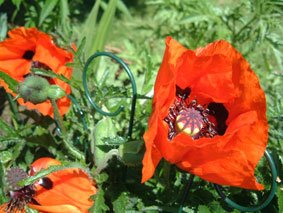
Iceland poppy Red Sails. Yes I know. It's orange.

Lots of new flowers have come out today. And they're all orange. Whether they were meant to be or not.

I've been nurturing the Iceland poppy from seed for two years expecting it to have red flowers. That's poppies for you ... always coming out different from what you expect. Also out today is this oriental poppy Allegro and some bright orange gazanias.

Most of my work today was in the vegetable plots. Blasting the blackfly off my Grando Violetto broad beans with a hose jet. Interestingly the red-flowered broad beans are not suffering from blackfly. Just one plant, the bi-coloured black and pink one, has a minor infestation. But the others are completely clean (see photo) with not an aphid in sight. This is exactly what happened last year so I'm assuming the red-flowered bean is naturally blackfly-resistant. What a turn up for the books in a variety that's already won me over with its beauty and taste.

I planted out the Kew Blue climbing beans against wigwam canes. They are still quite small, as they've been slow growers so far, but I thought they might as well take their chances in the open ground rather than hanging about in trays on the patio.

So, what do you do when you realise you've sown far too many vegetables and you haven't got room for them all?

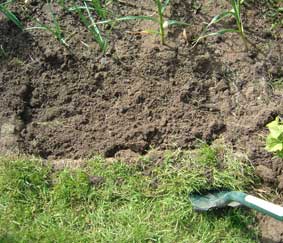
That's right. You dig up another chunk of the lawn.


And use the strips of turf to earth up your spuds. Seen here with Witch Hill potatoes. Note hi-tech irrigation system made from sawn-off Ribena bottles.

If you angle the turfs in an inverted V-shape along the row they form a nice moisture-conserving trough, which you can then top up along the middle with fine loose soil to earth up the potato haulms. Stacking the turfs like this holds the sides of the trench together, prevents water from running off and being wasted and absorbs it into the mats of decomposing grass, which helps to keep plenty of moisture around the roots and developing spuds.

It does have a downside: it requires vigilant weeding. Some of the grass roots always regrow, especially bits of couch.

Friday, 19 May 2006

Everything you wanted to know about broad beans but were afraid to ask

A red-flowered bean that actually has red flowers, just for a change

I grow three varieties of broad bean at the moment, all 'heritage' types. Red-flowered, Grando Violetto and Martock.

My favourite ... and I mean my favourite broad bean ever ... is the un-named Victorian red-flowered variety. I love it. The flowers are the most beautiful colour and glow in the sunlight. It's a smaller and more dainty plant than a conventional broad bean and grows to about 3ft with three red-tinged stems which usually stay up without support. The pods are small and the beans are pale green and about two-thirds the size of a modern type. But they are very abundant. And the flavour and texture are fantastic. I also found that other than a bit of nibbling by bean weevils the plant was fairly resistant to everything and only mildly bothered by blackfly.

The 'proper' colour for the flowers is a deep crimson with darker burgundy underneath, which fade slightly with age to a deep carmine. But there is some variability among the ones I've grown. Last year I grew six and no two were the same. Colours and markings varied from pale pink to dark cerise, charcoal grey with a pink flush to pale pink and black bicoloured. They were all gorgeous, but I saved seed mainly from the deepest red one. This year I grew 12 plants, mainly from my own seeds, but topped up the numbers with a couple from the original packet. I now don't know which ones were originals and which were mine, but I can guess: I have 10 deep red-flowered plants and two pink and black oddities. So I'm wondering whether the originals had accidentally been cross-pollinated with a 'normal' black and white flowered bean, or whether they naturally have that much variation. Broad beans do cross very readily.

Broad bean Grando Violetto in flower

Grando Violetto is an old Italian variety with very attractive dark purple beans. The plant itself isn't much to write home about ... it's a slightly straggly looking thing and the pods are unspectacular. It's a smallish plant but the stems need support from an early age and it has narrow grey green leaves which are slightly spear shaped. Flowers are a conventional black and white but quite unusual in form, with a pinky-mauve flush at the base. The beans and pods are smaller than a modern variety. They have plenty of substance and flavour though. I don't know how tall the plant naturally grows because mine all got their heads chewed off by slugs. Probably about 3ft though.

Martock can trace its origins back to the middle ages. That makes it the oldest vegetable variety I grow. (But not the oldest plant variety in the garden ... that would probably be a species rose called Alba Semi Plena which was brought over here by the Romans.) It has tiny beans compared to modern varieties, and I can't tell you any more than that because I haven't grown it yet. The plants have just germinated so it's early days.

Size differences in broad bean seeds: left to right, Martock, red-flowered, and a modern strain of Masterpiece Green Longpod.

I'd like to try breeding some new broad beans using the red-flowered type as a basis, but I've been having trouble working out exactly how they pollinate. I couldn't find much info about it on the internet so I had to take a flower to bits and have a look. Very clever it is. The stigma inside the flower is folded over and spring-loaded like a catapult. Given even the lightest touch (i.e. by a bee hovering about wondering how the hell to get in) it boings up and slaps itself straight into the pollen.

Plants are so unsubtle about these things. It's all wham bam thank you ma'am. Or a nymphomaniac on a spring, in this instance.

Maybe if I'd googled for "nymphomaniac on a spring" I'd have got a few more hits. Ah well. And now anybody else who googles for it is going to find my gardening blog and be very disappointed.

So, a broad bean flower doesn't even need to be pollinated by bees, even though that's what it's designed for. Which is probably just as well: I saw a bee the other day chewing through the base of the flowers to get straight to the nectar without bothering to go inside. Lazy little bugger.

Anyroad, I'm beginning to see that hand-pollinating broad beans is going to be extremely difficult. With such a touch sensitive stigma it would only work if you opened up a flower bud and emasculated it before the male bits were ready to shed pollen. Then you'd have to sellotape the bud shut to stop the stigma from drying out. A bit of a palaver really. I think, given that the plants are naturally diverse, I might just let them do their own thing and then select the variations I like and see whether any of them come true from seed.

Another little known fact about broad bean flowers ... they smell utterly gorgeous.


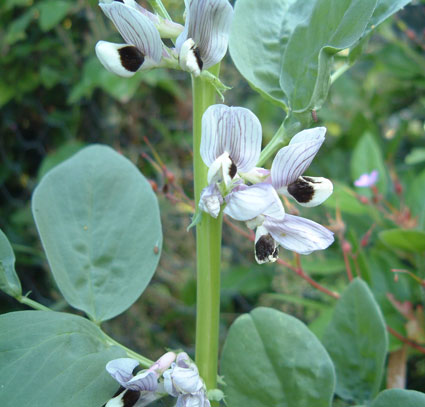
Phwoar, look at them broad bean flowers. Pale pink and black bicoloured variants of the red-flowered type.