Showing posts with label Runner beans. Show all posts

Monday, 2 April 2007

Whoops

Hmmm, something tells me these white runner beans have got crossed.

My neighbour asked me "D'yer want some o' them white runner beans?" meaning the ones he was growing last year. I wasn't planning to grow any runners this year but I don't like to turn down the offer of home-saved seed, because I can always horde it or pass it on to someone else. I was intrigued when I saw what he had though, because some of the white beans were black. And he'd harvested them all from his White Emergo plants. Clearly some had been fathered by the Black Magic crop I grew last year, despite my attempts to use a large jasmine hedge as a barrier. And there were some other beans which were a more conventional black and purple mottled type, presumably cross-pollinated with another variety growing in someone else's garden. He was going to pick out the white ones for me but I said I'd be happy to take some of the funny coloured ones too.

It's a strange quirk of some vegetables such as beans and sweetcorn that a cross-pollination can show up in the colour of the seed coat. With most plants, you won't find out about an accidental cross until you grow the next generation of plants. But where beans of different colours are grown together, individual beans that come out the 'wrong' colour are a sure sign of cross-pollination. A cross won't always show up in the seed colour though, so it's not a foolproof way to check the purity. In other words, black beans appearing in the pods of a white-seeded plant are a sure sign of an accidental cross with a black-seeded plant. But that doesn't mean for sure that the white beans aren't cross-pollinated. They may or may not be.

I collected a number of seeds from my black-seeded plants and they were all perfectly black, but the likelihood is that some of them will have been crossed with the white variety. The fact that there are no white seeds among my black ones doesn't necessarily mean anything, other than that the black colour is probably dominant.

Luckily none of this matters very much. My neighbour really doesn't care what variety of runner bean he grows, he just wants runner beans. The accidental crosses are technically F1 hybrids so they may even show a bit of extra vigour if he's lucky. And although I normally try to keep my varieties pure so that I can save their seed, I wasn't bothered too much about my Black Magic runner beans because I knew it was not going to be possible to isolate them from the crop next door. Runner beans cross so readily, it was inevitable that if we grew the same crop in adjacent gardens we would get crosses. If I'd really wanted to be sure of getting some pure seeds from my plants I could easily have resolved this by putting a bag over a few flower clusters to keep the bees out, and saving seed only from those. But I wasn't very impressed with Black Magic anyway so I didn't bother.

Fortunately for me, my neighbour's vegetable growing doesn't clash with mine very often. Most of the things I want to save seed from are things which normally self-pollinate (like tomatoes, peas and French beans) or which wouldn't normally be flowering if grown purely as a vegetable crop (like beetroot, carrots and onions). And most are things my neighbour doesn't grow anyway, as he has quite a narrow range of things he likes. The neighbour on the other side of me doesn't do any gardening at all, so there's no risk of cross-pollination from there.

Meanwhile I've been having to think about cross-pollination issues within my own garden. I've been planting out my special peas. These are mostly from the Heritage Seed Library, and are rare varieties which are not available to buy, and of which I've only got tiny quantities ... four to eight plants of each. The obvious thing to do would be to put up a nice sturdy trellis and plant them all together, but I can't do that. I need to save pure seed from all these varieties, and so I have to be as sure as I reasonably can be that they don't cross-pollinate. Accidental crosses between peas are not very common ... unlike runner beans, peas are designed to self-pollinate and their flowers are sealed so that insects can't normally get to the reproductive parts. But even with self-pollinators, there is always some risk of crossing. How big that risk is in your own garden can only be found out by trial and error because it depends on environmental factors such as local populations of insects. As I have an organic garden full of plant diversity, the pollinating insects are likely to be more abundant than they would be in, say, a conventional farmer's field. And as I can't readily replace these pea seeds if I screw them up, I have to be extra careful.

So ... I spent all day yesterday making small individual wigwams and twiggy structures for them all in different spots all over the garden, so that all of them are at least 10 or 15 feet away from any other pea varieties. Because I don't have that huge a garden it's not possible to separate them any further than that, so it'll have to do. If I have a cross-pollination disaster I'll have to rethink my strategy completely for next year. But hopefully they'll be fine. It was a lot of work though to plant them all at individual stations like this.

And it also makes conventional ideas of crop rotation pretty meaningless in my garden. All my crops are spread out and jumbled up with a bit of this here and a bit of that over there. So I don't bother with rotation, other than trying to be vaguely conscious of what grew in a particular spot last year and doing my best to mix things up. Crop rotation is a practice which goes hand in hand with monoculture. When you fill an area with large amounts of the same crop, pests and diseases soon become a problem. That's because areas of just one kind of plant goes against nature's way of doing things, and the result is an imbalance. The more diversity you have in your garden, and the more you blend different crops together and interplant with other things, the less of an issue it is. Diversity enables the garden to find its own balance in which pests exist but rarely reach problematic levels. I'm a great believer in trying to make use of nature's tides and balances rather than fighting against them. So I don't practice crop rotation as such because it makes more sense in my garden to avoid the need for it in the first place.

And of course the other advantage of garden biodiversity is that it gives you an excuse to buy loads of seeds. Heehee.

Sunday, 28 January 2007

Heritage vegetable review
Runner bean: Black Magic


Age: pre-1970
My supplier: Heritage Seed Library
Pros: beans are large and go through beautiful colour changes
Cons: string! string! string!

Black Magic is a macho runner bean. The pods are easily capable of growing over a foot long, the beans are massive and a hard glossy black when dried. But if you want to eat them as conventional runner beans you have to get in there quick and harvest them while the pods are very small. Otherwise you'll be chomping on a mouthful of green gristle. To say that the pods are stringy is an understatement.

Personally I don't think the flavour is anything special either. The pod flesh is juicy and succulent but coarse in texture and taste. I was not impressed.

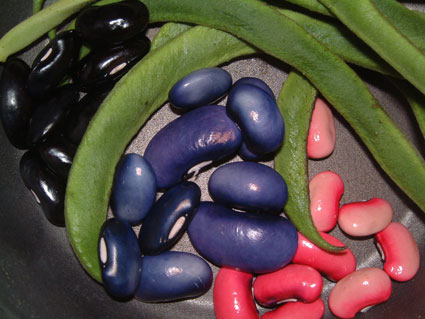
Inside the pods the beans start off green and turn deep pink as they start to swell, and then go a gorgeous midnight blue before maturing to jet black. It's only by shelling them that these colour changes can be appreciated, but they are very, very beautiful. The dried black beans are a delight to look at and handle.

In the end I gave up trying to eat the pods and just used this variety for shelling out. It may not be the conventional way to eat runners, but I found that leaving the beans to reach a mature size and discarding the stringy old pods is the most rewarding way to use it. The beans have a texture very similar to butter (lima) beans ... they're substantial and delicious to eat. You can eat them while they're still small and pink or leave them to the midnight blue stage. As is so often the case though, the colour doesn't survive the cooking process. On contact with boiling water the beans turn an inky mauve regardless of what colour they were to start with.


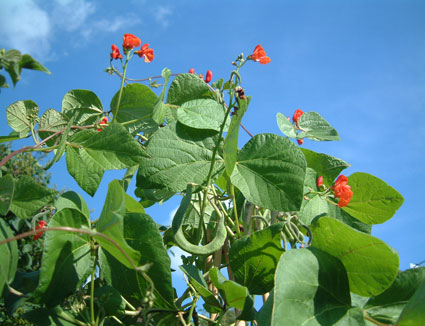
In the garden the plants were moderately attractive, having some red veining in the leaves and stems, and nice orangey-red flowers. But the usual runner bean glut never materialised. I probably didn't grow mine in the most advantageous position, but even so, the yields were very low. Mine also performed poorly in flower production, although pod set was good on the few flowers it did produce.

So on the whole I was disappointed with Black Magic. It has size and looks but the pod flavour doesn't match up to it. And although it certainly has merit as a shelling bean, the primary purpose of runner beans is eating the whole pods and it's no fun to find yourself chewing what feels like a mouthful of wire wool. It might appeal to exhibitors who are looking to grow enormously long pods but not necessarily to eat them.

It may not be fair to judge its lacklustre performance this season because I know several other bloggers (and my neighbour) had problems with their runner beans in 2006, so the poor yields may not be anything to do with the variety. I might be inclined to give it another go just to see, but probably not just yet ... I think there are other better varieties out there.

Sunday, 10 September 2006

Today in the garden ... colour magic


I was able to try the first ripe Clementine tomato today. It's a French cocktail tomato, a deep golden yellow. Lovely tangy flavour too ... and just as it says in the catalogue, it tastes distinctly citrusy. Very nice indeed and a lovely colour.

When I do my Heritage Vegetable Reviews they'll be divided into three categories: the exceptionally good, the perfectly adequate and the stuff consigned to the metaphorical compost. And I don't mind telling you that the last category is where I was planning to put this year's heirloom runner bean, Black Magic. Its yields have been very poor ... although next door has also had poor yields from his runners which are a different variety, so it may just be one of those years. But the notes I've been making for the reviews are along the lines of "stringy as hell" ... "unchewable" ... "flavour not much to write home about". It's not a bad looking plant. Left to their own devices with plenty of water the pods will grow to a huge size (some of mine are just over a foot long) but if you want to actually eat them you have to catch them while they're still very small. Otherwise you'll be chomping on a mouthful of green gristle. Yep, I was not impressed with this variety.

But then I wondered what they'd be like if I just left them to mature for a bit and shelled them out, like I did with the other climbing beans. I've never heard of runner beans being used like that in this country, but there are apparently people who do it in other parts of the world, so presumably they're not poisonous. I shelled out a couple of the pods which were way too large and knobbly to eat as green beans and whoooooooo! The beans were an amazing dark midnight blue. I shelled out another pod and the beans were practically fluorescent pink. Wowee!

Black Magic beans change colour right through their growth cycle. The pink develops early on in the green pod stage and at some point as they get bigger they darken quite suddenly into a graduated dark blue like the night sky. When they are fully mature they are a shiny, burnished black. I mean really black. They are very beautiful and large and lovely to handle.

The four colours of Black Magic

But colourful beans are not just for looking at, so they went into a pan of unsalted boiling water for five minutes and ended up as a delicious vegetable with a similar size, texture and flavour to butter (lima) beans. It's not a refined texture in this case, but it's substantial and very tasty. And no string!!

As is so often the case, the colour doesn't survive the cooking process. On contact with boiling water the beans turn an inky mauve regardless of what colour they were to start with.

But anyway, Black Magic may not be consigned to the C-list just yet. It's an open verdict.

Friday, 25 August 2006

A seed saver's guide


Since we're getting into that time of year again, I thought it might be useful to put together a quick and simple guide to vegetable seed saving, since this sort of info is rarely found in gardening books. Most things can be home-saved, and it not only saves money but helps to maintain long-term biodiversity. As more and more traditional open-pollinated varieties disappear from the catalogues to be replaced by overpriced and overhyped hybrids, you could find yourself looking after a variety that's no longer available and helping to keep it from extinction. Like the lovely maroon and white beans shown above, an heirloom variety which is unavailable to buy.

When you save seed from year to year though, things can get more complicated. If you've read my post about F1 hybrids you may remember that plants fall into two basic types when it comes to reproducing. Inbreeders are happy to self-pollinate to kingdom come and show no ill-effects from it. Seed from a single plant, or even a single pod, can be enough to keep the variety going. Outbreeders are designed to cross-pollinate with other plants and need lots of genetic diversity. Without it they succumb to inbreeding depression ... within a few generations they start to lose their health and vigour. To avoid this you need to save seed from a number of plants, not just one or two. They will also often cross-pollinate with other compatible plants growing nearby so if you want to keep a variety true from seed you may need to isolate them from other similar crops.

So isn't it more hassle than it's worth to save seed from outbreeding crops? Not really, no. Because over the years you'll be selecting seed from the plants which grow best in your garden, and will gradually develop your own sub-strain which is optimised for your growing conditions. For this reason home-saved seed often does better than the stuff you buy (in America, commercial seed may have originated in a different zone with very different conditions ... while most seed sold in the UK is not produced in the UK at all).

F1 hybrid plants sometimes produce sterile seed, or no seed at all. And when they do produce viable seed it doesn't come true to type. The usual advice is not to save seed from F1 hybrids. If you're interested in plant breeding though, or just enjoy the element of surprise, you can ignore that advice. The resulting plants may turn out nothing like the parents, and may initially be inferior, but you'll have all sorts of brand new and possibly unique genetic combinations to choose from, and you're a step closer to producing a new open-pollinated variety.

Storage of seed is a whole subject in itself, but for year-to-year seed saving (as opposed to long-term storage) you can just dry them out as much as you can and store them in paper envelopes. I usually place each envelope inside a self-seal bag too.

OK, here we go:

Beans, French
Leave the pods on the vines for as long as possible, until they are dry or at least until they start to change colour. Then harvest them and dry them out further indoors. To hasten drying you can split the pods open, but try to leave the beans attached. When the pods are dry and brittle, shell out the beans.

Pollination issues: Strongly inbreeding and self-pollinating, so you can save seed from a small number of plants and grow different varieties close together with no problems.

Beans, Runner
Same method as for French beans.

Pollination issues: A rampant cross-pollinator, so keeping varieties true to type is almost impossible on allotments and where neighbours are growing them. If you need to keep them pure, hand-pollinate and bag up individual flower clusters to keep the bees out. If you're not bothered by a bit of genetic diversity though, don't worry about it.

Beetroot and chard
Beets and chards are biennial and normally go to seed in their second year. The seeds grow on long straggly spikes and take ages to mature. You can pick them off individually as they turn brown, or wait until they're nearly all brown, cut the whole spikes and run a gloved hand along them.

Pollination issues: Strongly outbreeding ... grow at least 16 plants to keep a healthy diversity. Beetroot, chard and leaf beet will all cross-pollinate with each other! To avoid this, grow only one type for seed at any one time. The pollen can travel up to five miles, so if purity is essential you'll need to bag up individual flower spikes.

Brassicas
Not the easiest to save for seed. Most flower in the second season. The long thin seed pods fall to bits very readily when they're ripe, and are likely to be ransacked by birds. The easiest solution is to cut the flower stalks as soon as they reach maturity and hang them upsidedown indoors with a paper bag over them to catch the little round seeds as they fall from the pods.

Pollination issues: Strongly outbreeding ... most can't self-pollinate and are prone to inbreeding depression. You really need to grow around 20 plants, if you have the space. They also cross-pollinate like mad, so isolation is needed to keep varieties true.

Garlic
Garlic is a plant that no longer bothers to set seed in the conventional sense. It's normally propagated by dividing and replanting the cloves. Save healthy bulbs from the regular harvest and leave them intact until planting time (autumn).

If you allow garlic to flower it will produce a huge number of bulbils in the flower head instead of seed. These are essentially miniature cloves and can be saved for planting. They take two years to produce full-size bulbs, but have the advantage that they're less likely to carry diseases. Cross-pollination is not an issue because the bulbils are produced asexually and are therefore genetically identical to the parent plant.

Lettuce
Seeds produce little white tufts, like thistles, when they're mature. They tend to mature at different times, so collect them regularly as they ripen. Allow them to dry indoors until very brittle then rub off and remove the fluffy tufts.

Pollination issues: Inbreeding. Seed can be saved from just one or two plants. They don't usually cross-pollinate, but to be on the safe side grow different varieties a few feet apart.

Onions and leeks
Flowering in the second year, onions and leeks produce beautiful spherical seedheads. Allow them to ripen until the seed capsules start to go pale and papery (they will probably all mature at different times), then cut the flower head and hang it upsidedown in a paper bag in a dry place.

Pollination issues: Strongly outbreeding, and need plenty of pollination partners ... try to grow at least 16 plants. Onions and leeks will readily cross-pollinate with others of their own type but not with each other, though onions may cross with shallots. To maintain pure varieties grow only one type for seed at any one time (you can still grow other varieties for eating, since those won't be flowering).

Peas
Same as for beans really; allow the pods to dry for as long as possible on the plant and shell them out when the pods are brown and crisp.

Pollination issues: Strongly inbreeding, so there are no problems with saving seed from just a few pods, and they're unlikely to cross-pollinate even when grown close together.

Potatoes
To save tubers for next year's crop, select them at harvest time and keep them in a cool, dark, frost-free place over winter. Select only firm and healthy tubers, which ideally should be about the size of a hen's egg. Leave them in a bright sunny place for a few days before storing them, which helps to toughen the skins and keep them dormant. Check them from time to time over the winter and chuck out any that are going soft or mouldy.

Some potato varieties will set top fruit which contain true seeds, and these can be saved too. If your plants have produced "apples", collect them when they're just starting to soften and are ready to drop from the plant. Process them in the same way as tomatoes (though the stinky fermentation process shouldn't be necessary ... just wash them thoroughly in a sieve to remove the pulp).

Pollination issues: Potato flowers cross-pollinate fairly readily, but in practice so few of them produce viable pollen it's unlikely to be an issue. Even when self-pollinated though, they will not come true from seed (because they have a slightly eccentric arrangement of chromosomes). Each one you plant will be effectively a new variety. Conversely, plants grown from tubers are genetically identical to the parent plant.

Squash (pumpkins, marrows etc)
The seeds are so huge you can't miss 'em. It's usually best to leave the fruits to ripen for a few weeks after harvest before collecting the seeds, or just leave them until you're cutting them up for eating. Wash the seeds to remove bits of pulp and fibre, then spread them out on a plate to dry thoroughly.

Pollination issues: Outbreeding, and will cross-pollinate with any other squash of the same species. Unlike most outbreeders though, it's not prone to inbreeding depression ... so you can get away with saving seed from just a few plants ... 6 or so will do.

Sweetcorn
Saving seed from sweetcorn is not really practical unless you have room to grow a lot of it!

Leave the cob (ear) on the plant for as long as possible or harvest when it's mature and bring it indoors to dry. When it's completely dry, the kernels can be removed by rubbing two cobs together.

Pollination issues: Extremely outbreeding! More prone to inbreeding depression than just about any other vegetable, and even sowing just one generation of inbred plants can result in an inferior crop. To be sure of maintaining health and vigour you need to grow and keep seeds from about 200 plants. Gulp.

Sweetcorn is wind-pollinated and produces stupendous amounts of pollen which is then cast to the four winds. To keep a variety pure it needs to be isolated from other varieties by some considerable distance.

Tomatoes
The 'proper' way to save tomato seeds is to scrape the seeds (including the gooey gel stuff) from ripe fruits into a small container, maybe add a tiny splosh of water, and leave it to ferment for a few days. During this time it will produce a crust of disgusting mould and a stench which could put you off tomatoes for life. When all the gel has dissolved away, rinse the seeds thoroughly in a sieve under running water and then leave them to dry for several days. Stir them around regularly to prevent them sticking together.

An alternative and much less stinky method is to scrape the seeds out onto a sheet of kitchen roll, spread them out to separate them and leave them to dry. The gel acts as a glue and sticks them to the sheet. I've heard this method criticised because the gel also acts as a germination inhibitor ... but in my experience the seeds germinate fine, even after several years.

Pollination issues: Strongly inbreeding. Saving a single fruit is enough, although more is better. Cross-pollination can happen but usually doesn't. If you want to be sure of pure varieties, isolate the plants from other types as far as you can.

Sunday, 30 July 2006

Today in the garden ... a dud spud

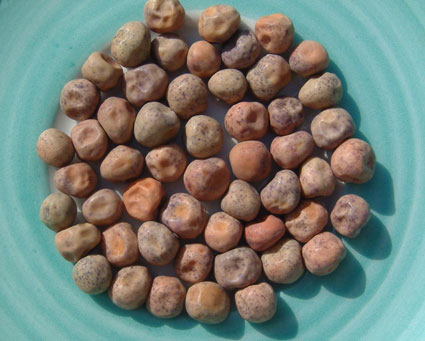
Golden Sweet peas: a saucerful of living history, with purple speckles

Well, you know how it is. You decide to conduct some proper purple-podded pea trials and you start ordering up a few varieties, and then you find someone's selling a nice yellow-podded pea. It seems a shame not to buy some.

Actually Golden Sweet has been on my wish list for a while, and I thought I could only get it from the Heritage Seed Library. It makes sense to buy these rare things from commercial sources wherever possible, to save my precious six-packet HSL quota for those varieties I really can't get anywhere else. These seeds came from The Real Seed Catalogue, whose website has a lot of useful information about seed saving as well as a lovely selection of open-pollinated vegetables. You know a seed company really is passionate about biodiversity when they tell you how to produce your own seed instead of buying it from them again next year.

Golden Sweet seeds are extraordinary. They are spattered with purple freckles. There's also considerable variability in the colour of the peas themselves, which is a characteristic of this variety. I'm completely in love with the seeds and it's going to be difficult to bring myself to plant them! Golden Sweet is believed to be one of the cultivars used by Gregor Mendel in his pea hybridising experiments back in the 1850s; the gene for yellow pods is recessive, and crossing this pea with green-podded varieties helped Mendel to spot the inheritance pattern which became the basis for modern genetic science. And I don't doubt he got as much joy from staring at the purple-speckled seeds as I do. At some point I will do a post dedicated to Gregor Mendel because he was a great bloke and I often think about him when I'm poking my scalpel up a pea stamen.


Meanwhile, runner bean Black Magic is starting to supply the table. My plants don't look too happy to be growing up close to a tall jasmine hedge, but needs must ... the neighbour has a garden full of runners flowering at the same time and I have to minimise cross-pollination. Black Magic is a little bit quirky looking. The flowers are orangey-red and many of the pods curved into a sickle shape. I'm not sure how much the pod shape is inherent in the variety and how much is caused by lack of water, growing under a hedge during a drought.

I've been reading up a few things in recent days in praise of potato microplants, and I concede that they do have their place; they make rare unlisted heritage varieties available which would otherwise be illegal to sell as seed potatoes (due to a daft and outdated EU law) and they are completely disease free, which is a real plus point if you're growing them in a nice sterile polytunnel. But this photo of my Witch Hill potato harvest illustrates the frustration they can pose for ordinary gardeners who want to grow them organically. This little slug-ravaged stash is all I have to show for two seasons of nurture and care. If I'm lucky, I might be able to get this variety established properly in the garden after one more year.

Pathetic results once again from the rare but much praised Witch Hill. Undamaged tubers salvagable for next year's seed are barely enough to fill an eggbox, leaving the scabby and mollusc-ravaged specimens in the top tray for me to eat as tasters. Yum.

But at least I got to taste them. And yes, the flavour is something pretty special, it's not just hype! If you like floury-textured spuds then this is probably potato paradise. I'm a waxy-texture spud lover myself, but even I appreciate how good this one is. And I can also see how it got its alternative cultivar name, Snowdrop. The flesh is so floury it turns to something resembling a crystalline powder after cooking ... which looks just like a sprinkling of fresh snow. But it doesn't disintegrate, it has a consistently good texture. It's thin skinned and smells nice. At least now I know it's worth persevering with, anyway.

I'm off to North Wales for a few days, so there may be a short hiatus in the blog ...

Sunday, 2 July 2006

Bean update

Buds and flowers on Trionfo Violetto climbing bean

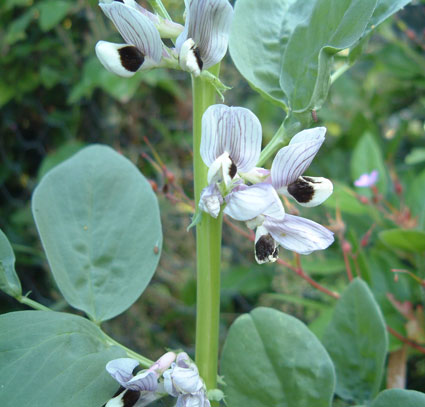
Just as all the other broad beans are being harvested, the late-sown Martock broad beans have come into flower. This is the really antique variety which is reputed to have been around since the 13th century. I'm only growing four plants, and they're all standing very upright and not branching at all. But as is often the case with these very old varieties with a well shuffled genepool, they all have slightly different flowers. They are all white with black blotches and purply-mauve at the base, but there's variability in how much purple they have and whether it's on the whole flower or upper parts only. Two have strong purple veining running through the petals while the other two are just white.

At this point I'd like to state my view that this variability is a very good thing. We've been conditioned into thinking that we want plants to come out consistently identical and to do exactly what it says on the tin. Not surprising really, when uniformity is one of the three traits a vegetable variety is required to have before it can be included on the National List, and the seed companies want you to choose uniform varieties because they tend to be F1 hybrids and they can charge more for those. From an ecological point of view though, the variability between plants is a sign of a healthy genepool with lots of sub-lines being preserved and reshuffled, which is important for long term biodiversity. I also think, personally, that the element of surprise ... not knowing exactly what the plant is going to come up with ... is one of the great joys of gardening.

Flowers on Martock broad bean. This one has lovely purple-black veining in the petals.

Kew Blue is claiming the distinction of being the most gorgeous plant in the bean plot, which is quite an achievement when I'm also growing Trionfo Violetto, which would normally win hands down. It's not as refined as Trionfo ... it has slightly gnarled and asymmetrical leaves which give it a kind of lopsided scruffiness, but its colour is so deep and vibrant it almost glows. It looks shinier, healthier and more vigorous than the other beans. The leaves are the richest green and the stems are a velvety purple. The stems are chunky. The leaf stalks fade gracefully from purple to green but some of the smaller petioles are almost black. It's a very striking looking plant. And it hasn't even flowered yet. I still have that pleasure to come.

Not to be outdone by a better looking rival, Trionfo Violetto produced the first pod of the season. I found it lurking in the undergrowth at the bottom of the plants. Yup, there's just the one.

Not really enough for a meal, but it's the thought that counts.

Of course it's possible that the superiority of the Kew Blue is down to the soil it's growing in ... I think it may have had more manure dug into it than the other bean plots, and manure is the thing that makes the biggest difference to plant performance, in my experience. I'll only find out for sure by growing it for a few more seasons. But for a variety that got off to an unimpressively sluggish start it's now looking very dapper.

Mrs Fortune's, it has to be said, is not a looker, poor dear. The leaves are very tidy and symmetrical, but they sag at night and have a rather anaemic pale green colour. The first flower buds are now forming and they're a boring green with a half-arsed splosh of mauve. Not one for the ornamental borders. But no doubt it has other qualities, and it's certainly growing well. No bother at all from pests.

Ha, things change very fast in the garden. In the time it's taken me to write up this blog post, a couple of the flowers have opened and they do have a nice dark pink colour on the inside.

It seems that the summer solstice is the cue for all the beans to flower, because my runner beans have also started to produce buds. There's a lot of red-colouring in the heritage variety Black Magic, including the leaf veins, which look lovely against the light.

Runner bean Black Magic from the Heritage Seed Library

Incidentally my neighbour had a crop failure with his runners (the damp weather in late May seems to have rotted the seeds) so he bought some plants that were on offer down at B&Q, and they're a variety called White Emergo which has white flowers and seeds. What will happen if that cross-pollinates with my Black Magic is anybody's guess. Skewbald beans!

Thursday, 18 May 2006

French beans, runner beans and things that grow up poles

My neighbour offered me some runner bean seeds yesterday and I declined them because I've just had some new ones from the Heritage Seed Library. He didn't get it at all. Why did I need new ones? Hadn't I saved any from last year? Why spend money when you don't have to? He sows the same ones every year which he got from an old geezer across the road, and saves the seed, and that's very commendable indeed. And they are impressive, I'll give him that. He always grows them in the same place, an enormous impenetrable wall of them which screens off the lower garden and yields more than he could eat in a lifetime. I grew some of them myself that he gave me a couple of years back, and they were nice. But I like trying different things too.

My different thing for this year is Black Magic, a black-seeded runner bean (still green podded though) which was commercially available in the 60s and early 70s. It's now only available from seed-saving organisations like the Heritage Seed Library, and I'll have to preserve it myself if I want to carry on growing it. That means I have to plant it as far away as possible from next door's Wall of Beans to avoid it cross-pollinating. Ideally the isolation distance should be about half a mile, and if I could put half a mile between myself and my neighbour I'd be only too happy, but as it is I'm having to make do with an obliging hedge. The thick jasmine hedge was already established along that side of the garden when I moved here and I've allowed it to grow taller to stop my neighbour looking at my undies on the washing line, and with a bit of luck it will act as a pollination barrier too.

Runner beans are quite decorative in their way – they were originally introduced to the UK as an ornamental plant before anybody thought of eating the pods. But I only grow small numbers of them, because they're quite prolific enough to supply as many as I want (I'm not a huge fan).

I'm much more enamoured with climbing French beans (Phaseolus vulgaris), also called pole beans, which are now making a comeback in the catalogues after almost disappearing in favour of dwarf French beans. They are much more tender and succulent than runner beans, and more versatile. You can harvest the pods whole as 'green beans' or allow them to mature for the dried beans ... or a bit of both. I have two Italian varieties from Franchi Seeds which I've grown for several years, having sourced them on the internet in the days when you couldn't really buy them in garden centres. Trionfo Violetto is gorgeous ... it has purple-tinged stems which darken to purple-black around flower buds, violet-purple flowers and dark purple pencil-shaped pods which are very yummy and probably full of nice anthocyanins. The beans themselves are kidney shaped and dry to a pale chestnut colour with slight mottling. It's extremely decorative throughout its lifespan. At my previous house I grew it up an arch and down the other side (it was very easy to pick because the pods hung down under the arch) and it got admiring comments from everybody who saw it. The pods turn dark green when cooked, but they still taste good. The other variety has pale yellow pods ... wider, flatter and with wavy edges, and is catchily named Meraviglia di Venezia. It has bigger leaves and very pretty flesh pink flowers which turn mauve. The dried beans are small, rounded and dusky black.

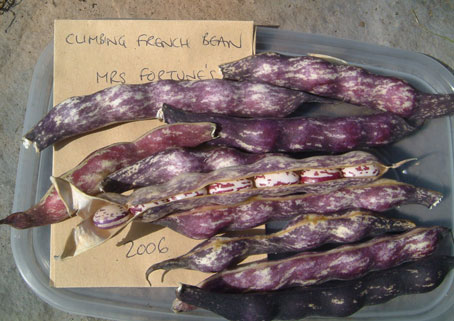
Climbing bean Mrs Fortune's

This year I'm supplementing the collection with a couple of varieties from the Heritage Seed Library. Mrs Fortune's is named after a lady called Doris Fortune, so I couldn't pass that one by. It might bring Revolving Doris some good luck. And look at the beans ... aren't they lovely? Speckled and ring-marked. The patterns almost look bitmapped.

They're rampant growers too and tough as old boots. They germinated incredibly quickly and turned into very sturdy plants which seem mostly unperturbed by the buffeting spring winds.

I'm also trying out Kew Blue, which I know almost nothing about. Not even sure which bits of it are blue. I'm finding it a little slow to germinate, but it's getting there.