Showing posts with label Organic methods. Show all posts

Sunday, 29 June 2008

Contaminated manure alert

Potato haulms showing typical symptoms of aminopyralid poisoning. Growth is stunted and the edges of the leaves curl upwards in a strange spoon-like pattern. Photo © Green Lane Allotments.

If you're not yet acquainted with the news that gardens and allotments across Britain are being contaminated with a toxic herbicide residue, you can read the full story in today's Observer. There's also a very detailed article (with more pictures of contaminated plants) from some of the growers affected at Green Lane Allotments, who kindly provided the photo.

The gist of it is this. Gardeners have been finding their plants growing a distorted mess of curled up leaves with an almost fernlike appearance. The leaves curl upward tightly in a spoon shape, and the plants are stunted and don't grow properly. The curled leaves get worse near the top of the plant. It's known to affect tomatoes, potatoes, peas, beans, carrots and salad vegetables, but possibly not courgettes. Fruits and tubers either don't form at all or are distorted and sometimes rotten. The symptoms are those of hormone weedkiller poisoning, and it's showing up in organic gardens.

The poisoning has been traced to manure, which most of us use abundantly on our gardens. Specifically to manure evacuated from the backsides of animals fed on hay or silage made from grass which had been sprayed with aminopyralid, a hormone herbicide made by Dow AgroScience.

Thus the buck stops with Dow AgroScience, but I think we can expect them to squirm every which way to avoid being held accountable. They'll most certainly try to blame it on the farmers. There is a reason it's called AggroScience.

Aminopyralid is used on grassland to kill off meadow weeds. It's a new product, introduced in the UK in 2006 and is not licensed for use on food crops. Treated grass is fed to livestock, and the toxin stays in the grass matter as it passes through the animals' system and lingers in the manure even after lengthy periods of stacking. Then the following season gardeners spread it on their plots. As the manure breaks down in the soil the aminopyralid is released and poisons the crops. Nobody (not even Dow) knows whether the poisoned crops are safe to eat or not, because the stuff has never been tested on food crops.

I certainly add my voice to those calling for an immediate withdrawal of aminopyralid products and for some chain of accountability.

If you think you've got aminopyralid poisoning in your garden, I suggest you get in touch with one of the campaign groups like the one at Green Lane Allotments or refer to their blogs for the latest advice on how to deal with it. The RHS also has an information page about it. There may be some chance of making Dow face up to their responsibilities if confronted with enough evidence from enough people.

If you don't yet have a problem, I suggest being extremely careful about sourcing manure, including bagged compost products that may contain it ... or avoid manure altogether for the moment. If you buy hay to feed to animals whose manure you then spread on the garden, be very cautious even if your hay comes from a trusted supplier. The problem has been reported across the whole of the British Isles but I'm not sure what the situation is in other countries. It's also important not to panic if you see poor growth or distorted leaves in your vegetable plants ... the symptoms of aminopyralid poisoning are very specific. If your plants don't look like the photo above, you haven't got it.

Friday, 9 March 2007

Peas: another whopping great post

Alderman, an old-fashioned tall pea, after summer rain

When I got my own garden for the first time nine years ago and started growing vegetables, I learned everything from The Vegetable Expert by Dr D.G. Hessayon. Published and endlessly reprinted in the 1980s, it's got to be the most ubiquitous veg-gardening book in the UK. I read it over and over again, so carefully that even now I can remember bits of it by heart. I used to follow its advice absolutely to the letter, sometimes successfully, sometimes not. It's still one of my most-used garden books and it's brilliant as a quick reference, but now, after a few years' experience, I more often than not find myself flinging my hands up in horror as I read it. It blithely recommends using all kinds of environmentally reprehensible products like peat and Chlorophos, and routinely sprinkling your soil with poisons to kill off pests before they even think about approaching your plants. I wouldn't dream of doing any of those things now. Many of the products recommended in the book have since been banned.

It's good to do things differently from what the books say sometimes, and flout the instructions on the seed packets. They're only given as general guides anyway, and it's only by experimentation that you find out what works or doesn't work in your garden. Don't be afraid to try things out just because the books tell you not to, or that it's better to do it some other way.

Over the years I've learned a few things about peas that differ from the received wisdom. I'm not an expert on pea growing. Far from it. I'm learning all the time. And I'm also still experimenting, because the more time I spend with peas the more I find much of the common knowledge about them is at best outdated and at worst misleading. For some reason, peas in particular seem rife with misunderstanding and non-information.

I think part of the problem is that once an idea is published it tends to get repeated and copied and passed around and nobody thinks to question it.

I remember seeing a tip about peas on that greatest of British institutions, BBC Gardener's World. Plant sweet peas in amongst your vegetable peas, a head gardener suggested, because the bees will be attracted to the scent and will pollinate your crop better. So I tried it, and it looked very lovely, but as soon as I'd planted it I thought - hang on ... unless I'm missing something, that's a complete misunderstanding of what peas do. You don't need to try to attract bees to them. Their flowers are sealed and enclosed. The male bits grow alongside the female bit inside a closed bag and dump their pollen all over it before the flowerbud has even opened. Super-efficient. No bees involved.

Growing sweet peas among your garden peas looks gorgeous but it won't make a sod of difference to pod set.

And another thing. These days I very rarely sow peas directly into the ground. For years I did, because that's what it says in the book and on most seed packets. But I invariably ended up wasting most of the seed as only a handful managed to survive long enough to grow into slug-ravaged stumps. Peas are hugely vulnerable to rotting in cold damp soil, and too much rain during the week after sowing can wreck a crop. Even if you're able to avoid that, the seeds are often gobbled up by mice or birds. And if they survive long enough to poke their heads above ground, the slugs and snails get 'em. In my garden, direct-sowing just doesn't work.

Baby peas in Rootrainers

So I generally start them off in modules indoors. It's more work than sowing direct, I admit, but the success rate for germination is many times higher. Like most leguminous crops they produce long roots which need space to develop freely, so it's best to sow them in deep open-ended pots. You can buy purpose-made "Rootrainers", which are deep modules with ridged sides designed to 'train' the roots straight downward. They're hinged at the base so that you can open them easily at transplant time with minimal root disturbance. They always seem to take ages to fill though and swallow up stupendous amounts of compost. They do work pretty well and are re-useable but I'm not absolutely convinced they justify their rather opportunistic-looking purchase price (around ten quid in the UK for what is essentially a pack of plastic flower pots).

Cheaper and in many ways just as good are the cardboard centres from toilet rolls. Lightly fill them with compost and stand them upright on a tray. They have the additional advantage that they're porous and retain moisture, which helps to keep the compost evenly moist between waterings, and as they're biodegradable they can be planted out just as they are without disturbing the roots at all. You can buy purpose-made biodegradable grow-tubes if you prefer, which work the same way and look less toilet-roll-like. Sow two or three peas in each tube. The key thing is to add water to the tray underneath and let them suck it up from below rather than watering from the top. That way they develop nice deep roots as they search for water and the compost around the seed itself stays relatively dry. The roots will quickly grow out of the bottom of the tube so it's important to keep them moist when they do.

Baby peas in bog rolls. This is a heritage variety, Ne Plus Ultra. And no I didn't choose that wallpaper.

"B-b-but..." I hear you say with a quivering lip, "what if I'm starting a large crop of peas and don't have the space or the time to sow them all in modules?" A good compromise is to pre-sprout the peas indoors before sowing them direct in the garden. Spread all the seeds out evenly between sheets of kitchen roll (I think that translates as paper towels in the US) and keep it well-plumped up with water but not so as it's floating. In a couple of days most of them will have developed small white shoots. You can then take them outdoors and sow them as normal. You will probably still get some losses but not as many as you would if you sowed unsprouted seed, and at least you won't have to wait three weeks for them to germinate in the cold ground.

There's a common misunderstanding that peas are frost tender. It does vary with different varieties and climates, with round-seeded varieties being hardier than wrinkle-seeded, but on the whole most peas cope well with spring freezes. The usual advice to delay sowing until the soil warms up in March is based on the assumption that you're sowing them directly (unsprouted) in the ground, because peas germinate so slowly and erratically in cold wet soil. So you can actually start them earlier than the packets suggest if you pre-sprout or sow in modules. With luck you can even plant them out before the slug and snail season has got underway, so the plants can establish themselves and the apical tip can grow beyond the snails' reach without being molested.

The most crucial thing if you want to get a decent crop is to encourage the plants to develop really good roots, as deep as possible, as quickly as possible. Which is why Rootrainers and bog-roll tubes are worth the extra hassle and compost. Adding some bone meal at planting time will benefit the roots, but any other kind of fertiliser may be counter-productive. What they do like though is a nice bit of organic matter dug into the soil. I use either leafmould or a spent mushroom compost made from horse manure. Another thing which I found made a huge difference was to apply a layer of the horse manure compost as a mulch around the pea plants once they've got established. Multi-benefits: it breaks down gradually and enriches the soil, it retains much-needed moisture around the roots and it stops a few weeks worth of weed growth, which is much appreciated later on when the plants are so big and tangly you can't weed around them anymore.

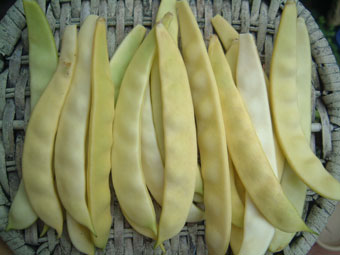
This is thought to be one of the pea varieties used by Mendel in his discovery of genetic laws in the 1860s, a yellow-podded beauty called Golden Sweet. The seeds come in many different shades and are speckled with purple.

And now for another nugget of pea wisdom I learned the hard way. My first vegetable plot was in the garden of a newly built house. The site had previously been a television factory, and before that it was a pig farm. It had never been a garden before. My first crop of peas failed dismally, and the second wasn't great either. I had no idea why.

It's fairly well known that peas and other legumes are able to accumulate and fix nitrogen through nodules on their roots. The usual advice is to leave the roots in the soil after harvesting, so that the root nodules biodegrade and release nitrogen to feed the next crop. What I didn't know, and only discovered in a post on Bifurcated Carrots last year, is that it doesn't just happen on its own. In order to perform this miraculous function peas need access to a specific soil bacterium called rhizobium, and although it builds up in the soil over time if you grow leguminous crops, it's not naturally present in useful amounts in 'virgin' soil. And without it, yields can be very low.

The relationship between pea plants and rhizobia is symbiotic. The bacteria can survive in the soil quite happily but can't start fixing nitrogen until they find a legume as a host. They 'infect' the plant by entering through the root hairs, and the plant responds by developing swollen nodules on the roots. The bacteria multiply rapidly within those nodules then set about transforming nitrogen from the atmosphere into a plant-usable form, effectively feeding the pea plant from within its own root system. In return for this free fertiliser the pea plant supplies the rhizobia with the oxygen they need, in the form of haemoglobin (which is why the nodules are sometimes red inside when you cut them open). If you want a nice clear explanation of the science involved, try here.

Because of their unusual nitrogen-fixing properties, peas don't need to be fed with conventional fertilisers or anything else high in nitrogen. As well as being harmful to the environment in excessive amounts, it encourages plants to produce masses of leafy growth which will attract pests, and fewer pods. The air is about 79% nitrogen so there's plenty of it about, but plants can't use it in this form. The beauty of rhizobia is that they convert that inaccessible nitrogen into a usable form, enabling peas to grow healthily without depleting the soil and without the need to add synthetic nitrogen compounds. In fact, growing them actively benefits the soil if their roots are left in the ground to biodegrade as a natural slow-release fertiliser for the next crop.

If peas have never been grown in the plot before, you need to use an inoculant to get them working their nitrogen magic. That means buying the appropriate strain of rhizobium (there are different ones for different legumes) and applying it at planting time, usually by mixing it into a paste and dipping the seeds in it before sowing. According to the University of Minnesota, who have a research programme on rhizobia and legumes, the use of an inoculant will often increase yields by around 30%.

I felt a bit of a chump for not knowing anything about this before. But when I started researching it I found a black hole of non-information, at least in the UK. It's a different story in the US ... you can buy rhizobium inoculants very cheaply from garden stores. Over here though they are non-existent. There appears to be only one inoculant product in the UK, with the brand name "Natures Nitrogen". However, in all my googling I've not been able to find a single supplier, nor any indication of its price. Clearly nobody in the UK inoculates their peas! There's no information about it in any of my gardening books either. It's a total blank.

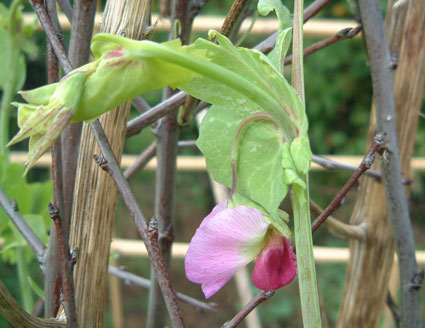
Pink flowers and purple pods: Mr Bethell's Purple Podded

I'm perplexed by this situation, because it has significant environmental implications. For the last 60 years or so farmers here have been throwing artificial nitrogen products all over the land, causing algae blooms in ponds and streams which suffocate fish, harm other wildlife, and contaminate our drinking water. Growing leguminous crops with the help of rhizobia has the opposite effect; it utilises nitrogen from the air rather than the soil and contains it in a form that will not contaminate the soil or the groundwater. It also reduces the need for fertilising the subsequent crop, which has economic as well as environmental benefits. Unlike conventional nitrogen products, it's benign and sustainable.

Maybe once again it's a case of everybody doing it the way everybody else does it and not questioning whether or not there's a better way.

But anyway, as far as me and my tiny patch of land are concerned, I can't try rhizobium inoculation because I can't get it. So here's what I'm doing instead. I'm digging out some of the old root systems from last year's pea crops, mashing them up with a little soil and distributing them around other parts of the garden, specifically the areas where I haven't grown peas before, and digging them in with a sprinkle of seaweed meal. One of the things seaweed meal does is stimulate microbial activity in the soil, which I'm hoping will help the rhizobia to thrive as the nodules break down. I must emphasise though that this is just an experiment ... I have no idea whether or how well it will work.

Blimey, I didn't intend to write this much, but those are my tips for growing peas, anyway.

I would love to hear from you all about whether your pea flowers are visited by bees. I don't think I've ever seen them taking an interest in mine, but I'd be curious to know whether there are occasions when they do. Sometimes when bees are desperate they bite their way into flowers they can't normally get into, but that may or may not include peas. If you've ever had accidental cross-pollination with peas, I'd be interested to hear about that too.

Postscript: I've just found a UK supplier for "Natures Nitrogen". One of the seed companies in my recommended list, Seeds of Italy, are offering it at £1.25 a pop.

To summarise:
Peas are reasonably hardy. Germinate them indoors, harden off and plant out.
Sow them in deep modules and water them from the bottom.
Manure or compost dug in before planting will keep them happy all season.
Mulch the plants to conserve moisture and smother weeds.
Peas ideally need rhizobium bacteria, which are not always present.
Peas do not need nitrogen fertiliser.
Peas do not need bees or other pollinators.

Tuesday, 19 September 2006

Today in the garden ... doom and gloom looms

Still Life With Bifurcated Carrot

There comes a point in the year when you realise you're starting to push against the tide instead of riding along with it. Trying to keep the plants chivvied along while nature is trying to make them keel over. The mini heatwave in early September has extended the ripening season for things like tomatoes but it's also given the pests and pestilence a good boost. Everything seems to be under attack at the moment, when until now it had been an almost trouble-free year. Any parts of the pea plants which aren't covered with mildew are being infested with greenfly ... not just on the leaves, but getting inside the flowers and distorting the pods. My sweet peas are completely encrusted, absolutely seething with greenfly. It's really quite revolting, and although I've dosed them with biodegradeable washing-up liquid there are really too many to tackle, and hardly a ladybird or hoverfly in sight (I suspect their populations have suffered badly in the drought). I had to harvest my carrot crop, pathetic as it was, because the tops were afflicted with a spectacular eruption of small caterpillars. I don't even know what they are ... they look like small sawfly larvae. Another community of caterpillars has moved in on one of my leek crops and eaten the hearts out of about two thirds of the plants. Bastards.

The milk and water treatment I tried on the mildew has worked, but it only slows down the spread of the infection and doesn't get rid of it. (The same would be true of a chemical spray, it's just the tenacious nature of mildew in our climate.) Some of the Alderman leaves are now more white than green and the plants are wilting slightly as their mildewed stems struggle to take water up to the tops (which are currently 6ft high). Each day I cut out more blighted trusses from the tomato plants, again merely delaying the inevitable and slowing down its spread. As a last resort I tried using a copper fungicide (Bordeaux mixture), but all the tomato plants now have blotches of blight and it's spreading on a daily basis so there doesn't seem much point using something as toxic as copper just to prolong the life of the plants by a few days.

There's hardly a single crop that isn't being assaulted one way or another.

Some of these Clementine tomatoes had to be harvested early as the blight spreads

The climbing beans are mostly free of pests and diseases but they were damaged by some strong winds a couple of weeks ago and haven't really recovered. I have noticed with French beans that wind damages them far more than cold does. Mrs Fortune's is surviving the best; it's sagged a bit and some leaves are going yellow but it's otherwise looking robust and has just produced a new flush of flowers. Kew Blue is looking bedraggled and the leaves are going through odd colour changes (bright pinks and blues showing up as the chlorophyll breaks down) but it's still producing healthy new leaves and pods. Some of the older pods are now being attacked by blackfly. By far the worst affected by the weather is Meraviglia di Venezia, whose leaves wilt and shrivel even in fairly moderate winds. And being such a big plant, sprawling right over an 8ft arch, it looks a complete and utter disaster area with bits of shredded and shrivelled leaf hanging off a great tangle of sagging vines. But its yields are not much affected ... it's producing pods faster than we can eat them. Small succulent knobbly pods the colour of banana milkshake.

Thursday, 29 June 2006

A mega-post about peas

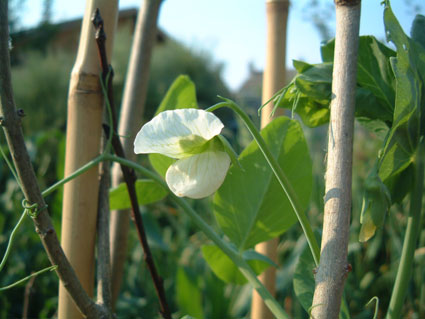
Large flowers are a feature of the Alderman pea

I was expecting Alderman to be tall, but I no longer have anything long enough to measure it with. It's exceeded all expectations, including those stated on the seed packet. It reached about 8ft before starting to droop a tiny bit at the top, which is quite impressive because its support cage is only just over 4ft high. The top halves of the plants are standing up on their own.

"What the heck did you put on them?" I hear you ask.

Uh, some of this.


And lots of this.


And a few grass cuttings as a mulch.

Alderman is wonderful. I've grown peas many times before and I've never had anything like this. All my previous crops have been standard varieties. Growing tall Victorian types for the first time I've found them to be superior on just about every level. Although they're meant to be shelling peas they are just as good if you pick them when they're still flat and eat them as mangetout (they remain stringless until quite a late stage) so they are effectively a dual-purpose pea. The pods grow at a height that makes them easy to pick (well away from the soil and the slugs) and they keep cropping prolifically for several weeks, producing an average of nine very large peas per pod. The flavour is absolutely bloody out of this world. Even the mature pods taste good eaten raw, straight off the plant, if you peel off the fibrous layer on the inside. The plants are fast-growing and untroubled by pests, so they're particularly well suited to organic culture.


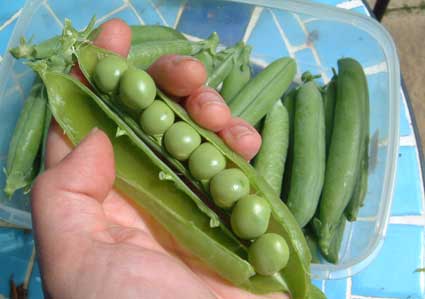
As I mentioned in a previous post, the variety was introduced by Laxton's in 1891 and was developed from another old variety called Duke of Albany (now rescued from apparent extinction by the HDRA). One observation I've made ... some sources of information suggest that Alderman bears its pods in pairs. Mine have all been produced singly. Not that I'm complaining, because the yields are very generous. The photo above shows one day's harvest (35-40 pods) from my plants, which occupy an area of land only 2ft by 5ft. As you can see, the mature peas are so huge they're trying to squish each other out of the pod. And even when they reach this size they remain exquisitely sweet. If you pick them younger they taste unbelievable.

Another reason to grow tall peas. You can see the developing peas inside the pods when the sun shines through them. No more harvesting big fat succulent pods only to find that the peas inside are the size of pimples.


Alderman is one of the most readily available of the heritage peas. That doesn't mean you'll find it in the average garden centre, unfortunately, but you can certainly get it from The Organic Gardening Catalogue.

The other two varieties of pea I'm growing this year are harder to find. I got my seeds from the magnificent and ever-bountiful Heritage Seed Library.

I think it's fairly safe to say that Mr Bethell's Purple Podded is one of the less well known pea varieties. A Google search yielded only three hits, two of which were for this blog. So there you go. I have the distinction of being the world's greatest contributor of web information on this variety. And so I proudly present this photo showing the exotic colouring in the leaves, stems and flowers.


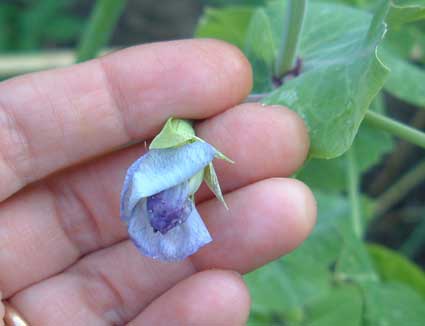
The leaves are a pale and rather flat olive green, quite different from other peas I've grown. The purple-maroon colouring is strongest in the leaf axils and in some of the stems and tendrils. Some of the leaves are also flushed or streaked with maroon. Flowers are pink with a darker cerise petal below. They start off very pale pink and darken as they mature, eventually turning blue when they've gone over.

The flowers go through constant colour changes, finally turning blue

Almost nothing seems to be known about it. The HSL catalogue just says it originates from the north of England. Presumably it was named after the person who donated it to the Heritage Seed Library, or the last person who was known to grow it. It's one of several purple peas offered by the HSL but as I've never grown them before I'm not sure how they compare.

Beautiful and colourful though it is, I'm slightly nervous because purple-podded peas have a reputation for being inedible unless you snaffle them up as mangetout. We'll see.

Champion of England (below), originally introduced in 1843 as Fairbeard's Champion of England was much prized throughout the 19th century for its superior vigour and flavour, and became very popular in Canada and the US too. It was bred by William Fairbeard, a nurseryman in Teynham, Kent, who was a highly respected pea specialist of his day. Indeed Charles Darwin wrote to him in 1855 asking for information about cross-pollination and inherited traits in pea varieties, as part of his research for Natural Selection. Darwin had obviously spotted that most plants decline in vigour if they're inbred for too many generations but that peas are one of the few plants that don't suffer from this phenomenon. Even today it's not completely understood, but it's known to be a genetic function, the opposite of hybrid vigour, and is called inbreeding depression. Peas don't succumb to inbreeding depression because they're natural inbreeders, designed to self-pollinate. Their flowers are fully enclosed and pollen is shed directly onto the stigma before the buds have even opened. So even when two varieties are grown together they are unlikely to mingle. Fairbeard told Darwin that accidental cross-pollination between pea varieties was so rare that he didn't take any special precautions to stop it, which confirmed what Darwin had noticed in his own garden. Several decades later peas played a crucial part in the discovery of genetics.


Fairbeard introduced several other acclaimed pea varieties which have slipped into obscurity or extinction. It's taken me two years even to find a source of Champion of England seeds and there's limited information available online. So I'll be sure to post plenty of information and pictures of mine as it matures. At the moment it's just beginning to develop its first flower buds.

Now that all three pea varieties are at the flowering stage I'm going to experiment with some hybridisation. The fact that peas don't naturally hybridise makes it all the more fun (and easier to keep control of). Wouldn't it be nice to cross Alderman with the Purple Podded to see what happens? Pink-flowered Alderman? Purple pods with bigger sweeter peas? To do this I'll have to hand pollinate a few buds. Watch this space.

Friday, 19 May 2006

Get your filthy osculum off my lettuce

Where have all the frogs gone? Normally they come and hop about all over the patio whenever it rains, but I haven't seen a single one this year. A month or two ago I could hear them all croaking away in next door's pond every night. Now there's no sign of them.

Not only is that bad news for frogs, it's resulted in a mega slug epidemic. For the last two years I've barely had a single slug in my veg patch ... thanks to Frogville, a pile of damp stones and logs next to the veg. As soon as the slugs appeared the frogs would nip out and scoff the lot. But this year they're out of control. I put ten fine sturdy sweetcorn plants outside to harden off and the next day there were four and a half left. Nine out of twelve lettuces vanished without trace in a couple of hours, with only a tell-tale smear of silvery slime. They are vile and destructive little sods.

Also causing trouble at the moment are the dreaded sawfly caterpillars on the gooseberry bushes. Horrible little green wrigglers which are well camouflaged and hang out on the undersides of leaves where you can't see them. Left to their own devices they will skeletonise a plant in just a few days. And as I don't use sprays I haven't much choice but to pick the little blighters off by hand. Ugh.

Same goes for lily beetles, which are already turning my lilies into lace doilies. Luckily they're a shiny chestnut red colour which makes them quite easy to spot. And on warm days they go up to the top of the plants to shag in the sunshine, filthy little exhibitionists that they are. So at least you can pick them off two at a time.

Not all the wildlife is pissing me off though, there's nice stuff too. Blackbirds are nesting in the rose bush on the patio, and goldfinches at the bottom of the garden. I have a sociable robin who sits and watches me working in the garden and we often sing to each other. It freaks him out a bit actually, but he still keeps coming back.

The other day a red mason bee came along and landed on my arm, and stayed there for about ten minutes.

And then there's the slow worms. I'd never seen one before I moved here, but they are regulars in this garden (probably because it's such a mess and they've got plenty of things to hide under). They look like snakes, but have cuter faces. They're actually not snakes at all and are from a different family of legless reptiles.

Heh. Legless reptiles. I've been courted by a few of those in my time.

Found this chap on the patio the other day. Yeah it's not a great shot, but it was the only one I could get of his face.