Showing posts with label Garden wildlife. Show all posts

Tuesday, 15 April 2008

Garden gallery ... mid April


I don't have much time for blogging at the moment, so here's a load of pictures which I'm never going to get round to writing about properly. Rather than have them languish in the bowels of my hard drive I may as well just post 'em.


Apple buds, Ashmead's Kernal, a local heritage variety originating in Gloucester c.1700.

An unusual variegated rosemary called Silver Spiers which I've had for years (salvaged from my previous garden when I moved here). The leaves are a sage green with cream edges and although it has a slightly less vigorous growth habit than most rosemaries it tastes just as good.


Tuesday, 8 January 2008

Today in the garden ... fungus rules

There's something very magical about the way mushrooms just emerge from fragile skeletons of wood.

There's not much interesting stuff growing in the garden at the moment, though the snowdrops are preparing themselves for action and I'm still bringing in some Jerusalem artichokes to mix in with the roast potatoes on a Sunday.

The garden looks a diabolical mess at this time of year, and I freely admit that's partly because I can't be bothered to go out there and clear it up. But I've never been the kind of gardener who strives for all-year-round colour and interest, I've more of an instinct for letting everything have its time and season. Winter is the time when everything dissolves into a squelchy quagmire with mouldering twigs and brown saggy stuff all over it.

Guests who come round at this time of year say "I can't wait to see your garden!" and then take one look though the window and go "aaaaargh!"

But however unsightly it looks to the human eye, nature makes good use of it. Birds are supplied with a diet of seeds, insects have hollow stalks to nest in, and the worms are active converting last year's spent leaves into instant fertiliser.

And in a pile of soggy twigs down the bottom of the garden, we have fungus activity. Lots of it. I don't know what any of them are called.


Something else that grows nicely in winter is garlic. Usually at this time of year I find one or two dense tufts of garlic tops emerging where I forgot to harvest some of last year's bulbs. I dig them up and replant them, but very often I get a lot of cloves which are too small to be worth planting.

Here's what to do with them. Carefully wash all the soil off them (the clove skins will probably come off as well, and that's fine) and dunk them roots an' all into a mug of water on the kitchen windowsill. They'll keep for at least a week like that if you keep the roots submerged and change the water every day. Use them as fresh garlic greens in any dish that wants garlic. All you need to do is chop off the roots ... you can use all of the rest of it, green (and pink) bits included. They taste wonderful.

Garlic greens from some unharvested Music bulbs

Wednesday, 30 May 2007

Today in the garden ... potatoes and poppies

Here's the first of the oriental poppies (Papaver orientale) and this one didn't flower last year so I'm all the more grateful for it. It only produced this one bloom which opened just as the weather changed and it got pelted with fierce winds, rain and hailstones, but it survived. It's a variety called Patty's Plum.

I must thank Vicki of I Need Orange for linking me to some info about the blue speckled slow worm I recently posted a photo of. (She has some pretty amazing wildlife photos on her own blog, by the way.) Apparently they sometimes develop the blue colour when they're three years old or more, especially in coastal areas (I'm in the midlands, but never mind). I didn't know slow worms lived for multiple years, but that one was quite a whopper, admittedly. It's now living under a black polythene sheet in the middle of the veg patch and somewhat thwarting my tomato planting as I dare not move the sheet. As they're a protected species and they do a sterling job in munching slugs and snails off the vegetable patch, priority goes to the legless reptiles. (And we all know a few of them, right girls?)

And another beautiful item of wildlife, courtesy of next door's pond, is the damselfly. Available in two colours, bright azure and bright red. Here's one of the red ones, perching on a leaf on one of my heritage peas. They are smaller than dragonflies but just as welcome in the garden and also more likely to hang around long enough to be photographed.


I got an electric shock off a beetroot today. I'm not sure who was more surprised, me or the beetroot. In fairness I had just been stroking one of the cats so that must have built up a static charge which zapped when I touched the leaf. I've had a lifelong problem with static electricity ... when I was a kid I had to have other people open car doors for me because if I touched any part of the car (plastic, metal or glass, inside or out) I would get a really nasty electric shock. Thankfully it's nowhere near that bad these days but I'm still more prone to static shocks than most people and I've never found out why.

Talking of beetroot, I've read in several gardening books that you must never, ever allow leaf beet to run to seed at the same time as beetroot because they will cross with each other and both be ruined. Well I can't resist a challenge like that, so I've got three of last year's Cheltenham Green Top heritage beetroots sprouting nice big flower spikes among the similarly robust flower spikes of last year's Bright Lights chard (two pinks and a scarlet). Chard and beetroot are both the same species, Beta vulgaris, which is a rampant outbreeder so they cross like the clappers. They do however have minor varietal differences, with chard (var. cicla) producing nice succulent stalks and leaves, and beetroot (var. conditiva) being optimised for plump edible roots. If you cross them you will probably end up with the worst of both worlds ... inferior roots and small leaves, at least for the first generation or two. But with a little patience and careful selection they should start to separate out in lots of different ways. And that could *possibly* result in beetroot infused with some of the beautiful intense pinks and reds of leaf beet. Modern beetroot breeding has focused on other factors of commercial importance to farmers, such as "monogerm" varieties (seed clusters which only contain one seed instead of the usual 2-5, eliminating the need for thinning). I don't know of anyone who's trying to produce new beetroot with beautiful leaf and stem colours. So that seems like a good reason to try it. And as always, the beauty of amateur plant breeding is that even if it's a total cockup, you can still eat it.

Everything you ever wanted to know about beetroot can be found in this wonderful eBook, made freely available to all by the generosity of its author Stephen Nottingham.

May I also draw your attention to the much underrated flowers of the common spud? Well, this is not one of the really common ones but it's enjoying a renaissance in the UK ... Salad Blue, which is not a salad potato at all, being very dry and floury, but it certainly is completely blue. I don't rate it that highly for flavour but it produces very interesting blue mashed potato which has health benefits over ordinary white-fleshed potatoes. And as you can see, it has very pretty flowers sporting blue-violet petals and unusually dark anthers. It's the first of my potatoes to flower this year, and no doubt I'll be posting more pictures of spud blossoms over the coming weeks as some of them are very beautiful.

The dusky blue flowers of Salad Blue potatoes.

Friday, 25 May 2007

A brief pea-free interlude


Here's a picture of a red-flowered broad bean (fava), another heritage vegetable treasure which I've already reviewed. I'm growing them in the patio border this year because they have a beautiful scent (one of the rarely mentioned blessings of broad beans) as well as that gorgeous colour. They look breathtaking when the sun shines through them because they have a very subtle translucence, but that's one of those things that cannot be photographed because the intensity of light and colour is beyond the scope of digital media. So you'll have to make do with this non-sunlit picture and use your imagination. Or grow some yourself.


Another translucent red heritage vegetable I'm growing this year is this beetroot, a very old French variety called Rouge Crapaudine. It's a fairly rare one only available by mail order, which is probably just as well because you wouldn't want to have to go in to a garden centre and ask for it by name. Thomas Etty Esquire is one of the few suppliers who stock it. It's a bit different from yer average modern beet. The root is very long and thin, more like a carrot, and it has a black skin with a cracked and fissured surface. This one has a way to go before harvest time though.

The garden here is a paradise for slow-worms and I see them a lot (ssh, don't tell my mum, she's terrified of them and won't go out in the garden unless I tell her there aren't any) but I've never seen one like this before ... it has bright blue flecks all the way along its body. At first I wondered whether it had gone through next door's garden while he was respraying his motorbike, but nope, it really is that colour. It's the same bright azure colour you see in damselflies. And appropriately enough, seen here lounging under the Salad Blue potatoes.


Errr ... mum, if you're reading this, it's not a real one, OK? Just a plastic inflatable one I put there for a laugh.

Two of my young apple trees couldn't be arsed to flower this year, but the third was an absolute corker. I was worried it would be unable to set fruit in the absence of a pollination partner (one day I'll explain why most apples are not capable of fertilising themselves, which has to do with them having one too many chromosomes) but luckily the neighbour four doors down has an apple tree which flowered at the same time, and despite the distance and the separating fences my tree got well pollinated. It's now covered in fluffy little apples.


This is a variety called Ashmead's Kernal, which is over 300 years old and currently enjoying a comeback. I love it because of its acid-drop sharp flavour and crispness (I hate sweet mushy supermarket apples, bleurgh) but also because it's a local variety which originated in Gloucester, only 7 miles up the road. Another oft-plugged selling point for Ashmead's Kernal is its beautiful flowers, though actually I find them a bit big and blousy for my tastes and prefer the smaller crisper flowers on my other trees (when they can be bothered).

And finally, here's a picture of an upside-down cat attacking my cardigan.

Saturday, 17 March 2007

Do Ireland a favour ... don't buy peat

Appropriate that it should be St Patrick's Day when I saw the first slow-worm of the season, lounging around underneath a blackcurrant bush

Meanwhile, 'tis the season to start getting through vast amounts of potting compost, so I thought it would be a good time to recommend the things I've found useful.

The big problem with potting composts is that (in the UK at least) they're usually made of peat. I haven't knowingly bought peat since I stood on the summit of Croagh Patrick in the west of Ireland and saw the hideous gouges ripped across huge areas of what was otherwise a breathtakingly magical landscape. It really shocked and upset me. There's no shortage of beautiful scenery in Ireland, but even so, the destruction of vast areas for commercial peat extraction (mainly to feed an English addiction to cheap compost) is a sickening thing to behold. And since then I've tried to find a less environmentally damaging substitute ... with varying degrees of frustration.

Peat bogs are ancient and irreplaceable habitats supporting their own unique range of flora and fauna. They take hundreds of years to develop. Destruction of these ecosystems damages the wider environment too, because peat bogs play an important part in the spongelike absorption of carbon dioxide. Although Ireland suffers the brunt of the damage, peat-rich habitats in the UK and Europe are also being pillaged.

Things are going the right way, very slowly. The late lamented Geoff Hamilton outraged the peat industry more than a decade ago by urging BBC viewers not to buy it, and after his death Alan Titchmarsh took up the gauntlet. Retailers have started to work towards reducing or diluting peat products. But the reality is, despite the good example set by TV gardeners and recent government targets to reduce its use, most of the stuff available to buy in garden centres is either peat or it contains peat. Most people still buy it rather than put up with the hassle of finding substitutes. To make matters worse, many of the peat-free composts which have started to appear in recent years to cater for the environmentally-conscious are totally crap. Some go mouldy. Some are full of weed seeds. Some are so dense, stodgy and heavy they're unusable unless you mix them with something else. And they're often more expensive. No wonder so many people just buy the peat and stuff the environment.

Rainbow chard seedlings growing in pure coir

My compost preference has always been for the John Innes types, but I've been completely frustrated in my attempts to find a peat-free John Innes. It may be that somebody somewhere is making one, but I certainly can't find it at any garden centre in my local area. So these days I mix my own composts.

I started doing it as a last resort, after I bought a large bag of so-called multipurpose peat-free compost which turned out to consist of soggy black half-rotted tree bark which was so completely useless for its stated purpose it probably violated the 1968 Trade Descriptions Act. Rather than write to my MP in disgust or throw it away and buy something else I tried mixing it with horticultural sand and coir to break it up and aerate it a little. I ended up with a lovely compost ... and found the process of mixing it quite rewarding. It certainly wasn't any more trouble than driving down to my local soulless B&Q megastore and trying to hump bloody great bags of the ready-made stuff into the boot of the car. It only takes a couple of minutes and I make it up in small batches and adjust the mix for whatever I'm planting in it.

My basic compost recipe is just coir and sand with a sprinkle of fertiliser. It's a bit lazy but most things grow in it happily enough. For seed composts I often just use pure coir on its own, and that works well too. If I need something more specialised I might add perlite (for aeration), vermiculite (for extra moisture retention as well as aeration), coarse sand (for drainage), dried blood (for boosting leaf growth) or bonemeal (for growing good roots). Home-produced compost and leafmould are also excellent, though I can't produce either in very large quantities.

My basic material is coir bricks which I get from Chase Organics by mail order. They're lightweight and don't take up much space in the shed. They look rather like giant slabs of hash (I should be so lucky) but are actually made from compressed coconut fibre. They cost a couple of quid each and when you dunk them in warm water they mushroom into a great mound of fluffy compost, albeit with a rather odd resinous smell. And even when reconstituted they weigh less than most composts, which saves backache when lifting large pots around. They contain little or no nutrients, so I add that myself as and when it's necessary (for seeds you don't need it ... I just start watering them with a liquid fertiliser once they get established). Coir blocks are not the perfect earth-friendly solution ... they come from Sri Lanka and the Philippines and have to be flown in, but seem to me to be the lesser evil compared to peat. They're a by-product of the coconut industry and would otherwise go to waste.

Pipe dreams: no it's not a slab of finest pressed Moroccan, it's just a coir brick ... light, convenient and renewable

Also available from Chase Organics are these biodegradable coir pots called Green Start sets, a very fine alternative to the popular Jiffy-7 peat-pots. The pots themselves are formed from stringy coconut fibres, and have very good aeration and drainage. Each one comes with a compressed coir disc at the bottom. You just add a little water and within five minutes the tiny discs swell up to fill (and overflow from) the pots with compost. I tried them out last year and they gave me very good results. The open fibrous structure of the pots keeps the compost contained but allows the roots to grow through freely. They have an amazing ability to conserve water within the compost and stay dry on the outside while remaining very open and permeable.

Tomato seedlings growing in Green Start coir pots. Six pots fit snugly into a Tesco's mushroom punnet.

Whether coir is as good as or even better than peat is something that can be endlessly argued over, because it really depends what you're growing and what you expect from a compost. One of the disadvantages of peat is that it's difficult to reconstitute when it dries out and forms an impermeable crust on its surface ... coir doesn't have this problem. On the other hand, if you grow azaleas, coir can't compete with the natural acidity of peat.

Going completely peat free is a tricky matter because many of the plants you buy in the garden centre are still grown in peat. None of my local garden centres seem to stock peat-free container grown plants. One solution of course is to grow everything yourself from seed, and not buy container-grown plants at all, but that's not really the point ... it would be nice to be able to go out and buy a tray of pansies without having a guilt trip over it.

There is one peat-based product which is more or less environmentally sound, Moorland Gold, which is produced from peat and silt deposits built up from natural erosion by the filtration of water off the Yorkshire moors. It's high quality and I've heard a lot of good things about it. Local availability is another matter though.

The magnificent Eden Project has had a peat-free policy since its inception. The National Trust has adopted one. So has Kew Gardens. It's time the garden centres and manufacturers of composts got their act together ... but they won't do it unless consumer pressure forces them to.

Saturday, 19 August 2006

Today in the garden ... Dodgem RIP

California poppy and wild chamomile growing in the potato patch

Well, I did say Dodgem looked like he was nearing the end of his rummaging. I found him under the Tewkesbury Baron apple tree this afternoon, and he seems to have died of natural causes. We buried him in a tumulus under the tree.

There are plenty more animals in the garden though. Including this big woolly one who does plenty of rummaging of her own. This is Chiana, our Norwegian Forest cat. She's very camera shy so I never get to photograph her face.


So far I've only tried Mrs Fortune's climbing bean in the form of green beans, i.e. cooking and eating the whole pods, and they're very succulent but I haven't found the flavour to be outstanding. Today I found that this variety really comes into its own when you leave the pods to swell a bit and then shell them out and cook the beans fresh. Shelling them is a bit laborious because the pods are still very fleshy and succulent at this stage, but it's worth it. I also found it hard to find any cooking instructions, because fresh shelled French beans are something you almost never get in the UK ... I guess it doesn't make an economical commercial crop so you don't find it in the shops. Darned shame too, because if these are anything to go by we're really missing out. Boiling the beans in unsalted water (salt hardens the skins) for 5 or 10 minutes seems to do the trick. Mrs Fortune's beans are greenish white and rounded like a haricot. Texture and flavour are wonderful. When fully mature they develop beautiful maroon splodges on the seed coat, but I think for eating they're best before they reach that stage.

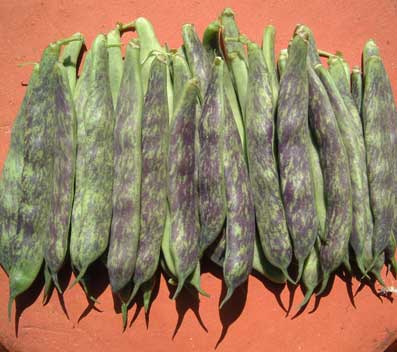
Mrs Fortune's climbing bean has a lovely texture and flavour when cooked without its pods. Notice the variation in the blue streaks on the pods because the blue only develops with exposure to sunlight. The pod at top left is reaching full maturity and is turning maroon and cream. I'm keeping that one for seed.

I also tried some shelled out Kew Blue beans cooked the same way, and they were possibly even more gorgeous ... the beans are slightly kidney shaped and start off white but turn a greyish blue after cooking, and they have a firmer and nuttier texture and flavour than Mrs F. But where Mrs Fortune's really has the advantage is in its mad yields, which far exceed Kew Blue's, so shelling is the obvious thing to do with it since you'd have a heck of a job getting through it all if you ate them as green beans. A preposterously abundant crop.

It's still raining on and off, and I'm starting to fear some of the tomatoes will not get a chance to ripen unless we get an improvement in the weather. It's not the rain that's a problem, it's the grey skies. Tomatoes need a certain level of light in order to photosynthesise; if the sky is overcast for any length of time they just don't grow. I had to move a couple of my American tomatoes because the bed I'd planted them in no longer gets enough sun now that the season is turning and it's getting lower in the sky, and they basically refused to grow any further. Unfortunately I'm completely out of growing space, sunny or otherwise, so I had to create a new bed for them out of the corner of the lawn, give it a frenzied digging over and enrich it with horse manure. It looks ridiculous, sliced out of an otherwise square lawn, but the plants are happy now.

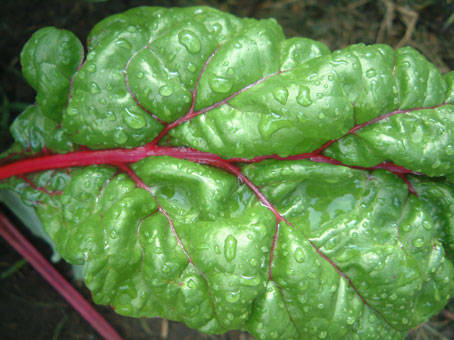
One crop doing especially well this year is rainbow chard Bright Lights; last year the leaves were mangled by an assortment of slugs and caterpillars but this year they're pristine. I'm hoping this is a sign that the ecosystem is finding a balance now. The garden was managed with chemicals up until the time I got it (2004) so it's still in the process of adapting to organic.

Monday, 14 August 2006

Today in the garden ... the rummager unmasked!

Evidence of rummaging

I went out for my morning inspection of the garden and discovered that my Alderman pea seedlings (above) had been rummaged overnight, as had my newly planted potatoes and a few leeks. The mulch of grass cuttings I put around my tomato plants a few days ago had been burrowed into and flung all over the path. Grrrr!

But this time there was forensic evidence! There in the soil around the pea seedlings were some claw marks, and in one place something resembling a footprint. It wasn't very clear, but enough to see that the phantom marauder has small clawed hands with a spread of about half an inch. Which immediately led me to conclude it was a hedgehog. It's the most common nocturnal digger in the UK with feet of that size, and it eats worms and grubs. It still doesn't explain how or why it got to the pots I'd put in high places, but it was by far the most likely.

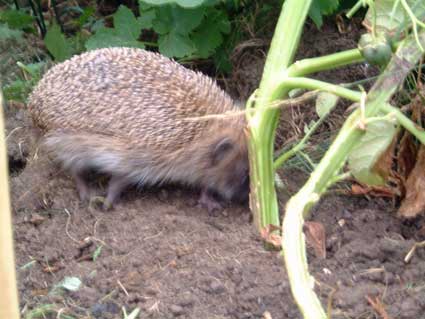
And then I turned round and saw the culprit himself! A hedgehog waddling across the scrubby patch of lawn I laughingly call a wildflower meadow at the bottom of the garden. "That's odd," I thought. "They don't normally come out in the daytime." I had the camera in my hand so I managed to snap the evidence before he sauntered off into a pile of discarded potato haulms.

Rumbled!

And another thing that was odd ... he showed no fear of me at all, and not even much awareness that I was there. Most hedgehogs leg it into the bushes when they encounter a human. Then I got a closer look at him and saw that he was blind. In fact he looks like a very elderly and decrepit hedgehog indeed and I fear his rummaging days are drawing towards their natural close. I stood very still for a bit so as not to startle him and he came right up to me, brushed against my legs and then walked over my foot!

One of my cats came out to see what was going on but she obviously knows that prodding hedgehogs is not a good idea so she just sat and looked at him. At first I thought he was on his last legs because he spent some time slumped under a butternut squash plant making wheezing noises, but then he got up and started scampering about ... found his way into next door's garden and then came back in the late afternoon and scampered around on the patio, trampling my chocolate cosmos in the process.

I'm calling him Dodgem because he charges around bouncing off things. He seems happy enough; he can't see where he's going so he just crashes through stuff.

Out on a 24-hour rummaging spree. And I hoped you wouldn't get to see those horrible slug-tunnelled spuds. Dang.

Wednesday, 26 July 2006

Today in the garden ... harvesting legumes

No this isn't a legume. It's a purply-black hollyhock. Nice though, isn't it?

Although I'm far from self-sufficient (until I find a way of growing chocolate biscuits in the garden it's never going to happen) I am now eating home-grown food pretty much on a daily basis. And the leguminous crops are doing especially well just now, so I've been having a big harvest day to get some of the surplus into the freezer.

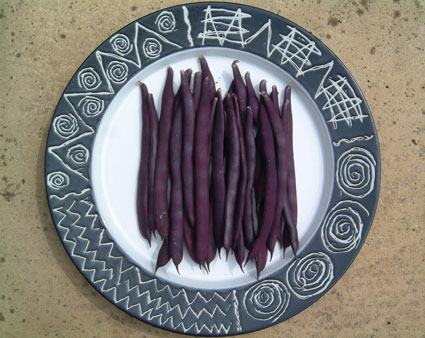
Kew Blue is just delightful. Look at the pods ... long, thin and straight, satin-textured, and the most beautiful rich purple. The plants produce fewer leaves than other climbing beans and the pods are produced in pairs on long trusses, like they're dangling from little handlebars. You can see them easily when you want to harvest them. Yields are high and the flavour and texture are both superb.

Kew Blue: a gourmet bean if ever there was one

So this is another superior heritage vegetable which I know a lot of people would appreciate having the chance to try. But it isn't widely available ... I've only found one supplier other than the Heritage Seed Library. I haven't been able to find out anything much about this queen of beans ... even Google is pretty low yielding, and most of the hits are for a salpiglossis with the same cultivar name. I assume it has some connection with Kew Gardens. It appears it was accidentally omitted from the Heritage Seed Library's 2006 catalogue ... which may explain why they've been sending packets of it out as freebies to members this year. That's where I got mine from, in fact, and as freebies go it's a real corker.

My other HSL bean, Mrs Fortune's, doesn't come into quite the same flavour class but it makes up for it with massive yields. I have yet to try the dried beans.

Mrs Fortune's: blue-streaked and curly-tailed

Any moth experts out there? We had an enormous (about one and a half inches across) and spectacularly beautiful moth fly into the lounge today and take up residence just under the ceiling. I've never seen anything like it. Its outer wings were a standard mottled-brown mothy colour but underneath it had incredibly vivid orange and black underwings. I've looked at all the moth identification websites I can find and the nearest thing I've found is the Orange Underwing (huh, there's an imaginative name for such a beautiful creature) but I'm still unsure because it seems to be the wrong time of year for them. If anyone can help identify it from my admittedly crappy photographs I'd be forever grateful.

Yeah yeah, there is a wee bit of camera shake. I was standing on a chair with a hand-held zoom lens and it was the best I could do! The second shot is better but it had closed its wings by then.

Once it had settled it stayed put for several hours, but eventually we decided we'd better evict it because one of the cats had her beady eye on it. So with a lot of precarious balancing on furniture (husband) and frenzied flapping (moth) we trapped it in a long-handled bug-catcher and released it outside.

Friday, 7 July 2006

Today in the garden ... after the deluge

These lilies (I've long forgotten the variety name) survived a rainy pelting unscathed

Just as it looked like we were in for a summer of extreme drought ... the rains came. It rained non-stop for 24 hours. And I don't mean normal rain. It was torrential and there was no let-up in it at all. I was woken up again and again during the night by the noise of it pelting on the roof. I fully expected to open the curtains the next morning and find the house had floated off down the street. But no ... the pavement outside was impassable (our street has a double grass verge which acts like banks in wet weather and turns the pavement into a river) but we're still in the same place. And apart from a snapped-off top on one of the Martock broad beans and some very bedraggled roses, there was hardly any damage in the garden. Just a lot of baling out on the patio where a lot of the plants were floating in their pots.

And my rainwater butt, empty since April, has certainly filled up!

But now the weather has cleared a bit I've been able to get out there and do my daily inspection. The daily inspections are taking a little longer at the moment as I pause along the way to stuff my face with fresh produce. Raspberries, tayberries, peas, blackcurrants, then more raspberries.

I chanced to have the camera in my hand when I spotted this beautiful bright orange butterfly on some Mr Little's Yetholm Gypsy potato leaves. Butterflies are outside my area of expertise but I think this one is a Comma.

Peas are still the main focus for me at the moment. I'm not sure how well my hand-pollinations have taken. The pods are developing nicely, but the peas inside (which you can see if you view them against the light) are very small, and even those that are developing normally only have a couple of peas in each pod. To some extent this is normal ... hand-pollination is quite hit and miss and it's usual for some of the pollinations not to take. It's just a matter of doing lots of them to ensure enough material for my experiments. But there are factors which may make a difference to the success rate. One is the weather ... peas pollinate much better when it's cool and I did mine on blazing hot summer days. Another is a possible mismatch in the maturity of the flower parts. I have been emasculating the buds at a very early stage to ensure I catch the male bits before they shed any pollen, and there's a strong possibility that at this stage the female part is not yet receptive either. The solution to this is to emasculate the buds a day or two before I do the hand-pollination, which will give the stigma a chance to mature. Worth a try, anyway. I will just have to do lots of pollinations and see what works.

Champion of England produces its first pods

Champion of England is looking fairly typical of an old-fashioned tall pea. The flowers are small-ish and a very slightly creamy white. And it has long, long pods which look like they're going to have 9 peas in them.

The moment has come: I sampled the first raw mangetout pod from Mr Bethell's Purple Podded. Um ... being brutally honest, the flavour was a bit on the weak side ... not to mention slightly earthy and bitter. I ate a similar sized Alderman pod for comparison, and the purple one was noticeably poorer (although it certainly looked a lot more exciting). I will have to try them cooked when I have enough of them. But even if they turn out to taste horrible in every form, it's still worth my while growing them as a heritage variety and as breeding stock. Because I'm guessing the main reason purple peas taste less good is that all the breeding work in the last 150 years has focused on green varieties. Given that the gene for purple colouring is dominant, I see no reason why the colour can't be bred into some existing sweet plump green varieties.
Here are a couple of oddities I have in the garden at the moment.

Americans may recognise this, but it's rarely seen in UK gardens. It's Black Cohosh (Cimicifuga racemosa) which is a powerful hormone-balancing herb much prized in Native American medicine. It likes to grow in damp shady places and it produces an effervescent-looking white flower spike which flowers from the bottom up, like a sparkler in reverse. From Poyntzfield Herbs

This is Allium guttatum ssp. dalmaticum, which is so rare it doesn't have an English name. It's an ornamental member of the onion family. From Rare Plants

Monday, 12 June 2006

Today in the garden ...

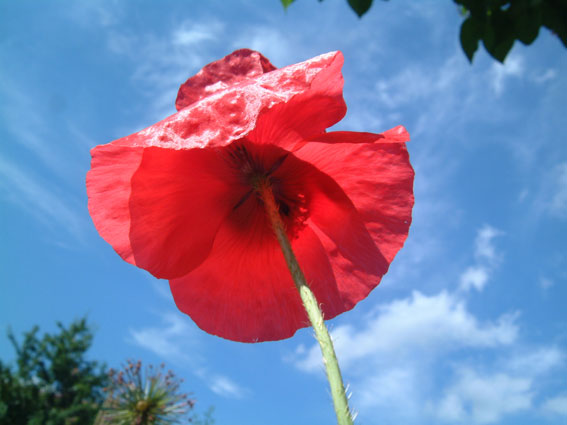
Self-seeded field poppy (Papaver rhoeas). This is the same flower that was shown as a bud on my June 2nd post.

The sky exploded early this morning (well, not quite, but it sounded like it) and resulted in a ferocious deluge. It saves me watering the garden this morning, a job which was becoming a twice-a-day necessity in the recent heatwave, but I wish I hadn't left the cushion out on the garden bench. Oops. Soggy arse for the next person who sits on that.

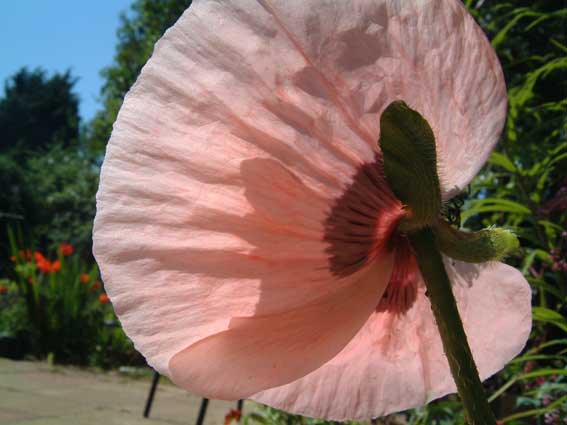
The rain smacked the heads off all the remaining oriental poppies, so no more pollen-diving fun for the bees. They did very well this year though because they mainly flowered during the dry spell. At its peak the orange Allegro poppies had 19 flowers at once, all of them the size of my hand. They may only last a couple of weeks but they are stunning. And just as they are going over, the annual poppies are coming out (see above). You never know what colours you're going to get with annual poppies, which is one of the reasons I love them.

No sooner had I written that when one last bud of oriental poppy Princess Victoria Louise came out. And so did a whole load of brown butterflies. I even managed to photograph them together.


And there's no shortage of frogs now. As I was walking down the garden path this morning something landed with a great splack right in front of me. A very knobbly frog with a green head and a black back. Thought it was a toad at first, but it wasn't quite that knobbly.

I know it's getting a bit late for sowing stuff now, but I've just had some tomato seeds through the post from America. Unusual varieties which you can't get over here. Two of them are marbled and striped in red and yellow, the other supposely looks like black cherries. They sent me a freebie packet too. Bless.

I have this nerdy obsession with seeking out the unusual ... can't just go down the garden centre and buy normal stuff like everyone else. It cost me more in postage than for the seeds themselves, but I don't care. I'll have the only marbled and black cherry tomatoes in Cheltenham.

I do have a minor concern about buying seeds from America though ... there is such widespread use of GM material in the US, most of it unlabelled, I wonder how much stuff over there gets accidentally cross-pollinated. I don't have any means of testing for it and I assume the risk of GM contamination is small, especially with tomatoes since they're natural inbreeders (i.e. they usually self-pollinate). But if anyone knows anything about this issue I'd be grateful to know.


The Alderman pea is still going nuts. Advertised in the Organic Gardening Catalogue as reaching a height of 5ft, mine is now just over 7ft. And those tendrils are still reaching for the sky. I'll be posting another pea-specific report shortly.

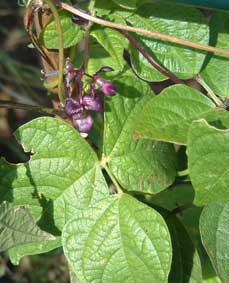
My climbing French beans are all coming along nicely now, having benefited from the clement weather. It's actually not the cold which devastates these plants, it's the wind. During late May it was very breezy and my newly planted Trionfo Violetto and Meraviglia di Venezia (which I'm growing together over an arch) suffered a lot of damage to their leaves, and in their weakened state fell prey to slugs. I wasn't sure whether they'd make it or not but in the last week they've made a miraculous recovery, have grown beyond sluggy reach and look very green and lush. Trionfo Violetto is already in flower (right). Then there's the two varieties I got from the Heritage Seed Library. Kew Blue is now recovered from the shock of finding itself planted out in the real world and is starting to shoot upwards. I'm growing it in a small clearing in a potato patch, and as the potatoes continually encroach it does get a little shady and claustrophobic. But it's also very sheltered, and that has kept the leaves lush and pristine green ... in contrast to Mrs Fortune's, which I planted in a sunny open site and whose leaves have been rattled and flapped and baked to parchment (although it's still thriving well enough). I was also afraid the Kew Blue might be eaten by snails down in the moist verdant undergrowth but they've been largely untouched and most of the snails I've been finding there are just broken shells. I assume that means the moist verdant undergrowth is populated by hungry frogs and slow worms.

Climbing French bean Kew Blue sitting in a mulch of horse manure and grass cuttings. See how the colour of the leaf stalk graduates from purple to green.

I've been experimenting with very basic CSS coding on my blog template and have discovered how to highlight the plant variety names in my posts in a separate colour (without having to go through and code them all individually ... how cool is that?) So now people who google in here looking for information on specific varieties should find it easier to spot the ones they want. Let me know if it looks weird in your browser or the colour annoys you.

Sunday, 11 June 2006

Today in the garden ...


Well, my elderflower cordial was a success. Husband glugging the stuff like there's no tomorrow. I need to go and get a bucket from the homebrew shop so that I can make it in bigger quantities. I'll also need to take a trip out into the Cotswolds with the secateurs ... I don't want to pillage my own tree any further because I like elderberry beverages too and I want to leave it with enough blossom for that. There's no shortage of it around here though. Previous wildflower recces suggest that Leckhampton Hill might be a particularly good place for elder.

Of course I'm not superstitious. *cough* Not at all. It's just that I have a curious feeling of respect for elder trees and always like to ask them nicely before taking their blossom.

I love this time of year in the garden ... everything looks at its best in June, before it all goes blowsy and flops over. This picture was taken from the window of the music room, the room where all Revolving Doris's music is recorded (or my half of it, anyway). Looks nice at this time of year, doesn't it? No wonder I'm not getting much music done.


The music room is now being supplied with some especially lovely red Dianthus flowers, courtesy of the plants which I picked up on a trip to Devon a few months back. I'm usually reluctant to cut flowers because they look so lovely in the garden, but it's nice to have a jar of them on my desk too. I tend to bring in mature flowers anyway, because Dianthus is at its best when it's aging a bit. The pistils curl up into a very attractive spiral after they've been pollinated and the flowers still last for ages.


The broad beans are doing very well, and the red-flowered type now has huge numbers of tiny pods. Still a few flowers on there too. Grando Violetto began to set pods much earlier, and some of them are getting big, but it seems to produce them one at a time so there's never enough for a meal. Grrr.

The blackfly season is well underway. Even the red-flowered variety is now under attack, although interestingly it's only the largest and lushest plants which are affected. Some of the plants have stayed quite small and those are still clean as a whistle. The Grando Violetto variety is suffering quite badly and I'm having to hose them off on a daily basis. The plant tops are looking very feeble now (probably from being violently blasted with a water jet every day as much as from the blackfly) and it doesn't look like I'll be getting a huge yield from them.

Had a toad hopping about on the patio this afternoon. I've noticed an increase in their numbers over the last couple of weeks and a corresponding drop in the slimy invertebrate population. Hooray.

I dunno about you, but I like to spend a lot of time just standing around in the garden staring idly into the middle distance, especially in the twilight. Yesterday evening when I was doing this I heard a snuffling noise and a hedgehog came sauntering out of the 'cornfield' patch straight towards me. This happened once before when I was sitting on the bench in the wild garden and a hedgehog came over and started snuffling at my foot. I had my eyes closed and didn't realise it was there until it touched me and I went "waaaaah!" and leaped about three feet in the air and the hedgehog scarpered. They certainly can shift if you frighten the shite out of them. This time though I kept very still and the hedgehog passed within two feet of me, carried out a brief inspection of the broad beans and waddled off into the raspberries. Very cute. And very snuffly.

Thursday, 8 June 2006

Today in the garden ...

Cheltenham Green Top beetroot ... with a rather groovy flower spike

Mowed the lawn and used the cuttings as a mulch around the peas and beans. At this time of year I only apply the mulch very thinly, which means it doesn't really work as a weed suppressant but it does still keep the warmth and moisture in the soil, and allows water to penetrate. After a few days it dries out into a kind of mat of hay, rather than a compacted slimy mess, and breaks down very quickly into the soil. By reapplying it every couple of weeks I can get a lot of organic matter into the soil without having to spend weeks composting it first.

I think this is going to be a good year for fruit. The gooseberries are coming on well, as you can see. Looks like the Ashmead's Kernal apple tree couldn't be arsed to blossom this year, but Taynton Codlin produced one flower cluster and now has one solitary apple. Tewkesbury Baron, by contrast, was such a mass of blossom it looked like a funereal tribute. And now it has loads of swelling apples. But the tree is not even two years old, so for its own sake I'll have to force myself to take them off. Blub.

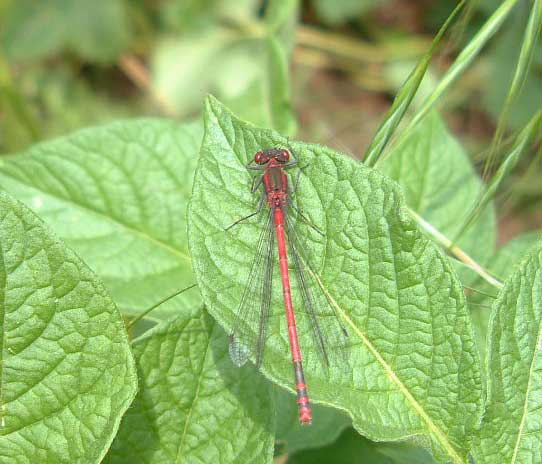
The damselflies are everywhere now, like miniature dragonflies but in bright red or sky blue. I've now managed to get a photo of one, which hasn't been easy because they're so thin and elongated my camera's autofocus can't pick up on them. They're also a bit camera shy and tend to fly off. They are a delight though. Tiny levitating sticks of turquoise.

Unless I'm much mistaken this is the imaginatively named Large Red Damselfly. Seen here posing on Fortyfold potato leaves.