Showing posts with label Apples. Show all posts

Thursday, 17 April 2008

Tewkesbury Baron


I posted about my Gloucestershire apple trees in the very early days of this blog but as I hardly had any readers back then I don't expect anyone to remember. So this is the story of my Tewkesbury Baron apple.

At one time Gloucestershire was one of England's primary apple-growing areas (not surprisingly, as it's joined to Somerset at one end and Worcestershire and Herefordshire at the other) but three quarters of the county's orchards have been lost since the 1950s. Fortunately the hard working Gloucestershire Orchard Group have identified, saved and propagated a large number of the survivors and are helping people to reestablish orchards in the area. They have a beautiful database of local heritage varieties which revel in such names as Black Tanker, Foxwhelp and Hen's Turds. I'm sure Bastard Underleaf would have a welcome home in my garden if I had more space, but sadly it's believed to be extinct. Fortunately though many of these trees are now available to buy, albeit from only one or two specialist suppliers such as the one I got mine from, Lodge Farm Trees near Berkeley, Gloucestershire.

A couple of years back I decided to get three heritage apple trees, and to choose the three that were most local to me. Ashmead's Kernal is the localest, originating 300 years ago in the garden of a Dr Ashmead only 7 miles away in Gloucester. The next most local is Tewkesbury Baron, which takes its name from the town of Tewkesbury (pronounced "chucks'bry" around here, not "tyooksburry") about 12 miles away. We used to live there when I was a kid. It used to flood all the time back then too.

A knobbly green cider/cooking apple Taynton Codlin makes up the trio.

Tewkesbury Baron is of uncertain origin but was certainly in existence by 1883. It doesn't get a lot of good press. Its qualities are summed up by the experts at the Brogdale National Collection as (and I quote) "Little flavour." Their online database elaborates on this slightly: "Fruits have a little coarse, dry, white flesh with an insipid flavour." There's not much other info available apart from that, and nobody has anything good to say about it.

I must admit I did wonder if I was a bit mad as I hurtled up the M5 with a tangle of tree branches curled around the inside of the car windscreen ("Whatchoo looking at? Haven't you ever seen a VW Polo with a tree wrapped round its windows before?") A fruit tree is a long-term commitment, it takes up space and its roots will steal nutrients from my vegetable plots. It's important to choose the right one. So why was I being so daft as to give up my precious garden space to a flavourless apple?

My decision was partly sentimental because I used to live in Tewkesbury, and because I wanted to have the most local varieties. But the real clincher was that Tewkesbury Baron is critically endangered. By the criteria of the Gloucestershire Orchard Group that means its population has dwindled to "two sites or fewer". I felt morally obliged to take it on.

I was impressed and inspired by my visit to Lodge Farm Trees. Its proprietor Rob is a great bloke and he's completely passionate about his trees. He loaded them into the car for me and spent a good ten minutes explaining how to prune them and care for them. I also have him to thank for galvanising me into starting this blog. He knows more about apples than I ever will, but when I asked about the flavours and flowering habits of the trees I was buying he shrugged and said "Some of these trees are so rare nobody's grown them for years. So we won't know what they're like until somebody grows them and shares the information." I was really astonished by that because it had never occurred to me before that ordinary gardeners like me can make a really significant contribution to the available knowledge. Instead of being a passive consumer of other people's expertise we can all grow, observe, note, photograph and share information, especially now, in the internet age. I was inspired and set up Daughter of the Soil that very same week.


So, that was over two years ago and I can now share some information about Tewkesbury Baron. My tree was certainly keen to produce fruit. I'd read that apple trees can take seven years to start fruiting properly, but my one-year-old tree produced an abundance of flowers within a few weeks of planting and managed to set 12 fruits. For the sake of the tree I picked off 11 of them and just let it produce one, for tasting purposes. The fruits are a deep rosy red where the sun gets to them, green where it doesn't, and lightly speckled. They have a very waxy shiny skin which feels quite distinctive and silky to touch. The wax is so intense it rubs off on your fingers.

But here's the surprise. I gathered the one specimen fruit when it was ripe, and ate it. And I can say, hand on heart, it was absolutely the most gorgeously exquisite apple I've ever tasted. The texture was slightly grainy, but not in a bad way, it was bursting with juice, and the flavour was beautifully poised between sweetness and sharpness. It was equally sweet and sharp at the same time, so tangy it was almost fizzy ... a really rich and complex flavour. The fruit itself also had a beautiful, beautiful scent even before I bit into it. I left it on my desk for a few hours before eating it and it filled the whole room with an exquisite apple aroma.

How this apple ever got labelled as having "little flavour" is totally beyond me. I'm in no position to argue with the pomologists at Brogdale, but I can only assume they based their assessment on some duff fruit. There could be any number of reasons why the specimens they had weren't up to scratch, but anyway I can vouch that in my garden Tewkesbury Baron is wonderful, an absolute treasure and delight.

The blossoms, as you can see from these pictures taken yesterday, are a deep pink and grow in little posies right the way up the trunk of the tree. I'm training mine into a festoon, hence the bits of string in the top photo. When the flowers open they'll be pale pink.


Hurrah for Lodge Farm Trees, rescuing and distributing these endangered varieties. And if you would expect a specialist nursery with lovingly nurtured heritage varieties and personal service from a genuine expert to be more expensive than a garden centre flogging the bog-standard commercial varieties, well it wasn't. The trees were £12 each, which is several quid less than in most garden centres. They were also well developed for their age and in fabulous condition. They'd really responded well to being grown with loving care rather than churned out by a production nursery. For those with less space to spare the nursery was also offering "family trees" where several heritage varieties had been budded onto a single rootstock, producing a tree with different fruit on every branch.

The moral of the story? Don't let anything you read put you off trying stuff.

Friday, 25 May 2007

A brief pea-free interlude


Here's a picture of a red-flowered broad bean (fava), another heritage vegetable treasure which I've already reviewed. I'm growing them in the patio border this year because they have a beautiful scent (one of the rarely mentioned blessings of broad beans) as well as that gorgeous colour. They look breathtaking when the sun shines through them because they have a very subtle translucence, but that's one of those things that cannot be photographed because the intensity of light and colour is beyond the scope of digital media. So you'll have to make do with this non-sunlit picture and use your imagination. Or grow some yourself.


Another translucent red heritage vegetable I'm growing this year is this beetroot, a very old French variety called Rouge Crapaudine. It's a fairly rare one only available by mail order, which is probably just as well because you wouldn't want to have to go in to a garden centre and ask for it by name. Thomas Etty Esquire is one of the few suppliers who stock it. It's a bit different from yer average modern beet. The root is very long and thin, more like a carrot, and it has a black skin with a cracked and fissured surface. This one has a way to go before harvest time though.

The garden here is a paradise for slow-worms and I see them a lot (ssh, don't tell my mum, she's terrified of them and won't go out in the garden unless I tell her there aren't any) but I've never seen one like this before ... it has bright blue flecks all the way along its body. At first I wondered whether it had gone through next door's garden while he was respraying his motorbike, but nope, it really is that colour. It's the same bright azure colour you see in damselflies. And appropriately enough, seen here lounging under the Salad Blue potatoes.


Errr ... mum, if you're reading this, it's not a real one, OK? Just a plastic inflatable one I put there for a laugh.

Two of my young apple trees couldn't be arsed to flower this year, but the third was an absolute corker. I was worried it would be unable to set fruit in the absence of a pollination partner (one day I'll explain why most apples are not capable of fertilising themselves, which has to do with them having one too many chromosomes) but luckily the neighbour four doors down has an apple tree which flowered at the same time, and despite the distance and the separating fences my tree got well pollinated. It's now covered in fluffy little apples.


This is a variety called Ashmead's Kernal, which is over 300 years old and currently enjoying a comeback. I love it because of its acid-drop sharp flavour and crispness (I hate sweet mushy supermarket apples, bleurgh) but also because it's a local variety which originated in Gloucester, only 7 miles up the road. Another oft-plugged selling point for Ashmead's Kernal is its beautiful flowers, though actually I find them a bit big and blousy for my tastes and prefer the smaller crisper flowers on my other trees (when they can be bothered).

And finally, here's a picture of an upside-down cat attacking my cardigan.

Wednesday, 13 September 2006

Today in the garden ... scrumpy

I thought I'd seen the last of the poppies this year, then along came this translucent purple-black opium poppy. It self-seeded from Black Paeony, which is a fully double (frilly headed) variety, but this one has come out single-flowered. That's poppies for ya!

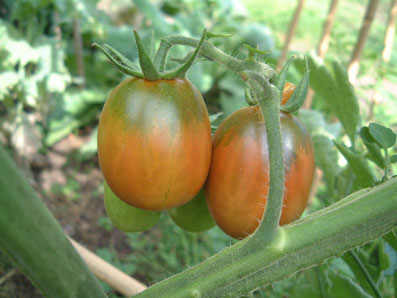
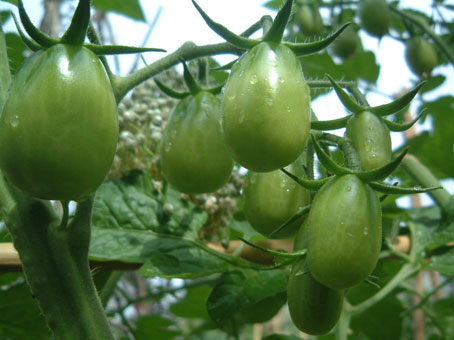
My Black Plum tomatoes are finally showing signs of ripening after what seems like weeks of sagging under the weight of large, dense, bell-shaped green fruits. They have now taken on a dusky dark orange hue and look quite unlike any other tomato I've seen. There's also one missing from the biggest truss, although there's no sign of it on the ground. I've noticed this a few times now, semi-ripe tomatoes disappearing off the vine overnight never to be seen again. Either some critter is scampering off with them or my neighbour has been using a stick with a hook on the end to scrump them through the fence. (Me? Paranoid?)

Black Plum contemplates the possibility of ripening. And yes, it is meant to be that weird colour.

Meanwhile I've been keeping a close watch on my one and only Taynton Codlin apple, because it appears to be naturally green all over and therefore difficult to judge when it's ripe (and unlike tomatoes, you can't really squidge them to see how soft they are). This morning when I did my tour of the garden I found it had fallen off the tree altogether, which I took to be a reasonable indication of ripeness. So ... only a few months after I bought these trees as flimsy twiggy one-year-olds I am doing my second heritage apple tasting. I had expected to have to wait about five years.

One thing I need to explain about this apple is that I know next to nothing about it. There is no information out there, it's so rare. It's not listed in my apple encyclopedia, nor on the Brogdale National Collection database, so when I eat it I'll be biting into uncharted territory. All I know about it is that it originated locally in about 1700 and it's a cider/cooking apple, which could mean anything really. My mum, who is a Somerset lass and knows a thing or two about cider apples, says it probably means it'll have a tartness that takes the roof of your mouth off. Sounds good to me!

The first striking thing about this apple is the scent. I don't think I've ever come across a more aromatic apple ... just having it on my desk it's filling the room with exquisite appleness. It's a beautiful aroma, quite different from the bland crap you get in the shops. Unlike the Tewkesbury Baron, which I photographed from a particular angle so that you couldn't see the brown blotchy bits on the other side, this apple is flawless. It has natural lumps and bumps as befitting a 300-year-old cider apple but not a single blemish. And it was organically grown too. I'm impressed.


The skin is quite waxy and although it has a dull matt sheen it polishes up to a high gloss. The colour is a really bright pea green which is consistent all over.

I will do a taste test but in all honesty it smells so good I just have to leave it sitting on my desk for a couple more hours ... *sigh* ...

6 hours later ...
Mmmm, wonderful! The skin is a bit on the chewy side, and the pale green flesh oxidises and browns very rapidly, but the flavour is fantastic. Very acidic, very sharp, with none of the crabapple dryness I was expecting. A real acid-drop sensation with an intensely appley flavour. It's definitely not for the sweet-toothed but it's very very lovely. The flesh texture is crunchy and juicy. And if this is what our rustic ancestors used to make cider with then it's a wonder they didn't just sit around pissed all day. (Oh, er, actually ...)

What a joy it's been to rediscover these old apples. I pretty much stopped eating apples many years ago because I can't stand the homogenised supermarket varieties, boring and sweet and watery. I don't even like the mushy and over-rated Cox which is about the only old-fashioned English apple still readily available. In recent years I've found a local farm whose orchard shop sells a decent range of apples which taste massively better, and it's worth going there just to listen to the farmer's "I can't believe anyone really talks like that" Gloucestershire accent. But the fruit on these old local varieties, which I didn't even have a chance to try out before I committed to planting them, is out of this world.

Monday, 4 September 2006

Today in the garden ... a pleasant surprise

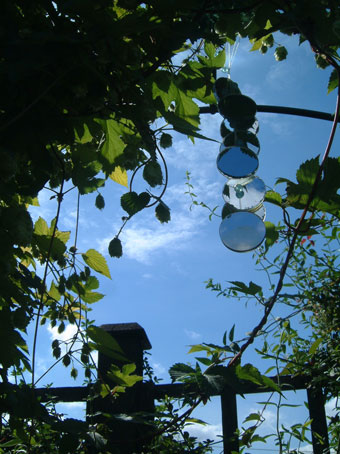
Golden hop growing over an arch with a dangly mirror thingy

I'd like to say a big thank you to all of you who have left comments ... I really appreciate them. It means a lot to me when people tell me they've found my little instructional articles useful. And I thoroughly enjoy writing them.

I'm working on some detailed reviews of all the heritage fruit and veg I've grown this year, so watch this space.

I've had a very busy week, with my parents visiting for a few days and also a lot of time spent on music. I had an invite from a band whose music I really love, asking me to sing a lead vocal on their forthcoming EP (woot!) so that's taken priority over other things.

I've still had time to do a bit of digging though, trying to make room for some Chinese cabbage (which I've never grown before) currently languishing in pots on the patio. The soil here is wonderful; even though the area I dug over had been overlaid with lawn for years, it only needed a couple of turns with a spade to make it into a perfect dark crumbly tilth. A fellow Cotswold gardener I spoke to recently described the soil around here as "like chocolate cake" ... and it is. When I dug into the compacted earth under the lawn, full of bits of limestone, it looked like a slice of chocolate fudge with honeycomb chunks. Mmmmm. Not that I'm obsessed with chocolate or anything. But it's probably one reason I became a gardener, because I used to love making mud pies when I was very small and although I discovered fairly early on that they don't taste anywhere near as good as they look, the infatuation with soil has never left me.

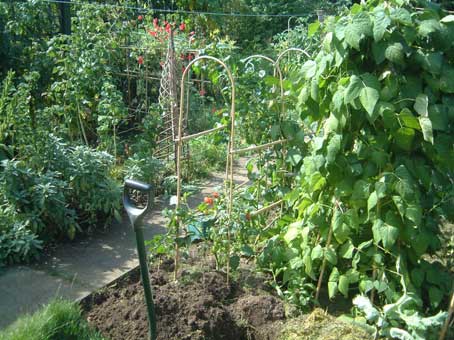
Sage and raspberries on the left, Mrs Fortune's climbing beans on the right, and lots of lovely chocolatey soil.

The bad news is, the largest and most luxurious of my experimental hybrid peas had its stem chewed right through by a slug or snail this week. And the next day two more had been bitten off at ground level. That may mean I'm now down to 8 plants. It's a bit ironic really because the slugs and snails have been very efficiently controlled by the assorted reptiles in the garden, and hardly anything gets eaten. But when they do eat things they find the stuff that's precious and irreplaceable. I'm going to try sprinkling some fine grit around the stems of the plants ... the stuff that's used at the bottom of bird cages. It doesn't kill them ... they just don't like crawling over it because it's scratchy on their little slimy undersides.

When I decided to plant some heritage apple trees earlier this year I did some research to find out which varieties were most local to my garden. One was obvious ... the relatively well known Ashmead's Kernal which originated in Gloucester (about 7 miles away) in around 1700, and readily available on local farms. It has a lovely acid flavour for those who like acidic apples (which I do). The second most local apple is Tewkesbury Baron, originating about 12 miles away, and that was a bit less exciting. In fact I was rather disappointed, because what little info I've been able to find about this rare variety describes its flavour as insignificant. I had to think long and hard about whether I wanted to plant an apple tree in my garden whose fruit didn't taste good, bearing in mind the space it will take up and the shade it will cast. It was certainly a dilemma, and when I decided to go for Tewkesbury Baron it was pretty much an act of charity on account of it being rare and endangered. And as I used to live in Tewkesbury I'm probably a bit sentimental. I planted it in the least favourable spot, where it thrived rampantly despite being on the shadowy side of the garden.

My apple encyclopedia describes Tewkesbury Baron as having "little flavour". The Brogdale National Collection website, by far the most definitive apple guide in the UK, says "Fruits have a little coarse, dry, white flesh with an insipid flavour." Uh?! I just tried mine today. No complaints here.

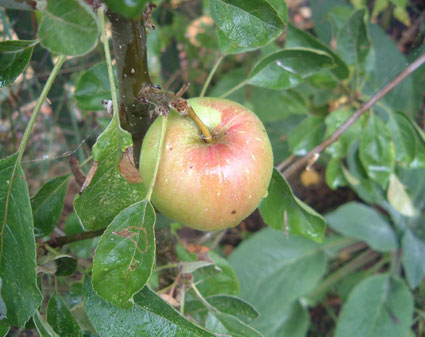
Tewkesbury Baron ... surprisingly absolutely bloody delicious.

It's a nice looking apple, having a proper old English shape and size with a deep pinky red skin (flushed green where the sun doesn't get to it) and a very waxy shiny surface. Texture-wise the flesh is slightly grainy, but succulent and bursting with juice. The flavour is exquisite. It's so tangy it's almost fizzy. It's got distinct sharpness and sweetness in a beautiful symbiotic balance. I'm really bowled over by how good this apple tastes.

Maybe it needs the chocolatey soil of North Gloucestershire to develop its flavour potential, or maybe there's some other reason Tewkesbury Baron got a reputation for blandness, but I'm certainly delighted to have it in my garden.

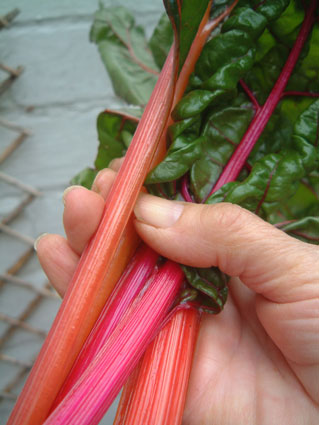
My mum models the latest Bright Lights rainbow chard

We're eating very well from garden produce at the moment ... chard, beetroot, onions, garlic, potatoes of all colours and a profusion of beans. Not to mention the herbs, from Italian thyme to Greek oregano. Yum.

Thursday, 17 August 2006

Today in the garden ... wet fruit

This is one of the reasons I fell in love with this garden the moment I set eyes on it

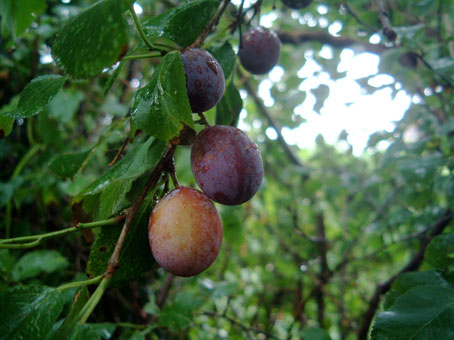
Up until the 1920s and 30s, the west side of Cheltenham was covered with orchards and lots of different fruit trees. As the town expanded almost all of it disappeared. Our house was built in the mid 1930s on land which had been growing damson trees (damsons are like small plums) and although most were lost a few of the original trees still survive along garden boundaries. I'm especially lucky to have two in my garden (although one is growing on the corner point of three gardens so it's hard to say who actually owns it). One has fairly large black fruits with a grey bloom and is slightly on the bitter and tastless side, to be honest. The other one (shown in the photo) has smaller, golden-reddy-purple fruits which taste exquisite. So exquisite I even crawled through a big heap of stinking soggy twigs to get at them and ended up with a spider in my hair. Ewww.

It's been a really good year for tree fruit. They don't seem bothered by drought, but then Cheltenham is a spa town and there's underground water pretty much everywhere in this area, so they've probably got their roots into the nearest aquifer. The damsons have been very abundant. I also have an old and decrepit pear tree which is fruiting like billio. I don't actually like pears as it happens, but I can certainly find willing recipients to palm them off onto. And the apple trees I planted earlier this year are looking fine and dandy.

A Tewkesbury Baron apple, a local heritage variety I planted just a few months ago

I haven't seen Dodgem out on the prowl for the last couple of days so hopefully he's gone back to his regular nocturnal routine. It certainly looks like it, because I had a pot of holy basil ransacked overnight and its contents spread across the patio and in the cats' water bowl. But one thing I have discovered is where he hangs out during non-rummaging times. And I found it because I heard him snoring while I was tending some tomato plants at the bottom of the garden. When Shakespeare wrote his famous three witches scene and came up with the line "Thrice and once the hedge-pig whin'd" he was using some artistic licence, because the noise they make is more of a wheezy snuffly slurp. But then I guess "wheezy snuffly slurp" would have been harder to fit into an iambic tetrameter. Not to put too fine a point on it, hedgehogs sound like somebody with a very bad cold. And following the noise to its source, I found a narrow hedgehog-sized gap between the chainlink fence and a large log which forms the boundary of my bog-garden, and there was Dodgem curled up asleep with a few flies buzzing round him.

Things I've learned today: if you're cleaning out a vase with a long and very narrow neck it's NOT a good idea to turn the tap on full blast.

It's been perfect weather for the garden today because it chucked it down with rain all morning and then the sun came out. No matter how much effort you put into irrigation the garden always responds best to real rain. And now the sun will help the plants make the most of it. Rain followed by sun makes everything smell wonderful, and the water and light create some beautiful photo opportunities.

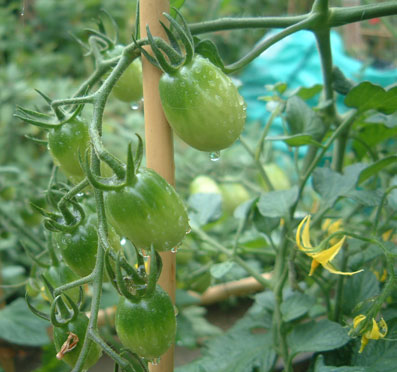
I don't have any red tomatoes yet, but the green ones give me plenty to look at. This is Pink Jester ...

... and this is the Russian heirloom Black Plum

Tuesday, 4 July 2006

Today in the garden ... purple pods


Last night's dinner included some of the Edzell Blue potatoes and red-flowered broad beans. I tried baking the potatoes this time but this obviously isn't one of Edzell Blue's strong points. They have too much dry matter in them and go very floury, and the flavour isn't very inspiring. The skins go extremely crispy and leathery and take a lot of chewing. Some people like their jacket potatoes that way ... but I've had a lot better. When I discover which cooking method does suit this beautiful but fickle spud I'll let you know. The red-flowered broad beans, on the other hand, are the best I've ever tasted. They have slightly smaller beans than the modern varieties I've grown in the past, but they taste fantastic with no bitterness in them at all and only need to be lightly steamed. The plants are more blackfly-resistant than any I've ever grown, which in practice means higher yields. I got my seeds from W Robinson & Son and they may in fact be the only supplier of this variety, although I've also seen it doing the rounds on the HSL seed swap. Highly recommended.

Apple Taynton Codlin coming along a treat

The fruit garden is going like the clappers ... most things are ready to harvest now. I have more raspberries than I can possibly use for anything, mainly because the bushes I inherited as part of the garden are a crappy type which all ripen in one enormous simultaneous glut. The flavour isn't much to write home about either. I'm intending to replace them with Autumn Bliss which is massively better and definitely my raspberry of choice. The only fruit failure so far this year is my miniature peach tree, which has taken umbrage at something and dropped all its fruits in disgust. Bloody temperamental thing. Meanwhile my single solitary apple is swelling nicely.

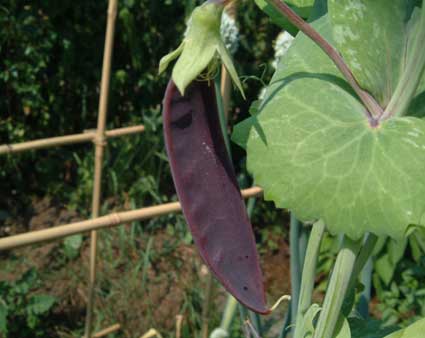
Well, here's the evidence. Mr Bethell's Purple Podded has purple pods.

How about that then. Purple podded peas. They start off green when the flower first dies off but within a day of exposure to the sun they go this shiny purple-maroon colour. Another thing I really like about this variety is that the sepals on the flower buds are speckled with maroon, especially while they're in the bud stage. It's very pretty. And with the flowers changing colour all the time I'm wishing I planted it closer to the house where I could stare at it more. Mine bears some of its flowers upsidedown; I'm not sure what that's all about. I'm not finding it to be quite as vigorous as Alderman, but that's hardly surprising. I suspect Alderman has been hybridised with a triffid.

Pollinations done today (it's technically too hot for it, but the others I did the other day seem to have taken all right):

Champion of England: one bud pollinated with Mr Bethell's Purple Podded
Mr Bethell's Purple Podded: two buds pollinated with Champion of England
Alderman: three buds pollinated with Mr Bethell's Purple Podded; two with Champion of England

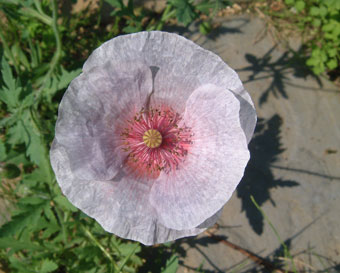
Another nice poppy showed up today ... a lavender-grey one with a pink centre. Once again it's a self-seeded Mother of Pearl.

I thought it was time I posted a picture of one of the vegetable plots, because they look lovely at the moment with everything growing away like mad. But you'll soon see why most of the photographs I post are tightly-cropped close-ups ... it's so you can't see what a scruffbag muddle everything is actually in. I dug this veg bed out of the lawn last year, so this is only its second season. That's my excuse and I'm sticking with it.

From left to right: tomato Pink Jester; climbing bean Mrs Fortune's (on wigwam); pea Champion of England (on other wigwam); sweetcorn Swift (F1); onion Hysam; garlic Music. There's also some Mascara lettuce and Cheltenham Green Top beetroot in the foreground and Red Duke of York and Fortyfold potatoes behind and God knows what else.

Wednesday, 21 June 2006

Midsummer!


It's that time of year again. Driven indoors by the stench of burning flesh as everybody in the neighbourhood dredges out their barbecues. I've been vegetarian for 15 years and the smell of roasting meat really turns my stomach. And just to add insult to injury it sets off my asthma.

I steeled myself for the unavoidable and denuded the Tewkesbury Baron apple tree of 10 out of its 12 apples, before they get too plump and shiny and untouchable. The tree didn't want to let go of them either, which made it harder. But it had to be done. I ate one. It was disgusting. But I was still delighted with it.

The other vegetables are doing well though and some things are now ready to harvest. Climbing French bean Mrs Fortune's (right) is working its way up the bamboo poles. Runner bean Black Magic is already at the top of its 7ft poles. The red-flowered broad beans are just producing the first mature pods, and although they are now being pestered by blackfly it's a fairly light infestation compared to other varieties. Pea Alderman is around 8ft high and yielding very generously ... the peas are so sweet it would be a crime to cook them, so I just stuff myself with them every day straight from the plant. Pods an' all. (Even when they're way past the mangetout stage, the pods are very edible if you peel away the hard starchy membrane on the inside and just eat the outer part.)

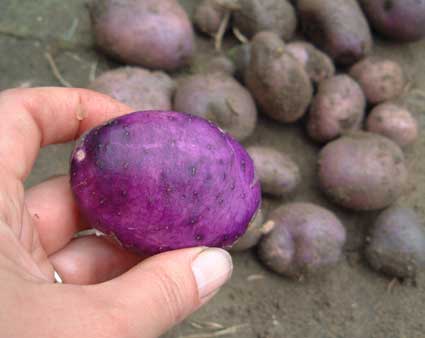
I'm also starting to harvest potatoes. I dug up a few plants of Edzell Blue, primarily because I've completely run out of growing space and needed to clear something to make room for other things. They are pretty much ready anyway, because they don't grow very big compared to modern spuds. As you can see in the photo, they are a beautiful colour and scrub up a treat. I cooked these as new potatoes, and very tasty they were too. Unfortunately they aren't ideal for boiling ... they lose their colour (they just end up a murky brown colour and the water goes dark green) and they also readily disintegrate, but you can't have everything.

Freshly harvested Edzell Blue potatoes, which look especially nice when they're scrubbed up

It may be time to declare a crop failure on the Grando Violetto broad beans though. They've been so badly afflicted by blackfly they've stopped growing altogether. They have a few pods which are developing OK but not much of a yield. Unless I pretend I was growing them as a green manure all along. Yes, that's it. I only wanted the nice nitrogen nodules on their roots. Blub.

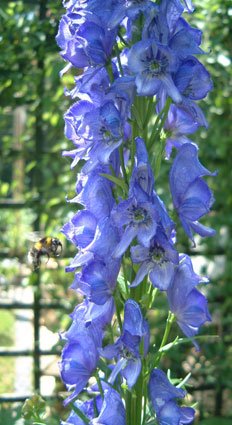
The wild part of the garden is coming along nicely. Look at this lovely monkshood flower spike (Aconitum napellus) with a bee just poised to shove its proboscis in there. It's highly poisonous but the bees love it. Having a wildlife-friendly garden has its downside though. I started work on a path I've been making between the fruit and veg plots, and had to move the polythene sheet I'd put down to kill off the lawn. I peeled it back very carefully, because there are usually slow worms under polythene sheets in this garden. They adore polythene. Sure enough, I uncovered an elaborate nursery of baby slow worms. There were four of them just under one corner. Very cute they were, only about 4 inches long. The dried up lawn had formed a layer of matting over the earth and they were sitting curled up in little round hollows underneath. They all poked their little faces up through the straw when I disturbed them. So it doesn't look like I'll be building my path now until the autumn. And neither can I walk on the polythene. Which means the only way I can access the fruit bushes for the rest of this season is by trampling over the vegetable plot and wading knee-deep through potato plants. Ah well, nothing I can do about it.

I saw a couple of ants attacking a ladybird today. I didn't know they did that. The ants were going ballistic but the ladybird seemed only mildly bothered.


And finally, I came across this mutant poppy, which has two flower heads on one stalk (although it actually seems to be two stalks fused together). Since taking this photo it has flowered, and the buds opened at different times. I have found a few other examples of this in other poppies around the garden so I assume it's just something that poppies do from time to time.

Saturday, 13 May 2006

Gloucestershire apples

Apple blossom: Tewkesbury Baron

Gloucestershire is in the middle of a major apple-growing region and once had a good roster of unique varieties with names like Crackstalk, Bastard Underleaf, Kill-Boys (allegedly that's what one of its rock-hard fruits did) and Hen's Turds ... half of which are now extinct. This February I planted three baby apple trees in the garden, all local varieties. Ashmead's Kernal is over 300 years old, has sharp-tasting pale green russeted fruit and originated in Gloucester about 7 miles up the road. Also 300 years old is Taynton Codlin, an acidic cooking or cider apple from the village of Taynton a few miles north of here. It's very rare these days and not a lot is known about it. And a mere youngster at 140 years old, Tewkesbury Baron (that's pronounced "Chucksb'ry" of course, as you'll know if you read my music blog) produces dark red apples, reputedly not especially flavoursome, but we'll see, and is also extremely rare. I got them from Lodge Farm Trees, a specialist grower of Gloucestershire and/or heritage apples, and very helpful they were too. They're connected to the Gloucestershire Orchard Group, an amazing bunch of people who have rescued dozens of rare local varieties from extinction. And since the bloke clearly makes his living from supplying entire orchards, it was especially good that he was happy to sell a few single trees to individuals like me, and meticulously explained how to plant and prune them. He also made sure I chose the right ones. Apples need partners to pollinate them, and they all flower at different times, which doesn't help. Tewkesbury Baron is very early, and flowers before Ashmead's Kernal has even bothered to show any leaves. But Taynton Codlin bridges the gap between them. That's the idea, anyway.