Showing posts with label Poppies. Show all posts

Wednesday, 7 July 2010

July miscellany

Papaver rhoeas
Is there anything more beautiful than poppies at this time of year? This is one of my Somme poppies (see below) but with white flecks.

My last couple of posts have been pretty demanding in terms of time and research, so I feel the need just to blather about more casual stuff today.

Tomatoes ... what can I tell you about tomatoes?

I have a greenhouse full of 'em, laden with flowers and green fruits. I've been doing a few crosses, in a half-arsed kind of way, but I consider them very much a sideline. For one thing, I get fed up with hand-pollinating tomatoes very quickly. In principle they are exactly the same as potatoes and all the instructions I gave in my potato-hybridising post should translate conveniently to tomatoes, which are of course from the Solanum family and have the same basic flower type, except that they're small and yellow. But I find tomato pollination much more frustrating. The small flowers are very fiddly to work with, and the anthers tend to be tightly fused into a cone, so you have to separate them with a careful incision ... they can't be succulently and individually plucked like potato anthers. They are quite a bugger to get off, in fact - which wouldn't be a problem if it wasn't for the fact that they are snugly clamped against a ridiculously fragile pistil. There's none of the "green bendy bit" as described in my pea video ... with tomatoes it's an unyielding green brittle bit. I've destroyed flower after flower by accidentally clonking the pistil off as I attempt to wrench at recalcitrant anthers. Some varieties have a pistil so fine and spindly you can barely see it. And when you do find it, the pollen has to be applied so lightly and delicately, because the tiniest shove in the wrong direction and the pistil is cast aside like a green splinter. Grrrr.

Before I put you off tomato breeding forever, I should mention that I have a preference for small tomatoes, which tend to come from small flowers. Many of the larger-fruited varieties have much sturdier blossoms which are relatively easy to work with. Ever wondered why large-fruited tomatoes are so popular among hobbyist breeders? Now you know.

Just to show that I can and do get successful hand-pollinations though, here is a product of my own fair wobbly hand.

Banana Legs x Green Tiger F1

It's an F1 hybrid of Banana Legs x Green Tiger, a cross I made in 2008. Let me admit now that I know very little about tomato genetics, and made this cross very much on a whim just to see what would happen. Banana Legs is an American variety derived from the breeding work of Tom Wagner, though it wasn't raised by Tom himself but selected from a batch of mixed seed bought from his TaterMater company in the 1980s. It's a long plum tomato with a bright banana yellow skin with silver-green stripes, and yellow flesh, and attractive lacy foliage. Green Tiger is something of an enigma, as I obtained it from a packet of Marks & Spencer's eating-tomatoes, and they claim it's exclusive to them (or it was, until me and dozens of other gardeners started saving and sharing its seeds). It has a dark olive green and red striped skin, dark red flesh, and is as round and shiny as a snooker ball, but with a better flavour. Intriguingly, the F1 is producing egg-shaped fruits, which are pretty much intermediate between the two parent fruit shapes.

My tomato experiments are always going to be limited though by the fact that I don't have the space to do it properly. It's all very well having this solitary F1 plant, as you don't need to grow many plants at the F1 stage. Next year when I come to plant the F2 I will have a problem, as I won't be able to grow more than three or four plants ... so it's pot luck whether I'll get any interesting phenotypes. That's fine though ... I have enough on my plate with the peas and potatoes, and can do without too many extra projects. I'd rather give away the F2 seed, if I can find anyone who wants some, so that those with more space and more tomato passion can make use of it.

Here's another tomato curiosity: variegated Green Zebra.

Green Zebra variegation
Variegated leaves on a Green Zebra tomato.

It would be nice if this was a heritable feature, but no such luck. It's a spontaneous somatic mutation - which is the posh way of saying that nature freaked out and made a cockup in the cell division, and the cockup then replicated itself, resulting in two different types of leaf tissue within the same leaf. As the cockup is in the cells of the leaf, and not encoded in the DNA, it won't be passed on to the plant's offspring. In fact this tomato is already reverting to normal fully green growth.

And funnily enough, there is a similar thing going on in one of my peas. This is a variegated form of the already lovely Buerre Cosse Rouge. Again, I'm pretty sure it's a somatic mutation and won't be passed on in the seeds.

Variegated pea leaves


Then there's my Wilfred Owen poppies, which were pretty much the first thing I wrote about when I started this blog in February 2006, and you can read the story of them if you're interested. The gist is that I collected wild poppy seeds from plants growing in a relic of a first world war trench on the Somme. The trench was, I believe, occupied by Wilfred Owen in January 1917 and his poem The Sentry was written about his experience in it. I've been growing the Somme poppies for many years in my garden, and they are rather lovely ... deep silky bright red with a distinctive black cross at the base, though they vary in how strongly the black cross is expressed.

Somme poppy
Somme poppy, with a partial black cross.

The native wild poppies of northern France probably haven't changed much since WW1, but during its tenure in my garden the Somme poppy has taken the opportunity to hybridise with some Mother of Pearl poppies I had growing elsewhere at one time. There's not a lot you can do about this; poppies are sluttily promiscuous and will cross over large distances. And I can't say it bothers me. I'm of the view that genes are the important thing, and outer appearance is secondary. I still get plenty of "true" Somme phenotypes every year, and additionally I get some beautiful variants like this.

Hybrid poppy
Natural hybrid between a Somme poppy and a garden variety. It has the perfect black basal cross of the Somme type with the pink radial stripes of Mother of Pearl.

And finally, a whinge.

When I moved into this house/garden, there was a trellis fence along the western boundary adjoining my main vegetable plot. The previous owner, who was also a keen vegetable gardener, had made a point of having a fence there which let full sunlight through to his vegetable plot. Well, my next door neighbours just took it upon themselves, without consulting me, to remove the trellis fence and replace it with solid 6ft panels. I can see why they didn't consult me. They knew very well I would object, on the grounds that I now have a permanent shadow along a sizeable strip of my vegetable plot. They didn't even do a tidy job ... I'm sure it looks immaculate on their side but they've lumbered me with scrappy bits of wooden battens with sharp nails sticking out of the wood. As they just went ahead and did it, the only recourse I have would be to try to force them legally to remove it. Do I want to get into legal shenanigans with people I have to live next to? No, not really. But all the same, I am well pissed off.

I get on fine with the neighbours and haven't had any dispute with them before, although our garden ideals are polar opposites. Their garden is polished and scrubbed with lawns as sterile as astroturf, and mine is a voluptuous muddle. That, it seems, is the reason for the fence - the missus got fed up with untidy things from my garden growing through the trellis. They have no knowledge of the work I do with my scruffbag plot; they just find it baffling that I grow vegetables for seed and don't eat them. Why save seeds when you can get them for 99p down B&Q? The concept of breeding new varieties and conserving heritage ones meets with blank incomprehension. It's just a different outlook on gardening, and neither of us appreciates the other's aesthetic or way of doing things. At least now they won't have to worry about my dandelion seeds contaminating their garden, and I won't have to worry about their chemical sprays contaminating mine. The privacy is also a blessing. But I'm still pissed off.

Taking a fence
Yes I know it's extremely childish, but it makes me feel better.

Monday, 9 July 2007

Today in the garden .... some occasional bits of summer


It looks quite nice when the sun's on it, dunnit?

Despite weeks of torrential rain and blustery winds the garden doesn't take long to start looking summery when the sun finally comes out. There was some nice weather over the weekend and I managed to catch up on a lot of weeding, hacking, unchoking and fending off of encroaching brambles. Even so, the garden has a bit of a voluptuous feel to it this year, kind of hovering on the edge of being out of control. What you see in the above photo is the bottom end of the garden which is a bit on the rampant side (the very bottom where the trees are is completely wild anyway ... I leave all that to the faeries). The very tall spikes of pale blue flowers are clary sage (Salvia sclarea), an obscure medicinal herb which I grew from seed. It is beautiful, but I confess I had no idea it was so bloody enormous. I sowed it expecting it to be like the tame little shrubby things which provide us with sage and onion stuffing. The equally tall darker blue flowers behind it are aconite, or monkshood (Aconitum napellus), a very poisonous herb (grown for academic interest only, and for its beautiful flowers). Then there are the Somme poppies, which have completely subsumed two tomato plants and a row of carrots. There is actually a concrete garden path running somewhere up the middle, but I haven't seen it since April.


And here's a closer view of one of the Somme poppies, with some rather lovely deep red veining in its petals (most of them don't have this, but poppies are very diverse). The seeds for these came from one of several trips I made to the WW1 battlefields ... I collected them from the remains of a trench which was known to have been occupied by Wilfred Owen in 1917, near the French village of Serre. They are botanically the same as wild British poppies but tend to be much larger and deeper red. Poppies are highly attuned to the cycle of cornfield cultivation and will wait (for years if necessary) until the soil is dug over before they germinate. This super-sensitivity to soil disturbance is the real reason for the mass germination of poppies over the WW1 battlefields ... they assumed four years of being relentlessly pounded with mortar shells was a sign of very thorough cultivation. (I'm sure there's some deep philosophical lesson in that if I could be bothered to think it through properly.)


And lastly, the ginger peril. Doesn't he look cute? I let him have a rummage around in the shed the other day. He is a very naughty cat, but there's not much opportunity for him to do any damage in the shed, I thought.

Ha ha ha.

Somehow he managed to knock over a tin of emulsion paint. All over the lawnmower.

He's not allowed in the shed any more.

Thursday, 5 July 2007

Today in the garden .... bleeuurrgh!

Wild white campion, grown from seed I collected locally, is one of the few things still looking good in the garden at the moment.

My garden is in a very sorry state at the moment. I have a few nice flower pictures taken over the last two or three weeks, and those will have to do for today's blog because the veg plots are a mess. Most of May and June had very turbulent weather, which has become far worse in the last week or two. It has been really bad for some people in the UK, so it seems churlish to complain about my vegetables when others have had their homes devastated ... but even so, I find it quite depressing to go out in the garden at the moment. (Quite apart from the risk of getting soaked.)

For a start I've been unable to get out there much to deal with routine jobs, so the lawn is like a hayfield and the weeds are springing up everywhere. But there's also a huge problem with disease which I've never had on this scale before. All over the vegetable beds, things are blighted, mouldy and rotting.

The pattern of the weather for the last couple of months has been constant warmth and frequent bursts of intense pelting rain. The rain barely has a chance to soak away before the next lot comes. Everything is soaking wet, pots need baling out on a daily basis, and some plants are being damaged by the force of the rain or the blustery winds. They're probably rather confused about what season it is, because they had a kind of 'summer' in April and it's been warm and wet ever since. But the biggest problem is that warmth and wet is the perfect environment for some of the worst bacterial and fungal diseases to thrive and spread. The most deadly of all these is blight, and yes – I now have blight in my garden.

Let's look at another pretty flower picture. This is Allium christophii with a California poppy growing up through it.

I don't ever recall having blight strike this early in the season. Last year it didn't come till September. So far it's only making itself manifest on a few potatoes, but once it starts to appear it's really only a matter of time before it devastates every potato and tomato in the whole garden. It's very frustrating, because even just a few years ago it wasn't really a problem. According to Alan Romans in his Potato Book, there used to be only one type of blight in Europe, which made only asexual spores. Then a second blight type arrived in a consignment of infected potatoes from Mexico. So now blight reproduces sexually and asexually and is really having a very jolly old time at the expense of potato and tomato growers. And all the while, whichever type it is, it's mutating like the clappers. The spores are wind-borne, so there's not really any way you can keep it out of your garden. **shakes fist**

Less devastating, but still very annoying, is the garlic rust. I picked off the worst affected leaves a few weeks ago, but now the remaining ones are completely encrusted and there's not much more I can do. The orange crusty bits turn black when they're about to release their spores, so I tried to pick off all the leaves with black bits as soon as they appeared ... and it seems to have helped, because the ones I picked the leaves off are thriving better than the ones I left alone. But even so, they are all in an appalling state. It shouldn't directly affect the bulbs underground, but plants need their leaves to provide nourishment, so a really bad rust attack can choke the plants and reduce bulb size. For some reason it's only affecting the hardneck garlic. I'm growing one softneck type, Solent Wight, and that's absolutely fine (though it never produces good sized bulbs in my garden anyway). I don't know whether softneck garlic is more rust resistant or whether it's a special property of Solent Wight.

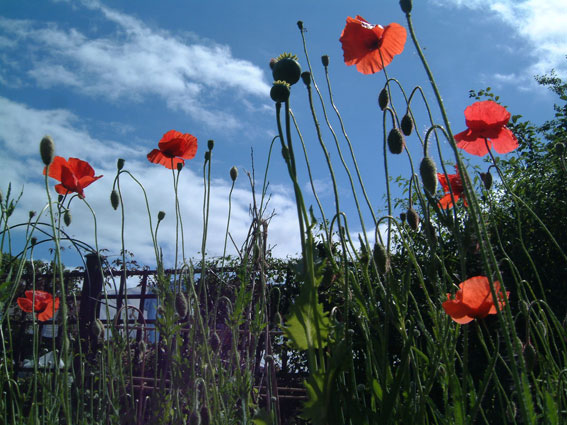
Some plants are loving the warm wet weather. My crocosmia flowers are better than I've ever seen them. And also the Somme poppies ... most days the flowers have been pelted to smithereens by the rain but they have kept producing more ... and they're bigger and brighter than ever before. Poppies have a lot of variability in their flower size and colour depending on the growing conditions, and the moist soil obviously suits them.

Wild poppies from seed collected on the Somme. They are doing fabulously well this year.

My blogging is a bit sporadic at the moment because I'm getting very close to releasing my album at last, and it's all gone a bit manic. I've just been working on the final-final-final mixes – as opposed to the final and final-final mixes, because every time I listen to them I hear something else I want to change. Is that mandolin too loud? Would that vocal sound better panned to the left instead of the right? It can get quite obsessive. Of course if I was a rock star I would have somebody else do all this for me, but due to a combination of thriftiness and control freakery I am my own producer and engineer. But yesterday I sent off all the tracks to the record label (hurrah!) so I can't tinker with them any more. Not that that's the end of the hard work by any means ... I still have all the legal and marketing stuff to deal with. Tsk ... I thought being a musician meant I'd be able to sit around strumming a guitar all day, but it's actually just as much work as being a graphic designer. (Oh, and that's my next job ... because I'm an ex-graphic designer I'm doing my own CD booklet design too. Aaargh!)

Thursday, 7 June 2007

Poppy days are here again

Iceland poppies, Papaver nudicaule. These are actually golden yellow with orange streaks ... the camera hasn't managed to capture the colour very accurately. Despite its name this species of poppy originates in Asia.

The camera also freaked a little in trying to capture the intense red of this newly opened California poppy (Eschscholtzia californica) with fluted petals and orange streaks ... but you get the idea.

Another view of the Patty's Plum oriental poppy (Papaver orientale).

A common wild field poppy, Papaver rhoeas, self-seeded in a pot on the patio. Poppies have a curious ability to express their flower size according to the available conditions, and this rather small bloom is typical of what happens when they grow in pots.

Wednesday, 30 May 2007

Today in the garden ... potatoes and poppies

Here's the first of the oriental poppies (Papaver orientale) and this one didn't flower last year so I'm all the more grateful for it. It only produced this one bloom which opened just as the weather changed and it got pelted with fierce winds, rain and hailstones, but it survived. It's a variety called Patty's Plum.

I must thank Vicki of I Need Orange for linking me to some info about the blue speckled slow worm I recently posted a photo of. (She has some pretty amazing wildlife photos on her own blog, by the way.) Apparently they sometimes develop the blue colour when they're three years old or more, especially in coastal areas (I'm in the midlands, but never mind). I didn't know slow worms lived for multiple years, but that one was quite a whopper, admittedly. It's now living under a black polythene sheet in the middle of the veg patch and somewhat thwarting my tomato planting as I dare not move the sheet. As they're a protected species and they do a sterling job in munching slugs and snails off the vegetable patch, priority goes to the legless reptiles. (And we all know a few of them, right girls?)

And another beautiful item of wildlife, courtesy of next door's pond, is the damselfly. Available in two colours, bright azure and bright red. Here's one of the red ones, perching on a leaf on one of my heritage peas. They are smaller than dragonflies but just as welcome in the garden and also more likely to hang around long enough to be photographed.


I got an electric shock off a beetroot today. I'm not sure who was more surprised, me or the beetroot. In fairness I had just been stroking one of the cats so that must have built up a static charge which zapped when I touched the leaf. I've had a lifelong problem with static electricity ... when I was a kid I had to have other people open car doors for me because if I touched any part of the car (plastic, metal or glass, inside or out) I would get a really nasty electric shock. Thankfully it's nowhere near that bad these days but I'm still more prone to static shocks than most people and I've never found out why.

Talking of beetroot, I've read in several gardening books that you must never, ever allow leaf beet to run to seed at the same time as beetroot because they will cross with each other and both be ruined. Well I can't resist a challenge like that, so I've got three of last year's Cheltenham Green Top heritage beetroots sprouting nice big flower spikes among the similarly robust flower spikes of last year's Bright Lights chard (two pinks and a scarlet). Chard and beetroot are both the same species, Beta vulgaris, which is a rampant outbreeder so they cross like the clappers. They do however have minor varietal differences, with chard (var. cicla) producing nice succulent stalks and leaves, and beetroot (var. conditiva) being optimised for plump edible roots. If you cross them you will probably end up with the worst of both worlds ... inferior roots and small leaves, at least for the first generation or two. But with a little patience and careful selection they should start to separate out in lots of different ways. And that could *possibly* result in beetroot infused with some of the beautiful intense pinks and reds of leaf beet. Modern beetroot breeding has focused on other factors of commercial importance to farmers, such as "monogerm" varieties (seed clusters which only contain one seed instead of the usual 2-5, eliminating the need for thinning). I don't know of anyone who's trying to produce new beetroot with beautiful leaf and stem colours. So that seems like a good reason to try it. And as always, the beauty of amateur plant breeding is that even if it's a total cockup, you can still eat it.

Everything you ever wanted to know about beetroot can be found in this wonderful eBook, made freely available to all by the generosity of its author Stephen Nottingham.

May I also draw your attention to the much underrated flowers of the common spud? Well, this is not one of the really common ones but it's enjoying a renaissance in the UK ... Salad Blue, which is not a salad potato at all, being very dry and floury, but it certainly is completely blue. I don't rate it that highly for flavour but it produces very interesting blue mashed potato which has health benefits over ordinary white-fleshed potatoes. And as you can see, it has very pretty flowers sporting blue-violet petals and unusually dark anthers. It's the first of my potatoes to flower this year, and no doubt I'll be posting more pictures of spud blossoms over the coming weeks as some of them are very beautiful.

The dusky blue flowers of Salad Blue potatoes.

Thursday, 3 May 2007

Well here we are in May already ...

California poppies, from seed I sowed last year. They overwintered without any protection and were in flower by late April. Pretty good going I reckon!

Oh dear, I have been most remiss in keeping my blog up to date over the last month. I've been totally wrapped up in getting everything sorted out for my album, which is a month behind schedule and still not ready for release, but it's getting there.

So I thought I'd just catch up a little by posting some pictures taken in the garden today, since everything has been growing away nicely in spite of me.

One of the things I love about California poppies is the groovy little witches hats they produce when they're in bud. As the flower unfurls, the hat slides off. Then another one appears as the seedpod develops.

Meanwhile, I should be able to make a start on some pea breeding work in the next few days. I'm trying to produce a new purple mangetout (snow) pea for The Real Seed Catalogue based on a cross between their yellow-podded mangetout Golden Sweet and a purple-podded sheller, Desiree. They sent me some seeds to start me off and I've been growing them side by side in a bamboo frame and hoping to goodness they'll both flower at the same time so that I can do some hand-pollinations. Fortunately, as the pictures below show, they are looking to be doing just that.

I've grown Golden Sweet before, but I didn't know much about Desiree before I started growing this crop. I'm a bit surprised to find it's a dwarf variety (or at any rate, doesn't seem inclined to get beyond about one and a half feet). The reason I'm surprised is that all the other purple-podded peas I've collected have been tall varieties which reached at least five feet ... so I'd kind of taken it for granted that this one would be too.

You can tell when Golden Sweet is getting ready to flower because it starts to show a lot more yellow colour in the young leaves and stems. And the buds are quite easy to spot as soon as they start to form because they have pale cream-coloured sepals (those are the little spiky bits that make up the 'pixie-hat' around the flower) which stands out visibly from the greeny yellow of the leaves. Another peculiarity of this variety is that the flowers never really open out properly, but to make up for it they do go through some beautifully dramatic colour changes.

This Golden Sweet flower bud is at about the right stage for hand-pollination. Yes I know it's tiny, but peas are extremely efficient at self-fertility, so if you don't catch them early in the bud stage it'll be too late to do a cross with another variety. This bud is so small it hasn't started to open or colour up yet, and the petals are still tucked away under the sepals ... but the female stigma will be receptive by now, so this is the right time to make a cross by introducing pollen from another flower.

To find flower buds on Desiree I have to delve into the foliage because they're a bit less developed, but they are there. Here you can see a whole cluster of tiny flower buds, which have a distinctive purple flush on the sepals. These are too young for hand-pollinating, but soon, soooooon ...

As it's going to be a few days yet before Desiree is ready for pollinating, I may start off by making a different cross. I will have no shortage of flowers on these plants, so I can make as many crosses as I like as long as I label them properly. The only other pea that has flowers open at the moment is the dwarf sugarsnap, Sugar Ann. So I may as well try crossing Golden Sweet with Sugar Ann ... the obvious outcome would be the possibility of a yellow-podded sugarsnap, which would be nice, but actually these varieties are so different almost anything could happen. So it must be worth a go.

The flowers of Sugar Ann look a little different from the other peas I grow ... they have very wide open wing petals, so the innermost keel petal (which is normally fairly well hidden) is exposed. I don't suppose it makes much difference to anything, it's just an observation.

Sunday, 18 February 2007

The purple pimpernel

Self-seeded annuals like this field poppy (Papaver rhoeas) are always welcome in the vegetable garden (photographed last summer)

I managed to get outside today and get on with some weeding. Even at this time of year when there are very few crops growing, weeding is a delicate business for me and has to be done carefully. That's because I'm selective with my weeds. In all the veg beds I allow annual flowers like poppies and calendula to self-seed. I've had to get good at recognising different plants at the seedling stage, so that I know what's what. Field poppies like the one above have not really got started yet, but I have quite a few California poppies which have successfully overwintered and there are also some new self-seeded opium poppies, so I have to carefully hoe around all those. I love opium poppies; not only do they have the most beautiful colourful mop-headed flowers but the bees go absolutely nuts over them. These pollen-rich flowers are a good thing to have in the vegetable plots because they attract hoverflies, bees and other beneficial insects, quite aside from looking gorgeous. The result is a mini-ecosystem with lots of biodiversity and natural pest resistance, thrumming with life. I don't subscribe to the idea of having a separate flower border and vegetable patch. In this garden it all gets shoved in together.

I'm also careful to preserve any scarlet pimpernels I come across, at least until they flower. Now that probably does seem a bit mad, because the scarlet pimpernel is a bogstandard weed in the UK with pretty flowers but no obvious garden merit. But mine are special.

When I first moved here in 2004 and the whole garden was laid to lawn, I spotted something with purple flowers growing through the grass just as I was about to run the mower over it. It took me a moment or two to be sure it really was a scarlet pimpernel because I've never seen one with any flower colour other than the usual creamy scarlet-orange. I spent the rest of the season carefully mowing round it, which meant I had a weird sticky-up tuft in the middle of the lawn all summer, but needs must.

Scarlet pimpernels are not always scarlet (photo taken last summer)

I know nothing about the genetics of scarlet pimpernels. And I don't suppose anybody else does either. Research on plant genomes is limited almost exclusively to economically important crop plants, and there's not much funding available for garden weeds. So I can only hazard a guess at why this plant had purple flowers. It could be a recessive gene which is commonly present in the landrace (wild plant population) but rarely gets a chance to express itself. Or it could be a spontaneous mutation, a natural "mistake" in the plant's DNA. Either way, I only had the one plant so my only option was to save its seeds and hope some of its offspring would be purple. There was no guarantee at all that they would be.

In 2005 I spread the seeds around the garden and let nature do its thing. To my delight, several of the plants turned out purple-flowered. I started weeding out any 'normal' scarlet flowered pimpernels and just left the purple ones to mature and self-seed. In 2006 there was another increase in their number.

So now I appear to have my own strain of purple pimpernel. If you're wondering what's the point, there isn't one. I just like having something different in the garden even if it's a weed. And why not? I don't know how common purple pimpernels are but it's something which my garden gave me spontaneously, so I treat it as a gift.

Wednesday, 13 September 2006

Today in the garden ... scrumpy

I thought I'd seen the last of the poppies this year, then along came this translucent purple-black opium poppy. It self-seeded from Black Paeony, which is a fully double (frilly headed) variety, but this one has come out single-flowered. That's poppies for ya!

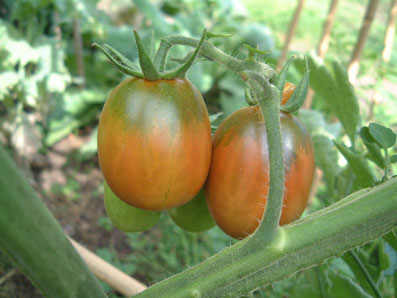
My Black Plum tomatoes are finally showing signs of ripening after what seems like weeks of sagging under the weight of large, dense, bell-shaped green fruits. They have now taken on a dusky dark orange hue and look quite unlike any other tomato I've seen. There's also one missing from the biggest truss, although there's no sign of it on the ground. I've noticed this a few times now, semi-ripe tomatoes disappearing off the vine overnight never to be seen again. Either some critter is scampering off with them or my neighbour has been using a stick with a hook on the end to scrump them through the fence. (Me? Paranoid?)

Black Plum contemplates the possibility of ripening. And yes, it is meant to be that weird colour.

Meanwhile I've been keeping a close watch on my one and only Taynton Codlin apple, because it appears to be naturally green all over and therefore difficult to judge when it's ripe (and unlike tomatoes, you can't really squidge them to see how soft they are). This morning when I did my tour of the garden I found it had fallen off the tree altogether, which I took to be a reasonable indication of ripeness. So ... only a few months after I bought these trees as flimsy twiggy one-year-olds I am doing my second heritage apple tasting. I had expected to have to wait about five years.

One thing I need to explain about this apple is that I know next to nothing about it. There is no information out there, it's so rare. It's not listed in my apple encyclopedia, nor on the Brogdale National Collection database, so when I eat it I'll be biting into uncharted territory. All I know about it is that it originated locally in about 1700 and it's a cider/cooking apple, which could mean anything really. My mum, who is a Somerset lass and knows a thing or two about cider apples, says it probably means it'll have a tartness that takes the roof of your mouth off. Sounds good to me!

The first striking thing about this apple is the scent. I don't think I've ever come across a more aromatic apple ... just having it on my desk it's filling the room with exquisite appleness. It's a beautiful aroma, quite different from the bland crap you get in the shops. Unlike the Tewkesbury Baron, which I photographed from a particular angle so that you couldn't see the brown blotchy bits on the other side, this apple is flawless. It has natural lumps and bumps as befitting a 300-year-old cider apple but not a single blemish. And it was organically grown too. I'm impressed.


The skin is quite waxy and although it has a dull matt sheen it polishes up to a high gloss. The colour is a really bright pea green which is consistent all over.

I will do a taste test but in all honesty it smells so good I just have to leave it sitting on my desk for a couple more hours ... *sigh* ...

6 hours later ...
Mmmm, wonderful! The skin is a bit on the chewy side, and the pale green flesh oxidises and browns very rapidly, but the flavour is fantastic. Very acidic, very sharp, with none of the crabapple dryness I was expecting. A real acid-drop sensation with an intensely appley flavour. It's definitely not for the sweet-toothed but it's very very lovely. The flesh texture is crunchy and juicy. And if this is what our rustic ancestors used to make cider with then it's a wonder they didn't just sit around pissed all day. (Oh, er, actually ...)

What a joy it's been to rediscover these old apples. I pretty much stopped eating apples many years ago because I can't stand the homogenised supermarket varieties, boring and sweet and watery. I don't even like the mushy and over-rated Cox which is about the only old-fashioned English apple still readily available. In recent years I've found a local farm whose orchard shop sells a decent range of apples which taste massively better, and it's worth going there just to listen to the farmer's "I can't believe anyone really talks like that" Gloucestershire accent. But the fruit on these old local varieties, which I didn't even have a chance to try out before I committed to planting them, is out of this world.

Saturday, 12 August 2006

Today in the garden ... the phantom rummager

Newly harvested Mr Little's Yetholm Gypsy potatoes ... can't get enough of these beauties.

On the whole I've had a slow week in the garden again. The muse has been upon me and my hands have blisters from guitar playing.

But a mystery is unfolding out there. Every night some unidentified critter has come along and ransacked the pots on my patio. It's wrecked several trays of seedlings and pulled stuff out of tubs. And now it's taken to digging out seedlings in the garden too.

I assume it's a small nocturnal mammal of some sort, but I don't know what it is or what it's looking for. It doesn't eat the plants or their seeds, it just rummages about in the soil medium, casting aside any seedlings which get in its way, then buggers off. Leaving me to replant everything in the morning.

The first thing it went for was a large half-a-beer-barrel tub in which I'd sown some nasturtiums and California poppies. The whole lot got raked out night after night no matter how many times I resowed it. Then while I was away in Wales it hoiked a good sized Sweet William seedling out of its pot which I'd been nurturing for months.

I thought I'd foil the little blighter by putting the seed trays on top of a large wire cage I have in the corner of the patio (I use it to thwart the snails in spring). But it managed to get up there and drag all the seedlings out of their pots again. I have one safe place ... the top of a patio table ... and that's where I'm keeping my precious experimental pea seedlings. Everything else gets rummaged.

So I'm baffled ... and somewhat fed up with having my horticultural efforts wrecked on a nightly basis.

I planted out some more pea seedlings this week, since Ezethas Krombek Blauwschok is already producing good sized plants and I have a new batch of Mr Bethell's Purple Podded on the go. At this time of year the priority is to get stuff into the ground so that it can make the most of what's left of the growing season ... very different from springtime, when I let things grow for longer in their pots to give them a sporting chance of surviving the snails. Snails are now being efficiently controlled by the frogs and slow worms and aren't a problem. So the only hindrance the plants face now is the phantom rummager, which has hoiked several pea seedlings out of the ground altogether and dug neat little scrapes around the bases of all the others. Bastard.

The patch of ground recently vacated by the onions is now becoming a pea patch. I'm planting them out a bit more widely spaced than the earlier crop, in the hope that keeping a bit more air circulating around them will minimise the impact of powdery mildew. My experience is that most heritage varieties have poor resistance to it (one exception being Ne Plus Ultra and I'll be trying some of that next year) and this late crop is more at risk since it'll be setting pods in the moist autumn weather. But the peas are certainly hitting the ground running ... they grow very quickly at this time of year, especially if you keep them well watered. I dug in some manure and seaweed meal beforehand to enrich the soil. I've run out of pea sticks though and had to cut some new ones from an obliging tree. Fortunately the Ceanothus tree had a ready supply of dead branches of exactly the right size, and has just the kind of straggly spindly twigs that peas love.

A fanfare please for the emergence of my first F1 hybrid pea! The ones in the tubes behind it are Golden Sweet ... no germination problems at all with those.

The pea in question was one of those huge ones which appeared in the photo in my 28th July post. You saw how big it was straight from the pod ... well it swelled up even more when it was planted. I can see it under the vermiculite and it now looks more like a grape than a pea. And the good news ... you can't really see this in the picture, but the emerging seedling has a distinct purple blush on the leaf veins. That means it's definitely the result of a successful cross, because it came out of an Alderman pod and pure Alderman seedlings don't have any purple on them at all. And secondly it's consistent (so far) with what I'd predicted, that the F1 offspring are expressing the dominant A gene which enables purple colouring.

It's interesting (well it is to me anyway) to compare it with the Golden Sweet seedlings growing on the same saucer. They germinated much quicker, so although I planted them more recently they're at about the same stage. Thing is, although they're a yellow-podded variety they're showing more purple colouring in the stems and leaves than the purple-podded types. So Golden Sweet must have the same A gene as the purple-podded peas, which I should have realised as soon as I saw the purple speckling on the seeds. Gene A switches on the plant's ability to produce anthocyanin, the chemical pigment which produces red, blue and purple colouring; but a series of other genes, some dominant and some recessive, control where in the plant the colour appears. Presumably Golden Sweet has a gene which puts a splash of anthocyanin into the seed coat, and another that fills the flowers with it (the variety has unusual purply blue flowers), and another yet that keeps it out of the pods so that they express a beautiful golden yellow colour.

My non-gardening neighbour, whose back garden is a tangled mess of overgrown grass which he rarely ventures into, had some beautiful California poppies glowing amid the weeds earlier this year. Just the standard orangey-gold ones, but really beautiful specimens. I coveted some, but I was too shy to go round and ask for some seeds, and although much tempted just to leg it over the fence while he was out at work, I never did. But nature has provided; a self-seeded California poppy flowered in my garden today and showed itself to be the same type as next door's. I'm very chuffed with that.

And talking of poppies, I still have a few late flowers on the Mother of Pearl poppies but at this point in the season they often come out smaller and more crinkly than normal. Like this white one, which had smooth single flowers a month or two ago and has now produced this small frizzy double flower, which I rather like.

Monday, 10 July 2006

Today in the garden ... a lot of bluster

A poppy from the Somme growing with wheat in my wild garden

The recent rains may not have done any damage but the wind has been ferocious over the weekend and that has caused some havoc. A huge branch came down off a mature lilac tree in the middle of the garden. Fortunately it fell onto the lawn and didn't wreck anything (or anyone) in the process. It might actually be a blessing because it should let more light through into the borders behind it (which have become so shady almost nothing will grow there) and the bottom half of the branch itself is thick, 5ft long and perfectly straight ... a veritable pole, which is bound to come in useful for something if I strip the leafy bits off and dry it out.

Unfortunately the strong winds did some damage to my beloved Alderman pea plants, which is entirely my own fault because they weren't supported properly. I'm hoping they'll survive long enough to provide me with my experimental hybrids and a few more opportunities to stuff my face with their bounty. I did the second stage of the pea pollinations, i.e. re-pollinating the ones I did yesterday. Or four of them, anyway. I couldn't find the other one. Despite my use of very eye-catching gold braid tied around the buds some of them seem to just vanish into the greenery never to be seen again. Even the purple-podded pea has a gold-braid missing, and I know exactly where I put them all (there are only eight plants, so they have nowhere to hide). I'm beginning to suspect the faeries come out and untie them during the night.

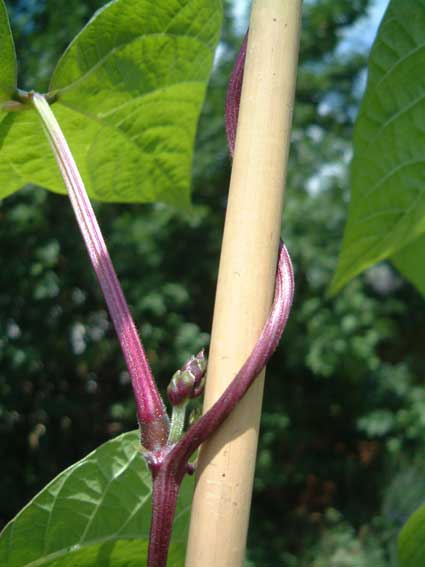
Climbing bean Kew Blue has some of the nicest colouring of any vegetable in the garden

In the bean garden, Kew Blue has started flowering. The buds are a rich purple but open up into a slightly scruffy pink-mauve flower. No pods yet either ... the first few flowers have fallen off without setting. That seems to be normal though for most beans. While they're actively growing the plants seem to focus all their energies on surging upwards. Trionfo Violetto, whose flowers are a similar colour but more elegantly presented, has started to set pods now. The Meraviglia di Venezia (both these varieties are from Seeds of Italy) is growing faster and has reached the top of the arch but has not flowered yet (it's a late maturing variety).


The blackcurrants are yielding some excellent fruit at the moment. There are three main bushes in the garden and I think there's at least two different varieties there, as they taste noticeably different. I've no idea what varieties they are, mind. All I know about them is that they have been here since 1967, because the old lady who owned the house before us told me she brought them here from her previous garden (on the west side of Cheltenham). So they are over 40 years old. And one of them in particular has the scrummiest berries I've ever tasted, really strong and complex in flavour (but then I have weird tastes because I like sharp-flavoured fruits much more than sweet ones). I don't think they'd been pruned for 40 years either, judging by the state they were in when I moved here, but they have regenerated successfully from the rather drastic remedial action I took on them. They were literally bearing their feeble yields on the tips of 5ft long horizontal branches which were dry and dead and clattered together like old bones ... they gave me the creeps as well as taking up an entire border on their own. I had to take the risk of killing them by cutting them right down to the original stem (or trunk, rather) and fortunately they decided to survive and resprout, and are now fruiting, albeit in smallish amounts at the moment, on healthy new branches. I've taken cuttings too.


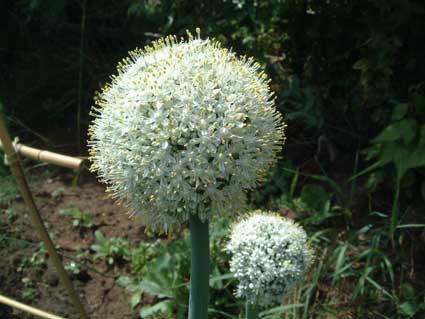
Something else that's nice at the moment is these onion flowers. I've been growing them for seed and have been surprised at how beautiful they are ... as lovely as the drumstick ornamental onions like Allium giganteum, only white. This variety is Jet Set, which originally came from Chase Organics. I've got 20 or so plants here but I'm only going to keep the best six. The others are being grown solely as pollen providers. This is because onions are outbreeders (see my post on F1 hybrids if you want an explanation of why this matters) and need to spread their genepool more widely. If I just grew the six plants there is a higher risk that their offspring would be feeble and pathetic due to inbreeding depression. They are pollinated by insects of various kinds ... flies, moths, hoverflies ... who just seem to land on the flower heads and stand around for a bit, then fly off somewhere else. But it obviously works. A couple of days ago I was out there in the twilight watching a moth giving one of the flower heads a good trampling. Although it was just walking around, it was beating its wings so fast I could only see them as a ghostlike blur.

Tuesday, 4 July 2006

Today in the garden ... purple pods


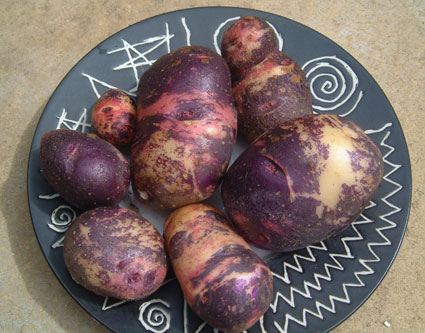
Last night's dinner included some of the Edzell Blue potatoes and red-flowered broad beans. I tried baking the potatoes this time but this obviously isn't one of Edzell Blue's strong points. They have too much dry matter in them and go very floury, and the flavour isn't very inspiring. The skins go extremely crispy and leathery and take a lot of chewing. Some people like their jacket potatoes that way ... but I've had a lot better. When I discover which cooking method does suit this beautiful but fickle spud I'll let you know. The red-flowered broad beans, on the other hand, are the best I've ever tasted. They have slightly smaller beans than the modern varieties I've grown in the past, but they taste fantastic with no bitterness in them at all and only need to be lightly steamed. The plants are more blackfly-resistant than any I've ever grown, which in practice means higher yields. I got my seeds from W Robinson & Son and they may in fact be the only supplier of this variety, although I've also seen it doing the rounds on the HSL seed swap. Highly recommended.
Apple Taynton Codlin coming along a treat

The fruit garden is going like the clappers ... most things are ready to harvest now. I have more raspberries than I can possibly use for anything, mainly because the bushes I inherited as part of the garden are a crappy type which all ripen in one enormous simultaneous glut. The flavour isn't much to write home about either. I'm intending to replace them with Autumn Bliss which is massively better and definitely my raspberry of choice. The only fruit failure so far this year is my miniature peach tree, which has taken umbrage at something and dropped all its fruits in disgust. Bloody temperamental thing. Meanwhile my single solitary apple is swelling nicely.

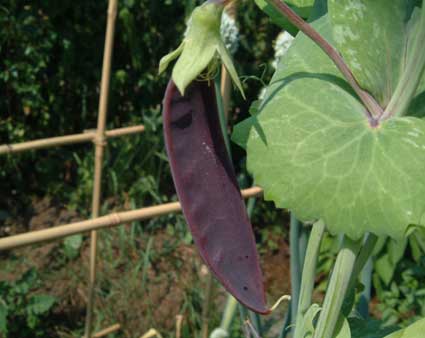
Well, here's the evidence. Mr Bethell's Purple Podded has purple pods.

How about that then. Purple podded peas. They start off green when the flower first dies off but within a day of exposure to the sun they go this shiny purple-maroon colour. Another thing I really like about this variety is that the sepals on the flower buds are speckled with maroon, especially while they're in the bud stage. It's very pretty. And with the flowers changing colour all the time I'm wishing I planted it closer to the house where I could stare at it more. Mine bears some of its flowers upsidedown; I'm not sure what that's all about. I'm not finding it to be quite as vigorous as Alderman, but that's hardly surprising. I suspect Alderman has been hybridised with a triffid.
Pollinations done today (it's technically too hot for it, but the others I did the other day seem to have taken all right):

Champion of England: one bud pollinated with Mr Bethell's Purple Podded
Mr Bethell's Purple Podded: two buds pollinated with Champion of England
Alderman: three buds pollinated with Mr Bethell's Purple Podded; two with Champion of England

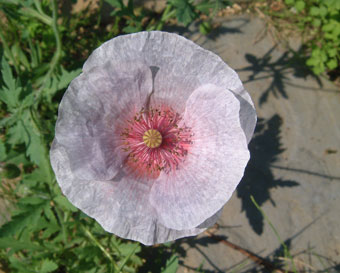
Another nice poppy showed up today ... a lavender-grey one with a pink centre. Once again it's a self-seeded Mother of Pearl.

I thought it was time I posted a picture of one of the vegetable plots, because they look lovely at the moment with everything growing away like mad. But you'll soon see why most of the photographs I post are tightly-cropped close-ups ... it's so you can't see what a scruffbag muddle everything is actually in. I dug this veg bed out of the lawn last year, so this is only its second season. That's my excuse and I'm sticking with it.

From left to right: tomato Pink Jester; climbing bean Mrs Fortune's (on wigwam); pea Champion of England (on other wigwam); sweetcorn Swift (F1); onion Hysam; garlic Music. There's also some Mascara lettuce and Cheltenham Green Top beetroot in the foreground and Red Duke of York and Fortyfold potatoes behind and God knows what else.

Saturday, 1 July 2006

Poppy gallery

Somme poppies: collected from a French trench 10 years ago and seen here growing with wheat

As today is the 90th anniversary of the Battle of the Somme, an event I've delved into all too deeply in the course of my researches a few years ago, I'm posting up some pictures of the poppies which are growing in the garden at the moment. Starting with a photo of the French landrace (wild stock) I collected on the Somme, from the ditches of the British front line in the village of Serre, which was part of the Somme battlefield. I've already blogged the story of how I found them. I've had a 'thing' about poppies ever since.

And having looked through so many images of the First World War, it was quite weird today how the TV pictures of defeated England footballers with their slumped and heavy limbs looked uncannily like the photos of the soldiers who came off the fields of the Somme. You could read quite a few levels of symbolism into England's misfortunes and mistakes.

All these pictures have been taken in the last couple of days.

Opium poppy (Papaver somniferum) grown from seed I collected on a disused railway line near Cheltenham station


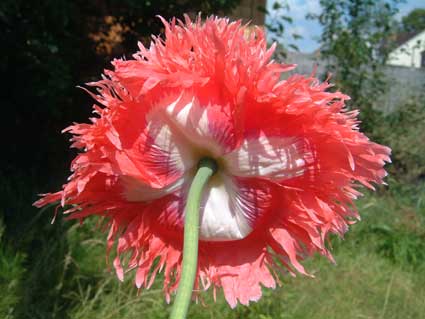
This frilly-headed opium poppy with a white base appeared out of nowhere: it's a lacinatum-type and not quite like any of the other poppies in the garden. I might save some seeds from it to plant next year but I may not get another one like it because poppies are promiscuous outbreeders and it's likely to have cross-pollinated with all the slightly less interesting flowers surrounding it. Ha.


These three pictures are all of self-seeded field poppies (Papaver rhoeas) from the variety Mother of Pearl. The flowers often have rays of colour running through them that look like fine stripes.

Wednesday, 21 June 2006

Midsummer!


It's that time of year again. Driven indoors by the stench of burning flesh as everybody in the neighbourhood dredges out their barbecues. I've been vegetarian for 15 years and the smell of roasting meat really turns my stomach. And just to add insult to injury it sets off my asthma.

I steeled myself for the unavoidable and denuded the Tewkesbury Baron apple tree of 10 out of its 12 apples, before they get too plump and shiny and untouchable. The tree didn't want to let go of them either, which made it harder. But it had to be done. I ate one. It was disgusting. But I was still delighted with it.

The other vegetables are doing well though and some things are now ready to harvest. Climbing French bean Mrs Fortune's (right) is working its way up the bamboo poles. Runner bean Black Magic is already at the top of its 7ft poles. The red-flowered broad beans are just producing the first mature pods, and although they are now being pestered by blackfly it's a fairly light infestation compared to other varieties. Pea Alderman is around 8ft high and yielding very generously ... the peas are so sweet it would be a crime to cook them, so I just stuff myself with them every day straight from the plant. Pods an' all. (Even when they're way past the mangetout stage, the pods are very edible if you peel away the hard starchy membrane on the inside and just eat the outer part.)

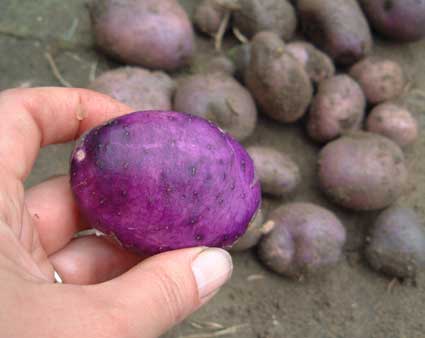
I'm also starting to harvest potatoes. I dug up a few plants of Edzell Blue, primarily because I've completely run out of growing space and needed to clear something to make room for other things. They are pretty much ready anyway, because they don't grow very big compared to modern spuds. As you can see in the photo, they are a beautiful colour and scrub up a treat. I cooked these as new potatoes, and very tasty they were too. Unfortunately they aren't ideal for boiling ... they lose their colour (they just end up a murky brown colour and the water goes dark green) and they also readily disintegrate, but you can't have everything.

Freshly harvested Edzell Blue potatoes, which look especially nice when they're scrubbed up

It may be time to declare a crop failure on the Grando Violetto broad beans though. They've been so badly afflicted by blackfly they've stopped growing altogether. They have a few pods which are developing OK but not much of a yield. Unless I pretend I was growing them as a green manure all along. Yes, that's it. I only wanted the nice nitrogen nodules on their roots. Blub.

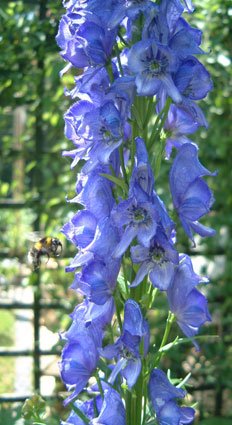
The wild part of the garden is coming along nicely. Look at this lovely monkshood flower spike (Aconitum napellus) with a bee just poised to shove its proboscis in there. It's highly poisonous but the bees love it. Having a wildlife-friendly garden has its downside though. I started work on a path I've been making between the fruit and veg plots, and had to move the polythene sheet I'd put down to kill off the lawn. I peeled it back very carefully, because there are usually slow worms under polythene sheets in this garden. They adore polythene. Sure enough, I uncovered an elaborate nursery of baby slow worms. There were four of them just under one corner. Very cute they were, only about 4 inches long. The dried up lawn had formed a layer of matting over the earth and they were sitting curled up in little round hollows underneath. They all poked their little faces up through the straw when I disturbed them. So it doesn't look like I'll be building my path now until the autumn. And neither can I walk on the polythene. Which means the only way I can access the fruit bushes for the rest of this season is by trampling over the vegetable plot and wading knee-deep through potato plants. Ah well, nothing I can do about it.

I saw a couple of ants attacking a ladybird today. I didn't know they did that. The ants were going ballistic but the ladybird seemed only mildly bothered.


And finally, I came across this mutant poppy, which has two flower heads on one stalk (although it actually seems to be two stalks fused together). Since taking this photo it has flowered, and the buds opened at different times. I have found a few other examples of this in other poppies around the garden so I assume it's just something that poppies do from time to time.