Showing posts with label F1 hybrids. Show all posts

Monday, 31 May 2010

Please universe, may I have some edible red podded peas?

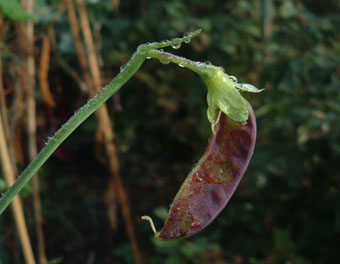
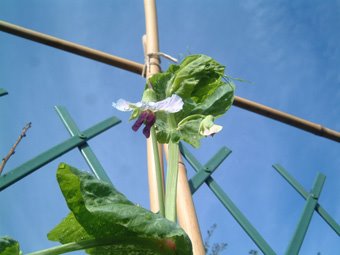
Purple mangetout pea F2
Golden Sweet x Carruthers' Purple Podded F2. First one to flower.

Today has been a perfect day for hand-pollinating peas. Warm and dry but not too sunny - which creates just the right conditions for pollen to spill its abundance and for stigmatic goo to be in the right mood to receive it. Even more usefully, it was completely breezeless with not so much as a leaf blade stirring. The bitter lessons of trying to hand-pollinate flowers that are thrashing about in the wind, not to mention walking across the garden with a precious blob of pollen on the end of a scalpel, have taught me that pollinations on breezy days are the stuff of futility. All the more so for those of us with waist-length hair, which is guaranteed to flap across your face at the very moment you were trying to deposit a miniscule dab of pollen onto a particularly wobbly and elusive stigma.

As the weather was so perfect for it, I was really hoping to get some useful pollinations done for my red podded pea project. Only trouble is, most of the flowers I want aren't ready. The true red podders aren't even producing buds yet, and my semi-red mangetout line, which I'm hoping to cross with the Luna Trick sugarsnap for some peachy-red snap pods, didn't want to play either. I found a prime pollen-bearing bud on it that was well past the usual stage for self-fertilisation but when I cut it open I found it stubbornly refusing to dehisce.

Red-blush peas about to flower
An F4 plant from my semi-red podded mangetout line, currently struggling under the temporary working name of Peachy, getting ready for some blossom action (but not yet).

So instead I did some pollinations I didn't really need using the flowers I had available. It is worth pointing out that my beloved Luna Trick pea is the result of just such a casual union, in which I used up the last of some Sugar Ann flowers to pollinate a few buds of Golden Sweet just because I was bored. It turned out to be an inspired combination. Today's efforts mostly involved Sugar Snap flowers as females, pollinated with some of my purple F2 plants which may or may not turn out to be any good. I used the opportunity to take some close-up photographs of the pollination process. It's my fourth attempt to take such pictures. Thing is, you really need three hands for it, or an assistant who knows what they're doing. I have neither, so Plan B was to stick the camera on a tripod and use the self-timer for some very cumbersome hands-free photography, which resolved the three-hands issue but gave me some more challenges in trying to get it to focus in the right place when there's negligible depth of field. Anyway, if any of them are any good I'll add them to my previous pea-breeding tutorial.

The hand pollinations are just one aspect of what I'm doing on this crimson seeking project. Since my pièce de résistance in the red podded pea department stubbornly refused to yield me any fibre-free pods, I've been looking at alternative ways of getting them. Which now involves several simultaneous endeavours.

Growing out the rest of the F2 seed from whence the original came. This is the biggest hope. The particular combination of genes I need are a minority class which will only show up in a small proportion of the F2 offspring. I need the yellow pod gene (recessive), two purple pod genes (both dominant) and two fibre-thwarting genes (both recessive). I can't be arsed to look up in a Punnett Square what the actual chances are and calculate the number of plants I need for 95% probability … I'm content to know that it may take a lot of plants in order to deliver the holy grail. This year it's down to luck anyway, as I have only a small amount of F2 seed left and so I can't grow lots of plants. Even the seed I do have is of poor quality because it was grown from a late summer crop (I used to have this trick of growing two consecutive generations in one season to double the speed of my breeding work, but have since stopped doing it because the second crop yields weak seed at best, and at worst yields nothing and just wastes valuable breeding material). So I have about fifteen, maybe twenty plants, and they may or may not offer any red pods. The moment of truth is approaching, as the F2 plants have got flower buds.

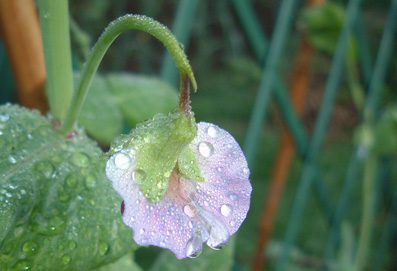
Purple mangetout pea F2

Purple mangetout pea F2

They're very pretty buds, with the mauve blush that promises bicolour flowers. Both parent varieties had bicolour flowers, so I'm expecting to see it in all the offspring. The ones shown above are fairly typical and there are others similar, with more or less purple sploshing on the stems and leaves. But I can already categorically rule out any red pods from these two plants or any of the others currently budding. The reason? Green calyx.

Green calyx means green pods. I've noticed from my work with yellow podded peas that there is a direct correlation between the calyx colour and the pod colour. Yellow podded peas are always preceded by pale cream buds which turn into a cream calyx. Sometimes it has green mottling, and pink dapples, but the base colour is always cream. (Have a look at the picture of Peachy above and see how cream the calyx is compared to these F2 buds). I suspect the cream calyx/yellow pod may actually be coded by the same gene. If they are separate genes, they are certainly slapped together pretty tightly on the chromosome, and inherit together. It's not affected by flower colour - you can get white flowers or purple bicolour flowers on a yellow-podded pea, it's just the calyx and pod colour that are inseparable from each other.

When I say that green calyx means green pods, it may also mean purple pods … or partial purple. That's because purple podded peas are in fact green podded. I know that sounds weird, and I've had to explain it so many times on plant breeding forums it's obviously something a lot of people find hard to follow. If you look closely at a purple pod, the very tip where it attaches onto the plant is green. Break it open and it will be green inside. The purple pigment, no matter how intense it looks, is merely on the surface, and the base colour of the pod is green. This is also the reason why all purple podded peas turn green when cooked. The water-soluble anthocyanin pigment is just sitting on the surface and is washed away in hot water.

I admit it did take me a while to work this out. The first time I grew F2 seeds from this cross, it produced red, green, yellow and purple pods in varying proportions. I couldn't understand why a cross between a purple podder and a yellow podder yielded so many offspring with green pods. Neither of the parents appeared to have green pods so where did they come from? The simple answer is that the purple parent is green podded, with the green hidden under the layer of purple. In the great gene reshuffle, some of the offspring end up with green pods without the genes for purple overlay, and so they stay green.

The same principle applies to red pods. They are simply yellow-podded peas with a purple overlay, which combines visually to make deep red. It's not possible to have red pods unless the base colour of the pod is yellow. That's how I know the two buds shown above are not going to give me red pods. A red-podder bud will invariably have a cream calyx, not a green one.

While I shouldn't condone the practice of peeking inside unopened leaf clusters to look at bud colours, I naturally can't resist it. And it's been very encouraging. Because two of the upcoming F2 plants which are not ready to blossom yet are showing cream buds among distinctly yellowy foliage. Even when they're tiny, the cream colour is unmistakable. The cream buds don't necessarily result in red pods, some will just stay yellow, it depends whether the genes for purple overlay are also present. But they do open up the likelihood of it. Also, one of the cream buds is showing a speck of pink colour on the calyx. While I don't have a genetic explanation for it, I have noticed a strong correlation between pink markings on the calyx and red pods. So I'm feeling lucky with this one.

Cream buds ... red pods?
Maybe it's not very clear in this photo, but this developing bud has a cream calyx - ergo yellow pods. Also a tiny pink spot on the calyx which is a good sign.

It's still pot luck whether any of the plants in this small sample will give me exactly what I want, but the solution is in there if only I can grow enough F2 plants. Which brings me on to my convenient back-up plan …


Growing out more F1 plants to make new F2 seed. I still have a number of F1 seeds saved from when I made the original cross. The seeds are good, healthy mature ones too. I started off a batch of about ten F1 plants this year. The beauty of peas and their efficient self-pollination is that you don't need to do anything except grow the F1 plants and save seed from them. They are veritable F2 seed machines. Every pea they produce has a unique individual genome, its own personal reshuffling of all those genetic goodies. Somewhere among the reshuffles is bound to be the specific five-gene combination I'm looking for.

Purple/red mangetout pea F1
F1 hybrid of Golden Sweet x Carruthers' Purple Podded. Flowering like billy-o and hopefully making lots of nice F2 seeds for me.

What's interesting about these F1 plants is that they are showing massive hybrid vigour, or heterosis. It's a phenomenon brought about by having a mixed up genome, a by-product of heterozygosity. Its cause has always been something of a mystery, though I'm told that some recent research has put it down to an enhanced ability for photosynthesis. Whatever the reason for it, my own observation is that it only happens in certain crosses - though there are degrees of it. And it's for one generation only - you don't tend to see it in F2 plants. This has been especially marked in my current crop, because I sowed the F1 and F2 seeds from the same cross side by side in the same rootrainer tray, and they are now growing side by side out in the garden. And from the moment of germination, the F1 plants rocketed away from their F2 nephews. They grew faster, had thicker stems, established themselves in the outdoors quicker, produced substantially bigger leaves and grew taller. They were also earlier to flower - and still having a burst of surplus energy to get shot of, have thrown out a lot of sideshoots too. Pea sideshoots are usually feeble, spindly things, if they ever get going at all. These are nothing of the sort. They are full-size, chunky, vigorous new branches which look set to flower and make pods.

Something else peculiar about the F1 plants, or one of them at least. I've been writing about the leaf aberrations in my peas this year, which I'm beginning to conclude are probably weather related. I mentioned the fasciation (thickening of the stem) in one of my other hybrids, despite the fact that it's a trait caused by recessive genes. Well, now some spontaneous fasciation has occurred in one of these F1 plants. To my knowledge, there are no fasciation genes in this hybrid, which is not related to the other one - they are completely separate breeding lines. Which leads me to assume that pea fasciation is not solely genetic, and can arise as an environmental reaction. What's even more weird is that the plant in question managed to unfasciate itself by splitting into two stems. A single stem with a well developed sideshoot is one thing, but this is a pair of twin stems growing at the same rate in different directions, equal and opposite.

Purple/red mangetout pea F1
This F1 pea developed spontaneous fasciation (stem widening) and then split into two separate but equal growing tips. This is not normal for peas!

Edit: I've just done some homework on fasciation, following a link from Rhizowen's wonderful blog, and it seems that spontaneous fasciation from environmental stress is a well known phenomenon - actually more common than genetic fasciation. It's caused by damage to the growing tip by virus, bacteria, insect nibbling or frost - and a reversion back to normal growth is also common. In this case, frost is almost certainly the culprit.

Other avenues. I had just eight seeds left from my original red podded pea. I sowed them, and three fell victim to marauding gastropods. The five survivors are doing well though, and although there will be no edible pods among them, they will enable me to make some crosses. The priority will be to cross them with my two Luna Trick lines, which are genetically similar, being derived from the same original parent variety, but represent a superior form of it with good-flavoured and fully edible yellow pods. Another batch of twenty or so are on the go, thanks to my big haired friend Graham, who grew some last year and gave me back some seeds from the best of them. Again, they won't have edible pods, but they will be priceless for making crosses and might also make the basis for a red-podded shelling pea. Also of course there's the Peachy line which has edible pods which are part-red. That might turn into a variety in its own right, and will certainly be useful for making crosses with the pure red (if it ever gives me any pollen).

Friday, 14 May 2010

F1 hybrid peas and axil splodges

I thought I'd put up some pictures of the F1 hybrid peas I've got going, even though they don't look all that exciting at the moment. They aren't flowering yet but this is a good time to admire their axillary pigmentation.

I don't read up as much as I should on pea genetics, but it certainly seems that the genes controlling the expression of colour in different parts of the plant tend to come as a package deal. From what I have bothered to read, I know that there are distinct and separate genes for pink splodges in the leaf axil, for purple or pink bicolour flowers, purple seedcoat speckles and purple pods - plus another gene which switches colour production on or off for the whole plant. The purple pod genes (there's actually two of those) are often inherited separately, but the rest seem always to go together. It's quite useful in some ways, because the axil splodge enables me to predict flower colour several weeks before they flower, or even to select for flower colour before I sow by going for the dark-coloured or speckled seeds. Although they're different genes they are presumably all squidged right up together on the same chromosome.

The axillary splodges are made by just one major gene, but there is a lot of subtle variation in how they are expressed.

Golden Sweet x Kent Blue F1

I made this hybrid in 2007 and the seeds have been sitting around ever since waiting for me to do something with them. The plants have a very intense blotch in the leaf axil, with a distinctively purple hue.

I'm not sure what I'm expecting to get from this hybrid, it's one of my suck-it-and-see crosses. Both parents are heritage varieties of some considerable vintage, which usually makes for interesting hybrids. Certain traits can be predicted in the F1: Golden Sweet is yellow podded, but there is no trace of yellow colouring in these F1 plants because it's a recessive trait and will be hiding for now. I expect to see yellow pods in a quarter of the F2 offspring next year, but not in these. Bicolour purple flowers are pretty much a certainty though, as both parent varieties have them. But Kent Blue has the unusual feature of changing its flower colour. The flowers open as normal mauve and maroon bicolours, but within a day or so they change to a sky blue and midnight blue bicolour. They also have very pronounced veining on the back of the petals, which is very pretty. Whether these traits will show up in the F1 flowers remains to be seen. I'm also curious to see what happens to the pods in terms of width and knobbliness. Both parents are edible podded varieties of a slightly primitive type (i.e. not as sleek and fibre-free as a modern cultivar). There are two recessive genes responsible for edible pods and the way they interact is quite crucial. Depending on which ones I have here, the hybrid may be completely fibre-free (better than either parent) or they might be totally inedible. It may seem strange that you can cross two edible-podded varieties together and end up with inedible pods, but it does happen (and has happened to me!) It's one of the endearing little quirks you get in a multi-factor cross with recessive genes.


Golden Sweet x Carruthers' Purple Podded F1

This hybrid is the parent of my red-podded pea. The red pods showed up in a small proportion of the F2 seeds, and so I'm growing another batch of F1 plants in order to produce more F2 seed, in the hope of getting some red edible podded recombos. These plants are from the original batch of seeds from the cross I made in 2007, and despite the seed being three years old they are showing considerable hybrid vigour, overtaking all the other peas in the garden.

The axillary pigmentation is very flamboyant, forming two distinct pinky-red rings with a white band in the middle, and something of a Bowie lightning flash at the top. This is an exaggerated form of the double axil ring inherited from Golden Sweet.

As I've already grown some of these F1 seeds I know what to expect from them, but a lot of it is easy to predict anyway. Both parents have purple flowers, which are dominant, so the F1 will have them too. Both parents are tall, and that's also dominant. Carruthers' Purple Podded passes on the two dominant genes for purple pods, so the F1 hybrid will have purple pods. Golden Sweet contributes the yellow-pod gene, but that's recessive, so none in the F1 generation. It's when these genes segregate out in the F2 that things get exciting, because when the two purple pod genes happen to come together with the yellow pod gene, that's the magic formula that gives red pods.


Alderman x Salmon-Flowered F1

Another 2007 hybrid which has sat in a box and never been grown before. This one is a cross between one of the best heritage shelling peas and a botanical curiosity, so it is venturing into uncharted territory. See how subdued the axil colour is on this one. It's a soft muted pink and sits tightly within the axil without spreading out into the leaf. The upper stem and tendrils have a rosy blush too, and the leaves have red edges. These traits are all inherited from dad, Salmon-Flowered. There are no obvious colour genes in Alderman, though it may have some unexpressed ones lurking in its genome waiting to burst forth in an unexpected carnival. On the surface it's a fairly normal green-podded pea, chosen for its excellent flavour.

What makes Salmon-Flowered such a curiosity is that it's an umbellatum type pea. These were popular in past centuries, once known as crown peas, but they are now rare. Instead of producing flowers and pods up the length of the stem, they bear all their bounty in a whopping great clump at the top. They look so different from normal peas that they were formerly classified as a separate species, Pisum umbellatum. This has now been dropped, however, since it was discovered that they are botanically the same as other domestic peas and their bizarre form is merely the result of a combination of three recessive genes, whose exact function and interaction is still not fully understood.

Well I don't understand them either, but as they are all recessive I can probably assume that none of the umbellatum traits will be apparent in an F1 hybrid. Even in the F2, it may be a very small minority class (where all three recessives combine). Never mind, there is other excitement to discover. Such as flower colour. Alderman is a white-flowered pea, and white flowers are recessive. Salmon-Flowered is ... er ... salmon flowered (two-tone pale pink and salmon pink) which I believe is also recessive. What happens when I cross these two shrinking violets? God knows. I'll have to wait and see. They may be pink, they may be white - or they may be neither. As I said above, a multi-factor cross with recessive genes can throw up surprising and counterintuitive results. I'm looking forward to seeing what turns up.

Tuesday, 30 September 2008

The joy of genes ... illustrated!

Patient readers who have put up with me banging on about gene segregation and F2 hybrids ... here's a little photo sequence from one of my breeding projects to show the process in action. I hope this will be a lot more interesting and meaningful than my simply talking about it, since it shows what amazing and beautiful diversity is locked up within every seed. If it inspires you to have a go at some hybridisation yourself ... so much the better.

OK, so these are pictures of pea seeds from my Yellow Sugarsnap project. It matters not what the objective of the project is or how close I am to achieving it ... this is just an illustration of what happens when you cross two varieties.

In this case I started off with Golden Sweet, an old heirloom supplied by the Real Seed Catalogue, and Sugar Ann, a bog-standard commercial variety from a garden centre.

The original parent varieties. Golden Sweet (left) has dimpled tan or grey seeds with purple speckles, while Sugar Ann has pale grey-green or cream seeds which are more wrinkled and slightly bullet-shaped.

So I made a cross between these two varieties, thus creating an F1 hybrid, and this is what the seeds looked like:

F1 hybrid between Golden Sweet and Sugar Ann

Sorry this is a bit of a small sample, but I'd already planted most of my F1 seeds by the time I took the photo. Anyway, you may notice that the F1 hybrid seed looks exactly the same as the original Golden Sweet seed. There's a good reason for that. The embryo hidden deep within the seed has the hybrid DNA made by the cross-pollination, but the rest of the seed (including its outward shape and colour) is the product of the mother plant. Therefore it looks just like any other seed produced by the mother plant. If I'd done the cross the other way and used Sugar Ann as the mother plant, then all the F1 seeds would have looked like Sugar Ann.

The next step was to grow the F1 seeds and collect seed from them, giving me the F2 generation. I didn't make any further crosses ... as peas are self-pollinating, all I had to do to obtain the F2 seed was to grow the F1 plants and allow them to produce seed naturally. This is the result:

F2 hybrid between Golden Sweet and Sugar Ann (i.e. the seeds from the F1 plants)

Hey up, now we've got something happening. The F2 seeds no longer look exactly like the Golden Sweet parent. In fact if you look closely they're all different. The differences are quite subtle but they vary in colour, size and shape. Some are wrinkly while others are smooth or dimpled. Some have purple speckles, others are plain. They show a jumbled up mixture of traits from the original parent varieties, caused by the random segregation of genes from both parents.

This is the point where plant breeding becomes immensely fun. Because every one of these F2 seeds produces a plant that is unique. And once again I don't need to do any crosses, I just grow the F2 plants and let them set seed naturally to produce the F3 seeds. And I get THIS:

F3 hybrid between Golden Sweet and Sugar Ann (i.e. the seeds from the F2 plants)

This is actually just a random sample, the first nine plants to reach maturity. There were many many more variations, but these few are enough to show you what's happening. I've saved seed from each F2 plant individually, and you can see that there is some consistency in the seed type for each plant, but HUGE variability between plants. Plant 58 produced seeds the same shape as Sugar Ann but a much brighter green and with purple speckles. Plant 02 produced seeds the same shape as Golden Sweet but green instead of tan. Plant 25 produced exceptionally wrinkled seed with no speckles. Plant 09 produced large round smooth yellow seeds which are totally unlike either of the original parents. Plant 14 shows some variability within itself but again a spectacular diversion from the original parent varieties, because the whole seed coat is sploshed with solid purple with a few bright greens and pinks thrown in.

Same image, detail

Every one of these packets of F3 seed is a brand new, unique variety in its own right. I could give them all names and launch them on the world. There wouldn't be much point doing so, partly because their offspring would still show some variability and further segregation (so they need to be stabilised for a few more generations first) but also because they won't all be worth pursuing. At a glance I'd say that Plant 09 with its big smooth yellow seeds is probably not going to taste good. In fact I did eat some of its seeds while they were still fresh and they were hard, mealy and bitter. By contrast, the exceptionally wrinkled seeds of Plant 25 indicate an exceptional sweetness, confirmed by taste tests, and that one is probably worth pursuing. Plant 37 also looks useful, as it has the supersweet ultra-wrinkled seed combined with pretty purple, pink and green colouring. There's enough interesting material here to keep me occupied for years. All from a single cross!

Anyway, what I hope this illustrates is that all these seeds are different from the original parent varieties in ways I couldn't have imagined when I made the cross. There are some familiar traits showing up, but also a lot of brand new ones which weren't displayed by either parent. And some of those brand new traits are really quite exciting.

What these pictures show is segregation for seed-coat colour and seed shape. Because in peas those two traits are readily observable. Of course the same level of segregation is happening to ALL traits right across the genome, with potentially millions of different combinations. I hope this gives some idea of how much diversity and scope for new varieties is possible just from making one simple cross-pollination.

Wednesday, 26 March 2008

The Real Seeds Purple Mangetout Pea Project

Photographed in 2007, this is a home-made F1 hybrid, Golden Sweet x Carruthers' Purple Podded

I've talked a bit about my yellow sugarsnaps and I'll post another update on those soon. But it's about time I posted about my Purple Mangetout project again.

To briefly recap, Ben of The Real Seed Catalogue asked me to produce a new pea variety for him because he wants to be able to offer a good purple mangetout pea and currently there aren't any. You can eat purple podded peas at the mangetout stage, but they don't have anything like the sweet and crunchy pleasure of a green-podded mangetout. There's no particular reason for that, except that nobody in the crop development industry has bothered to breed a mangetout with purple pods because pod colour has no agricultural importance ... so the job falls to amateurs like me.

Ben's favourite mangetout pea is Golden Sweet, which is a yellow-podded heirloom pea with red-flushed stems and purple flowers. It's a spectacularly gorgeous variety (see my pictures), it's tall and voluptuous, and the bright yellow pods are sweet and crunchy and delicious. There's nothing else remotely like it. He considers it the best mangetout there is, so basically what he wants is a pea which is just like Golden Sweet but with purple pods instead of yellow ones.

In theory that should be quite easy to achieve. Golden Sweet already has many of the genes associated with purple-podded peas. Most importantly, it has the gene which switches on the production of anthocyanin (purple pigment). A whole load of other genes are involved in determining which parts of the plant the anthocyanin shows up in. To turn Golden Sweet into a purple-podder, all I have to do is get hold of the genes which make purple pods and breed them into it. Purple pods in peas are controlled by two dominant genes, which I can get from any purple podded variety. And I can transfer those two genes into Golden Sweet by a method known as recurrent backcrossing.

It works like this. A cross between Golden Sweet and a purple-podder is going to have half its genome from each parent. The offspring at the F2 stage will have a mixture of traits from both parents, all jumbled up. Let's say I select one of the F2 plants which has purple pods, and cross it with Golden Sweet. This is known as a backcross, because I'm crossing it back to one of the original parent varieties. The resulting offspring (F3 generation) will have three-quarters of its genes from Golden Sweet and only a quarter from the purple podded variety. Hopefully there will still be some offspring with purple pods though. So I select those again, and backcross them with Golden Sweet again ... giving me an F4 generation which is seven-eighths Golden Sweet and one-eighth the purple. By using this method up to the F5 generation, I should end up with a fairly true-breeding variety which is almost entirely Golden Sweet but with purple pods! Recurrent backcrossing is a powerful technique because it eliminates a lot of unwanted variability very quickly while enabling me to hang on to those two dominant genes which make purple pods.

That's the theory anyway!

If all goes according to plan I should have a stable new variety by the end of 2009.

Another photo from 2007. This time it's the Golden Sweet x Desiree F1 hybrid

So how's it panning out in practice? Well, I grew the F1 plants in 2007 and you can see from the pictures how they turned out ... they were pretty much as expected. When I crossed Golden Sweet with a purple podded pea, the offspring (F1 generation) all had purple pods. That's because the purple-pod genes are dominant, and they mask out Golden Sweet's recessive yellow-pod gene completely. In fact there was no trace of yellow colouring anywhere in the plants. As for the pods, they were all purple as expected, but partially blotched with green. I've been getting this in all my purple pea hybrids. When I cross a purple-pod with a green-pod, I get a marbled swirl of purple and green in the F1. When I cross a purple-pod with a yellow-pod as I did here, I still get a marbled swirl of purple and green. There are two likely causes I can think of. One is co-dominance, where the dominant purple genes fight with dominant green genes, and you end up with a mix of the two (if so, I should see them separate out into solid colours again in the F2 generation, about half and half of each). The other possible explanation is incomplete penetrance, where the purple-pod gene simply doesn't assert itself fully, for reasons best known to itself. I think on balance this is the most likely cause. The pods in the picture (Golden Sweet x Desiree) are the ones showing the most solid purple ... most of them were decidedly blotchy.

I'm working with two separate crosses in this project. Ben sent me a purple-podded pea called Desiree to do the cross with. It's not a variety Real Seeds currently sell, and I don't know much about its origins. It's a semi-dwarf variety (an unusual thing in peas) which grows to about three feet high. It's bushy and has beautiful flowers borne in pairs. The pods are just beautiful ... a rich dark indigo-purple colour, wide and flat, and ripening into fat little leathery pods with a glowing burgundy colour. It's normally grown as a soup pea and when the pods are mature they're so tough it's a job to pull them off the plant. My own favourite purple-podded pea though is Carruthers' Purple Podded, which is very different. I trialled a number of purple podded peas last year and there was a lot of difference between varieties. Carruthers is tall and refined with elegant, lantern-like flowers borne singly on long curvy stems. It has a brighter burgundy pod colour than Desiree, and smoother, sweeter-tasting pods. So I decided to make two separate breeding lines for this project, Golden Sweet x Desiree and Golden Sweet x Carruthers' Purple Podded, and to grow them side by side and see what differences there are.


The F2 seedlings, photographed a week or so ago. Golden Sweet x Carruthers' Purple Podded in the top picture, Golden Sweet x Desiree below.

I saved seeds from the F1 plants of both crosses. And a few weeks ago I sowed them, three each in bog-roll tubes. These are the F2 generation, and this is where the interesting stuff starts happening. The plants in this generation should segregate into roughly a quarter yellow-podded and three-quarters purple-podded, but I'll have to wait and see. I sowed 27 seeds of each cross, but germination has been quite erratic and I currently have 18 seedlings of GS x D and 19 of GS x CPP. I may sow a few more, but in theory I shouldn't need too many. As I'm looking for traits associated with dominant genes, I expect about 3/4 of these plants to have what I want. Very different from the Yellow Sugarsnap Project, where I'm after two recessive genes and will only get them in about 1/16.

This is the sort of splodge I'm getting in the F2 leaf axils. Seen here on a GS x CPP seedling.

The F2 seedlings are still small at the moment, but there are already some obvious differences. The GS x D cross is segregating into 3/4 tall and 1/4 short (which is normal in crosses between tall and dwarf peas) while the GS x CPP seedlings are all of a similar height because they are a cross between two tall varieties. Almost all the seedlings have purple splodges in the leaf axils, but they vary as to how much they have and how splodgy it is.

Purple spots on GS x D

And now here's a curiosity. About a quarter of the plants in both crosses have purple spots on the leaves, which is not something I've seen in any of the parents. I assume there's some recessive trait in Golden Sweet coming through here.

What larks.

Saturday, 23 February 2008

Commercial F1 hybrids

Rants are like buses. There had to be another one round the corner.

It's been nearly two years since I wrote a post about F1 hybrids, and with the seed-buying season now underway it seems like a good time to revisit it.

If you browse through almost any seed catalogue, even those of ethical and responsible companies like the Organic Gardening Catalogue, you will see a lot of varieties with 'F1' next to their name. Most vegetables, with the exception of peas and beans, are extensively offered as F1 hybrids. There is a good reason for this: they are extremely profitable for the companies who produce and sell them. Sometimes they have benefits for gardeners too. But there's a catch. Well, several actually.

Commercial F1 hybrids are produced by environmentally dubious methods and they often need chemical inputs in order to grow properly. They're expensive, and they force gardeners to keep buying more packets year after year because you can't save true-breeding seed from them. They effectively curb the centuries-old sustainable practice of seed-saving and replace it with a cycle of marketing.

There is nothing wrong with F1 hybrids in themselves. They are the first step in every plant breeding project. When I breed my peas, I make my own F1 hybrids by hand-crossing different varieties and then use the resulting genepool to select potential new varieties. Nature creates F1 hybrids all the time, which is how plants evolve and diversify. It's a natural, wholesome and vital process. The problem lies in the commercial abuse of it.

The basis of F1 hybrids' popularity is hybrid vigour, or heterosis. When two dissimilar varieties are crossed, the result is a hybrid which will often be bigger, brighter, faster-growing or higher-yielding than either of its parents, which makes for a great selling point. But it's a one-hit wonder. Subsequent generations don't have the same vigour or uniformity, and the idea is that you don't save seed from it, you just throw it away and buy some more. This is bad for the plants, bad for the garden and bad for you, but the seed companies make a packet out of it and gain increasing control of what we buy and grow.

In my opinion, hybrid vigour is slightly overrated anyway. There's no doubt that F1 hybrids can produce abundant crops in the right circumstances, but so can natural open-pollinated varieties. You can make more of a difference to a crop's performance by providing decent growing conditions than by buying "superior" seed. I'm not convinced that the benefits of F1 hybrids are worth the costs.

One of the costs is that it's part of a push to industrialise seeds, giving corporations more control of what we grow. Industrialisation also involves taking seed production and plant breeding out of the field and into the laboratory, with patented technology increasingly seen as the path to profit. It's easy for me as an amateur plant breeder to condemn these practices, and I do understand how hard it must be to make a living from natural plant breeding - I don't expect to be financially compensated for the hours of work I put in on mine. But I still don't like the way things are going.

The problem in producing F1 hybrid seed commercially is that it's expensive. Hand-pollinating flowers is not difficult in itself, but it's time-consuming. One solution is to have the work carried out in countries where skilled labour is cheap. That may work with tomatoes, where hand-pollination is easy to do and a single pollination produces a large amount of seed. But it ain't much use with things like carrots, where the flowers are so tiny that hand-pollination is practically impossible. The only way to make F1 hybrids economically viable is to use Cytoplasmic Male Sterility (CMS).

The simplest application of CMS is to find a naturally-occurring gene for male sterility and breed it into your target crop. The plants are unable to produce their own pollen, which makes it easy to pollinate them en masse by exposing them to pollen from a different variety. Instant hybrids, in whatever quantity you want.

However, not all plants have been obliging enough to offer a male sterility gene, so it has to be done forcibly. One way of going about it is to use chemical sprays to prevent pollen being released. Another is the patented technique of protoplast fusion, where leaf tissue cells from different plants are fused (either with electrical current or chemicals) to transfer the male sterility attributes from one species to another. It's a method of forcing the transfer of genetic material between plants which don't naturally cross, although at the moment it only works with related species. The resulting plant tissues are tetraploid (i.e. they have double the normal number of chromosomes) and are propagated in the laboratory. It's not the same thing as GM, because it's a joining together of two complete and separate genomes rather than splicing genes from one genome into another. But some argue that it is a form of genetic engineering and should be labelled and regulated as such.

There are other problems with the production of commercial F1 hybrids. The parent varieties will usually have been inbred to an extremely unhealthy degree (because a lack of genetic variability is crucial to the uniformity of the resulting hybrid). Extreme inbreeding goes against nature and reduces genetic diversity. CMS (even in its "natural" form) has problems ... a male sterility gene used in maize hybrids happens also to convey susceptibility to a form of corn blight, which nobody realised until the blight started wiping out crops on a huge scale. Hybrids made by CMS sometimes produce sterile seed, so you couldn't save and replant it even if you wanted to.

But perhaps the most simple and straightforward objection to F1 hybrids: they are extremely poor value for money. Here's a few examples from the 2008 catalogues I happen to have lying around on my desk (try it for yourself):

Tomato Roma (non-hybrid) £1.99 for 75 seeds = 2.65p each
Tomato Suncherry Premium F1 £2.99 for 6 seeds = 49.83p each

Carrot Yellowstone (non-hybrid) £1.99 for 1500 seeds = 0.13p each
Carrot Purple Haze F1 £1.99 for 300 seeds = 0.66p each

Cauliflower All The Year Round (non-hybrid) £1.25 for 250 seeds = 0.5p each
Cauliflower Concept F1 £2.75 for 30 seeds = 9.16p each

Pepper Oro (non-hybrid) £1.49 for 45 seeds = 3.31p each
Pepper Attris F1 £3.09 for 5 seeds = 61.8p each

You will notice that catalogues disguise the price difference by varying the quantities in the packet. You may not worry too much about the difference between a £1.85 seed packet and a £2.85 one, but when the cheaper one contains 100 seeds and the expensive one 5 seeds, that's a huge differential, and one which they're hoping will slip beneath your radar. It's daylight robbery.

There are three ways you can help reduce the stranglehold big business has on garden seeds:

1. Boycott F1 hybrids, by choosing only non-hybrid varieties when you buy seeds.

2. Dehybridise them yourself: call the seed companies' bluff by saving and sowing seeds from F1 hybrids and selecting the best progeny, to create an open-pollinated version of the hybrid.

3. Make your own F1 hybrids. It's easy and fun!

Tomatoes are particularly suitable for home-made F1 hybrids. Choose any two non-hybrid varieties (the more unalike they are, the more fun the results) and when they are both in flower cross them manually (here's my easy guide to hand-pollination). Even from just two or three hand-crossed fruits, you can save enough seed to provide you with more than you can grow. Given that tomato seeds can easily stay viable for 10 years, if you like your hybrid you can keep sowing the seeds from the original cross for many years without having to redo the cross or save seeds from the hybrids.

There's never been a better time or a better reason to become an amateur plant breeder!

Monday, 14 January 2008

Summary of the Purple Pea Project 2007

And when I say "purple peas", I ain't kidding!

This is just a general update on my progress with the peas so far. In my usual disorganised fashion I've ended up with two main projects and a large number of sub-projects, but that's all part of the fun.

Before I start, I'd better reiterate what I mean when I talk about F1 hybrids. When two distinct varieties of a plant are crossed, F1 is the term used to describe the first generation of seed resulting from that cross. It stands for "first filial". When the F1 plants are grown, the seed they produce is called F2 (second filial), and so on. F1 plants tend to be very uniform because their genes are a fairly straightforward half-and-half combination of both parent types. But in the F2 generation the genes are randomly recombined and all sorts of different traits start emerging. That's why the received wisdom dictates that you should never save seed from commercial F1 hybrid varieties, as they won't come true to type. But that's exactly why they are so valuable to plant breeders ... every F2 seed is potentially the basis of a new variety.

Biologically speaking there's no difference between an F1 hybrid made by a gardener for breeding purposes and the F1 hybrid varieties you see in garden centres and seed catalogues. The difference is in how they're used. Seed companies sell F1 hybrids as varieties in their own right, because they make way bigger profits than non-hybrid seed ... not least because you have to go back and buy it again next year if you want to carry on growing it. Whether these commercial F1 hybrids are in any way better than standard open-pollinated varieties is open to debate ... in my own opinion they're overhyped, largely a waste of money and potentially very harmful to long-term biodiversity. But that's a topic for another post! From a plant breeder's point of view, an F1 hybrid is an exciting opportunity to mix up a whole load of genetic material and see what you end up with.

My pea breeding endeavours in the 2007 season had two phases. The first was to make crosses by hand-pollinating my chosen varieties. The rest of the season was taken up with growing out F1 hybrids. My F1 seeds were from the crosses I made in 2006, but I also managed to re-plant some newly harvested seed from the crosses I made in early 2007 (i.e. two generations in one season). It was only the projects based around Golden Sweet that matured quickly enough to squeeze two crops into one season. Alderman is a late maturing variety and doesn't have time to complete a late-season crop before keeling over with mildew, so it's better to be patient and grow one generation a year. Peas are one of the few vegetables you can do the two-generations-in-a-year trick with anyway, because they fulfil their lifecycle in a fairly standard timeframe regardless of when you plant them (within reason). Peppers, tomatoes, onions etc rely on having a proper 'season' and are senstive to changes in daylength, so it's no good growing them outside their proper time.

Another subject of debate is whether F1 hybrids really do have hybrid vigour. I recently attracted some criticism on a plant breeding forum for suggesting that naturally inbreeding plants (such as peas) don't show hybrid vigour, at least not to any significant extent. My own experience is that some crosses show hybrid vigour in an obvious way and others don't, but either way it involves such an elaborate range of factors there really is no precise scientific way of measuring it. With Golden Sweet x Sugar Ann it was pure vigour ... the plants were huge and grew like rockets. Others had more subtle ways of expressing it, in their elegance and beauty or their hardiness. But a number of others just seemed to take after their least-vigorous parent.

Although flavour is one of the most important factors I'm looking for in a new pea, at this stage none of the hybrids are being tasted or assessed for flavour. There's not much point, because the genes will not start to reshuffle properly until the next generation. Any special qualities in the F1 plants are for this one generation only, and their progeny will all be different. Besides, the peas are far more valuable as seed stock, as each one of them has its own unique genetic possibilities. The breeding work really starts with the F2 generation, so the main purpose of the F1 plants is to produce as much F2 seed as possible.

The crosses I've made so far are quite diverse, but the project mainly centres around two principle varieties which have been used as mother plants.

Alderman (click here for pictures)
A very large and luxurious variety of white-flowered, green-podded pea. So far none of the hybrids I've made from it have matched it for pod size, pea size or flower size, though environmental factors may have contributed to this as the hybrids were grown late in the season, and I haven't found Alderman to be well suited to late season cropping, it does best when allowed to flourish slap-bang in the middle of the year. Its real trump card though is its knock-out flavour, which it retains even when the peas have reached a huge size. So flavour will have to be monitored in future generations. It's probably the interactive result of a number of different genes so I don't expect it to be easy to maintain it.

Golden Sweet (click here for review and pictures)
Golden-podded, blue flowered, speckle-seeded and gorgeous, this one was given to me by Ben at Real Seeds to use as the basis for a new mangetout variety. There must be a lot of dominant genes in it because all the hybrids I've made from it have been pretty close matches to the mother plant in every detail. Except – the yellow colour. That is totally absent from all the hybrids. Not a trace of it. I knew the "yellow" gene was likely to be recessive, and this is as good an example as any of how a recessive trait will totally vanish from the F1 population.

Ideally when crossing plants it's a good idea to make the cross both ways, so each plant has a chance to be a seed bearer and a pollen provider. In some cases though that isn't possible because of variety differences. Purple podded pea Desiree is so quick to shed pollen I found it almost impossible to find flowers in a virgin state ... even the tiniest newly-formed buds had already self-pollinated. Earliness of pollination is something that varies from one variety to another, but it's also affected by times of day, weather and seasons, so it's not a precise science. You just have to get used to the individual quirks of the peas you're working with. At the opposite end of the scale, Ne Plus Ultra was an absolute doddle to hand-pollinate, always very obliging.

Splodgy pod, courtesy of Mr Bethell's Purple Podded x Alderman (F1 hybrid)

Here are some brief notes about the various crosses I'm working with, i.e. the ones I've actually grown. Some of them were interesting enough that I'll do a whole separate post about them. I made many more F1s which I haven't grown out yet.

Alderman x Kent Blue F1
Green pods and white flowers. Doesn't have many obvious Kent Blue traits at the F1 stage. It looks like Alderman, but nowhere near as vigorous. The F2 seed does look interesting though, with a mix of colours and round/wrinkled types.

Alderman x Carruthers' Purple Podded F1
A cross between what are probably my two favourite pea varieties, and the F1 hybrid showed many of the best traits of both. The pods are beautifully marbled and mottled with purple and green. This marbling is quite common in a hybrid between a green-podder and a purple-podder (probably co-dominance of the respective colour genes) but they don't usually have colours and patterns as attractive as these. They are really beautiful.

Alderman x Salmon Flowered F1
The F1 here is so unexpected in form I'm starting to worry that I might have mislabelled something. The flowers are a deep, dark, velvety purple with beautiful veining and are borne elegantly in pairs. It actually looks more like a Desiree hybrid than the product of its white single-flowered Alderman mother and pink cluster-flowered father. But at any rate it's been the least successful of the hybrids this season, because it hasn't set seed properly. The pods were late to form, and barely got past mangetout size, so there's virtually no viable seed for the next generation. I only found two part-filled pods of mature size, yielding a total of 3 seeds ... not a very helpful sample size for an F2 crop. Shame, as it has other useful traits as well as its flower beauty and paired pods. It's by far the most cold tolerant pea in the garden, still green and still flowering (albeit with straggly mildewed stems lower down) in late November after hard frosts, and even now still clinging on to life in January.

Mr Bethell's Purple Podded x Alderman F1
My original breeding project. This one is turning out pretty interesting so it'll be getting its own post very soon. The F1 plants produce dramatically bi-coloured green and purple pods with bold splodges (see photo above) along with pretty bi-colour flowers. Most of the F2 seeds it produced are purple-speckled, which is not uncommon for heritage peas but it's a trait not seen in either parent! But it really amazed me by producing one pod of F2 seeds which are actually purple. I've been aiming to breed for purple pods, but purple peas is something I've never seen before. See the pic at the top of this post. They are properly pigmented with beautiful purple right across their surface, it's not just a concentration of speckling. I really wasn't expecting that!

Alderman x (Mr Bethell's Purple Podded x Alderman)
This one is a backcross. In other words, I used an F1 hybrid to pollinate one of its own parent varieties. I know that sounds a bit incestuous, but it's actually a very effective way to transfer a dominant trait from one variety to another. In this case I'm looking to get the dominant purple-pod gene into a plant which otherwise looks and tastes like Alderman. This cross is a quarter Purple Podded and three-quarters Alderman, so I have a better chance of preserving the Alderman traits in its offspring while still getting some purple pods. In this instance however only one plant made it to maturity, so the seed sample is probably too small to make much progress with. I may have to grow more of this one to collect enough seed to take it any further.

Golden Sweet x Desiree F1
This is the hybrid I made on behalf of the Real Seed Catalogue, in the hope of developing a good purple-podded mangetout for them.

To all intents and purposes it looks like Golden Sweet but without the yellow. The flowers are attractive (bi-coloured) and borne mostly in pairs. Pods are predominantly purple, but with some green streaking. The F2 seed it produced was large in quantity but quite small in size, despite both parents having reasonably large seeds. This seems to be a common phenomenon with peas at the F2 stage.

Golden Sweet x Carruthers' Purple Podded F1
A companion to the Desiree cross above. And very similar to it in appearance, though perhaps slightly less vigorous.

Golden Sweet x Sugar Ann F1
You wouldn't believe that the father of this hybrid was a tiddly little dwarf variety of about one foot in height. The F1 grew very rapidly and voluptuously to over 7ft and was top heavy with its bounty. In appearance it was basically like Golden Sweet, but without the yellow. I'm not sure what the status of Sugar Ann is, whether it's protected by plant breeders' rights. Most of the crosses I make are based on heritage types which are in the public domain, but I suspect Sugar Ann is a modern variety. Anyway, it was super-vigorous and produced masses of F2 seed so I'm well set up to continue with it this coming season.

Other lines to look forward to (crosses already made and F1 seed ready to sow): Golden Sweet x Kent Blue, Ne Plus Ultra x Kent Blue, Magnum Bonum x Carruthers' Purple Podded, Mr Bethell's Purple Podded x Champion of England.

Sunday, 25 March 2007

Purple pea project photo gallery

My own personal F1 hybrid, which I got by crossing Alderman with Mr Bethell's Purple Podded. The flowers have a colour different from either parent, two-tone with deep maroon wing petals underneath. This one is just opening so the colour is at its most intense. All photos taken September and October 2006.

The standard petal (the wide main petal) is a kind of pinky blue, or more precisely it has streaks of pink and blue all swirled together. It looks more like a sweet pea than a culinary one.

There was some variation in pod colour in this batch of plants. This one was mostly purple, but they all had some green in them too.

Marbled pods. There are several possible reasons for this mish mash of purple and green. It's most likely co-dominance between the genes for green and purple.

When I was planning out the project I predicted that my F1 hybrids, which are the first generation of plants grown after making the cross, would have purple pods. That's because I'd read that the purple pod gene is dominant, and so I would expect purple pods to assert themselves as the default type. And some were indeed almost entirely purple. But they all had some green in them, and they all stayed blotchy and semi-purple until quite late in their development, purpling up a little as they matured. And some just remained blotchy. F1 hybrids are not supposed to show much variation, so I was a bit surprised, but nature is full of surprises and she's no great respecter of one-size-fits-all genetic theory. And there may have been environmental factors involved too.

The blotchy mixed up colouring looks to me to be a case of co-dominance, where the dominant purple gene has found itself matched up with a dominant green gene, and their struggle for dominion over one another produces the halfway house you see in the pod picture above. There are other possible reasons for it, but in my limited experience that's the most likely one.

I'll find out more when I grow the next generation (these plants didn't survive, but I'll be growing and saving seed from more of the same). If it is co-dominance, I will know because the offspring (F2 generation) will come out approximately a quarter green podded and a quarter purple podded, with the remaining half being blotchy bi-colours like their parents. That's because when plants reproduce they inherit one half of the genome from each parent, and so each parent can pass on either the purple gene or the green gene, but not both. The result of this is four different possible combinations: green-green, green-purple, purple-green, or purple-purple. It's entirely down to chance which of these each seed inherits. Green-purple and purple-green both result in blotchy pods as the two colours fight for dominance, so they pretty much count as the same thing.

If the colour mixture is caused by something else other than co-dominance, I won't see these ratios. For instance, if it turns out the green gene is actually recessive rather than dominant, I will end up with roughly three quarters purple podded and only a quarter green. That's because the purple gene will dominate in three out of the four possible combinations, leaving only 'green-green' capable of creating green pods.

*sigh* I keep meaning to write a post on basic genetics ... then my strange ramblings would make more sense!

It's complicated but it's all great fun.

Another variation: one of the plants produced two flowers per node, as shown here (the blue flower is older and has started to fade). This is a trait not usually seen in either parent.

Monday, 23 October 2006

Update on the purple pea project

My hand-pollinated hybrid pea reveals its flower colour. Innit lovely?

Well, plant breeding may be a complicated pain in the neck, involving a lot of poking of flowers with scalpels and potentially years of patience and careful study, but I reckon there's no greater gardening thrill than to see one of your home-made hybrids burst into flower for the first time ... and find out what colour it is.

I'm getting immense pleasure just from looking at these large flamboyant purple-pink flowers, created by me, on a garden vegetable which normally has quite unexciting flowers. They are so beautiful.

The pods are turning colourful too, after a fashion. They're not as decisively purple as a true purple variety, but they're purple nonetheless. The flower buds start off a pale creamy pink with the maroon inner petal just showing through, then open out into a lovely two-tone pink which gradually matures to blue.

And so far my hybrid is following the pattern I predicted from what I know about the genes involved in pea colouration.


Just to recap on what this project is all about: I'm trying to breed my ideal garden pea. The basic spec is for all the fine qualities of a 19th century variety called Alderman, but with pink or purple flowers and purple pods instead of the usual white and green. Alderman has large white flowers, grows from between 6 to 8 feet tall and has the most exquisitely sweet and juicy peas (when eaten raw) that I've ever tasted. I couldn't tell you what they taste like cooked, because I've never got any as far as the kitchen. They taste too good straight off the plant. The peas are also huge in size and stay sweet even when fully mature. It's a fabulous variety and well worth seeking out.

To start my quest for a colourful version of Alderman, I did some crosses earlier in the year using Alderman flowers hand-pollinated with pollen from Mr Bethell's Purple Podded, an heirloom pea with pretty two-tone pink flowers and purple pods, which I got from the Heritage Seed Library. Its actual peas are green and reasonably large and pleasant tasting, but I'd be lying if I said they had anything like the ambrosial sweetness of a good green-podded pea like Alderman.

Usually when you do a plant breeding experiment you just have to try things out and see what happens, because very little is known about most of the genes in most plants. Peas have been better studied than most because their genetic patterns are very uniform and simple ... which is why they were responsible for the discovery of the fundamental laws of genetics. But even so, not all the genes have been identified. I have no idea what genes (or groups of genes) are involved in the production of Alderman's sweet flavour, so all I can do is grow my hybrid for several years and do loads of very thorough taste tests in each generation to find the flavour I want (it's a hard life).

But things are slightly easier when breeding for colour, because those genes have been identified and named. If I want plants with purple pods and a purple flash or ring in the leaf axils, there are four genes I need and they're all dominant. Gene A is the crucial one that gives the plant the ability to synthesise anthocyanin, the pigment responsible for purple colouring in most vegetables. A is effectively the 'on' switch for purple, but it doesn't control where the colour is expressed within the plant. To get purple pods, I need two additional genes, Pu and Pur (no I'm not making these up), and to get the purple splash at the base of the leaves I need another gene called D. A plant may carry genes Pu, Pur and D and have no purple colouring at all, because these genes can only express themselves in the presence of gene A.

I've made the assumption that Mr Bethell's Purple Podded has all four genes, A, Pu, Pur and D, because it has purple pods and purple leaf axils. And I also assume that Alderman, being green podded and green leaved, doesn't have A, although it may or may not have any of the other three genes. Therefore, when I make a cross between these varieties, I expect the F1 hybrid (that's the first generation of seed from the cross) to have purple pods and purple leaf axils. Why? Because they will inherit one half of their genome from the green podded variety and one half from the purple podded, and in this case the genes in the purple variety are dominant.

And so far that's exactly what I've got, which suggests that my hybrid pea, as well as being beautiful in its own right, has all four of the genes I want.


At first it looked as though the plants were going to produce green pods, because they were quite slow to change colour. With most purple podded peas, the baby pods start off green with a purple strip along the top edge, and then the rest of the pod colours up when it's a couple of days old. My hybrid variety is taking a couple of days longer to turn purple than I would normally expect, and the colour is slightly patchy on some of them. It's too early to draw any conclusions about why that's the case ... but it may be that the dominant purple pod genes are competing with another dominant gene for green pods, resulting in co-dominance and a colour part way between the two.

I haven't yet found out what genes are involved in the flower colour, but my guess is that they too are dominant but reliant on the presence of A. I'll know more about that when I grow the next generation. The flowers on my hybrid are basically the same colour as the 'father' plant, Mr Bethell's Purple Podded, but they're larger (an Alderman trait) and they have a very flat standard petal (that's the wide one at the back) which is a characteristic not seen in either parent. Most intriguing.

More intriguing still, one of the plants has started producing two flowers at each node, when both of the parent varieties produce only one. (There is a purple podded pea which does have paired blooms at each node, Ezetha's Krombek Blauwschok, but I didn't use that variety in my cross.) Presumably there is a gene for two-flowers-per-node which was being carried, but not expressed, by one or both of the parents.

But anyway ... aside from the joy of seeing a new hybrid come into flower, it doesn't really matter how beautiful the plants of this F1 generation are ... they will not be the same in the next (F2) generation. Those two halves of the genome will be broken up and randomly recombined, so that different genes from either of the original parents will start to show up in the offspring, with a huge number of different combinations possible. That's where you get the opportunity to choose the ones you like as the basis for a new variety. So the purpose of my growing these plants is just to obtain as many (self-pollinated) seeds as possible for the next generation, and those seeds will show a mixture of green pods and purple pods, from which I will select the best purple ones.


And while we're on the subject I must publicly thank Silvia (of the Windywillow blog) for the beautiful artwork she did based on my purple podded peas and my complaint that the faeries were coming along in the night and stealing the gold threads I was using to tag my hand-pollinated buds. Though in fairness to the faeries, they rarely actually steal things ... things disappear but nearly always turn up again, albeit in odd places. My missing gold threads turned up about three days later on a different plant, so it'll be interesting to see what happens when I plant the seeds from that batch. Silvia's artwork shows a couple of very smug-looking faeries tugging the threads off the flowers and is really wonderful ... she's very talented.

Friday, 15 September 2006

Today in the garden ... tomato weirdness

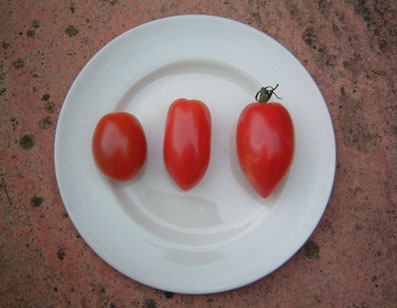
This is what happens if you plant seeds from F1 hybrids (known as F2 seeds). As the genes start to segregate, every plant ends up with a different fruit shape! Whoopee!

As my three Pink Jester tomato plants ripen I'm becoming increasingly convinced that the original Pink Jester I saved the seeds from was an F1 hybrid. Look at the variability between the ripe fruits of the three plants.

Plant 1 has rounded oval fruits, exactly as Pink Jester should have, but they are more red than pink. Plant 2 has the deep pink colouring exactly right but with an elongated shape more like a San Marzano plum tomato, and slightly on the small side. Plant 3 has wide topped pointy-ended heart-shaped fruits with a lovely deep pink colour, slightly flamed with orangey red, and the fruits are significantly bigger.

But wait a minute ... I've been growing these tomatoes from the same original batch of seed for five years ... how come I never noticed the variability before? Well, I did have one plant with elongated fruits one year, but I didn't think anything of it. I knew a lot less about plant breeding then. And because my growing space is limited I often only grow small amounts of any one variety. Over the course of those five years I've grown two or three Pink Jesters each year, and the total so far is about twelve. Of those twelve plants, three have had elongated fruits. Now that's starting to look like a Mendelian ratio, if the rounded fruit gene is dominant over the elongated fruit gene. Twelve is still a very small sample, so it's hard to draw any conclusions, but it's a start.

I think it does show that it's worth growing seeds from F1 hybrid tomatoes though. I have three very lovely plants here, all different, all lovely in their own right, and each capable of becoming a new and unique variety. All I have to do is save seeds from the one(s) I like best and keep growing those for a few generations, weeding out any that don't match. It's likely that most will come true from seed if I simply save the seeds from these fruits, because tomatoes are self-pollinators and their genes are very stable compared to most plants.

Ripe fruits on Pink Jester 1

There are other differences between the plants too. Plant 3 has large blistered leaves (not very attractive) but the fruits go through particularly beautiful colour changes as they ripen (I showed the peachy colours in a pic in a recent post). Plant 2 has fruits with extra-smooth skins, and slightly shorter trusses. Plant 1 has a determinate growth habit ... it's formed a small bush only one and a half feet high, while the other two plants are sprawling upwards. And it's not just the appearance that's different either. Plant 2's fruits have a significantly better flavour than the others, very rich and mellow, with soft flesh. Plant 3 has the same wonderful flavour in its juicy areas but it has thicker and crunchier flesh, which dilutes the flavour a little. Plant 1 has tasty fruit too, but it's not the same as the others.

I'm actually going to save seed from all three of these plants because they each have qualities that I like. I can decide later which (if any) are worth pursuing long term.

Semi-ripe fruit on Pink Jester 3 going through a lovely orangey phase

Towards the end of the tomato season you often see weird things appearing. As the plants run out of energy and the weather becomes less clement, some of the flowers don't form or pollinate properly, and the result can be some odd aberrations in fruit shape. Here's one example: I've spotted a few double flowers on my Tangella plants in recent weeks, where the flower was wider than normal and had two completely separate pistils (resulting in a double tomato, if both are pollinated). Even more curious was a flower which produced a very wide, flat ribbon shaped pistil. And now that the fruit is swelling it seems that it wasn't a ribbon shaped pistil at all, it was multiple pistils fused together. The result is a series of tomatoes fused together, or one very wide and very pleated tomato, whichever way you look at it. Unfortunately I don't think there's enough left of the growing season for this one to reach maturity, but I'll keep it going as long as I can.

Multiple fused tomatoes on Tangella make a weird puckered beauty

Another oddity (which unfortunately has already fallen off the plant) is this three-horned fruit from Pink Jester 3.

It looks more like a dragon than a tomato.

Friday, 25 August 2006

Today in the garden ... smugness

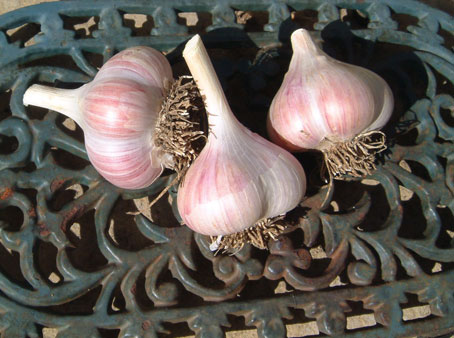
I'm well proud of this year's crop of garlic ... this variety, appropriately enough, is called Music.

This year I experimented with a different method of growing garlic. It seems to have paid off too, if this crop of Music is anything to go by, grown from cloves saved from last year's crop. They look just like shop-bought bulbs and they taste phenomenal. I've also had very positive feedback from the people I've given them away to. Music is a continental-type, which has a slightly different bulb structure from 'normal' garlic. It has between two and five very large fat cloves, which only keep for a few months but taste exceptional. I suppose its relatively short shelf life is the reason you don't often see it in the supermarkets, but it's worth seeking out.

The definitive book about garlic has got to be Ron L. Engeland's Growing Great Garlic, which is written with the expertise of someone who makes a living from garlic farming and the passion of someone who genuinely loves and respects the plants. It's a wonderful book. And one of the things he describes is how he grows his garlic in low ridges, a bit like potatoes, rather than the conventional planting in flat ground. I don't know why this should work any better, but I thought if that's what Ron does with his own plants then I'd like to try it too, and it does seem to have produced some beautiful results.

They were grown in ground which hadn't been manured, and I didn't feed them much ... they don't seem to need it. They just got watered during very dry weather. Another tip I picked up from the fruits of Ron's experiments is removing the flower scape at a later stage than is normally recommended. He suggests leaving it until it forms a loop-the-loop, so that's what I did. Logic would suggest that leaving the flower to develop to that extent just wastes energy that would otherwise go into forming the bulbs ... but as you can see, they've come out plump and perfect.


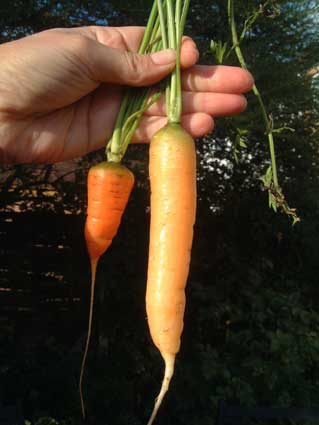
I'm also succumbing to carrot smugness having harvested these two beauties. The only downside is that this is the entire crop, for the moment at least. I do have others still in the ground but they look more like pipecleaners. However, I'm smug anyway because this is the first time I've ever successfully grown a carrot, having been trying on and off since my parents first let me take over a section of their garden in the late 70s. Yes, the one on the left is supposed to be small and wedge-shaped, it's a Chantenay, a French variety which has been around since 1830 and is still one of the best-flavoured ... there's even an official website devoted to it. The one on the right is a light orange specimen from the mixture which Chase Organics sell as Rainbow Carrots. Others will allegedly turn out mauve, purple or white, though at this rate I may need a magnifying glass to see them.

These two carrots came out flawless and tasted wonderful.

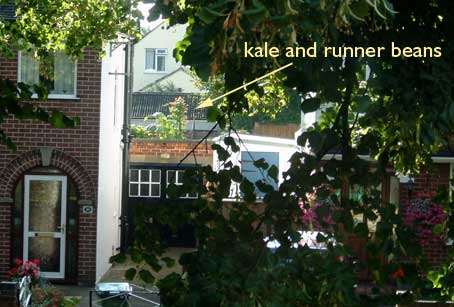
Despite the wonderfulness in my own garden, I can't help gazing in awe across the road at the old geezer's runner beans which are visible by virtue of being about 8ft tall. And he's also got something else unbelievably enormous growing in front of it ... looks like some kind of kale. God, aren't I nosey?


And lastly, an update on my pea-breeding experiment. The first of my F1 hybrids (Alderman x Mr Bethell's Purple Podded) is in the ground and growing like a rocket. Peas shouldn't really display hybrid vigour, because inbreeding plants generally don't, but it's certainly got some vigour from somewhere. I have eight more growing in bog-roll tubes waiting to be planted out ... they've all germinated but some are a bit small as yet. For some reason the hybrid seeds have been ridiculously slow to germinate, so I'm going to have to hope for nice weather this autumn to bring them to maturity. The good news though is that they are all showing faint streaks of purple on the early leaves. They may or may not turn out to have purple pods (it doesn't matter anyway with the F1 generation ... it's the subsequent generations I'll be selecting from to get my new variety) but the main thing is that they all have the crucial gene that enables them to produce purple.

Tuesday, 22 August 2006

How to hybridise tomatoes

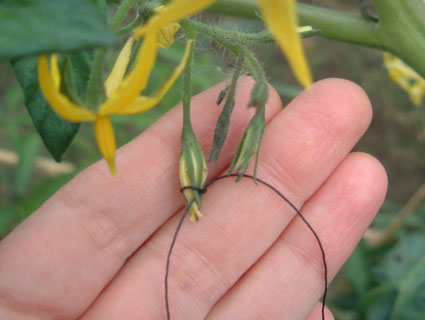
Emasculated tomato flower (in this case Tangella) with the anther cone removed, leaving just the outer ring of petals and the central pistil.

What more exciting project could a gardener wish for than to breed your own unique tomatoes? Many of the heirloom varieties and some of the long-standing catalogue favourites were originally bred by curious amateurs. And why not? All you need is a bit of patience and the easily learned skill of hand-pollination.

As with most things in the garden, there's a "proper" way to do it and an "oh sod it that'll do" way. I admit I tend towards the latter. So the method described here is slightly less complicated than some of the other pollination guides I've found on the net. But it really doesn't need to be complicated if you're doing it on a garden scale rather than a commercial one.

Compared with peas, hand-pollinating tomatoes is quite simple. The flower structure is very basic. But there are a couple of practical issues which make it less easy: the flowers are smaller, so you need good eyesight and/or a magnifying glass to see what you're doing, and the pistil is fragile and easily damaged. Unlike peas, where the pistil is quite bendy and robust, tomato pistils easily snap off or get kinked. So don't feel bad if you ruin a few flowers before you get the hang of it. The plants won't mind ... they'll just produce new ones.

Hybridising tomatoes is a two stage process: emasculation (removing the male bits) and pollination (introducing male bits from a different variety).

Tomato flowers have a layer of petals which open out fully when the flower matures, and a yellow cone in the centre which is formed from the anthers (pollen sacs) which are fused together. Inside the cone is the pistil: the long green stalk which carries the all important stigma at its tip. The norm for tomatoes is perfect self-pollination. Pollen is shed on the inside of the cone and falls straight onto the stigma. There are no bees needed, and the stigma may never be exposed to the outside world. To hand-pollinate a tomato flower, you need to stop this from happening by removing the anthers before they shed pollen.

These two buds both make good pollination candidates, subject to the variety and weather. The open flower on the right is at a good stage for pollen collection.

In an ideal world you would do your pollinations on the first few trusses that form on the plant, and use the first buds on each cyme. But any good-sized healthy bud will do the job. The important thing is to identify them at the right stage. Tomatoes normally self-pollinate at around the time when the petals open, so choose buds which are just starting to colour up, with the sepals (but not the petals) just opening. The exact time will depend on the weather, because they are reluctant to shed pollen if it's cool or wet but begin shedding it rapidly when the sun comes out. It's best to do the emasculation when the weather is cool and overcast.

My tool for tomato pollination is my artist's scalpel (and a cheapie one at that). People who do this commercially use pointy-tipped forceps, but most gardeners don't have things like that lying around in their sheds. Any small blade will do, as long as you clean it each time you poke it into a flower. I just wipe it on whatever I've got handy (my clothing has been known) and nip into the house to wash my hands before moving on to a plant of a different variety. As long as you're conscious of the risk of contaminating your hybrids with stray pollen and take reasonable care not to, you shouldn't have a problem.

Use the scalpel to prise the segments of anther cone open

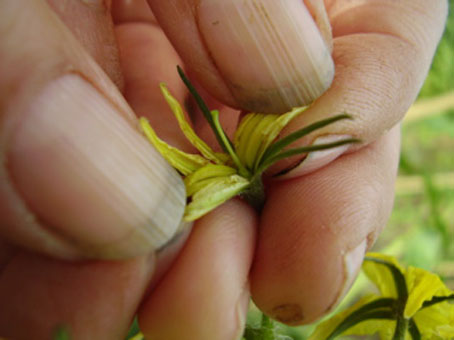
Having selected your bud, open out the petals to reveal the cone inside. The petals usually open quite readily and stay out of the way. Using the tip of the scalpel blade, prise the tip of the anther cone open just far enough that you can grab a segment of it with your fingernails, then peel it down to the bottom and pull it off. Remove all the segments so that you're left with just the long green pistil in the centre (see below).

Open the anther cone completely and pull off all the segments so that you're left with the green pistil (notice the bobbly stigma at its tip). Eww, look at the state of my fingertips. That's what playing the mandolin does for you. Like strumming a cheesegrater.

You can use the scalpel to remove the segments of anther if you prefer, but try not to poke it into the anther itself or it may spill some pollen. The aim is to remove the anthers without breaking them so that no pollen is shed. You should also have a look at them to make sure they aren't already shedding any; if you can see traces of yellowish-white dust then it's too late to do the cross and you'll have to try again with a slightly younger bud (or on a day when the weather is cooler and damper).

The other thing you will have to watch for is not to damage the pistil. In some varieties, especially older ones, the stigma is flush with or actually sticking out from the anther cone. In other cases the pistil is very small and thin and tightly snuggled within the anthers. Either way you will have to take care not to rip it off along with the anther segments. You will get better at this with practice but will probably end up ruining the occasional flower no matter how many times you do it!

OK, so that's the mother bud sorted out. The stigma is normally receptive a day or so before any pollen is shed, so in most cases you can get on and do the second stage of the process (pollination) straight away. The stigma tends to go somewhat bobbly and blobby when it's receptive, but it's more apparent in some varieties than others. It should certainly be free of any obvious traces of pollen. Once you've done a few pollinations you'll learn to see when the stigma is clean and receptive. Some tomato breeders leave the pollination until the next day to give the stigma more time to mature, others just get on with it. Better still, if you have the patience, is to do both. I've found that carrying out the pollination two or three times on different days increases the chances of it taking successfully.

Now you need to collect some pollen from the plant you're using as the other parent. For this you'll need to find a flower that's recently opened and pull off a segment of the anther cone. The anthers take the form of plump yellow sacs, which split along the seams when they're ripe so that the pollen is sprinkled out through fine slits. It's not always very abundant though, and it's also very fine and easily blows away! Most ripe flowers will usually have some pollen to spare though. The easiest way to collect it is to scrape the blade along the length of the anther a couple of times in one direction. It's quite a pale coloured pollen, and exceptionally long lived. Sometimes there's a small 'pool' of pollen towards the tip of the cone if it's already been shed. If it hasn't been shed yet you may have to extract some from the sac itself by slitting it open and scraping out the contents onto the scalpel blade.

Then take the pollen-laden scalpel to the mother plant (watch the pollen doesn't blow away en route) and dab it very lightly and gently on the stigma. If the stigma is a reasonable size and/or you use a magnifying lens you should be able to see the grains of pollen clinging to it.

And that's about it really. The flower may look a bit silly, being just a stigma in the middle of a ring of petals, but it generally doesn't need to be taped shut or protected with anything. The risk of contamination with stray pollen is low, since there's nothing to attract any insects to it, and there shouldn't be any problem with the stigma drying out as long as the weather is not too hot and dry. So you can just leave it to get on with it, and it's readily accessible if you want to give it a second dose of pollen the following day.

Sometimes when you try to pull the anthers off a mature flower to collect the pollen the entire flower face comes off – petals, anthers, the works – leaving behind only the pistil. You can often use the whole thing just as it is by placing it over the pistil of the emasculated mother bud. A kind of flower transplant. It only really works if the two plants have flowers of a similar size, and you may also need to tie a piece of cotton thread or wrap a tube of masking tape around it to hold it in place. My experience is that it's quite an effective way to get good pollination, but I'm much more likely to snap the pistil off in the process ... and that means starting all over again.

Pollinated bud clamped shut by tying a cotton thread around it in a single knot, not too tight. You don't need to do this unless you're trying to hold a "flower transplant" in place, or it's very hot and dry and you're worried about the stigma getting dessicated.

After pollination you have to wait for several days before you can see whether it's worked (unless the bud falls off, which is a pretty unambiguous negative). With a bit of luck you'll start to see some swelling at the base of the pistil and before you know it there's a tiddly green tomato emerging. You will almost certainly find that not all your efforts are successful. This is normal. Hand-pollination is rarely 100% effective, and it's best to do several buds to allow for some failures.

One thing I haven't mentioned is how to choose which tomatoes to hybridise. To some extent that's part of the fun. You can design your own ideal tomato by deciding which characteristics you'd like and breeding together two varieties which most closely bring together the traits you want. Or you can just hybridise whatever you happen to have flowering in the garden and see what you end up with.

If you want to breed a new variety which you can select from and continue to grow in the future, you'll need to start with open-pollinated varieties (i.e. ones that come true from seed). Most tomatoes are ... just avoid any that are already F1 hybrids. The seed you produce from your cross will be a new F1 hybrid, and all the plants from it will be very uniform. When you allow that generation of plants to self-pollinate you will get F2 hybrid seed, whose plants will show a range of different characteristics as the mixed up genes of the two original parents start to separate out. At that stage you can select the characteristics you want for your new variety.

How long it takes to create a new true-breeding variety depends on the genes involved, whether they're dominant or recessive and various other factors, but tomatoes are easier than most because they can be inbred without any ill effects. So breeding a new variety could be as simple as finding something you like in the F2 generation and allowing it to self-pollinate. In other cases you may get some variation in the offspring and have to 'rogue out' any off-types for a few more generations to stabilise your new variety.

If you choose one or more F1 hybrid varieties as parents for your hand-pollination you will end up with all sorts of unpredictable weirdness. That doesn't mean you shouldn't do it, but you should be aware that it's the genetic equivalent of chucking everything into a big melting pot. F1 hybrids are not true-breeding and the seeds you get from your pollination will have all sorts of segregations of different genes combining with more different genes from the other parent. You could end up with pretty much anything!

(With thanks to my friend Caroline for helping me with the photographs.)