At last, here they are.
I had been saving up the reviews to post together in batches, but have now decided to do each one separately ... which will be a lot more helpful for people googling for information on specific varieties. So they'll be appearing one at a time as I finish them.
There's very little information available about many of the older vegetable varieties, so how are people supposed to find out about them, let alone decide which ones they want to grow? That was what inspired me to start this blog in the first place ... to learn more about how the older and more obscure varieties fare in a real garden situation and then share the results with anyone who's interested.
We live in an age where the needs of commercial growers and food processors have superceded the needs of gardeners in most plant breeding programmes, so the modern varieties which fill the catalogues are optimised to produce a single glut for once-over destructive harvesting and to be tough enough for packing, transport and handling ... which is not what you want in the garden. Not to mention the tiresome spread of new and unmemorable F1 hybrids, which offer marginal improvements in performance but often at the expense of higher chemical inputs. Yuk. Heritage varieties have a lot to offer gardeners which makes it well worth the effort to seek them out. They may be better for general disease resistance (though modern varieties are often bred for resistance to specific diseases), flavour, colour, texture, an extended harvesting period ... and certainly for diversity. Many are just fascinatingly different. Most were originally bred by gardeners or nurserymen, not agribusiness.
It seems to me that with the ever increasing commercialisation of our food and our seeds and gardens it's more important than ever to keep our seed heritage alive and in the hands of ordinary gardeners.
Does that mean heritage vegetables are always a better choice than their modern equivalents? Absolutely not. Some are magnificent lost gems and some are a bit rubbish. That's why I'm reviewing them, and I'd be interested to know how other people get on with them too.
These are not scientifically conducted trials of course, just my personal subjective notes on how well the varieties did in my garden during 2006 under organic conditions. They may perform differently in other years and other gardens or with chemical inputs. I'm limited for space in my garden too, so I usually only grow a few plants of each variety, and I don't necessarily know the best way to grow them or cook them. You may find your experiences with these plants is different to mine. But I hope you find the info useful anyway.
All the photos were taken in the garden in 2006.
Saturday, 27 January 2007

Friday, 26 January 2007
Today in the garden ... an update

Ah, good old leaf beet. Not only is it one of the few vegetables still productive at this time of year, but it easily wins the title of prettiest plant in the garden, looking quite surreal in its flamboyance like a Spanish carnival stuck in the middle of the soggy brown winter squidge. The intensity and luminosity of the colours has to be seen to be believed, and the camera can't do justice to it. Some of the stems are two-tone, pink round the outside and orange up the middle. Rainbow chard as we know it has been grown since Victorian times at least, and a bright red form of it took Aristotle's fancy back in the 4th century. Most of the rainbow chard seeds available today are Bright Lights, which is sometimes sold as an heirloom variety but is actually a modern improved strain.
Leeks are also looking plump and happy ... they ain't huge but I ain't fussy. I harvest them as required. Meanwhile the purple sprouting broccoli is growing well, still producing leaves rather than flower tops. The whitefly have taken up residence but are not too bad at the moment.
 Purple sprouting broccoli. I know, it isn't purple or sprouting at the moment but it's getting there.
The snowdrops and crocuses are coming out and so is the hellebore. They may be regretting it now that the weather has turned wintry for the first time, but we haven't had any of the snow that I've been seeing on other British blogs. I've had a nasturtium growing on the patio since last summer, which was still quite green and robust until the recent cold snap, and it's still just about clinging on to life. I've never had a nasturtium survive into January before.
My home-made cold-frame (I use the term in the loosest sense because it's really four slabs of old window glass held together with luck, gravity, flowerpots and clothes-pegs) is currently nurturing seedlings of onions and broad beans. When we moved into this house I removed about 3 miles of net curtains from the windows and they are now coming in very handy as a substitute for horticultural fleece, or floating row covers as they're sometimes called. They even have floral patterns on them. What more could you ask for? I admit they do look a bit strange out in the garden, and I feel a sentimental twinge of guilt at what the lovely old lady who previously lived here would think if she saw how I was abusing her curtains, but they do work extremely well and it's a good way to re-use and recycle old fabric.
 My "cold-frame", with the old lady's curtains, optional bubble-wrap roll-top, and ginger kitten included for scale. (Needless to say, moments after this photo was taken he put his great clodhopping feet straight through it ... grrrrr!)
Tuesday, 23 January 2007
Five things you never wanted to know ...
I've been tagged by both Patrick at Bifurcated Carrots and Greenmantle to post up five things about myself that I haven't mentioned on my blog(s) before, so here goes:
 1. I'm one-sixteenth Indian, my great-great grandmother having come here from Madras in about 1860. My great-great-grandfather met her while serving with the British army in India and brought her back to his home town of Clacton-on-Sea. What it must have been like for her as an Asian immigrant at that time is difficult to imagine.
2. I have had an intense irrational fear of wells (and other water-filled holes in the ground) all my life and even now have occasional problems with plug-holes in sinks.
3. My earliest memory was waking up in the night to find a figure standing next to my cot, glowing with a pale blue colour in the dark. I couldn't see its face but I did touch its gown, which was feathery and soft. And no I don't have any theories about who or what it was.
4. My biological clock has no batteries. When I was five and I told people I didn't ever want kids, they would give a knowing wink and say "ah, you'll change your mind when you're older". Now I'm 38 people have finally stopped saying it.
5. During my 20s I was a very keen theatre actress (though I was repeatedly turned down at singing auditions) and the role I most enjoyed playing was a suicidal scuba-diver. They even built a real swimming pool full of water on the stage for me to fling myself into. Funnily enough the theatre itself was converted from a Victorian swimming pool – the stage was built over the deep end and if you went down one of the trapdoors you could still see all the lovely old tiles under there.
The deal is that I now have to similarly tag five more blogs. Only trouble is, almost all the blogs I regularly visit have already been pounced on, so I'm having to settle for three for the moment:
I Need Orange
Windywillow
Epileptic Gibbon (music and film reviews)
Sunday, 21 January 2007
Groovy implement of the month: the kirpi hoe
 Weedkiller: it may look a bit peculiar but the kirpi knows how to sort them weeds.
As it was my birthday last week and my parents have long since taken to sending me the cash to buy my own presents, I decided to treat myself to a new experimental gardening implement, and the thing I most need is a hoe.
I am rubbish at hoeing. I hate doing it, so it gets neglected until it becomes desperate and difficult. It usually looks more messy afterwards than it did to start with. And I always end up decapitating a sizeable percentage of my crop by accident.
At the moment I have an old wooden long-handled Dutch hoe which was in the potting shed full of nice stuff I inherited from the previous owner of the garden. I get a lot of splinters off it, but I still feel smug to be using such a fine old-fashioned implement ... a real daughter of the soil thrill. Unfortunately though, it's only any good for weeding between traditional straight rows, and me being a bit eccentric in my planting layouts and shoving stuff in any-old-how or in strange wobbly rows according to my whim or the phase of the moon, it just isn't compatible with my style of gardening. Plus, it's pretty labour intensive. Two minutes scratching backwards and forwards with it and I'm completely knackered.
So I usually end up going off for a cup of tea and then weeding with a trowel, which works for me, but I knew there must be a better way.
I saw the kirpi in the Organic Gardening Catalogue run by Chase Organics. They are my no.1 tried and trusted supplier so I'm always open-minded to the weird stuff that sometimes appears in their catalogue. The kirpi is a traditional multi-purpose gardening tool from India. It costs 17 quid, which is more than I can afford to spend without serious consideration, so I Googled it and found that it had come out as Best Buy in a Which? hoe trial. So that was a good sign. I bought one.
Kirpis are hand made by a blacksmith in India, where a chunk of my 17 quid will help sponsor an organic farming initiative, and arrives with the blade neatly swaddled in a shred of colourful silk. You certainly couldn't be in any doubt that it really is hand made; it's kind of lopsided in its handle and the blade is coarsely beaten and crimped. It looks very eccentric, not least because of the lively green and orange colour scheme (the orange paint is a protective coating intended to wear off over time). It actually feels like a piece of craftsmanship though. It's a nice contrast to the modern mass-produced gardening tools I'm used to ... it really feels like it's been made with care and skill and designed by someone who understands what it's like to be on their hands and knees scraping weeds.
Unlike most hoeing tools, its shape is odd, curvy, spiky and sickle-like. It looks a bit unwieldy in the picture in the catalogue, but once you get it into your hand it feels very natural. Only trouble is it does look like an offensive weapon and I can just see my neighbour screaming off down the garden path when he sees me emerge from the house with one of those in my hand. But it actually has reassuringly few sharp edges. It works more by its ability to maximise your hand movements than by sharpness per se.
I was surprised at how efficient it is for the amount of effort expended. Most gardening tools are straight edged and symmetrical, and I never realised how inefficient symmetry can be. The kirpi is like an extension of your hand and its various odd angles make it very versatile. It's intuitive to use too, and the weight is nicely balanced.
At its most simple level you can use it like a Dutch hoe and slice the weed tops off at soil level, but it's nifty enough to get in between even the most eccentrically spaced plants and because of its efficiency you can use it for extended periods without getting tired. It's sturdy enough to use as a cultivator for ploughing up the top couple of inches of soil, and for making small seed furrows. It's not bad at levering weeds out from between paving slabs either.
What it really excels at though is hoiking swathes of grass out from between the stems of other plants, which promises to make it a godsend in this couch-infested garden. Where there's a lot of grass you can just swizzle it round the blade like candy floss and whip the whole lot out in one sweep. Very satisfying. With a bit more effort the hooked blade is good at digging weeds out from around the roots of plants. The coarse saw-teeth on the inner edge will cut through anything thick or fibrous that gets in the way. I would guess it could be used like a small sickle too for hacking through rampant undergrowth, but at this time of year I don't have anything much to try it out on.

I did wonder what the point was of the sticky-outy bit on the top edge, but it was obvious as soon as I started using it: it acts as a heel which gives the tool substantially more shove. I also came to realise why the tool is lop-sided within its handle: the blade being closer to the edge on one side enables you to get a really good low angle on the soil if you want to (or not, if you turn it the other way up).
Any disadvantages? The blade can get a bit clogged up if you use it in soggy soil, especially on the serrated edge, but that's a small price to pay for the versatility of its design.
I'd certainly recommend it for anyone who likes to have one tool which instantly adapts to multiple jobs rather than lugging a whole array of different tools around the garden, or who wants to get the most power and least effort out of their wrist action. Or who relishes the idea of using something which will make other gardeners say "what the heck is that?"
Saturday, 20 January 2007
Heritage Seed Library time
It's that exciting (for me) time of year when I get to choose my six rare varieties from the Heritage Seed Library. Thanks to the ill-conceived legal restrictions on the sale of vegetable seeds in Europe the HSL is one of the few sources of rare heritage varieties in the UK, and they aren't allowed to sell them to you, so the scheme works by sending out free seed packets to members who pay an annual subscription, currently £16. Membership gets you six packets of your choice plus an optional lucky dip. The quantities are not large ... typically 10 or 20 seeds, and while that's not a problem with things like tomatoes and beans it can be a little frustrating with peas, because 10 seeds is not enough for a proper crop and you have to spend the first year just growing them for next year's seed and not eating them (well, a few maybe). But that's kind of the point really, they want to encourage you to save your own seed, and I've no complaints because the work they do is priceless and they have rescued many very rare and precious vegetable varieties from extinction. They have also enabled me to grow some wonderful things which were completely unavailable elsewhere and which have really wowed me with their colours and flavours. All hail the Heritage Seed Library!
 Seed diversity in pinky-purple heritage peas: Salmon Flowered, Carruthers' Purple Podded, Kent Blue, Clarke's Beltony Blue.
This year my choice is slightly restricted by my impending trial of purple peas. Although several strains of purple-flowered and purple-podded pea are now available commercially in the UK (I've been buying them up for months in readiness), the HSL maintains a number of non-commercial and heirloom varieties which differ in various ways from the readily available ones and I'm naturally keen to get get my hands on those. So peas have made up most of my HSL order for this year.
I've gone for two full-blooded purple-podders: Carruthers' Purple Podded and Clarke's Beltony Blue, both of which originate from Northern Ireland. The former has a lot of variation in its seed colour along with a small and variable amount of purple speckling, which none of my other purple podded varieties have. Hopefully they will both be included in the trial this season, although with only 10 seeds of each the priority will be bulking up seed production, so I may not get to do much in the way of taste tests.
Not purple-podded but still displaying interesting manifestations of anthocyanin pigment are Salmon Flowered, a green-podded bicolour pink-flowered variety unlike any other culinary pea I've ever seen and whose seeds are very attractive and speckly, and Kent Blue, a variety from ... er ... Kent which has bicolour purpley-blue flowers and unusual dark seeds. Both are round-seeded varieties, which means they are hardier than 'normal' peas but probably not as sweet.
I also grabbed a tall voluptuous white flowered/green podded pea called Magnum Bonum which dates from the 1860s and has been on my wish list for a while.
Ever the legume enthusiast, I've also been collecting more heritage French beans (with no idea where I'm going to put them all) of various sizes and colours. The HSL were able to supply me with Vermont Cranberry, and others I'll be trying out include Caseknife, Brighstone, Early Warwick, Coco Bicolour, Pea Bean and Canadian Wonder. Yum yum.
 Early Warwick, Pea Bean, Vermont Cranberry and Coco Bicolour
Friday, 27 October 2006
A not so happy resolution
Unfortunately we've lost the battle to save our cat, Bob. We always knew there was a risk he would deteriorate again when he came off the dialysis but he made such a good recovery after the last lot of treatment we had high hopes he would pull through. But he wasn't looking so good last weekend so we took him in for another blood test on Tuesday which confirmed that the treatment wasn't working. So it was just a case of deciding when to let him go.
Ian had a long chat with the vet on the phone yesterday about how and when to make these decisions (though we have plenty of experience already ... this is our fourth cat bereavement in three years). The vet is in the same situation himself: his own dog is seriously ill but so far he and his wife (who is also a vet) haven't been able to bring themselves to put him down. There's no fixed right or wrong answer but we wanted to keep Bob going for as long as he was happy. By this morning he had deteriorated to the point where we felt that line had been crossed.
We'd only had him for two years, having adopted him as a 10-year-old (though I have my suspicions he may have been older than that) because we're softies when it comes to the old and shabby cats that nobody else wants. Bob had been in the shelter for over two months and looked a bit of a mess, very overweight with a bald patch down his front where he'd had surgery. But he had such a lovely personality (and loud purr) we wanted to give him a chance, and he turned out to be a real delight to us. So at least he was spoiled rotten for the last two years of his life.
Monday, 23 October 2006
Update on the purple pea project
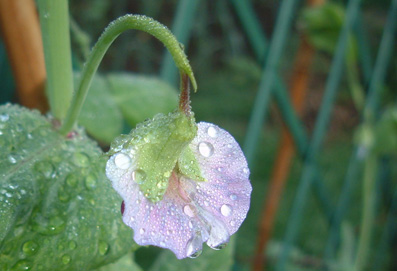 My hand-pollinated hybrid pea reveals its flower colour. Innit lovely?
Well, plant breeding may be a complicated pain in the neck, involving a lot of poking of flowers with scalpels and potentially years of patience and careful study, but I reckon there's no greater gardening thrill than to see one of your home-made hybrids burst into flower for the first time ... and find out what colour it is.
I'm getting immense pleasure just from looking at these large flamboyant purple-pink flowers, created by me, on a garden vegetable which normally has quite unexciting flowers. They are so beautiful.
The pods are turning colourful too, after a fashion. They're not as decisively purple as a true purple variety, but they're purple nonetheless. The flower buds start off a pale creamy pink with the maroon inner petal just showing through, then open out into a lovely two-tone pink which gradually matures to blue.
And so far my hybrid is following the pattern I predicted from what I know about the genes involved in pea colouration.

Just to recap on what this project is all about: I'm trying to breed my ideal garden pea. The basic spec is for all the fine qualities of a 19th century variety called Alderman, but with pink or purple flowers and purple pods instead of the usual white and green. Alderman has large white flowers, grows from between 6 to 8 feet tall and has the most exquisitely sweet and juicy peas (when eaten raw) that I've ever tasted. I couldn't tell you what they taste like cooked, because I've never got any as far as the kitchen. They taste too good straight off the plant. The peas are also huge in size and stay sweet even when fully mature. It's a fabulous variety and well worth seeking out.
To start my quest for a colourful version of Alderman, I did some crosses earlier in the year using Alderman flowers hand-pollinated with pollen from Mr Bethell's Purple Podded, an heirloom pea with pretty two-tone pink flowers and purple pods, which I got from the Heritage Seed Library. Its actual peas are green and reasonably large and pleasant tasting, but I'd be lying if I said they had anything like the ambrosial sweetness of a good green-podded pea like Alderman.
Usually when you do a plant breeding experiment you just have to try things out and see what happens, because very little is known about most of the genes in most plants. Peas have been better studied than most because their genetic patterns are very uniform and simple ... which is why they were responsible for the discovery of the fundamental laws of genetics. But even so, not all the genes have been identified. I have no idea what genes (or groups of genes) are involved in the production of Alderman's sweet flavour, so all I can do is grow my hybrid for several years and do loads of very thorough taste tests in each generation to find the flavour I want (it's a hard life).
But things are slightly easier when breeding for colour, because those genes have been identified and named. If I want plants with purple pods and a purple flash or ring in the leaf axils, there are four genes I need and they're all dominant. Gene A is the crucial one that gives the plant the ability to synthesise anthocyanin, the pigment responsible for purple colouring in most vegetables. A is effectively the 'on' switch for purple, but it doesn't control where the colour is expressed within the plant. To get purple pods, I need two additional genes, Pu and Pur (no I'm not making these up), and to get the purple splash at the base of the leaves I need another gene called D. A plant may carry genes Pu, Pur and D and have no purple colouring at all, because these genes can only express themselves in the presence of gene A.
I've made the assumption that Mr Bethell's Purple Podded has all four genes, A, Pu, Pur and D, because it has purple pods and purple leaf axils. And I also assume that Alderman, being green podded and green leaved, doesn't have A, although it may or may not have any of the other three genes. Therefore, when I make a cross between these varieties, I expect the F1 hybrid (that's the first generation of seed from the cross) to have purple pods and purple leaf axils. Why? Because they will inherit one half of their genome from the green podded variety and one half from the purple podded, and in this case the genes in the purple variety are dominant.
And so far that's exactly what I've got, which suggests that my hybrid pea, as well as being beautiful in its own right, has all four of the genes I want.
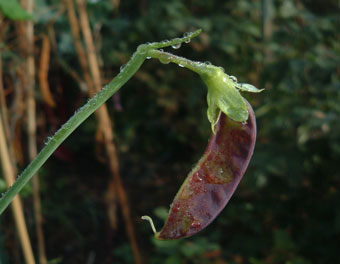
At first it looked as though the plants were going to produce green pods, because they were quite slow to change colour. With most purple podded peas, the baby pods start off green with a purple strip along the top edge, and then the rest of the pod colours up when it's a couple of days old. My hybrid variety is taking a couple of days longer to turn purple than I would normally expect, and the colour is slightly patchy on some of them. It's too early to draw any conclusions about why that's the case ... but it may be that the dominant purple pod genes are competing with another dominant gene for green pods, resulting in co-dominance and a colour part way between the two.
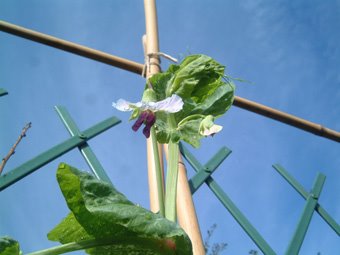
I haven't yet found out what genes are involved in the flower colour, but my guess is that they too are dominant but reliant on the presence of A. I'll know more about that when I grow the next generation. The flowers on my hybrid are basically the same colour as the 'father' plant, Mr Bethell's Purple Podded, but they're larger (an Alderman trait) and they have a very flat standard petal (that's the wide one at the back) which is a characteristic not seen in either parent. Most intriguing.
More intriguing still, one of the plants has started producing two flowers at each node, when both of the parent varieties produce only one. (There is a purple podded pea which does have paired blooms at each node, Ezetha's Krombek Blauwschok, but I didn't use that variety in my cross.) Presumably there is a gene for two-flowers-per-node which was being carried, but not expressed, by one or both of the parents.
But anyway ... aside from the joy of seeing a new hybrid come into flower, it doesn't really matter how beautiful the plants of this F1 generation are ... they will not be the same in the next (F2) generation. Those two halves of the genome will be broken up and randomly recombined, so that different genes from either of the original parents will start to show up in the offspring, with a huge number of different combinations possible. That's where you get the opportunity to choose the ones you like as the basis for a new variety. So the purpose of my growing these plants is just to obtain as many (self-pollinated) seeds as possible for the next generation, and those seeds will show a mixture of green pods and purple pods, from which I will select the best purple ones.
And while we're on the subject I must publicly thank Silvia (of the Windywillow blog) for the beautiful artwork she did based on my purple podded peas and my complaint that the faeries were coming along in the night and stealing the gold threads I was using to tag my hand-pollinated buds. Though in fairness to the faeries, they rarely actually steal things ... things disappear but nearly always turn up again, albeit in odd places. My missing gold threads turned up about three days later on a different plant, so it'll be interesting to see what happens when I plant the seeds from that batch. Silvia's artwork shows a couple of very smug-looking faeries tugging the threads off the flowers and is really wonderful ... she's very talented.
Sunday, 22 October 2006
Gah! One thing after another
Sorry for yet another period of inactivity ... husband has now done his back in and we also have a very unwell cat. We nearly lost the cat last week when he collapsed with kidney failure but our wonderful vet pulled him back from the brink ... we now just have to wait and see if he gathers strength over the next few days.
I shall be posting an update on my pea-breeding experiment very soon though, because my F1 hybrid is now flowering, which is very exciting ...
I shall be posting an update on my pea-breeding experiment very soon though, because my F1 hybrid is now flowering, which is very exciting ...
Sunday, 8 October 2006
Blight, blight, blight, blight and more blight
 Lovely orange Tangella tomatoes, ripened on a windowsill after blight killed off the plants
Long time no blog ... apologies for the break. We've been having a rubbish time recently ... my husband has been ill for weeks, his mum's been even more poorly, and I'm exhausted. It's also been a turbulent time with the music 'career' and my band has now officially broken up. It wasn't entirely unexpected, but it has meant a lot of time spent on trying to salvage as many songs as I can and launch myself as a solo artist. Things are looking up ... the record label have given me my own page on their website and I sang a song on a new EP by The Owl Service which was released this week.
The garden looks pretty depressing at the moment. But I guess that's normal for this time of year.
 Cold nights are bringing out some beautiful red and purple streaking on these Meraviglia di Venezia pods, which are normally just yellow
The beans are mostly over. The runner beans (Black Magic) are now just a few bedraggled pods. Meraviglia di Venezia has not done well this year, and I'm beginning to feel that this variety isn't a good choice for the British climate. A weekend of blustery wind in September absolutely shredded it, and it hasn't recovered. Many of the pods have no beans in them at all, just a floppy leathery pod which soon shrivels. As the nights turn colder it's beginning to show some quite attractive purply-red streaking on the pods, which is very pretty but doesn't make up for the poor yields. Kew Blue has been much more impressive, and kept flowering and podding right up until the middle of of September when it suddenly realised it was autumn and dropped dead overnight. I had good yields of yummy pods from it though, so no complaints. Mrs Fortune's, by contrast, is still resolutely flowering and setting pods. It looks a bit tatty, but it's soldiering on.
 Autumn colours start to show as chlorophyll breaks down in the leaf. The leaves on Kew Blue beans produce an amazingly vibrant violet-pink.
But the most significant change in the garden is blight. Blight absolutely bloody everywhere. Britain's most popular fungal infection, and the horticultural equivalent of the Black Death. I had to destroy almost all my tomato plants just as they were starting to ripen up, and I reckon I've lost about 70% of my crop this year (in 2004 it was 100%). Some have ripened up OK indoors, but many more have rotted. That's the horrible thing about blight, even things which look perfectly healthy when you pick them quickly succumb, because the infection is insidious and invisible.
Not all the plants were affected in the same way. Clementine was the first to be attacked, but it spread slowly and the plants carried on fruiting for a further two weeks. Tangella remained blight-free until quite late in the season, but when it did catch it the plants were a blotchy rotting mess within two days. And because it was the latest maturing of all my tomato varieties the fruits were still all green. I did manage to salvage a dozen or so by picking them early and ripening them indoors on a windowsill. Funnily enough my potato crops stayed blight-free much longer than the tomatoes, although they have been destroyed by it now.
The only remedy available to organic growers is copper fungicide, which is poisonous enough in itself ... but I found it completely ineffective this year. It didn't even slow down the spread. Blight patches treated with the copper spread out and produced spores just as readily as untreated areas. According to Alan Romans' lovely Potato Book, the blight problem is getting worse for several reasons. We used to have only one type of blight in Europe, whose spores only reproduced asexually. But thanks to a consignment of infected potatoes a few years ago we now have a second type, which has been breeding with the first type to create new strains which quickly adapt and mutate, not only to resist fungicides but to overcome blight resistant plant varieties. The warm moist weather brought about by climate change gives blight even more of a boost.
He also says that the blight fungus evolved from a seaweed, which is a strange thought.
 A few Black Plum tomatoes survived long enough to reach full ripeness.
But one single solitary tomato plant is still out there in the garden, still with green fruit, but still (so far) unblighted. It's one of the American varieties I bought from a US supplier and which isn't available over here: Isis Candy. It doesn't have a lot of fruit on it, but amid the mayhem of disease and destruction there it is, still sitting there, growing its fruit. I don't know whether it's a blight-resistant variety or whether it just got lucky. But I'll certainly grow it again next year to find out.
Many thanks to everyone who has left comments or emailed me during my absence ... I do really appreciate it even if it takes me a while to respond.
Subscribe to:
Posts (Atom)