Monday, 7 August 2006

Today in the garden ... harvest time

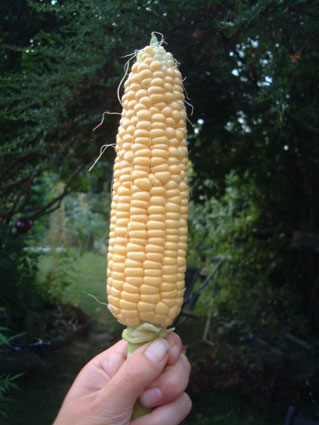
Just showing off my Swift F1 sweetcorn, which is as big as any supermarket cob and far tastier. Not bad for a crop which supposedly doesn't appreciate the British climate

I've had a lot of catching up to do after my time away ... lots of weeding, deadheading and propping up things that have collapsed under the weight of their own abundance.

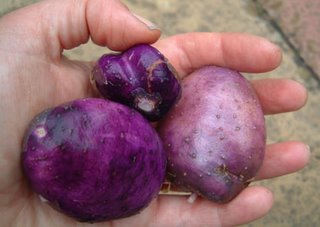
You may remember I've been ripening up a potato apple I found on one of my Marfona plants. Well, it's about as mature as it's going to get so it's time to extract the seeds from it.

There's precious little information out there about raising new potato plants from seed because not many people do it ... but it's basically the same as for tomatoes. The advantage of growing potatoes from seed is that they are likely to be free from any virus (unlike tubers, which store viruses very efficiently!) and it's also a voyage of discovery because every seed is potentially a new variety, with no two being quite the same.

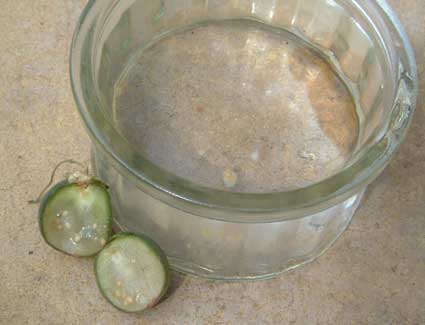
Just slice open the ripe potato apple (it's ripe when it just starts to go soft) and scrape the seeds out into a container of water. Any seeds that float are not viable and can be got rid of. Wash the sinkers to remove all the pulpy goo (a sieve or tea-strainer is probably the best way to do it) then spread them out to dry thoroughly.

As they're not hardy, I'll have to wait until the spring before I can sow them.

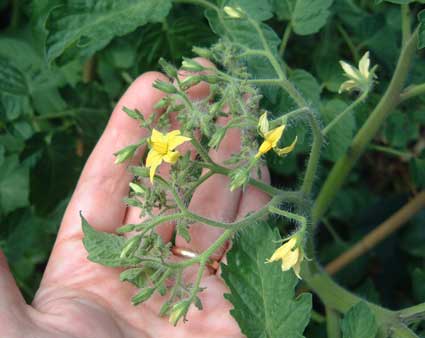
Marfona potato apple: it looks like a tomato from the outside ... and it's not dissimilar on the inside too. The seeds look like small tomato seeds and are easy to extract in a jar of water.

At last, one of my F1 hybrid experimental peas has germinated! I'm so relieved. It was one of the ones I sowed fresh from the pod into high quality coir and vermiculite. I've also got another batch started off in bog-roll tubes as per my usual method, and I'll see what happens to those. These are ones which I'd allowed to dry out before sowing them ... I want to see whether that makes a difference.

At this time of year lots of stuff is ready to harvest. I pulled up the Hysam onions today as it's been a couple of weeks since their foliage flopped over, so they're about ready.

Hysam onions drying in the sunshine

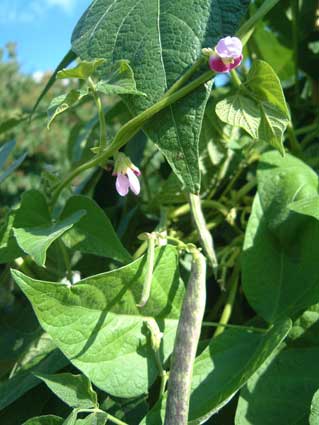
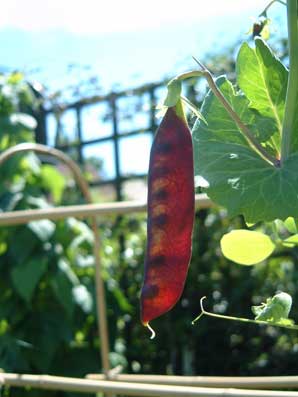
I've got more French beans than I know what to do with, and I've started to let Mrs Fortune's develop mature beans rather than keeping on picking the young pods. The plants have rather cheekily lashed themselves around some adjacent bamboo frames, having outgrown their own (7ft) supports, and are trying to take over the garden by stealth. I now have funny little blue-streaky pods growing among the tomatoes ...

Mrs Fortune's climbing bean is hard to beat if you want high yields and rampant vigour

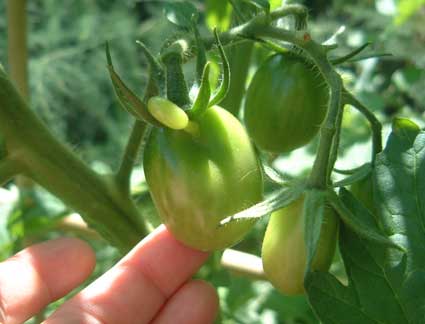
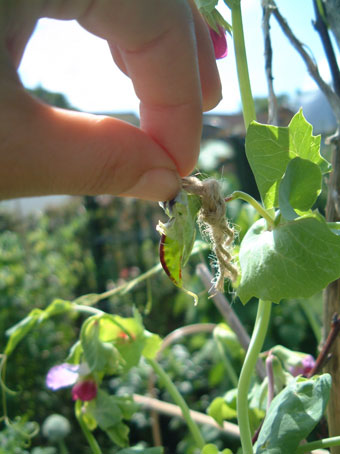
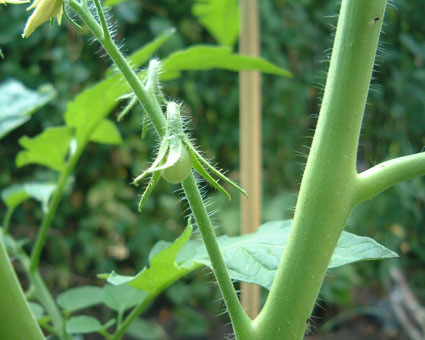
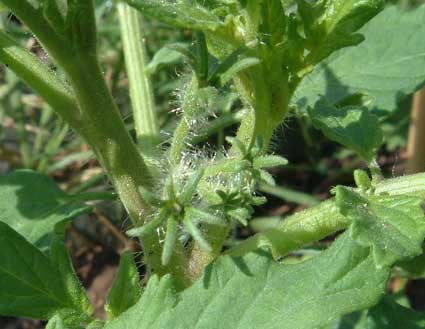
And there's more weirdness among the tomatoes. I notice one of the developing fruits on Black Plum has a strange appendage growing out of it. Not sure if it's trying to grow into a spare tomato or what. Anybody else had something like this?

Black Plum also has the distinction of being the healthiest and most rampant of all the tomato varieties I'm growing ... it's already over the top of the bamboo frame I made for it way back when. At the other end of the spectrum, my Pink Jester plants are looking very straggly and distorted and two of the three plants have elongated fruits which are not true to type. I dunno why that is, because they're from the same batch of seed I've sown for the last few years. They're oddly elongated with pointy tips, like peppers. Very curious.

Strange knobbly sticky-outy bit on a Black Plum tomato ... hmmm!

Sunday, 6 August 2006

I'm back!

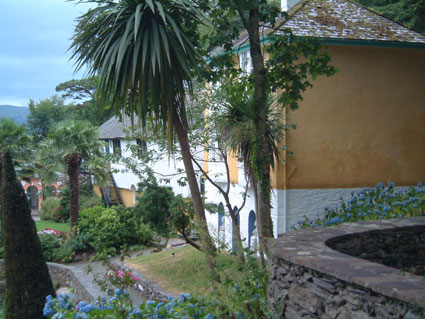
And this is where I've been ... Portmeirion in North Wales.
Not exactly a typical Welsh scene but they do have some nice blue hydrangeas and a sheltered microclimate


It's a very quirky private village and garden mostly built in the 1920s and 30s, and probably most famous for its use as a film set for the strange 1960s TV series "The Prisoner".

Me on the beach at Portmeirion, best known to Prisoner fans as the place where Patrick McGoohan got swallowed up by a weather balloon called Rover. Um ... yeah ... you had to be there really ...

The nearby scenery ain't bad either. This is part of Rhaeadr y Cwm, near Llan Ffestiniog. It was full of dragonflies, butterflies, acid-loving peat-bog plants, richly coloured foxgloves, and sheep.

Sunday, 30 July 2006

Today in the garden ... a dud spud

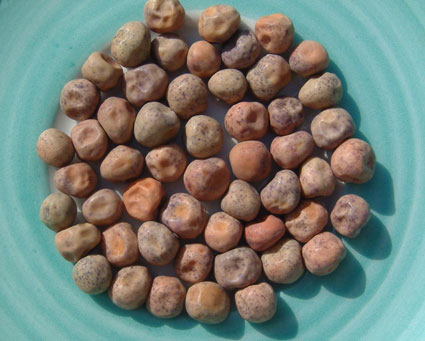
Golden Sweet peas: a saucerful of living history, with purple speckles

Well, you know how it is. You decide to conduct some proper purple-podded pea trials and you start ordering up a few varieties, and then you find someone's selling a nice yellow-podded pea. It seems a shame not to buy some.

Actually Golden Sweet has been on my wish list for a while, and I thought I could only get it from the Heritage Seed Library. It makes sense to buy these rare things from commercial sources wherever possible, to save my precious six-packet HSL quota for those varieties I really can't get anywhere else. These seeds came from The Real Seed Catalogue, whose website has a lot of useful information about seed saving as well as a lovely selection of open-pollinated vegetables. You know a seed company really is passionate about biodiversity when they tell you how to produce your own seed instead of buying it from them again next year.

Golden Sweet seeds are extraordinary. They are spattered with purple freckles. There's also considerable variability in the colour of the peas themselves, which is a characteristic of this variety. I'm completely in love with the seeds and it's going to be difficult to bring myself to plant them! Golden Sweet is believed to be one of the cultivars used by Gregor Mendel in his pea hybridising experiments back in the 1850s; the gene for yellow pods is recessive, and crossing this pea with green-podded varieties helped Mendel to spot the inheritance pattern which became the basis for modern genetic science. And I don't doubt he got as much joy from staring at the purple-speckled seeds as I do. At some point I will do a post dedicated to Gregor Mendel because he was a great bloke and I often think about him when I'm poking my scalpel up a pea stamen.


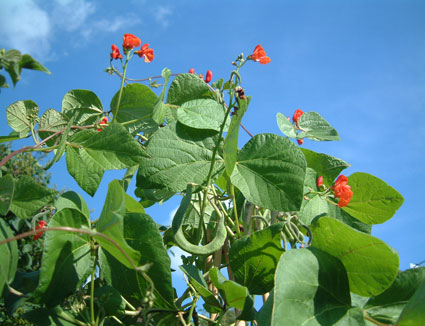
Meanwhile, runner bean Black Magic is starting to supply the table. My plants don't look too happy to be growing up close to a tall jasmine hedge, but needs must ... the neighbour has a garden full of runners flowering at the same time and I have to minimise cross-pollination. Black Magic is a little bit quirky looking. The flowers are orangey-red and many of the pods curved into a sickle shape. I'm not sure how much the pod shape is inherent in the variety and how much is caused by lack of water, growing under a hedge during a drought.

I've been reading up a few things in recent days in praise of potato microplants, and I concede that they do have their place; they make rare unlisted heritage varieties available which would otherwise be illegal to sell as seed potatoes (due to a daft and outdated EU law) and they are completely disease free, which is a real plus point if you're growing them in a nice sterile polytunnel. But this photo of my Witch Hill potato harvest illustrates the frustration they can pose for ordinary gardeners who want to grow them organically. This little slug-ravaged stash is all I have to show for two seasons of nurture and care. If I'm lucky, I might be able to get this variety established properly in the garden after one more year.

Pathetic results once again from the rare but much praised Witch Hill. Undamaged tubers salvagable for next year's seed are barely enough to fill an eggbox, leaving the scabby and mollusc-ravaged specimens in the top tray for me to eat as tasters. Yum.

But at least I got to taste them. And yes, the flavour is something pretty special, it's not just hype! If you like floury-textured spuds then this is probably potato paradise. I'm a waxy-texture spud lover myself, but even I appreciate how good this one is. And I can also see how it got its alternative cultivar name, Snowdrop. The flesh is so floury it turns to something resembling a crystalline powder after cooking ... which looks just like a sprinkling of fresh snow. But it doesn't disintegrate, it has a consistently good texture. It's thin skinned and smells nice. At least now I know it's worth persevering with, anyway.

I'm off to North Wales for a few days, so there may be a short hiatus in the blog ...

Friday, 28 July 2006

More pea-related ramblings

Sweet peas growing through the sagging remains of my Alderman crop. I'm a great believer in mixing up pretty flowers among the veg. For most things it encourages better pollination, although peas don't need bees so in this case it's purely decorative.

I've had grovelling apologies from both my next door neighbours today. Mrs Leafblower apologised after she accidentally hosed me down while watering a capacious shrub growing against the lattice fence which separates our gardens, having not noticed me crouched down sowing seeds on the other side of it. Then the other neighbour's mum came round to apologise for an incident early this morning when her son's dog spotted a cat in our front garden (not one of ours) slipped his leash and came charging through the hedge in pursuit. Fortunately for the cat, this dog is endowed with a peculiarly short attention span and only got half way across the garden before stopping to crap on the lawn.

Despite all this excitement I managed to get the Alderman peas planted out in the former potato bed. The soil has fluffed up a treat after having a sack of horse manure dug into it. I've put in a row of canes for them (for stability) and a few prunings from the Ceanothus tree for them to hang on to. This seems to be extremely important for peas, getting the 'pea sticks' in straight away; they know when they've got something twiggy to get their tendrils round and respond accordingly. If you don't provide them with twigs, they sit there and sulk.

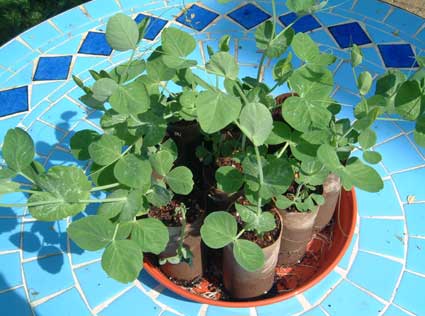
I've had a lot of failed pea crops in the past, and have had to experiment a bit to find a method of growing them which works for me. It may not work for anyone else, of course. But this is what I do. I put eight or ten bog-roll tubes on a large saucer (if I need to label the varieties I write on the tubes with a marker pen) and stuff them firmly but lightly with compost made from coir, sand and perlite. I don't bother being precise about proportions of different ingredients ... I try to trust my gut instinct with it. But I recently upped the perlite quota substantially after most of my precious Champion of England seeds rotted off ... it helps keep the mixture open and aerated. I keep space between the tubes too to allow air to circulate around them (otherwise they're prone to going mouldy). I sow two seeds in each tube.

Champion of England. It's tall.

The trouble with pea seeds is that they rot very easily, but still need plenty of moisture to germinate. Getting the balance right so that they survive the germination stage can be quite tricky. What I tend to do is keep the bottom of the saucer regularly topped up with water, without letting it build up to the point where the tubes are left standing in water. If they need the water, they soon suck it up. I usually water them several times a day in this manner. Watering from the base is the key though; it keeps the area around the seed relatively dry while encouraging the roots to push downwards to find the moisture. Usually the roots are poking out the bottoms of the tubes within a few days (and at that stage it's even more important to keep them well watered so that the roots don't dry out and die off). I still get the odd seed going mouldy but on the whole this method works pretty well for me.

And incidentally, I'm not just being a cheapskate here: I rate ordinary bog-roll tubes more highly than the purpose-made root-trainers you can buy in garden centres. They're sturdy, porous and biodegradable. All lavatorial cardboard in our house is assiduously collected throughout the year for this purpose.

My Alderman seedlings, well rooted and ready to make a bid for freedom

I'm currently trying to persuade my home-saved seed to germinate, but most of it is rotting off before it even thinks about sprouting. I'm not sure whether this is anything to do with sowing it fresh (I had no problems at all with the Alderman seeds which were dry from a packet) or whether it's some other factor. My thinking is that it's probably the balance of moisture and temperature which is to blame. But getting that balance right is still a matter of trial and error. According to Carol Deppe, and I've no reason to doubt her, you can sow fresh peas as soon as they mature without having to dry them down first. Just soak them in water until they germinate, she says. Well, I've tried that. And no matter how regularly I refresh the water I'm just ending up with a stinky fermenting mess.

It could of course be down to the weather. Peas are a cool-climate crop and sowing them in these mad summer temperatures is not ideal. I will try my next batch in the coolest place I can find. But these hand-crossed hybrid seeds are not easily replaceable so I can't afford to keep losing them.

And for my next trick I'm trying out a plastic pot sterilised in hot water, a posh expensive coir medium mixed with a little vermiculite, and sowing the peas with just a sprinkle of vermiculite on top. In theory this should keep the seeds moist but still allow plenty of aeration. I bloody hope so anyway.

The hand-pollinations were ostensibly successful. I have several nice plump pods full of home-made F1 hybrid seeds waiting for the right moment for harvest, and have gathered in a few already. They don't generally have as many peas in them as a naturally self-pollinated pod, but that's normal.

Lovely plump HUGE seeds from an Alderman x Mr Bethell's Purple Podded cross ... even if there are only three in a pod.

OK, here comes a load of nerdy botanical stuff. I've noticed that the hand-pollinated pods with the most peas in them are the ones where I left the outer sepals intact on the flower bud. When I learned to do pea pollinations I had instructions to take the sepals off first to make the tiny buds easier to handle. But I find it results in the outer petals quickly drying out and falling off, and I'm now wondering if this causes the stigma to dry out excessively. I've tried a few different variations and I'm finding that the less damage I do to the flower bud (even the parts which don't seem to matter) the more fruitful the pollination is, with the healthiest pods and largest pea numbers resulting from those where I did nothing more than cut a small slice in the keel to hoik the anthers out. I've recently discovered that removing the sepals is actually unnecessary as they're quite easy to fold back out of the way (tearing them slightly seems to do no harm). Leaving them mostly intact makes the pollination job marginally more fiddly but seems to increase the average yield from 0-3 peas per pod to something more like 6-7 per pod. Ha! Plant-breeding is a constant learning experience.

I've also, incidentally, noticed a higher success rate in the buds which I pollinated twice (emasculated and pollinated on one day and then pollinated again 24 hours later). So even though the stigma is supposedly receptive in the early bud stage, it does seem to be more receptive if you give it an extra day.

Knowing when to harvest is the biggest unknown for me at the moment, and the info I've found about saving seed from pea plants tells you to leave the pods on the plants until they're completely dried out, several weeks past the eating stage. That's all very well under optimal conditions, but it doesn't take into account the summer ravages of the dreaded pea moth. If I leave the pods on the plants until they start to go brown I'm finding them full of horrible little maggots ... a risk I can't afford to take with my precious hybrid experiments. I'm finding that the stage where the pods just start to go leathery is a good compromise.

Meanwhile, although I'll have to wait till next season to conduct a proper trial of purple-podded peas, a packet of Ezethas Krombek Blauwschok arrived this morning from Chase Organics and I've slung a few into bog-roll tubes to see if I can grab a late crop for this year. It's already clear that this variety is not the same as the ones I've already seen; the seeds are large-ish with a distinctly brown colour and many are somewhat flattened in shape. Although it's hard to be sure the colour differences are genetic rather than just down to variations in harvesting and storage, the ones I saw at the Rococo Garden had a similar flatness but were distinctly smaller and greener, while Mr Bethell's Purple Podded has larger, rounder seeds with a yellowy-green colour.

Taken a couple of weeks ago, this photo of a baby pod on Mr Bethell's Purple Podded shows how the colour starts developing just along one edge before the whole pod turns purple. This one has been hand-pollinated with Champion of England and you can see all the tiny peas inside ... the future of my breeding experiments.

Wednesday, 26 July 2006

Today in the garden ... harvesting legumes

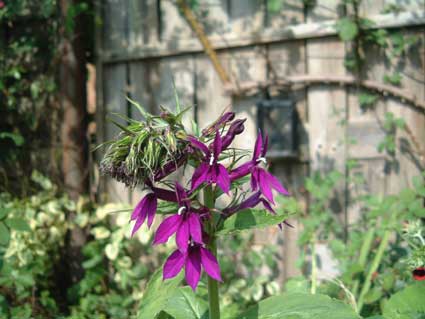
No this isn't a legume. It's a purply-black hollyhock. Nice though, isn't it?

Although I'm far from self-sufficient (until I find a way of growing chocolate biscuits in the garden it's never going to happen) I am now eating home-grown food pretty much on a daily basis. And the leguminous crops are doing especially well just now, so I've been having a big harvest day to get some of the surplus into the freezer.

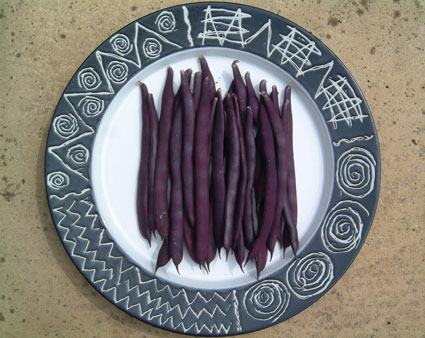
Kew Blue is just delightful. Look at the pods ... long, thin and straight, satin-textured, and the most beautiful rich purple. The plants produce fewer leaves than other climbing beans and the pods are produced in pairs on long trusses, like they're dangling from little handlebars. You can see them easily when you want to harvest them. Yields are high and the flavour and texture are both superb.

Kew Blue: a gourmet bean if ever there was one

So this is another superior heritage vegetable which I know a lot of people would appreciate having the chance to try. But it isn't widely available ... I've only found one supplier other than the Heritage Seed Library. I haven't been able to find out anything much about this queen of beans ... even Google is pretty low yielding, and most of the hits are for a salpiglossis with the same cultivar name. I assume it has some connection with Kew Gardens. It appears it was accidentally omitted from the Heritage Seed Library's 2006 catalogue ... which may explain why they've been sending packets of it out as freebies to members this year. That's where I got mine from, in fact, and as freebies go it's a real corker.

My other HSL bean, Mrs Fortune's, doesn't come into quite the same flavour class but it makes up for it with massive yields. I have yet to try the dried beans.

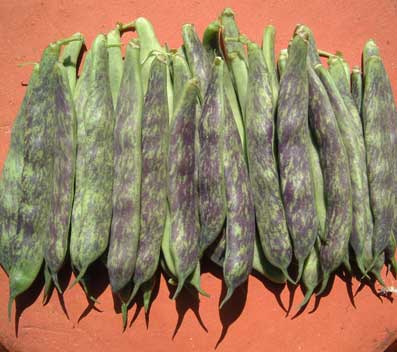
Mrs Fortune's: blue-streaked and curly-tailed

Any moth experts out there? We had an enormous (about one and a half inches across) and spectacularly beautiful moth fly into the lounge today and take up residence just under the ceiling. I've never seen anything like it. Its outer wings were a standard mottled-brown mothy colour but underneath it had incredibly vivid orange and black underwings. I've looked at all the moth identification websites I can find and the nearest thing I've found is the Orange Underwing (huh, there's an imaginative name for such a beautiful creature) but I'm still unsure because it seems to be the wrong time of year for them. If anyone can help identify it from my admittedly crappy photographs I'd be forever grateful.

Yeah yeah, there is a wee bit of camera shake. I was standing on a chair with a hand-held zoom lens and it was the best I could do! The second shot is better but it had closed its wings by then.

Once it had settled it stayed put for several hours, but eventually we decided we'd better evict it because one of the cats had her beady eye on it. So with a lot of precarious balancing on furniture (husband) and frenzied flapping (moth) we trapped it in a long-handled bug-catcher and released it outside.

Tuesday, 25 July 2006

Today in the garden ... too darn hot

And I only watered it this morning ...

Not a good day for working outside in the sun, but I've been doing a lot of digging today, getting the last of the Edzell Blue potatoes out and rejuvenating the land ready for the next crop of Alderman peas, which are on a window sill in the music room and already sending copious roots out the bottoms of their toilet rolls.

This is the vacated Edzell Blue patch being prepared for the next crop.

Despite the recent heavy rain the soil is rock hard and very difficult to work. I went out and bought another five sacks of horse manure, and some of that has gone into said rock hard soil to help improve its texture. It also got a dose of calcified seaweed over the surface and then watered in. Luckily there's no hosepipe ban here (I do feel for all you allotmenteers out there, tending your plots at the mercy of the councils who turn the water off at the first available opportunity) although I'm careful not to overdo it. The seaweed meal adds trace elements and stimulates bacterial activity in the soil, which improves its structure and helps release more nutrients. And it makes your garden smell like the seaside.

These look pretty hot too ... orange gazanias

My Swift F1 sweetcorn is doing better than ever. Last year I had strictly one ear per plant, although they were the biggest and tastiest I've ever grown. This year they all have at least two ears each (the seed was from the same packet, bought from Chase Organics). A couple of them have three.

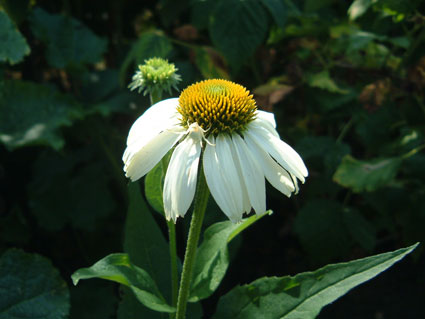
Echinacea doesn't mind the hot weather so much. This is White Swan, complete with a rather ugly white spidery bug thingy.

Monday, 24 July 2006

Potato update

Edzell Blue is a Scottish beauty from the early 1900s. Its flavour is nice but not wildly exciting, and I still haven't found how to cook it to best advantage

I've been harvesting a lot of potatoes in the last few weeks, and I shouldn't need to buy any more from the supermarket for the rest of the year.

I love potatoes. They're my favourite food and I will eat them in any form (well, I might draw the line at raw) and I've always found them very rewarding to grow. They will stick their roots down through anything, even if you couldn't be bothered to dig it first, and will usually produce a decent crop even if they're completely neglected. I have some leggy-but-fine specimens growing under my shady compost shack, self-propagated from discarded tubers.

I was hoping to try some potato cross-breeding this year but I'm still trying to establish which of the varieties I have produces decent pollen. So far only Marfona seems capable of setting top fruit, and unreliably at that. Potatoes are essentially inbreeders, but not to the same extent as tomatoes. It's easy to see why when you compare the flowers. Although ostensibly a similar shape, with the anthers fused together into a central cone, the potato flower has its stigmatic tip sticking out beyond the anther cone, where insects can jump around on it. Tomatoes usually have a shorter stigma; it stays inside the anther cone and gets self-pollinated whether it likes it or not.

But even with a sticky-outy stigma, potatoes don't readily cross-pollinate. Despite having bigger and prettier flowers than tomatoes they don't really attract anything. I often see butterflies and damsel flies on the leaves of potatoes, but nothing seems to take much interest in its flowers.

The first potato I harvested this year, a few weeks ago, was Maris Bard. It's a modern variety and a first early. Its flavour is absolutely wonderful. I only had one plant and its produce didn't hang around long enough to be photographed.

At the opposite end of the spectrum is Fortyfold, 170 years old and very late maturing (mine hasn't even flowered yet). I harvested a few plants today though, because it's the only way I can get to my Clementine tomatoes. As you may recall from an earlier post, I had to abandon a partially-constructed footpath in the veg garden when a community of slow worms moved in under the tarpaulin, and have only been able to reach stuff growing beyond the path by tramping across a double row of garlic and through the Fortyfold spuds. Fed up with getting garlic scapes up my skirt and potato haulms caught round my ankles, I harvested a swath through both at the weekend to improve access.
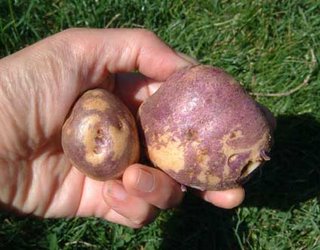
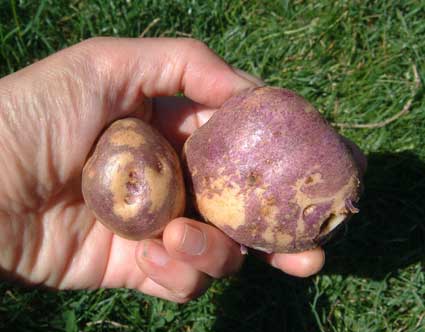
Fortyfold is the oldest known potato cultivar (introduced in 1836) and it's still pretty nice to look at

The mature tubers are mauve and cream, but some of the younger ones are a more intense purple. The colour doesn't survive any form of cooking though. They just turn bog-standard beige, although the streaking is still visible. The flavour is good, in an old-fashioned earthy kind of way, but they have tough skins and a lot of dry matter in them. My preferred use for them is roasting them in their skins and smothering them with gravy. But even then they take a bit of chewing. They are also nice baked ... the skins go thick and chewy with a flavour not unlike popcorn.

Red Duke of York is a variety that always does really well for me. It's the only potato I've ever grown which is largely untouched by slugs and wireworm. I had a few tubers that split in the dry weather, but otherwise they're trouble free. Yields are ridiculously high ... I dunno where to put them all.
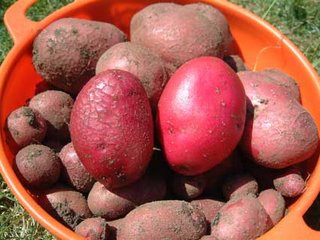
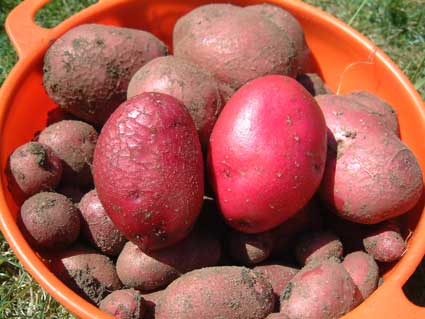
Red is my favourite colour, so you can imagine how much I like this variety, a reliable wartime spud introduced in 1942

The high yields are fortunate in the light of Rebsie's First Law of Potato Harvesting, which states that whatever tool you use, and however far away from the plant you stick it in, the first slice will always go through the biggest and best tuber. Harvesting Red Duke of York today, I managed to slash open two succulent potatoes and a red ants' nest simultaneously in the first stroke! Wow.

My Red Duke of York didn't flower at all this year, although it produced plenty of buds, but the plants are quite decorative anyway because they have a strong purple tinge in the leaves and stems. And the important thing is the lovely spuds. Harvested young they're a smooth red with freckles on. If left to mature for a bit they develop a crazed appearance (ha! I know the feeling) but they taste wonderful whenever you harvest them. Really, really good flavour ... sweet and refined. The flesh inside is yellowish.

The red pigment seems to act as a natural sunblock as well, because they don't go green when they're exposed to the sun unless they're left out for a very long time. The colour is retained to a greater or lesser extent after cooking. Boil it in its skin and it stays bright red. Bake it and it turns a golden russet.

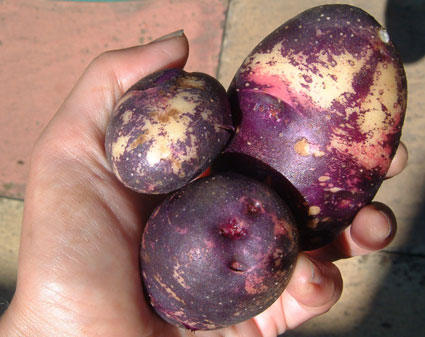
Mr Little's Yetholm Gypsy is the novelty of novelties. But it's also a good 'un in its own right. I have yet to buy Alan Romans' Potato Book (though I really really want it) but I understand he's the person responsible for preserving this unique variety, having been given a tuber by the late William Little of Yetholm (that's in the Scottish Borders, by the way, an appropriately magical area for the emergence of a strangely colourful vegetable). It's extraordinary in its colour, having both red and blue near the surface (in variable proportions) and a creamy-white inner flesh. Its origins are not known ... even Mr Little didn't seem to know where it had come from, having picked it up at a horse fair 50 years earlier.
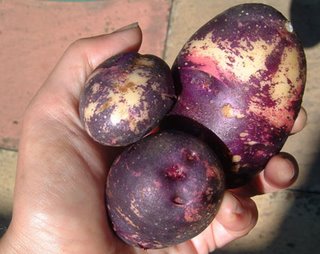
Mr Little's Yetholm Gypsy: Like a bit of colour interest in your spuds? Beat that!

Looking at it from the outside I wondered if it might share some ancestry with Fortyfold, because I detect a certain similarity in the wispy streaks of colour in the skin. But it doesn't have the same texture or flavour.

One characteristic of this variety is that it's slow to chit (sprout). But that can be an advantage, because it extends the season. I planted four tubers in the spring and those plants are almost ready to harvest (I dug out a sneak preview for the photo above). Meanwhile, the rest of the tubers from the same original batch have been sitting on a north-facing windowsill since autumn last year and are still perfectly firm with healthy dark purple sprouts. They've only sprouted about half an inch in six months. I shall plant those whenever space in the garden allows. In a suburban garden within Cheltenham's gentle climate I can get away with planting potatoes ridiculously late, though I will have to hope for a blight-free summer ... many of these old varieties have poor resistance.

The plants are very lanky. I mean very lanky. They grow bolt upright for a certain while and look very smart, and then they flop over and grow leggily in all directions. It isn't the tidiest of potatoes. But it does have quite pretty pale purple flowers, which if you're lucky will blossom before the rest of the foliage splats gracelessly over the floor.
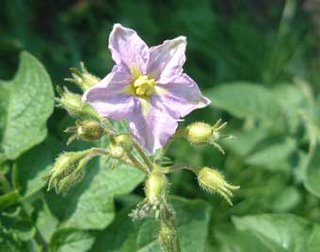
Dainty mauve flowers are a feature of Mr Little's Yetholm Gypsy

The colouring in the tubers appears to be created by a thin layer of purple-blue pigment over a thin layer of pinky red pigment over white flesh. Some of the streaks appear naturally as the tuber grows. And when you wash the freshly dug spuds, a little of the dark blue rubs off and gives you more streaks of red and white. Then as the potato dries a little the colour seems to set and become permanent. It really is a most distinctive and unusual thing.

I was fully expecting the flavour to be insipid though. When you find something this wacky you can't really expect it to come up with a knock-out taste as well. But ... this is a very special potato. It tastes fantastic. Under its thickish skin the texture is waxy and moist, and the flavour strong, sweet and earthy. And as if that wasn't enough, it retains its colour after cooking! That's right, you can tuck into a blotchy purple red and white jacket potato and still be able to marvel at how magnificent it tastes.

Obtaining this exotic specimen may be difficult. I hope it will become commercially available in the coming years, because I'm sure lots of people would love to grow it. Mine came from The Organic Gardening Catalogue (Chase Organics) in the form of laboratory-grown microplants. I've said before that I loathe microplants, and I'll say it again. I loathe microplants. Yetholm Gypsy is one of several rare heritage varieties which can only be bought in microplant form at the moment. It costs ten quid for 5 tiny plants which have no immune system and succumb to every nastiness nature can throw at them. Then, if you manage to keep them alive for a whole season, you have to abstain from eating the tubers because you'll need to save them all as seed for the following year. These tubers you see in the picture above are the first edible ones I've had from plants I bought in the spring of 2005. I would much, much rather have bought them as seed potatoes if they'd been available.

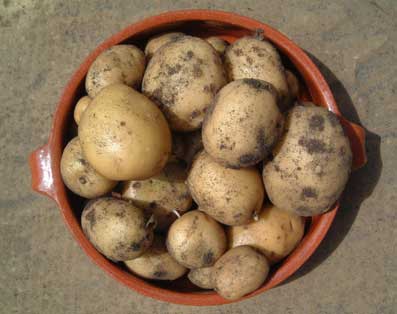
Mr Little's Yetholm Gypsy has become my joint favourite potato along with the delectable Marfona, which funnily enough is not a heritage variety, it's one which is often used for large-scale commercial crops. Marfona was introduced from Holland in 1975 and is close to my idea of spud utopia. The main thing is the texture; a really waxy and moist melt-in-the-mouth texture but with enough substance to give you something to chew on. The flavour is really, really wonderful. Because of its rich moisture content it takes less time to cook than many spuds, is suitable for just about any purpose (though baking in its jacket is the most sublime experience) and generally needs less butter to give it a soft and buttery flavour. It's a truly superior variety and if I could only grow one spud, this would have to be it.
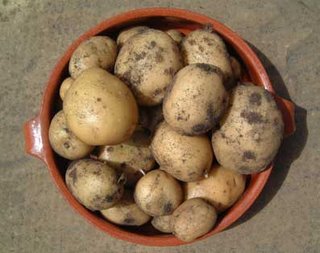
Marfona may not look as exciting as some of the others, but the texture and flavour are out of this world

Left to grow to maturity it produces large baking-type potatoes, but you can harvest it more or less whenever you like. Yields are high. The plants are very large and vigorous with white flowers. Some of my crop has been blemished with scab on the surface but I'm not really bothered because it doesn't greatly affect the eating quality. Scab is very common in light and dry soil, and my garden soil is about as light and dry as it gets.

Still to come in the potato plot is Witch Hill, another old and rare one bought (by necessity) as microplants and which I still haven't had the pleasure of tasting after 13 months of nurturing. It hasn't been doing hugely well in my garden, to be honest. Of the six tiny tubers I salvaged from last year's disastrous microplants, two plants have died. The other four were relentlessly attacked by slugs for weeks and weeks in the early summer. They are now looking reasonably healthy, so I'm hoping for a small crop ... eventually.
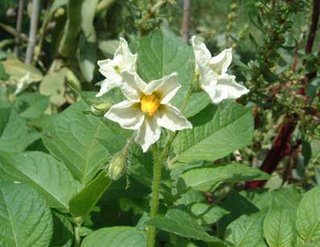
Witch Hill ... a relic of the 1880s and currently proving a bugger to grow
Sunday, 23 July 2006

Tomato update

Tomatoes beginning to form on Black Plum, a Russian heirloom variety

Potato update is still in preparation, so here's a botanically similar substitute.

It's still early days in the tomato season here, so there's no fruit to look at yet. But we're into that period where they grow like the clappers and new things are happening with them on a daily basis, so this is an overview of what I've got on the go. I'm going to experiment with making hybrids from these, and when I do I'll post up some instructions for hand-pollinating tomato flowers, like I did with peas. Tomatoes are naturally inbreeders, so creating new varieties is relatively easy. (I guess that's why there's so many out there already.)

I'm growing a daft number of tomato varieties this year. But because of space restrictions I'm not able to grow more than three of each variety. Not ideal, I know, but them's big plants.

Black Cherry from Tomato Growers Supply Company (US based)
Black Plum from the Heritage Seed Library
Clementine from Chase Organics (originates from Ferme de Sainte Marthe in France)
Copia from Tomato Growers Supply Company (US based)
Green Tiger (seed pillaged from Marks&Spencer's stock)
Isis Candy from Tomato Growers Supply Company (US based)
Pink Jester (from home-saved seed, originally pillaged from Marks&Spencer's)
San Marzano from Franchi Sementi
Tangella from the Heritage Seed Library
Tigerella from Thompson & Morgan
a couple of unidentified seedlings

This year, as I mentioned before, I'm growing three American tomato varieties. Copia is a large yellow and red finely-striped tomato that looks like nothing I've ever seen. Isis Candy (seedling pictured below) is bi-coloured red and gold and marbled inside, but has cherry-sized fruits and a good reputation for flavour. Black Cherry is an exceptionally dark black-red tomato with cherry-sized fruits. As far as I'm aware they're not commercially available in the UK, so I ordered them from a US supplier. This is not a cheap option, but it's not prohibitively expensive either; the only difficulty is that not all seed companies will accept international orders. Tomato Growers Supply Company is one that does. There's no guarantee that they will thrive in the British climate, but it'll be fun finding out.

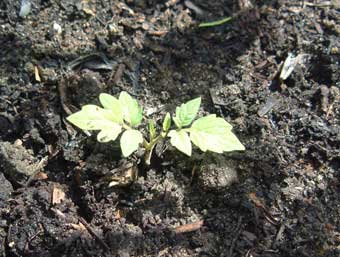
Something very weird happened with my American tomatoes though. I think the faeries may have got to them. I very carefully planted six seeds (two of each variety) into a six-module planting tray. And eight plants germinated.

This is really baffling me. Tomato seeds can very easily get stuck together and be sown two at once, but I was meticulously careful to make sure mine weren't. Besides, the 'spare' seedlings germinated at the edges and don't look quite the same as the others so it's not obvious what variety they are. They grew from within the compost, not on the surface, so it's highly unlikely they were dropped there by a passing bird (besides which I haven't had any self-seeded tomatoes anywhere else, just in this one tray). The compost itself was hand mixed by me from basic raw materials: coir blocks, sand and perlite. I don't see how any tomato seeds could have strayed into that. Needless to say this has intrigued me so I'm going to have to grow the mystery seedlings to maturity just to see what the hell they are.

Prolific flower clusters forming on Clementine, a French variety which will have small golden yellow citrusy fruits

Another of the varieties I'm growing is Tangella, which is an orange-fruited variety of some vintage which is not often found commercially these days (not in the UK, anyway). I didn't choose it. I simply ticked the box on the Heritage Seed Library order form to accept a randomly selected seed packet. It was quite odd really ... I sent off my order form the day before I read up a section in Carol Deppe's wonderful book about breeding orange tomatoes for their beta-carotene content, and I thought "Dang! I wish I'd ordered an orange tomato so I could experiment with that." You can choose a maximum of six packets a year from the HSL plus an optional random one, so I thought I'd missed the boat until next year. But when my order arrived the thing they'd chosen to send me randomly was an orange tomato.

And the thing that's making Tangella stand out at the moment is that it has weird flowers. The buds are like little green stars. I appreciate not everybody spends their time on their hands and knees peering at tomato flowers, but I'm one who does, and take it from me, most of them form buds which start off as enclosed cones ... the sepals remain clamped around the petal cone until just before the flower opens (as in the Clementine photo above). That's usually the stage at which hand-pollination is done. Tangella produces buds with the sepals wide open and curled back right from the start, before the petal cone has even developed. So how you tell when it's ready for hand-pollination is something I haven't worked out yet. They seem to have seven sepals too, rather than the more usual five.

Enlarged view of star-like buds on Tangella. The tiny pimple in the middle is the as-yet-unformed petal cone.

Thursday, 20 July 2006

Today in the garden ... heritage vegetable taste tests!

One of my hand-pollinated buds on Mr Bethell's Purple Podded, wearing some gold braid as a marker. This one was crossed with Alderman a few days earlier. I've found that if you leave the sepals intact when you do the pollination jiggery-pokery the flower will open as normal (as this one has). Tearing off the sepals makes the petals dry up and the flower dies off without opening. It's just a cosmetic matter, but I like to make the most of me flow'rs ...

Apart from the broad beans, which were from W Robinson & Son, all these vegetables came from the Heritage Seed Library.

I've been watching the progress of Mr Bethell's Purple Podded with great interest, as you'll have noticed, and overall I'm quite impressed with it.

It doesn't seem to like the really hot weather ... the lower leaves have died off considerably during the last couple of days. It's also stopped flowering now, but that's probably because I've allowed some of the pods to reach full maturity (this crop is mainly for seed production ... the Heritage Seed Library issues its pea seeds in packs of 10, which is not really enough for a proper food crop but does allow you to build your own stash of home-saved seed, which is kinda the point really).

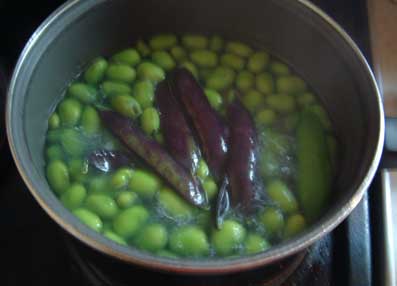
Stewing up some purple pods with the last of the red-flowered broad beans

There's enough there to provide a tantalising taster anyway. I'm finding that the pods are lovely as mangetout if you use them when they're small; once the peas start to swell inside they go a bit stringy. They are a beautiful maroon-purple (translucent in sunlight) but lose some of their colour when they're cooked ... still retaining enough to make them a show-stealer at dinner. The flavour is not outstanding when they're larger but if you use them young they're very sweet indeed.


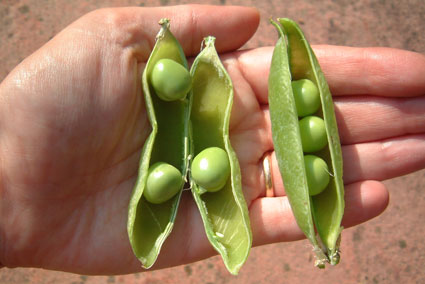
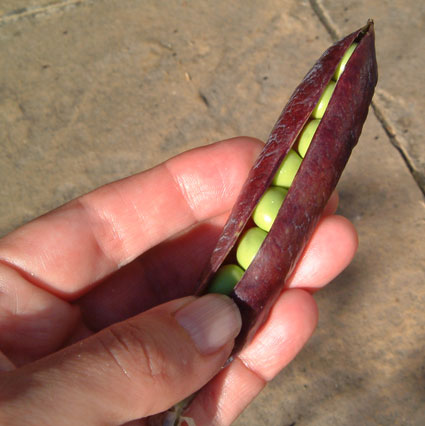
And here's what you get when the peas are fully grown ... as you can see, they're bright green. They're also larger than I expected, having just seen the ones at the Rococo Garden which looked miniscule by comparison. These are as large and green as a conventional culinary pea. I harvested these when they were past their best for eating, because I'm planning to save them for next year's seed, but I tried a couple (raw). They have a distinctive and unusual flavour, I'll say that for them. Kind of slightly nutty and mealy, and not massively pea-like, but still sweet and pleasant. Something quite old and earthy about them, but I mean that in a nice way. They don't have the exquisite flavour of Alderman, but then Alderman is an altogether superior pea on every level and I bow down before it.


I'm beginning to think my destiny here is to run some larger scale and more scientifically rigorous trials of purple-podded peas. The thing is, they've only just started appearing commercially in the last couple of years and are still something of a novelty ... so most of the ones you come across in catalogues are just called Purple Podded (the only named variety I've seen is Ezetha's Krombek Blauwschok). But the big differences between mine and the one in the Rococo Garden clearly shows they aren't all the same variety. Some are advertised as having purple flowers, others pink, others bicoloured. Mine have large sweet peas while the Heligan vegetable book describes their purple-podded peas as "virtually inedible". So I'm going to buy up a selection of purple-podded varieties from anywhere I can find them and grow them all together next year for comparison. See how similar or different they really are.

I also had the pleasure of briefly sampling Champion of England both in pea and mangetout form. Both were sweet and yummy eaten raw. I only have four plants though, so I'm having to keep most of the peas for sowing next year.

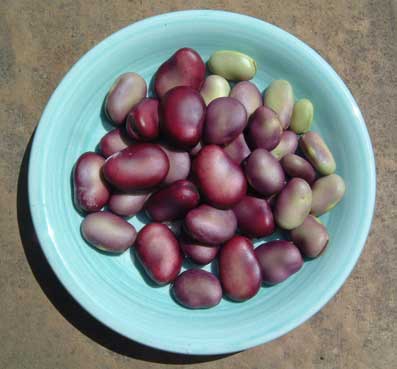
Grando Violetto needs to reach full size before the beautiful colour develops

Remember I put my Grando Violetto broad beans down as a crop failure? Well, this is what I salvaged from the blackfly encrusted stumps I finally slung in the organic recycling bag. Not bad from only four plants, and I'd had a couple of meals' worth off them already. They taste very nice indeed, and have a pleasantly sturdy texture a bit like butter beans. But this one isn't on my favourites list I'm afraid. The beautiful purple colour in the beans doesn't develop until they're fully mature and therefore past their prime for eating, so you really have to eat them while they're green and look like any other broad bean. Though you can dry them ... which turns them a lovely velvety purple black colour. The plants have no blackfly resistance at all, which makes them less than ideal for organic conditions.

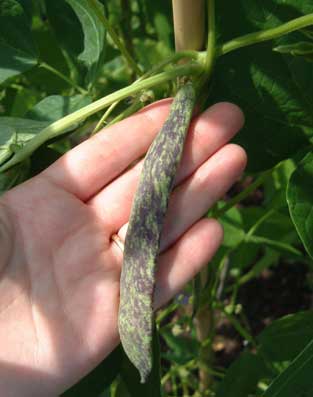
Moving on to the climbing beans ... ooh look! Mrs Fortune's, which I had branded the ugly duckling, has produced pods with mottled blue streaks!

They're a proper blue too, and colour up best in sunlight ... very decorative indeed.

They start to go a bit knobbly as the beans develop, some pods are wider or knobblier than others, and most have a little curved 'tail' at the bottom. It's also a high yielder. The pods seem to form almost as quickly as you can pick them. So we had some for tea, cooked as 'green beans'.

Before I go any further I should point out that some climbing beans are optimised for eating whole as young pods and others are best left to mature as dried beans. If a variety is good for one usage it's generally less good for the other. I think Mrs Fortune's is bred for dried beans, not for eating fresh.

So ... it isn't perfect. The colour vanishes completely on cooking, even with just a light steaming. *sniff*. The pods have a slight roughness to them after cooking, but a very soft texture when you eat them. The flavour is ... um ... not bad. A bit nondescript really.

Kew Blue on the other hand is meant as a pods-an'-all fresh bean, and it's very swish. Mine is now starting to set pods in great numbers, and they're dead straight (when young at least), velvety and very slender. They're a dark purple colour with a flush of green in the younger pods. They look much more elegant than the pods on my other purple bean, Trionfo Violetto, and I have to say they trump it for taste too. I had some steamed this evening, and they were sweet and lovely. Very fine indeed. The colour changes to dark green after cooking, and they have a very nice texture. I think I can recommend this variety if you want beautiful plants and super-tasty pods ... it looks to me to be the best of the climbing beans I've grown. As far as I know it's only available from the Heritage Seed Library.

Next up ... spud reviews.