Wednesday, 19 July 2006

A few pictures of someone else's garden for a change


I'm still catching up with my blogging on the garden after frenzied musical activity, but to give you something to look at in the mean time ...

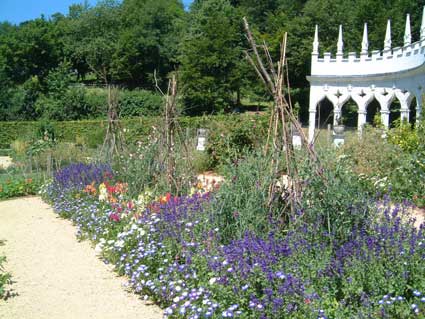
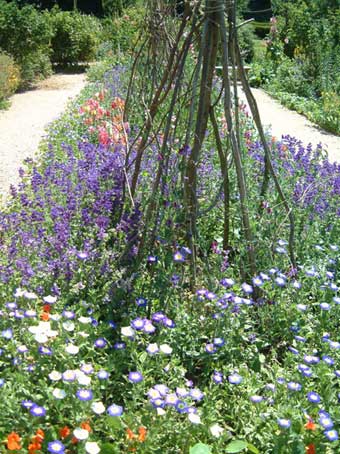
I took these pictures yesterday at the Rococo Garden in Painswick, Gloucestershire. How lucky am I to have a place like this just up the road?

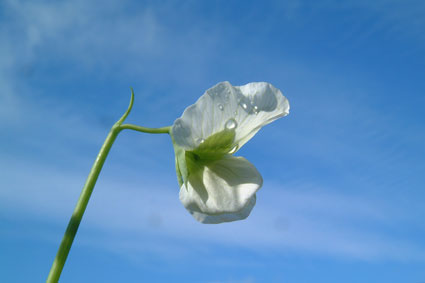
Convolvulus, Salvia horminum, sweet peas and nasturtiums. *jealous*


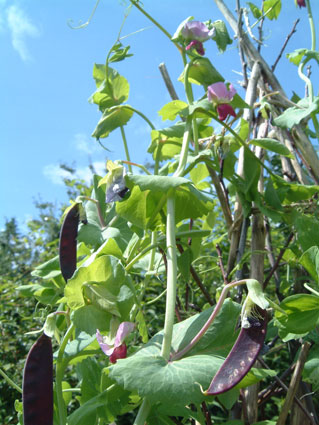
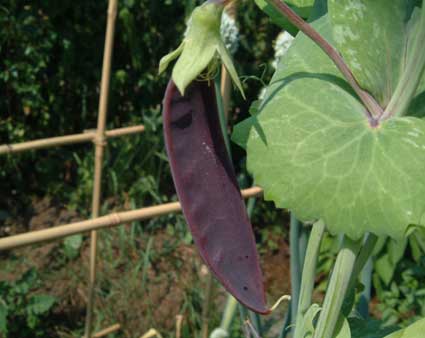
They even grow purple-podded peas. Woohoo!

This is definitely not the same variety as I'm growing. The leaf colours and pod shapes are different and the peas inside are tiny.

Saturday, 15 July 2006

Today in the garden ... an inedible wolfpeach

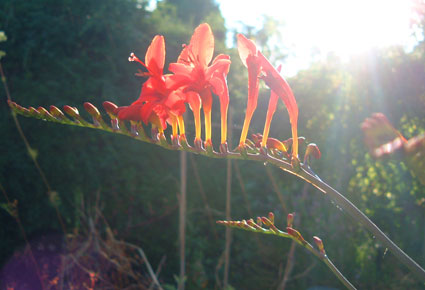
Crocosmia Lucifer ... ubiquitous in British gardens at this time of year but you can see why

I haven't had much time this week for gardening or blogging, because I've been *ahem* back in the recording studio working on a waily Celtic folk song. If anyone's interested in giving it a listen you can find it here.

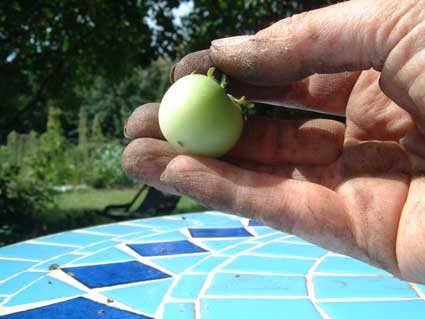
After I'd harvested a patch of Marfona potatoes the other day I found this lying on the ground. 'Scuse the state of my fingers.


I know it looks like a green tomato, but it's actually a potato apple. It came off one of the plants I harvested, and none of the others have any. You don't see them very often because potatoes have got accustomed to reproducing by tubers and most of them no longer bother to set fruit. Some varieties can't be arsed to flower at all, and those that do often produce ineffective pollen. But some spuds produce these tomato-like fruits, emphasising how closely related they are to tomatoes. And to the nightshade family too. Potato apples are poisonous. If the tomato is known as an edible wolfpeach (that's what Lycopersicon esculentum means) then I guess this is an inedible wolfpeach.

The first time I saw them was a few years ago when I had an allotment, and I planted some Desirée potatoes which had come from the supermarket and gone all manky and sprouted (yes I know you're not supposed to do that, but do I look like I care?) I turned up one day and all the plants had these little green tomatoes on them. I thought "what the heck are they?" ... I had no idea potatoes did that.

Potato apples are not a lot of use ... they just divert energy away from the tubers. But to nerds who like raising brand new things from seed they are a gift. Inside them are lots of seeds which, if planted and viable, will grow into a new and unique potato variety. Potatoes don't tend to come true from seed, so even if my fruit was self-pollinated or pollinated by another Marfona plant, the resulting offspring would not be Marfona. It would be a reshuffled combination of various genes that went into Marfona. That doesn't mean it will be anything special ... but it will probably be unique.

The downside is that it takes three years to grow the seed into a plant that's capable of producing decent sized tubers. So it takes a while before you can evaluate it.

Unfortunately this one probably isn't ripe enough to have viable seeds in it. If I'd seen it before I harvested the plant I would have left it to mature a bit, but there you go. I'll keep it just in case.

Monday, 10 July 2006

Today in the garden ... a lot of bluster

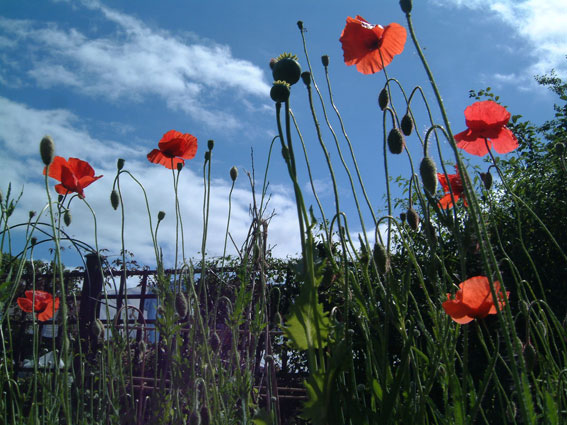
A poppy from the Somme growing with wheat in my wild garden

The recent rains may not have done any damage but the wind has been ferocious over the weekend and that has caused some havoc. A huge branch came down off a mature lilac tree in the middle of the garden. Fortunately it fell onto the lawn and didn't wreck anything (or anyone) in the process. It might actually be a blessing because it should let more light through into the borders behind it (which have become so shady almost nothing will grow there) and the bottom half of the branch itself is thick, 5ft long and perfectly straight ... a veritable pole, which is bound to come in useful for something if I strip the leafy bits off and dry it out.

Unfortunately the strong winds did some damage to my beloved Alderman pea plants, which is entirely my own fault because they weren't supported properly. I'm hoping they'll survive long enough to provide me with my experimental hybrids and a few more opportunities to stuff my face with their bounty. I did the second stage of the pea pollinations, i.e. re-pollinating the ones I did yesterday. Or four of them, anyway. I couldn't find the other one. Despite my use of very eye-catching gold braid tied around the buds some of them seem to just vanish into the greenery never to be seen again. Even the purple-podded pea has a gold-braid missing, and I know exactly where I put them all (there are only eight plants, so they have nowhere to hide). I'm beginning to suspect the faeries come out and untie them during the night.

Climbing bean Kew Blue has some of the nicest colouring of any vegetable in the garden

In the bean garden, Kew Blue has started flowering. The buds are a rich purple but open up into a slightly scruffy pink-mauve flower. No pods yet either ... the first few flowers have fallen off without setting. That seems to be normal though for most beans. While they're actively growing the plants seem to focus all their energies on surging upwards. Trionfo Violetto, whose flowers are a similar colour but more elegantly presented, has started to set pods now. The Meraviglia di Venezia (both these varieties are from Seeds of Italy) is growing faster and has reached the top of the arch but has not flowered yet (it's a late maturing variety).


The blackcurrants are yielding some excellent fruit at the moment. There are three main bushes in the garden and I think there's at least two different varieties there, as they taste noticeably different. I've no idea what varieties they are, mind. All I know about them is that they have been here since 1967, because the old lady who owned the house before us told me she brought them here from her previous garden (on the west side of Cheltenham). So they are over 40 years old. And one of them in particular has the scrummiest berries I've ever tasted, really strong and complex in flavour (but then I have weird tastes because I like sharp-flavoured fruits much more than sweet ones). I don't think they'd been pruned for 40 years either, judging by the state they were in when I moved here, but they have regenerated successfully from the rather drastic remedial action I took on them. They were literally bearing their feeble yields on the tips of 5ft long horizontal branches which were dry and dead and clattered together like old bones ... they gave me the creeps as well as taking up an entire border on their own. I had to take the risk of killing them by cutting them right down to the original stem (or trunk, rather) and fortunately they decided to survive and resprout, and are now fruiting, albeit in smallish amounts at the moment, on healthy new branches. I've taken cuttings too.


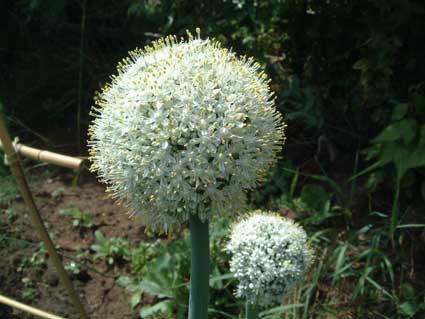
Something else that's nice at the moment is these onion flowers. I've been growing them for seed and have been surprised at how beautiful they are ... as lovely as the drumstick ornamental onions like Allium giganteum, only white. This variety is Jet Set, which originally came from Chase Organics. I've got 20 or so plants here but I'm only going to keep the best six. The others are being grown solely as pollen providers. This is because onions are outbreeders (see my post on F1 hybrids if you want an explanation of why this matters) and need to spread their genepool more widely. If I just grew the six plants there is a higher risk that their offspring would be feeble and pathetic due to inbreeding depression. They are pollinated by insects of various kinds ... flies, moths, hoverflies ... who just seem to land on the flower heads and stand around for a bit, then fly off somewhere else. But it obviously works. A couple of days ago I was out there in the twilight watching a moth giving one of the flower heads a good trampling. Although it was just walking around, it was beating its wings so fast I could only see them as a ghostlike blur.

Sunday, 9 July 2006

More waffle about my pea breeding experiment

Mr Bethell's Purple Podded

I did some more pea hand-pollinations today as the weather was favourable. The strategy with this batch is to emasculate and pollinate the flowers today and then go back and give them another pollen dusting over the next day or so. I'm hoping this might increase the success rate a little, although I've now looked it up in a book and it seems that the female parts of pea flowers mature earlier than the males anyway, so the stigma should be receptive whether it's pollinated the same day as emasculation or not. But it's worth trying different strategies. I needed something to mark these out separately from the ones I've already done, and didn't have any more string. So I've been tying these with some gold braid I found in my sewing box, which is a bit extravagant, but it certainly looks very pretty.

Slight problem though ... I'm running out of Alderman buds. This variety was sown a while before the others and the plants are coming to the end of their flowering cycle. I need to ensure I get enough successful pollinations to produce seed for the next part of the experiment. Luckily I don't need many ... even half a dozen viable seeds would be enough to proceed with. But I do have to ensure I end up with something ... otherwise I'll have to start again next year. I managed to pollinate five buds with Mr Bethell's Purple Podded. And to increase the chances of getting something useable I also pollinated a few buds of Mr Bethell's Purple Podded using Alderman pollen, i.e. the same cross but with the parents the opposite way round.

Alderman flower

There is a good reason why I've only used Alderman as the 'mother' plant until now. Alderman is a true-breeding green-podded variety; it has no trace of purple whatsoever. So if I hybridise it with a purple variety and grow the seed, and some of the resulting plants are purple, I will know for certain that those plants are the result of a successful cross. If some of the plants turn out green, I can probably assume they were the result of the bud having self-pollinated before I got to it. This is because the gene for purple colouring is dominant, so I am expecting all the plants of the first (F1) generation to be purple if they crossed successfully (I can't be 100% sure about that, since other unknown factors may turn out to screw things up, but it's a reasonable assumption at this stage). Being able to accurately identify the successful crosses in the F1 generation will save me time and heartache.

Genetically there's no difference between an Alderman x Purple Podded and a Purple Podded x Alderman cross. They should both yield the same results in subsequent generations. But if I use the purple podded variety as the mother, it's harder to recognise the offspring. All the plants grown from its seed will (theoretically) turn out purple, regardless of whether it crossed with itself or with Alderman. The green-podded gene carried by Alderman is recessive so I wouldn't expect to see it at all in the F1 generation. I would have to rely on other factors to identify the successful crosses by looking for other Alderman attributes, which may or may not be apparent (in which case I'd have to grow out the next generation where the various genes will begin to segregate). If the F1 generation turns out to be purple with big fat sweet-tasting peas, or has white flowers, then I can assume it's a successful cross with Alderman. If it doesn't, I'm none the wiser.

So that's why I've only used Mr Bethell's Purple Podded as a 'father' until now. But the shortage of appropriate sized buds on Alderman means I now have to hedge my bets a little.

Doing the cross in reverse today has really shown me how variable pea buds are in their maturity. I said in my earlier post that the buds were about right just as the petals began to protrude from the sepals, but that's only a starting point. In search of Alderman pollen I cut into a young bud which was only just starting to open ... only to find the pollen was all spent. The stamens were withered and the only traces of pollen were white and dusty and useless. Clearly Alderman buds complete their pollination process long before the flowers open, and I had to open up some very small buds to find any viable pollen. Conversely, Mr Bethell's Purple Podded still has copious amounts of pollen when the flowers are fully open, and may even still be viable as the flower dies off. This makes all my hand-pollination efforts a matter of trial and error ... because I don't really know which buds are going to work best. That's why I'm doing lots of them.


Also today I sowed some more Alderman seeds in my trusty bog roll tubes. Sowing peas in July? Well, in a sheltered garden within Cheltenham's benign microclimate I think I can get away with it. I would also like to sow at least a few seeds from my hybrid experiment this year if they mature in time. That would mean I could start next year with an F2 generation, which would be perfect. The F2 generation is the one where all the interesting stuff starts happening as the genes from the F1 start to separate out into various combinations. That's the one I want. The purpose of the F1 generation is solely to produce as much F2 seed as possible. So if I can do that before September then so much the better.

I'm partly growing more Alderman because it's lovely and I want to eat it, but also because I want it for backcrossing. Assuming I do sow some of my F1 seeds this year, one of the things I'll want to experiment with is hand-pollinating some Alderman buds with the F1 hybrid pollen. The resulting cross will be a quarter Mr Bethell's Purple Podded and three-quarters Alderman. And if I select any that are purple, and then do the same again (backcrossing them with Alderman) then within a few generations I should end up with a plant which is essentially Alderman but with purple pods. If it works, I could have one of the most beautiful and tastiest pea varieties around.

Friday, 7 July 2006

Today in the garden ... after the deluge

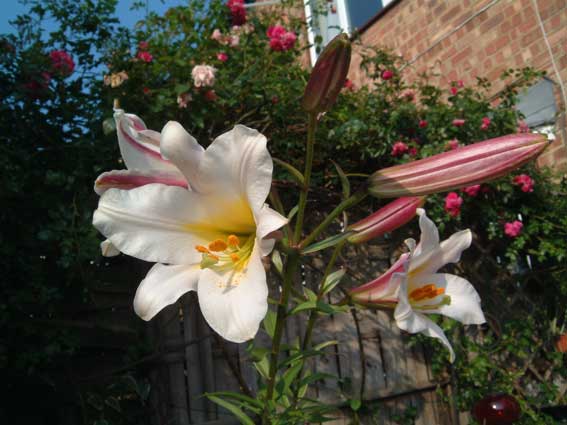
These lilies (I've long forgotten the variety name) survived a rainy pelting unscathed

Just as it looked like we were in for a summer of extreme drought ... the rains came. It rained non-stop for 24 hours. And I don't mean normal rain. It was torrential and there was no let-up in it at all. I was woken up again and again during the night by the noise of it pelting on the roof. I fully expected to open the curtains the next morning and find the house had floated off down the street. But no ... the pavement outside was impassable (our street has a double grass verge which acts like banks in wet weather and turns the pavement into a river) but we're still in the same place. And apart from a snapped-off top on one of the Martock broad beans and some very bedraggled roses, there was hardly any damage in the garden. Just a lot of baling out on the patio where a lot of the plants were floating in their pots.

And my rainwater butt, empty since April, has certainly filled up!

But now the weather has cleared a bit I've been able to get out there and do my daily inspection. The daily inspections are taking a little longer at the moment as I pause along the way to stuff my face with fresh produce. Raspberries, tayberries, peas, blackcurrants, then more raspberries.

I chanced to have the camera in my hand when I spotted this beautiful bright orange butterfly on some Mr Little's Yetholm Gypsy potato leaves. Butterflies are outside my area of expertise but I think this one is a Comma.

Peas are still the main focus for me at the moment. I'm not sure how well my hand-pollinations have taken. The pods are developing nicely, but the peas inside (which you can see if you view them against the light) are very small, and even those that are developing normally only have a couple of peas in each pod. To some extent this is normal ... hand-pollination is quite hit and miss and it's usual for some of the pollinations not to take. It's just a matter of doing lots of them to ensure enough material for my experiments. But there are factors which may make a difference to the success rate. One is the weather ... peas pollinate much better when it's cool and I did mine on blazing hot summer days. Another is a possible mismatch in the maturity of the flower parts. I have been emasculating the buds at a very early stage to ensure I catch the male bits before they shed any pollen, and there's a strong possibility that at this stage the female part is not yet receptive either. The solution to this is to emasculate the buds a day or two before I do the hand-pollination, which will give the stigma a chance to mature. Worth a try, anyway. I will just have to do lots of pollinations and see what works.

Champion of England produces its first pods

Champion of England is looking fairly typical of an old-fashioned tall pea. The flowers are small-ish and a very slightly creamy white. And it has long, long pods which look like they're going to have 9 peas in them.

The moment has come: I sampled the first raw mangetout pod from Mr Bethell's Purple Podded. Um ... being brutally honest, the flavour was a bit on the weak side ... not to mention slightly earthy and bitter. I ate a similar sized Alderman pod for comparison, and the purple one was noticeably poorer (although it certainly looked a lot more exciting). I will have to try them cooked when I have enough of them. But even if they turn out to taste horrible in every form, it's still worth my while growing them as a heritage variety and as breeding stock. Because I'm guessing the main reason purple peas taste less good is that all the breeding work in the last 150 years has focused on green varieties. Given that the gene for purple colouring is dominant, I see no reason why the colour can't be bred into some existing sweet plump green varieties.

Here are a couple of oddities I have in the garden at the moment.

Americans may recognise this, but it's rarely seen in UK gardens. It's Black Cohosh (Cimicifuga racemosa) which is a powerful hormone-balancing herb much prized in Native American medicine. It likes to grow in damp shady places and it produces an effervescent-looking white flower spike which flowers from the bottom up, like a sparkler in reverse. From Poyntzfield Herbs

This is Allium guttatum ssp. dalmaticum, which is so rare it doesn't have an English name. It's an ornamental member of the onion family. From Rare Plants

F1 hybrids: what every gardener should know

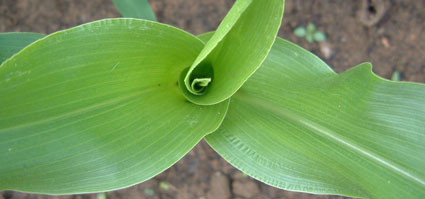
Sweet corn Swift F1 ... plenty of hybrid vigour here

I've been prompted to write a big post about F1 hybrids after reading an article about them in Seed News, the Heritage Seed Library's newsletter, which suggests that gardeners should avoid buying them but only scratches the surface in explaining why.

Personally, I tend to shy away from buying F1 hybrid seeds. But I don't boycott them. If I think an F1 hybrid is genuinely superior to a non-hybrid then I will buy it. They are not inherently bad. But most gardeners are blissfully unaware of how seed companies exploit F1 hybrids to maximise their profits, and the long term ecological harm that results from it.

Looking through mainstream seed catalogues these days there's no shortage of F1 hybrids on offer. We all know what an F1 hybrid is, right? It's a cross between two different plants which creates something new and exciting. The crosses have to be done under controlled conditions, sometimes by hand, which makes F1 hybrid seed more expensive to produce than normal (open-pollinated) seed. This is nearly always reflected in the price. But that seems fair enough for something that's bigger, brighter and more exciting. Doesn't it?

I'm not so sure. The price hike is often very substantial. The seed companies sometimes hide this very efficiently by pricing the packets only a little higher than the non-hybrids but with a much reduced quantity of seed inside. A packet of T&M tomato seeds, for example, may contain as many as 100 seeds or as few as 6 (see example below).

A well known fact about F1 hybrids is that they don't come true from seed. All the gardening books warn you about this. If you save seed from your beautiful hybrid plants and sow them yourself next year, the results will generally be crap. They will revert to a motley mixture of feeble and substandard plants which may look nothing like the plant you took them from. Which means if you want to grow more of your treasured variety you have to go back and buy it again next year. Another reason seed companies luuuurve you to buy F1 hybrids.

And another problem. To maximise their potential, F1 hybrids are often reliant on intensive culture based around chemicals. The seed company will happily sell you some fertiliser gunk to make them grow bigger, and then some pesticide gunk to kill off anything that's tempted to have a nibble. But without these chemical props they often do very badly. I think this little-known issue is a factor in putting people off organic gardening, because they try 'going organic' with F1 seeds and then get disappointed when they get stunted plants mangled by pests.

F1 hybrids are usually very uniform, i.e. all the plants turn out the same. This is often marketed as being an advantage, but it isn't really. Not unless you're a commercial grower and you're planning to sell your produce to a big supermarket chain. For gardeners there's more benefit in growing open-pollinated plants which have a healthily diverse genepool with natural pest and disease resistance, show a few interesting variations from time to time, and from which seed can be saved for free.

So are F1 hybrids superior to open-pollinated varieties or not? That depends ... not just on how you grow it but on what it is. If it's sweetcorn then yes yes, go for an F1, they're way better. If it's tomatoes, then F1 hybrids are probably a waste of money. The reasons for this are slightly complicated, but here goes.

It's all to do with the way different types of plants reproduce and how they like to shake up their genes. There are two basic types: inbreeders and outbreeders. Inbreeders, which include tomatoes, peas, lettuces and French beans, have enclosed flowers which almost always self-pollinate. No bees needed. The offspring is genetically almost identical to the parents, and they're quite happy with that arrangement. Outbreeders, on the other hand, chuck their pollen far and wide in the hope of mixing up the genepool as much as possible. Sweetcorn, carrots, onions, beets and brassicas are all outbreeders. They rely on being pollinated by other plants of the same species. Otherwise within a few generations they start to suffer.

This brings us to the phenomenon of hybrid vigour. If you cross two different varieties of an outbreeding plant, the offspring may well turn out bigger, better and faster-growing than either of the parents. This is exactly what an F1 hybrid is: the term stands for 'first filial' generation and refers to a direct cross between two separate varieties. If you then cross the F1 generation with itself you get an F2 generation, and so on. But the hybrid vigour is not passed on. It's for one generation only.

The opposite of hybrid vigour is inbreeding depression. If you cross two outbreeding plants of the same variety, or it self-pollinates, the offspring can turn out weaker and slower-growing than either parent, and it gets worse with each subsequent generation. (This has major implications for people who save their own seed and I'll cover it in more detail soon in another post.)

Hybrid vigour and inbreeding depression only affect outbreeding plants. Inbreeders can inbreed to kingdom come and not show any ill-effects. But by the same token they don't show any extra vigour when you hybridise them. This is an important point. Because it means there's no special advantage in buying F1 hybrids of these plants.

Let's give an example. The back cover of this year's Thompson & Morgan catalogue has a lovely photo of their new and exclusive F1 hybrid tomato Harlequin (although the cynical graphic designer in me says "hmm, they've montaged that picture in Photoshop to make it look like it produces massive trusses of fruit", but that's a separate issue). While it looks like, and probably is, a very fine tomato, the fact that it's an F1 is neither here nor there. It won't be any more vigorous than any other tomato, because tomatoes don't display hybrid vigour. But it is more expensive. A packet of Harlequin will set you back £2.89 for 8 seeds! Compare that with the open-pollinated old fave Alicante from the same catalogue, which retails at £1.69 for 100 seeds. So Alicante seeds work out at 1.69 pence each, while Harlequin seeds cost 36.13 pence each. Ewww.

In the absence of any hybrid vigour, paying twenty-one times as much for hybrid seed is a bit pointless. Unless you really like the variety, in which case fair enough, buy it. And then save the seed. Because the usual don't-sow-seeds-from-F1-hybrids rule doesn't apply to tomatoes, as they're inbreeders. Just as they don't display hybrid vigour, they also don't display inbreeding depression, so you can inbreed them all you like. It's my guess that if you grew some Harlequin and sowed the seeds from it, at least some of the offspring would breed true. After a few generations of roguing out any that don't look right you will probably end up with an open-pollinated version which you can carry on growing forever without buying more seed.

I'm not slagging off Thompson & Morgan here (I buy from them myself and they've always given me excellent service) ... I'm just trying to explain why some of the things they offer are much better value for money than others. Tomatoes are very profitable to sell as F1 hybrids because they are relatively easy to hand-pollinate and each pollination produces a large amount of seed. And if you keep going back to buy more year after year because you think you can't save the seed then they make even more profit.

There's more to this though than being ripped off. F1 hybrids are replacing open-pollinated varieties in the catalogues to such an extent that many reliable old favourites are becoming unavailable and this is seriously compromising the genepool which has been built up over centuries. Despite all the "NEW!" stuff that appears year after year, the range of varieties available is dwindling. This gives seed companies increasing control over what we grow in our gardens, and enables them to streamline their lists to the core varieties which maximise their profit margins and thwart the sustainable practice of seed saving. Meanwhile both our gardening heritage and the potential for future plant evolution are being lost at a rapid rate.

There has been a stealthy and active increase in the development of seeds which are only viable for one generation, as seed companies seek out ways to keep you coming back to buy more. The obvious headline grabber has been Monsanto's insidious "terminator" technology which has genetically engineered plants to produce sterile seed. But it's happening on a much more subtle level too. I bought some Calendula seeds a couple of years back ... normally something you only have to do once because they self-seed liberally. But then I read on the back of the seed packet that this variety had been bred to be "self cleaning – no dead heading required". The flowers just fall off as soon as they've gone over. That's supposed to make me think "woohoo, that'll save me some time and getting my fingers all sticky!" But wait a minute. Isn't there something fundamentally wrong with a plant which aborts its own flowers? Do I really want this in my garden?

Going beyond the realms of the domestic garden for a moment, there are serious issues with the introduction of hybrid seed in developing countries. What started off as aid has in some cases increased hardship and crop failure among some of the world's most vulnerable people. Big seed companies donate hybrid seed in vast amounts to community projects, which makes them look 'ethical'. In most cases this involves replacing the locally grown varieties which have been saved and replanted in these communities for generations. Once they have been given the hybrid seed, farmers are locked into a cycle of buying the pesticides and fertilisers to go with them, which are cripplingly expensive as well as unhealthy. The hybrid seed is not optimised for the local growing conditions and often does badly. Shockingly, many farming communities who have received well-intentioned charitable aid in this way are now worse off than they were before.

So, to sum up ... I don't think there's any need to completely avoid F1 hybrids. It's just a matter of being a savvy consumer and being aware of the wider issues. Work out the price per seed before you buy them and decide if it's worth it. Buy from a seed company which has a sustainable rather than a profit-driven ethos. Celebrate diversity. Save your own seed. Make your own hybrids.

Tuesday, 4 July 2006

Today in the garden ... purple pods


Last night's dinner included some of the Edzell Blue potatoes and red-flowered broad beans. I tried baking the potatoes this time but this obviously isn't one of Edzell Blue's strong points. They have too much dry matter in them and go very floury, and the flavour isn't very inspiring. The skins go extremely crispy and leathery and take a lot of chewing. Some people like their jacket potatoes that way ... but I've had a lot better. When I discover which cooking method does suit this beautiful but fickle spud I'll let you know. The red-flowered broad beans, on the other hand, are the best I've ever tasted. They have slightly smaller beans than the modern varieties I've grown in the past, but they taste fantastic with no bitterness in them at all and only need to be lightly steamed. The plants are more blackfly-resistant than any I've ever grown, which in practice means higher yields. I got my seeds from W Robinson & Son and they may in fact be the only supplier of this variety, although I've also seen it doing the rounds on the HSL seed swap. Highly recommended.

Apple Taynton Codlin coming along a treat

The fruit garden is going like the clappers ... most things are ready to harvest now. I have more raspberries than I can possibly use for anything, mainly because the bushes I inherited as part of the garden are a crappy type which all ripen in one enormous simultaneous glut. The flavour isn't much to write home about either. I'm intending to replace them with Autumn Bliss which is massively better and definitely my raspberry of choice. The only fruit failure so far this year is my miniature peach tree, which has taken umbrage at something and dropped all its fruits in disgust. Bloody temperamental thing. Meanwhile my single solitary apple is swelling nicely.

Well, here's the evidence. Mr Bethell's Purple Podded has purple pods.

How about that then. Purple podded peas. They start off green when the flower first dies off but within a day of exposure to the sun they go this shiny purple-maroon colour. Another thing I really like about this variety is that the sepals on the flower buds are speckled with maroon, especially while they're in the bud stage. It's very pretty. And with the flowers changing colour all the time I'm wishing I planted it closer to the house where I could stare at it more. Mine bears some of its flowers upsidedown; I'm not sure what that's all about. I'm not finding it to be quite as vigorous as Alderman, but that's hardly surprising. I suspect Alderman has been hybridised with a triffid.

Pollinations done today (it's technically too hot for it, but the others I did the other day seem to have taken all right):

Champion of England: one bud pollinated with Mr Bethell's Purple Podded
Mr Bethell's Purple Podded: two buds pollinated with Champion of England
Alderman: three buds pollinated with Mr Bethell's Purple Podded; two with Champion of England

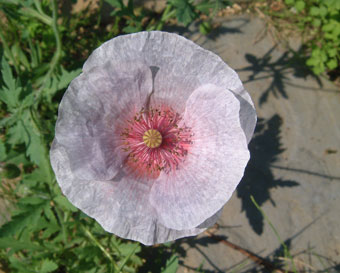
Another nice poppy showed up today ... a lavender-grey one with a pink centre. Once again it's a self-seeded Mother of Pearl.

I thought it was time I posted a picture of one of the vegetable plots, because they look lovely at the moment with everything growing away like mad. But you'll soon see why most of the photographs I post are tightly-cropped close-ups ... it's so you can't see what a scruffbag muddle everything is actually in. I dug this veg bed out of the lawn last year, so this is only its second season. That's my excuse and I'm sticking with it.

From left to right: tomato Pink Jester; climbing bean Mrs Fortune's (on wigwam); pea Champion of England (on other wigwam); sweetcorn Swift (F1); onion Hysam; garlic Music. There's also some Mascara lettuce and Cheltenham Green Top beetroot in the foreground and Red Duke of York and Fortyfold potatoes behind and God knows what else.

Sunday, 2 July 2006

Bean update

Buds and flowers on Trionfo Violetto climbing bean

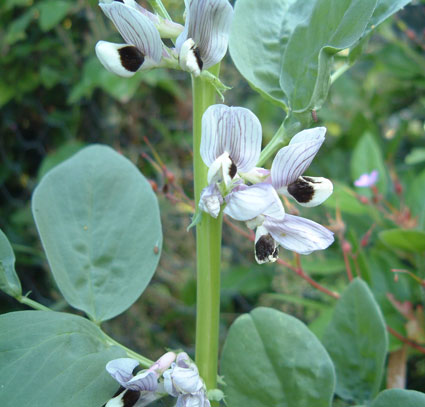
Just as all the other broad beans are being harvested, the late-sown Martock broad beans have come into flower. This is the really antique variety which is reputed to have been around since the 13th century. I'm only growing four plants, and they're all standing very upright and not branching at all. But as is often the case with these very old varieties with a well shuffled genepool, they all have slightly different flowers. They are all white with black blotches and purply-mauve at the base, but there's variability in how much purple they have and whether it's on the whole flower or upper parts only. Two have strong purple veining running through the petals while the other two are just white.

At this point I'd like to state my view that this variability is a very good thing. We've been conditioned into thinking that we want plants to come out consistently identical and to do exactly what it says on the tin. Not surprising really, when uniformity is one of the three traits a vegetable variety is required to have before it can be included on the National List, and the seed companies want you to choose uniform varieties because they tend to be F1 hybrids and they can charge more for those. From an ecological point of view though, the variability between plants is a sign of a healthy genepool with lots of sub-lines being preserved and reshuffled, which is important for long term biodiversity. I also think, personally, that the element of surprise ... not knowing exactly what the plant is going to come up with ... is one of the great joys of gardening.

Flowers on Martock broad bean. This one has lovely purple-black veining in the petals.

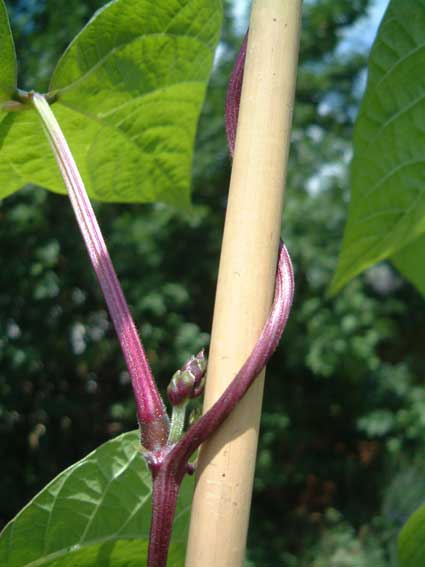
Kew Blue is claiming the distinction of being the most gorgeous plant in the bean plot, which is quite an achievement when I'm also growing Trionfo Violetto, which would normally win hands down. It's not as refined as Trionfo ... it has slightly gnarled and asymmetrical leaves which give it a kind of lopsided scruffiness, but its colour is so deep and vibrant it almost glows. It looks shinier, healthier and more vigorous than the other beans. The leaves are the richest green and the stems are a velvety purple. The stems are chunky. The leaf stalks fade gracefully from purple to green but some of the smaller petioles are almost black. It's a very striking looking plant. And it hasn't even flowered yet. I still have that pleasure to come.

Not to be outdone by a better looking rival, Trionfo Violetto produced the first pod of the season. I found it lurking in the undergrowth at the bottom of the plants. Yup, there's just the one.

Not really enough for a meal, but it's the thought that counts.

Of course it's possible that the superiority of the Kew Blue is down to the soil it's growing in ... I think it may have had more manure dug into it than the other bean plots, and manure is the thing that makes the biggest difference to plant performance, in my experience. I'll only find out for sure by growing it for a few more seasons. But for a variety that got off to an unimpressively sluggish start it's now looking very dapper.

Mrs Fortune's, it has to be said, is not a looker, poor dear. The leaves are very tidy and symmetrical, but they sag at night and have a rather anaemic pale green colour. The first flower buds are now forming and they're a boring green with a half-arsed splosh of mauve. Not one for the ornamental borders. But no doubt it has other qualities, and it's certainly growing well. No bother at all from pests.

Ha, things change very fast in the garden. In the time it's taken me to write up this blog post, a couple of the flowers have opened and they do have a nice dark pink colour on the inside.

It seems that the summer solstice is the cue for all the beans to flower, because my runner beans have also started to produce buds. There's a lot of red-colouring in the heritage variety Black Magic, including the leaf veins, which look lovely against the light.

Runner bean Black Magic from the Heritage Seed Library

Incidentally my neighbour had a crop failure with his runners (the damp weather in late May seems to have rotted the seeds) so he bought some plants that were on offer down at B&Q, and they're a variety called White Emergo which has white flowers and seeds. What will happen if that cross-pollinates with my Black Magic is anybody's guess. Skewbald beans!

Saturday, 1 July 2006

Poppy gallery

Somme poppies: collected from a French trench 10 years ago and seen here growing with wheat

As today is the 90th anniversary of the Battle of the Somme, an event I've delved into all too deeply in the course of my researches a few years ago, I'm posting up some pictures of the poppies which are growing in the garden at the moment. Starting with a photo of the French landrace (wild stock) I collected on the Somme, from the ditches of the British front line in the village of Serre, which was part of the Somme battlefield. I've already blogged the story of how I found them. I've had a 'thing' about poppies ever since.

And having looked through so many images of the First World War, it was quite weird today how the TV pictures of defeated England footballers with their slumped and heavy limbs looked uncannily like the photos of the soldiers who came off the fields of the Somme. You could read quite a few levels of symbolism into England's misfortunes and mistakes.

All these pictures have been taken in the last couple of days.

Opium poppy (Papaver somniferum) grown from seed I collected on a disused railway line near Cheltenham station


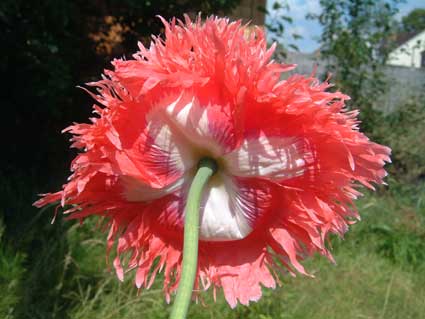
This frilly-headed opium poppy with a white base appeared out of nowhere: it's a lacinatum-type and not quite like any of the other poppies in the garden. I might save some seeds from it to plant next year but I may not get another one like it because poppies are promiscuous outbreeders and it's likely to have cross-pollinated with all the slightly less interesting flowers surrounding it. Ha.


These three pictures are all of self-seeded field poppies (Papaver rhoeas) from the variety Mother of Pearl. The flowers often have rays of colour running through them that look like fine stripes.