Wednesday, 21 June 2006

Midsummer!


It's that time of year again. Driven indoors by the stench of burning flesh as everybody in the neighbourhood dredges out their barbecues. I've been vegetarian for 15 years and the smell of roasting meat really turns my stomach. And just to add insult to injury it sets off my asthma.

I steeled myself for the unavoidable and denuded the Tewkesbury Baron apple tree of 10 out of its 12 apples, before they get too plump and shiny and untouchable. The tree didn't want to let go of them either, which made it harder. But it had to be done. I ate one. It was disgusting. But I was still delighted with it.

The other vegetables are doing well though and some things are now ready to harvest. Climbing French bean Mrs Fortune's (right) is working its way up the bamboo poles. Runner bean Black Magic is already at the top of its 7ft poles. The red-flowered broad beans are just producing the first mature pods, and although they are now being pestered by blackfly it's a fairly light infestation compared to other varieties. Pea Alderman is around 8ft high and yielding very generously ... the peas are so sweet it would be a crime to cook them, so I just stuff myself with them every day straight from the plant. Pods an' all. (Even when they're way past the mangetout stage, the pods are very edible if you peel away the hard starchy membrane on the inside and just eat the outer part.)

I'm also starting to harvest potatoes. I dug up a few plants of Edzell Blue, primarily because I've completely run out of growing space and needed to clear something to make room for other things. They are pretty much ready anyway, because they don't grow very big compared to modern spuds. As you can see in the photo, they are a beautiful colour and scrub up a treat. I cooked these as new potatoes, and very tasty they were too. Unfortunately they aren't ideal for boiling ... they lose their colour (they just end up a murky brown colour and the water goes dark green) and they also readily disintegrate, but you can't have everything.
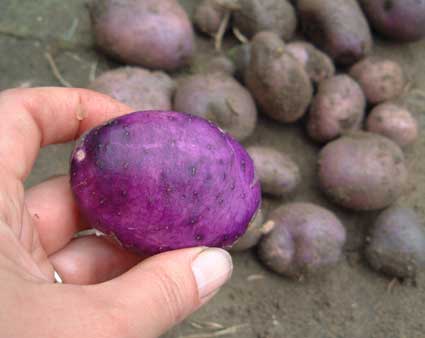
Freshly harvested Edzell Blue potatoes, which look especially nice when they're scrubbed up

It may be time to declare a crop failure on the Grando Violetto broad beans though. They've been so badly afflicted by blackfly they've stopped growing altogether. They have a few pods which are developing OK but not much of a yield. Unless I pretend I was growing them as a green manure all along. Yes, that's it. I only wanted the nice nitrogen nodules on their roots. Blub.
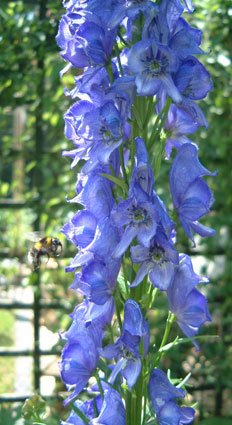
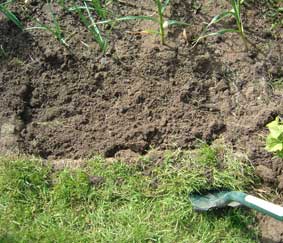
The wild part of the garden is coming along nicely. Look at this lovely monkshood flower spike (Aconitum napellus) with a bee just poised to shove its proboscis in there. It's highly poisonous but the bees love it. Having a wildlife-friendly garden has its downside though. I started work on a path I've been making between the fruit and veg plots, and had to move the polythene sheet I'd put down to kill off the lawn. I peeled it back very carefully, because there are usually slow worms under polythene sheets in this garden. They adore polythene. Sure enough, I uncovered an elaborate nursery of baby slow worms. There were four of them just under one corner. Very cute they were, only about 4 inches long. The dried up lawn had formed a layer of matting over the earth and they were sitting curled up in little round hollows underneath. They all poked their little faces up through the straw when I disturbed them. So it doesn't look like I'll be building my path now until the autumn. And neither can I walk on the polythene. Which means the only way I can access the fruit bushes for the rest of this season is by trampling over the vegetable plot and wading knee-deep through potato plants. Ah well, nothing I can do about it.

I saw a couple of ants attacking a ladybird today. I didn't know they did that. The ants were going ballistic but the ladybird seemed only mildly bothered.


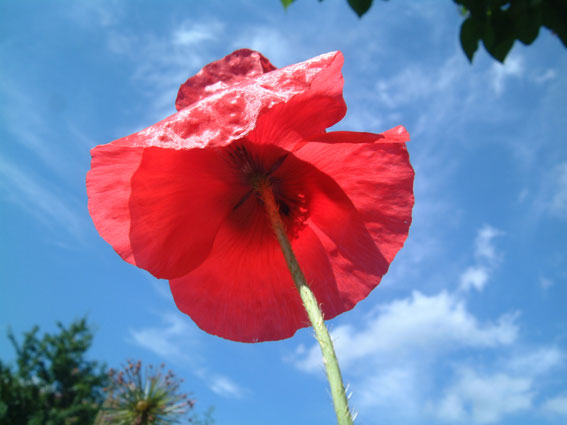
And finally, I came across this mutant poppy, which has two flower heads on one stalk (although it actually seems to be two stalks fused together). Since taking this photo it has flowered, and the buds opened at different times. I have found a few other examples of this in other poppies around the garden so I assume it's just something that poppies do from time to time.

Monday, 12 June 2006

Today in the garden ...

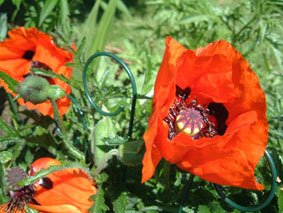
Self-seeded field poppy (Papaver rhoeas). This is the same flower that was shown as a bud on my June 2nd post.

The sky exploded early this morning (well, not quite, but it sounded like it) and resulted in a ferocious deluge. It saves me watering the garden this morning, a job which was becoming a twice-a-day necessity in the recent heatwave, but I wish I hadn't left the cushion out on the garden bench. Oops. Soggy arse for the next person who sits on that.

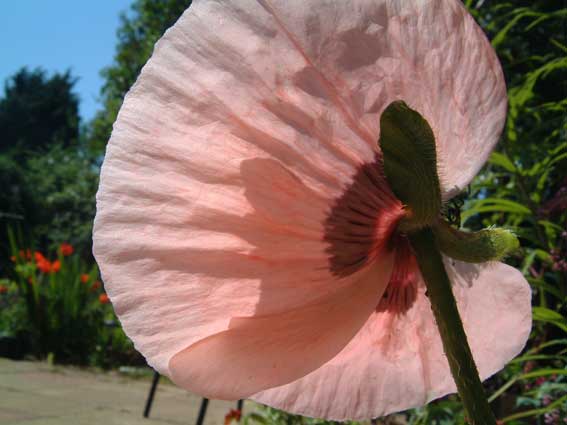
The rain smacked the heads off all the remaining oriental poppies, so no more pollen-diving fun for the bees. They did very well this year though because they mainly flowered during the dry spell. At its peak the orange Allegro poppies had 19 flowers at once, all of them the size of my hand. They may only last a couple of weeks but they are stunning. And just as they are going over, the annual poppies are coming out (see above). You never know what colours you're going to get with annual poppies, which is one of the reasons I love them.

No sooner had I written that when one last bud of oriental poppy Princess Victoria Louise came out. And so did a whole load of brown butterflies. I even managed to photograph them together.


And there's no shortage of frogs now. As I was walking down the garden path this morning something landed with a great splack right in front of me. A very knobbly frog with a green head and a black back. Thought it was a toad at first, but it wasn't quite that knobbly.

I know it's getting a bit late for sowing stuff now, but I've just had some tomato seeds through the post from America. Unusual varieties which you can't get over here. Two of them are marbled and striped in red and yellow, the other supposely looks like black cherries. They sent me a freebie packet too. Bless.

I have this nerdy obsession with seeking out the unusual ... can't just go down the garden centre and buy normal stuff like everyone else. It cost me more in postage than for the seeds themselves, but I don't care. I'll have the only marbled and black cherry tomatoes in Cheltenham.

I do have a minor concern about buying seeds from America though ... there is such widespread use of GM material in the US, most of it unlabelled, I wonder how much stuff over there gets accidentally cross-pollinated. I don't have any means of testing for it and I assume the risk of GM contamination is small, especially with tomatoes since they're natural inbreeders (i.e. they usually self-pollinate). But if anyone knows anything about this issue I'd be grateful to know.


The Alderman pea is still going nuts. Advertised in the Organic Gardening Catalogue as reaching a height of 5ft, mine is now just over 7ft. And those tendrils are still reaching for the sky. I'll be posting another pea-specific report shortly.

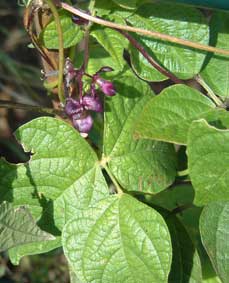
My climbing French beans are all coming along nicely now, having benefited from the clement weather. It's actually not the cold which devastates these plants, it's the wind. During late May it was very breezy and my newly planted Trionfo Violetto and Meraviglia di Venezia (which I'm growing together over an arch) suffered a lot of damage to their leaves, and in their weakened state fell prey to slugs. I wasn't sure whether they'd make it or not but in the last week they've made a miraculous recovery, have grown beyond sluggy reach and look very green and lush. Trionfo Violetto is already in flower (right). Then there's the two varieties I got from the Heritage Seed Library. Kew Blue is now recovered from the shock of finding itself planted out in the real world and is starting to shoot upwards. I'm growing it in a small clearing in a potato patch, and as the potatoes continually encroach it does get a little shady and claustrophobic. But it's also very sheltered, and that has kept the leaves lush and pristine green ... in contrast to Mrs Fortune's, which I planted in a sunny open site and whose leaves have been rattled and flapped and baked to parchment (although it's still thriving well enough). I was also afraid the Kew Blue might be eaten by snails down in the moist verdant undergrowth but they've been largely untouched and most of the snails I've been finding there are just broken shells. I assume that means the moist verdant undergrowth is populated by hungry frogs and slow worms.

Climbing French bean Kew Blue sitting in a mulch of horse manure and grass cuttings. See how the colour of the leaf stalk graduates from purple to green.

I've been experimenting with very basic CSS coding on my blog template and have discovered how to highlight the plant variety names in my posts in a separate colour (without having to go through and code them all individually ... how cool is that?) So now people who google in here looking for information on specific varieties should find it easier to spot the ones they want. Let me know if it looks weird in your browser or the colour annoys you.

How to make a Rebsie-style bamboo frame for huge floppy vegetables

This method will make a frame about four and a half feet high, just under four feet long and a foot and a half wide. I'd use a frame of this size to grow three cordon-type tomato plants. Or a row of peas, if you add a few spiky twigs for them to climb up.

You will need:
Set of three 5ft bamboo hoops (available from garden centres)
Five 4ft bamboo canes (you can use more if you want extra bars on your frame)
Rubber bands
String

Put five rubber bands on each hoop, one at the top and two on either leg, at a roughly equal height (you can adjust them later). They should be tight enough to grip the poles but still manoeuvreable.

After preparing the soil, lay two of the bamboo canes out on the ground as measuring rods, then position the hoops along their length with equal spacing. The outer hoops should be an inch or so inside the straight poles.

Hook a pole through the lower rubber band on the central hoop, and then hook either end of it into the bands on the outer hoops. Do this for all five poles. You will then have a nice sturdy structure. Try to make sure the poles sit on top of the rubber band, so that it acts as a support underneath.

Tie some string tightly around each rubber band joint to give the poles extra support. Why do you need to do this when the rubber bands are already holding it pretty securely? Well, try leaving the rubber bands out in the sunshine for a few weeks and you'll see what happens.

And here's the finished article, complete with three Black Plum tomato seedlings. Yes I know they look sweet and innocent at the moment (in fact they're so miniscule you can hardly see them) but they'll soon be splurging over the top of the frame.

Sunday, 11 June 2006

Today in the garden ...


Well, my elderflower cordial was a success. Husband glugging the stuff like there's no tomorrow. I need to go and get a bucket from the homebrew shop so that I can make it in bigger quantities. I'll also need to take a trip out into the Cotswolds with the secateurs ... I don't want to pillage my own tree any further because I like elderberry beverages too and I want to leave it with enough blossom for that. There's no shortage of it around here though. Previous wildflower recces suggest that Leckhampton Hill might be a particularly good place for elder.

Of course I'm not superstitious. *cough* Not at all. It's just that I have a curious feeling of respect for elder trees and always like to ask them nicely before taking their blossom.

I love this time of year in the garden ... everything looks at its best in June, before it all goes blowsy and flops over. This picture was taken from the window of the music room, the room where all Revolving Doris's music is recorded (or my half of it, anyway). Looks nice at this time of year, doesn't it? No wonder I'm not getting much music done.


The music room is now being supplied with some especially lovely red Dianthus flowers, courtesy of the plants which I picked up on a trip to Devon a few months back. I'm usually reluctant to cut flowers because they look so lovely in the garden, but it's nice to have a jar of them on my desk too. I tend to bring in mature flowers anyway, because Dianthus is at its best when it's aging a bit. The pistils curl up into a very attractive spiral after they've been pollinated and the flowers still last for ages.


The broad beans are doing very well, and the red-flowered type now has huge numbers of tiny pods. Still a few flowers on there too. Grando Violetto began to set pods much earlier, and some of them are getting big, but it seems to produce them one at a time so there's never enough for a meal. Grrr.

The blackfly season is well underway. Even the red-flowered variety is now under attack, although interestingly it's only the largest and lushest plants which are affected. Some of the plants have stayed quite small and those are still clean as a whistle. The Grando Violetto variety is suffering quite badly and I'm having to hose them off on a daily basis. The plant tops are looking very feeble now (probably from being violently blasted with a water jet every day as much as from the blackfly) and it doesn't look like I'll be getting a huge yield from them.

Had a toad hopping about on the patio this afternoon. I've noticed an increase in their numbers over the last couple of weeks and a corresponding drop in the slimy invertebrate population. Hooray.

I dunno about you, but I like to spend a lot of time just standing around in the garden staring idly into the middle distance, especially in the twilight. Yesterday evening when I was doing this I heard a snuffling noise and a hedgehog came sauntering out of the 'cornfield' patch straight towards me. This happened once before when I was sitting on the bench in the wild garden and a hedgehog came over and started snuffling at my foot. I had my eyes closed and didn't realise it was there until it touched me and I went "waaaaah!" and leaped about three feet in the air and the hedgehog scarpered. They certainly can shift if you frighten the shite out of them. This time though I kept very still and the hedgehog passed within two feet of me, carried out a brief inspection of the broad beans and waddled off into the raspberries. Very cute. And very snuffly.

Thursday, 8 June 2006

Today in the garden ...

Cheltenham Green Top beetroot ... with a rather groovy flower spike

Mowed the lawn and used the cuttings as a mulch around the peas and beans. At this time of year I only apply the mulch very thinly, which means it doesn't really work as a weed suppressant but it does still keep the warmth and moisture in the soil, and allows water to penetrate. After a few days it dries out into a kind of mat of hay, rather than a compacted slimy mess, and breaks down very quickly into the soil. By reapplying it every couple of weeks I can get a lot of organic matter into the soil without having to spend weeks composting it first.

I think this is going to be a good year for fruit. The gooseberries are coming on well, as you can see. Looks like the Ashmead's Kernal apple tree couldn't be arsed to blossom this year, but Taynton Codlin produced one flower cluster and now has one solitary apple. Tewkesbury Baron, by contrast, was such a mass of blossom it looked like a funereal tribute. And now it has loads of swelling apples. But the tree is not even two years old, so for its own sake I'll have to force myself to take them off. Blub.

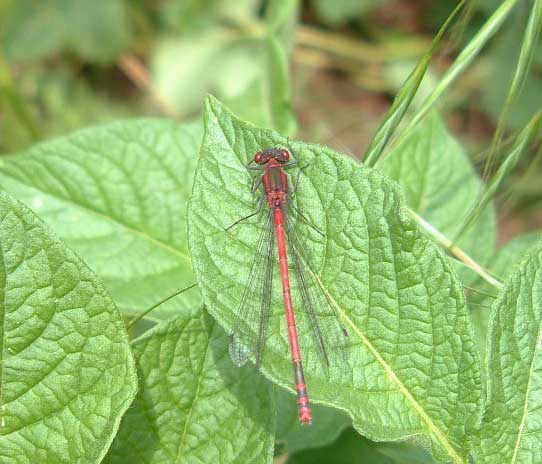
The damselflies are everywhere now, like miniature dragonflies but in bright red or sky blue. I've now managed to get a photo of one, which hasn't been easy because they're so thin and elongated my camera's autofocus can't pick up on them. They're also a bit camera shy and tend to fly off. They are a delight though. Tiny levitating sticks of turquoise.

Unless I'm much mistaken this is the imaginatively named Large Red Damselfly. Seen here posing on Fortyfold potato leaves.

Monday, 5 June 2006

Today in the garden ...

The bees can't get enough of this oriental poppy. They go in and roll around in the pollen. Actually this one looks rather like a miniature guinea pig.

I found some supports for the Champion of England peas. I was disinclined to drive out to a garden centre to buy canes (although I'll have to go soon because I've run out of horse manure). It occurred to me that I could plunder the mature lilac thicket at the far end of the garden, which is full of overcrowded suckers from last year. I just pruned out a few reasonably straight ones which were over 6ft and used those to make a wigwam. Of course they're all straggly and look a complete mess, but I don't mind as long as they stay up.

I planted the two Champion of England plants which are of suitable size (the others need to grow on for a bit). It's very easy to do because you just bury the whole bog roll in the soil. Meanwhile Mr Bethell's Purple Podded pea is steaming skywards, and Alderman is a joy to behold.

The peas they do grow high ... the 'Alderman' plants have outgrown their bamboo frame and have now overtaken me (I'm 5' 6").

It has to be said that Daughter of the Soil is not a Daughter of the Kitchen. In fact I was booted out of my domestic science class at school and ended up with a CSE Grade 3 in woodwork instead, which was far more useful. I'm competent enough at cooking, it's just that I don't much enjoy it. In an ideal world I'd just grow everything and let somebody else do the culinary stuff. But this morning the newly opened elderflower blossom at the bottom of the garden smells so fantastic I was motivated to stew up some sugary gloop which I hope will transform itself into elderflower cordial. I consider myself very lucky to have an elder tree in the garden, though I expect it got there as a weed when the previous owners weren't looking, and it's crammed in among the damson trees where it doesn't get enough sun. I love elder. It's supposed to be a defence against witches, although it hasn't got rid of me yet.

Home made elderflower cordial ... yum yum yum yum yum yum yum

Sunday, 4 June 2006

Today in the garden ...


Walking down the garden path this morning I was stopped in my tracks by a beautiful sweet scent. Really strong and very lovely. The dog rose beside the veg plots has suddenly come into flower (no, it's not orange) and is producing a tangible aura of scent over the whole area. I inhaled another deep lungful and ... uuurgh. Petrol.

Bloke next door was using a motorised leafblower. In June. Why?! The leaves are on the trees, for feck's sake.

It's the scourge of English middle class suburbia. Whenever the sun shines at the weekend, EVERYONE round here piles into the garage to rev up garden powertools. My views on garden powertools, and my neighbour's unhealthy macho obsession with them, have been well documented elsewhere and the song I wrote about it has become a minor radio hit. But honestly ... must I breathe toxic fumes in my rose bushes? Does it really take a two-stroke internal combustion engine to blow a few little bits of dust down the garden path?

But ... I appreciate it could be worse. I don't have any real problems with my neighbour other than a My Pink Half Of The Drainpipe style rebellion against his unimaginative worldview. I used to live in the unsalubrious St Paul's area of Cheltenham, and there on a summery Sunday you would feel the house gently vibrate to mega-decibel drum 'n' bass and hear the distant screams of street fighting in the adjacent council estate. I'd rather have the leafblowers, really I would.

I'm relieved that Leafblower Dave didn't catch me digging over that patch of lawn yesterday. He disapproves of lawn erosion. I assume it's because he makes part of his living mowing other people's, and just has a thing about lawn. Lots of it. This whole garden was grassed over when I moved here (which must've been paradise for him) and every time I've reclaimed a chunk of it to make a vegetable bed he comes over to the fence the moment the spade slices the first turf, curls his lip and says "Aaah. You diggin' that lawn up then, are you?"

Well, obviously.

This time I dug up a straight two foot strip right the way across so he hasn't noticed it.

I gave it a good digging over today and got the worst of the horsetail and couch grass out. Top dressed it with manure, seaweed and organic fertiliser. I'm planning to plant out my Champion of England peas in it first, because they're starting to outgrow their bog rolls. I only have a few plants of this variety, because the Heritage Seed Library only supplies small quantities and most of them had germination problems. I started off another 3 seeds with some perlite added to the planting mix and that seems to have resolved the rotting-off issue. But at best I will have five plants. And as I have no more seed, it's imperative that I grow these to maturity.

The other trouble with Champion of England is that it will grow big. About 7ft, according to the info I have. And since the Alderman pea is supposed to grow to 5ft and mine is already reaching 6ft and still rampant, I suspect it's going to need something pretty sturdy to hang on to. I don't have any pea sticks of that height, and I've run out of tall bamboo canes. So I'll have to think of something.

Saturday, 3 June 2006

Today in the garden ... orange

Iceland poppy Red Sails. Yes I know. It's orange.

Lots of new flowers have come out today. And they're all orange. Whether they were meant to be or not.

I've been nurturing the Iceland poppy from seed for two years expecting it to have red flowers. That's poppies for you ... always coming out different from what you expect. Also out today is this oriental poppy Allegro and some bright orange gazanias.

Most of my work today was in the vegetable plots. Blasting the blackfly off my Grando Violetto broad beans with a hose jet. Interestingly the red-flowered broad beans are not suffering from blackfly. Just one plant, the bi-coloured black and pink one, has a minor infestation. But the others are completely clean (see photo) with not an aphid in sight. This is exactly what happened last year so I'm assuming the red-flowered bean is naturally blackfly-resistant. What a turn up for the books in a variety that's already won me over with its beauty and taste.

I planted out the Kew Blue climbing beans against wigwam canes. They are still quite small, as they've been slow growers so far, but I thought they might as well take their chances in the open ground rather than hanging about in trays on the patio.

So, what do you do when you realise you've sown far too many vegetables and you haven't got room for them all?

That's right. You dig up another chunk of the lawn.


And use the strips of turf to earth up your spuds. Seen here with Witch Hill potatoes. Note hi-tech irrigation system made from sawn-off Ribena bottles.

If you angle the turfs in an inverted V-shape along the row they form a nice moisture-conserving trough, which you can then top up along the middle with fine loose soil to earth up the potato haulms. Stacking the turfs like this holds the sides of the trench together, prevents water from running off and being wasted and absorbs it into the mats of decomposing grass, which helps to keep plenty of moisture around the roots and developing spuds.

It does have a downside: it requires vigilant weeding. Some of the grass roots always regrow, especially bits of couch.

Friday, 2 June 2006

Today in the garden ... slow worm fisticuffs

Buds on a self-seeded poppy (Papaver rhoeas)

When there's a bustle in your hedgerow, as the song says, it could be a spring clean for the May Queen or it could be what at first looks like a writhing double ourobouros. In this case it wasn't quite, it was two serpentine creatures not biting their own tails but clamping their gobs round each other's midriffs in a most antisocial manner. A pair of slow worms having a dust-up.

I don't know what slow worms argue about. Maybe one was accusing the other of pinching his legs. But anyway they were coiled around each other and thrashing about, each trying to get its mouth further round the other's body. Then one scarpered, and the other rippled away through the chain link fence ... only to bump into another slow worm coming the other way. There was an awkward impasse for a while and then the first one turned round and made a sudden dash for the potato patch.

Oooh, I saw a damsel fly today. A bright red one. They are SOOOOO beautiful, I love them. It couldn't wait to get its proboscis stuck into a few valerian flowers. Yum.

The patio tends to get cluttered up with seed trays at this time of year ...

The garden is reaching its prime now, and the poppies are about to burst open, which is always a lovely time. Because of the slug crusade there's a much smaller number of opium poppies this year ... about 500,000 seedlings came up and were promptly eaten. But the field poppies (Papaver rhoeas) and variants thereof are doing very well.

Bad news on the blackbirds though. A neighbour's cat got in there on Tuesday night and took the babies. Such a shame, because they were so close to being ready to fly.

But you've got to admire the resolve of that female bird. She spent a couple of days sitting around looking depressed but now she's busily ransacking my flowerpots for nesting material. Starting all over again.