... with this gorgeousness of rosy-pink?
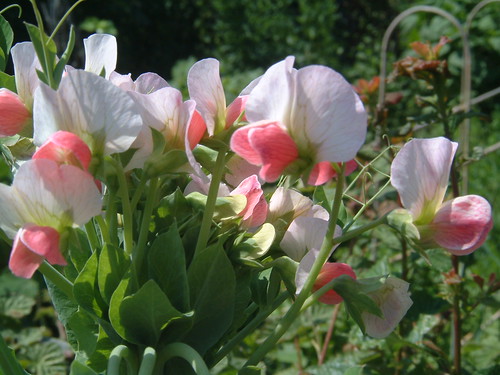
Well, I got this:
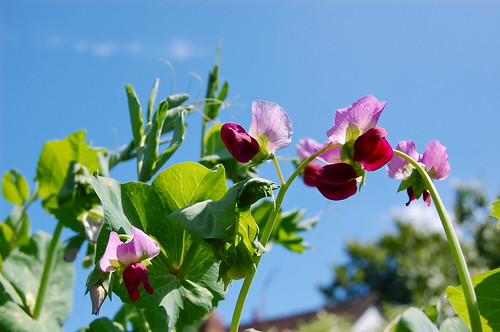
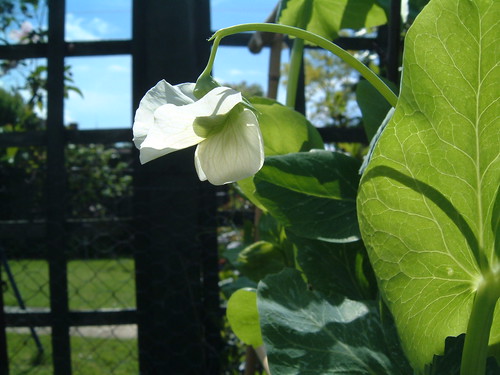
It's my F1 hybrid of Alderman x Salmon Flowered. It has just blossomed and produced flowers of the 'standard' mauve and maroon two-tone, the colour you get in field peas. Neither parent shows this colouring. Alderman is a delicious late Victorian pea with the snowiest of snow white blossoms. Its partner in this liaison was the strange umbellatum variety Salmon Flowered, supplied by the Heritage Seed Library, which is the only pea in my collection to have the particularly lovely two-tone pale pink and salmon pink flowers.
I don't know all that much about the genetics of pink flowers, but I know there are at least a couple of genes which can produce them. I don't know which one(s) are present in Salmon Flowered, but the ones I'm aware of are both recessive. The white flowers of Alderman are also recessive. (Yes, despite the fact that most garden peas have white flowers, it is a recessive trait.) When you cross two varieties which both have different recessive alleles controlling the same trait, some weirdness can show up in the hybrid.
So am I surprised that my hybrid came out purple? Actually, no, not really. I did wonder if it might. And here's what I think the explanation is.
I've mentioned many times in my pea genetics posts (for those who don't glaze over while reading them) the existence of a gene called A. That's short for anthocyanin. This particular gene is an on-off switch which controls the production of anthocyanin, the pigment responsible for all pink and purple colouration in peas. The function of A is that simple - on or off. There are other genes which control which part of the plant the colour is expressed in ... flowers, pods, leaf axils, seeds. They are all separate genes which can inherit independently. But none of them can express themselves without the dominant A allele which switches on the pigment production. Without it, the colour genes are still there but they are mute.
With Salmon Flowered, it's obvious that it has genes for colour in various places. The rosy pink blossoms, the pink blush on the pods, the soft pale pink smudge in the leaf axil. The presence of all these colours tells me that it has the dominant AA genotype - in other words, anthocyanin is switched on. Conversely, Alderman shows no anthocyanin pigment whatsoever. It is entirely green leaved and white flowered. I can safely assume that it carries the recessive aa genotype - in other words, anthocyanin is switched off.
Because Alderman is genetically incapable of producing anthocyanin pigment, I have no way of knowing what other colour genes it has hidden away, clawing at their nucleotides and begging for release. It's very possible that it has a full palette of colour genes, and that it wants to express purple flowers, splodgy leaf axils, purple stems, the works. Even though all these colour genes are dominant, they are helpless, disempowered, in the presence of aa. It's a curious subversion of the usual law of inheritance, with a recessive allele suppressing the expression of several dominant alleles.
Now this is turning into a very wordy explanation, but it's all so gloriously simple. The mystery purple flowers in my hybrid have almost certainly come from Alderman. I believe Alderman has the dominant gene which makes purple flowers, but it's not normally expressed in Alderman plants because they have no pigment capability. When I made the cross with Salmon Flowered, I gave it the 'on' switch. In a cross between a plant which is aa and one which is AA, the hybrid is going to be aA. The dominant allele gets the upper hand, anthocyanin is switched on, and all the colour genes in both varieties are free to express themselves. My hybrid is showing colour traits from Alderman as well as from Salmon Flowered.
I suspected this might be the case when I saw the colour blotches on the leaf axils in the hybrid plants. They were very prominent, with the dark pink colour streaking right out into the stems. Although Salmon Flowered does have pink in the leaf axils, it is very pale and subtle. This was quite different and could only really have got there if it came from Alderman. So I knew there was a good chance that Alderman might have a purple blossom gene as well, especially as those two colour genes are closely linked and usually appear together.

What this means for the F2 generation next year is that I will get a quarter of the plants unable to produce anthocyanin, and therefore having white flowers. Of the remainder, I will get mostly purples but I'm hoping that there will also be a few rosy pinks. I don't know exactly how the pink-flower gene works, so I wouldn't want to predict anything more than that at this stage.
Last time I wrote about my Alderman x Salmon Flowered F1 hybrid I said it was expressing the recessive trait for fasciation (stem widening). Well it isn't. It did show some fasciation, but it turned out to be from environmental causes and the plants reverted to a more normal pattern of growth. They do have very thick stems, but this is common to nearly all my F1 hybrid peas and I think it's mostly just hybrid vigour. They are, however, saving their flowers for the top of the plant, and have grown to almost 6ft before showing any buds. This, coupled with the late-maturing trait from Alderman, makes them very slow to reach maturity. That's probably something I will have to select against in the F2.
Meanwhile, jolly solstice blessings to all who observe such things.


