Showing posts with label Curiosities. Show all posts

Thursday, 27 November 2008

Ancestor worship

Door handle on Aldham church in Essex. This is the second of the ancestral churches I visited. I couldn't get too close to the first one at Marks Tey because at the time of my visit it was occupied by a grunting tramp with an inside-out Tesco bag on his head.

I've been visiting my parents in Essex these last few days and took the opportunity to go for a little tour of my ancestral heartlands. With my interests in history and genetics it's probably no surprise to anyone that I also have an interest in genealogy, and have been working on my family tree for just over ten years (all of it – not just the direct male line – because genetically the female lines are equally important, and so the whole thing becomes endless like a jigsaw puzzle without edges).

My dad is from north Essex and all his ancestors came from the same cluster of villages in the Colne Valley near Colchester. In the mid 19th century my great-great-great grandfather was living in this cottage:


This is the Three Horseshoes pub in Fordham. It was originally three separate cottages, and I think my ancestors lived in the small one on the far left. My g-g-g-gf was a shoemaker, but he (and his father before him) were also clerks of the parish, which was quite a prestigious position involving the keeping of parish records and shows that they must have been literate. In Fordham there was also a plot of agricultural land which came with the job but I don't know where that was located. It was probably here in this cottage that my great-great-great grandmother who went by the curious name of Mary Bugg died while giving birth to her twelfth child (my great-great-grandfather). How they got 12 kids into a cottage this size I can't imagine. The right hand cottage was a blacksmith's forge at that time. In the 1860s when agriculture was in serious decline and work scarce, the blacksmith took to brewing his own beer and converted the forge into a pub. Hence the Three Horseshoes.

Fordham is a very pretty place spread over a wide area with a real sense of being in the middle of nowhere (and lots of mud). It's now a strange mixture of modern housing estates and ancient timber-framed cottages but still has a distinctive character. I do feel quite a connection with the place, which surprised me a little bit, because when I visited my mother's ancestral village of Stogumber in Somerset I didn't feel I belonged there at all.

My dad's family lived in Fordham for about 100 years. We know that most of them were buried in the churchyard there. So I spent a freezing cold hour squelching through the mud and brambles looking at all the graves and found absolutely nothing. It didn't help that most of the 19th century gravestones were completely illegible. I have more experience than most at deciphering old tombstones, having had a lifelong passion for cemeteries, but some of them were so worn away I couldn't even tell which side the inscription was on. It's most likely though that my forebears couldn't afford headstones and that I was trampling on their graves as I waded over the swathes of brambly tussocks.

Trundling back into the 18th century, the pre-Fordham generation came from the nearby village of Little Horkesley. However, there isn't quite the same sense of unbroken history here. During World War 2 a passing German aeroplane on its way back from bombing somewhere else jettisoned a leftover bomb which floated down on a parachute and plonked itself in the belfry of Little Horkesley parish church. As it dropped down into the nave it went off and blew the whole thing to buggery. When you look at how rural the area is, miles and miles of open fields, you get a sense of what extraordinarily bad luck it was for the lovely medieval church to take a direct hit. But in one sense it was quite fortunate, because the immensely thick ancient walls contained the blast and probably saved the whole village from oblivion.

Remarkably, a set of 13th century carved wooden effigies in the church survived, albeit rather damaged. And yet the rest of the destruction was so complete there was nothing left standing above 3 feet in height and not a single shard of glass from any of the windows was found.

A treat you occasionally find if you hang out in old churchyards. The Reverend Charles Henry Brocklebank has his name writ in moss as nature traces over the inscription on his wooden cross. Little Horkesley churchyard.

A number of other old gravestones from the original churchyard still survive, but again there was no trace of my ancestors among them.

Anyway, none of this has anything to do with gardening. But there is a connection. This part of Essex has a long history in the seed industry and was a former centre of vegetable breeding. There's still an enormous number of nurseries around the area and acres of old-fashioned glasshouses along the roadsides. Close by is the small town of Kelvedon, which gives its name to several vegetable varieties. Kelvedon Wonder is still one of the most popular and widely available peas, found in pretty much every catalogue since its introduction in the 1920s. A sweetcorn called Kelvedon Glory is also still going strong. At least one of the old seed companies still survives, E.W. King, which will be familiar to many people who buy heritage seeds in the UK as they do great work in maintaining some of the important old varieties on the National List.

I would have liked to pay a visit to the farm where Kings Seeds are produced, but they seem to be solely mail order these days. My parents and I did, however, pay a nostalgic visit to another nursery a mile or so up the road in Coggeshall. This was the place where I remember buying my first packets of vegetable seeds (though I don't remember what they were) in the mid 1970s. It has changed and expanded quite a bit since then, and I was delighted to find they had a couple of racks of Kings Seeds, so I was able to get what I was looking for after all.

Sunday, 28 September 2008

Goddess tomatoes and seasonal joys

A plethora of newly harvested heritage beans

With all the crises I've been dealing with over the summer, the garden has been badly neglected this year. To the point where I'd be embarrassed to let anyone see it, even a non-gardener. I've managed to look after the crops OK, but I didn't keep on top of the weeds earlier in the season and they've got themselves well entrenched. And I had to steel myself to go out there and start dealing with them today, because I'm making a change to my gardening method this year.

Normally I allow the garden to biodegrade gracefully in its own time over the winter. It's partly laziness and partly hippy idealism. My reasoning is that by leaving a tangle of last year's decaying crops on the land over winter I'm providing shelter for overwintering insects, seeds for birds to eat, and ground cover to protect the soil, and by January it's all nicely broken down and easy to dig in ... a nice bit of organic matter to enrich the soil. But in the last couple of years it hasn't worked out so well because it also provides the perfect overwintering conditions for slugs and snails, whose numbers have erupted out of control over the course of two wet summers. So I'm afraid this year I'm clearing it all and the wildlife will have to find somewhere else to shelter. I'm hoping the birds and frogs will quickly gobble up the snails, or else they'll bugger off into next door's garden (where he doesn't actually grow anything so they won't bother him).

But I do have quite a task on my hands. It's a case of: Hmmm, I'm sure there are some gooseberry bushes somewhere over here under these swathes of long grass. I'll just carefully insert a gloved hand and OOOOOOOWWWWWW FUUUUUUUUUCK! Oh yes, there's one.

One thing that will directly benefit the wildlife (birds, mice and slow worms anyway) is the continued incapacitation of the Ginger Peril. We had another crisis recently when his bandage slipped and reopened his operation wound, which had to be stitched up again. And of course it had to happen on a Sunday, requiring a trip to the emergency out-of-hours vet, who charged £113 for a temporary bandage to last him until the morning. It also meant an extra two weeks in the cage, bringing his confinement time to 6 weeks. But he does look cute in his little plastic bonnet.


Most of the harvest is safely gathered in now. The last of the bean crops are now drying indoors, as seen below. The dark curvy ones on the left (and shelled out in the bowl) are Major Cook's Bean, which I'm growing for the Heritage Seed Library as part of their Seed Guardians scheme, and which has been so spectacularly prolific it's going to cost a small fortune to post it back to them. Look out for it in next year's catalogue, it's a corker. I've posted a full review of it here. In the middle are the dried out pods of the similarly abundant Poletschka (thanks Celia) and to the right some green-yellow San Antonio from the Heritage Seed Library, which also did well for me.


The area you see here spread with beans is the bed in the spare room. Needless to say we don't have many guests to stay at this time of year.

You will notice that I harvest bean pods for seed-saving as soon as they're mature, and dry them indoors rather than leaving them outside to dry on the plants, as is often recommended. The reason for that is the unpredictable weather, which can ruin an otherwise excellent crop if the rains decide to come down heavy in September. This year they haven't, and September has turned out to be better than August, but I wasn't taking any chances. It does no harm to harvest them at this earlier stage, as the plants have already given them as much nourishment as they're going to get. It is important though to keep them well ventilated, ideally by spreading them out so they aren't touching, and turning them regularly. If you don't, they can easily go mouldy.

And no harvest would be complete without a parade of weirdness. And so I proudly present my Threefold Goddess Tomato. She's taken her time to ripen, but here she is.

The bottle-top is for scale (gave me an excuse to crack open a beer anyway)


She is the Divine Feminine expressed in fruit. She is essentially three tomatoes fused together in harmonious symmetry, born out of one flower with an unusually wide stigma, and endowed with various crevices and hollows which look a bit ... erm ...

Anyway, she was the first fruit produced by an exotic variety called Orange Strawberry which I grew in my greenhouse. It's an oxheart type, which means it's large, heart-shaped (normally it is, honest) and exceptionally fleshy inside with very few seeds. It's really a cooking tomato, and has a wonderful flavour when cooked as well as this glorious bright orange colour. See here for a full review. Not one you'll find in garden centres ... I got my seeds from Association Kokopelli.

Sunday, 21 September 2008

Oxford - the bloggers' big day out


What finer setting could you want for a real-world get together of garden-allotment bloggers than Oxford University's beautiful Botanic Garden? The tower looks like it's rising up out of that building but it's actually the Magdalen College tower on the other side of the road.

Apart from me there were: Bifurcated Carrots - Veg Plotting - Spadework - The Plot Thickens - Fluffius Muppetus - Soilman - Manor Stables Vegetable Plot - Mustard Plaster - Hills and Plains Seedsavers - The Real Seed Catalogue

And here we all are, assembled in the corner of this beautiful historic garden.

Guest speaker Ben from Real Seeds 'urns' the respect of the assembled bloggers as he shows the various points where crops were domesticated along the agricultural blue nylon timeline. Seen stretched out like this, it really brings it home to you how much history and how many centuries of work and care have gone into every seed we have today.

And he continued to enthral everyone with his knowledge and enthusiasm as we enjoyed lunch on the lawn, replete with multi-coloured tomatoes, apple pie and exploding cucumbers. In fact, Oxford University's vegetable collection wasn't half as diverse and exciting as the contents of Patrick and Steph's home grown tomato bowl.

Emma (Fluffius Muppetus) photographs Michelle (Veg Plotting) and Kate (Hills and Plains).

There's never any shortage of things to look at in the Botanic Garden ... like this incredible lily pond.

Or this rather nice banana leaf.

The greenhouses were somewhat bigger than mine ...

And the flower borders somewhat tidier...

And neither is my greenhouse overlooked by dreaming spires, but you can't have everything.

I still think we could teach 'em a thing or two about vegetable diversity.

Many thanks to Patrick for all the work he put into making this meeting a success and a pleasure.

Sunday, 29 June 2008

Contaminated manure alert

Potato haulms showing typical symptoms of aminopyralid poisoning. Growth is stunted and the edges of the leaves curl upwards in a strange spoon-like pattern. Photo © Green Lane Allotments.

If you're not yet acquainted with the news that gardens and allotments across Britain are being contaminated with a toxic herbicide residue, you can read the full story in today's Observer. There's also a very detailed article (with more pictures of contaminated plants) from some of the growers affected at Green Lane Allotments, who kindly provided the photo.

The gist of it is this. Gardeners have been finding their plants growing a distorted mess of curled up leaves with an almost fernlike appearance. The leaves curl upward tightly in a spoon shape, and the plants are stunted and don't grow properly. The curled leaves get worse near the top of the plant. It's known to affect tomatoes, potatoes, peas, beans, carrots and salad vegetables, but possibly not courgettes. Fruits and tubers either don't form at all or are distorted and sometimes rotten. The symptoms are those of hormone weedkiller poisoning, and it's showing up in organic gardens.

The poisoning has been traced to manure, which most of us use abundantly on our gardens. Specifically to manure evacuated from the backsides of animals fed on hay or silage made from grass which had been sprayed with aminopyralid, a hormone herbicide made by Dow AgroScience.

Thus the buck stops with Dow AgroScience, but I think we can expect them to squirm every which way to avoid being held accountable. They'll most certainly try to blame it on the farmers. There is a reason it's called AggroScience.

Aminopyralid is used on grassland to kill off meadow weeds. It's a new product, introduced in the UK in 2006 and is not licensed for use on food crops. Treated grass is fed to livestock, and the toxin stays in the grass matter as it passes through the animals' system and lingers in the manure even after lengthy periods of stacking. Then the following season gardeners spread it on their plots. As the manure breaks down in the soil the aminopyralid is released and poisons the crops. Nobody (not even Dow) knows whether the poisoned crops are safe to eat or not, because the stuff has never been tested on food crops.

I certainly add my voice to those calling for an immediate withdrawal of aminopyralid products and for some chain of accountability.

If you think you've got aminopyralid poisoning in your garden, I suggest you get in touch with one of the campaign groups like the one at Green Lane Allotments or refer to their blogs for the latest advice on how to deal with it. The RHS also has an information page about it. There may be some chance of making Dow face up to their responsibilities if confronted with enough evidence from enough people.

If you don't yet have a problem, I suggest being extremely careful about sourcing manure, including bagged compost products that may contain it ... or avoid manure altogether for the moment. If you buy hay to feed to animals whose manure you then spread on the garden, be very cautious even if your hay comes from a trusted supplier. The problem has been reported across the whole of the British Isles but I'm not sure what the situation is in other countries. It's also important not to panic if you see poor growth or distorted leaves in your vegetable plants ... the symptoms of aminopyralid poisoning are very specific. If your plants don't look like the photo above, you haven't got it.

Friday, 20 June 2008

The tenacity of seeds

Seeds are survivors. This one has germinated in the old drainpipe above my water butt.

As my post of out-of-date seeds seems to have gone down well I thought it was worth pointing out this story from The Guardian earlier this week. A new record has been set for the world's oldest viable seed ... a date palm from the edge of the Judean desert, which germinated in a research facility in Jerusalem. The seed surfaced in an archaeological dig and has been dated at around 2000 years old.

What's interesting is how different it is from current cultivars. "The ancient date palm differs from modern Moroccan, Egyptian and Iraqi varieties at around half of the 399 genetic markers the researchers looked at."

Saturday, 12 April 2008

Things we dig up in the garden - Part two


I found this screwtop bottletop thingy while I was planting my Mr Little's Yetholm Gypsy potatoes. It's plastic, but it's an old, dense, heavy type of plastic, probably bakelite or something of that ilk. I love the smell of bakelite, but to be honest this just smells of earth at the moment. I love the smell of earth too though, so that's OK. It was buried in a part of the garden which hasn't been dug over for years, possibly decades. There's a logo and inscription stamped on it, scratched and damaged but still legible, a capital B and the words "Bartholomew" and "Cheltenham". I've no idea what kind of company Bartholomew was or what products it sold, but it's a little piece of social history dredged up from the soil.

Now, one thing I'm certain of is that ever since the dawn of civilisation, when mankind first tilled the soil and sowed seeds and invented agriculture, people have delighted in finding misshapen vegetables which look ... well, rude. So it's my great pleasure to share with you these lewdly bulbous Jerusalem artichokes which I dug up yesterday while clearing the space for the greenhouse. Fnarr fnarr.


If you have a slightly less puerile sense of humour than me you might prefer this artichoke elephant.


The chokies will have to find a new home elsewhere in the garden, but I'm sure they won't mind.

Just after I'd posted about Sugar Magnolia peas and how they have these unusually long touchy-feely tendrils I went and had another look at the description of it on Dr Kapuler's website and saw something I hadn't noticed before, a reference to hypertendrils. Now I must confess my ignorance and say I had no idea what hypertendrils are. Though it does seem like a good name for them, they are pretty hyper. When I googled it I only got three hits, all of which referred to Dr Kapuler's peas, so now I don't feel quite so ignorant. It seems (according to this inspiring article) that hypertendrils are the result of his breeding experiments using parsley peas interbred with other lines.

And funnily enough, I just came across a wonderful picture of a parsley pea on Miss Fuggles' blog the other day. They're not very common and I'd never seen one before ... they have long leafy 'fingers' growing out of them and are very unusual and distinctive. I can highly recommend Miss Fuggles' blog. She's only recently started blogging but she has a lot of interesting stuff to share with the world and it's a great read.

Saturday, 23 February 2008

Ulluco


If you're thinking "What the heck is that?"... that's what I thought when I first saw what appear to be small rainbow-coloured potatoes on the Real Seed Catalogue's website, though I think actually my first thought was "I've gotta have some of that whatever it is!"

All I can really tell you about ulluco is that it's a South American tuber, grown and used in a similar way to potatoes even though they're not in any way related. It's not a well known crop in Europe. The only book on my shelves which has any significant information about it (three pages) is Simon Hickmott's Growing Unusual Vegetables.

What arrived in the package were several genuinely multicoloured tubers of varying sizes. Some were pretty small, but the packet says they will still grow into full sized plants. The small ones are all yellow, though one has deep pink mottling on it. Two of the larger ones are a solid orangey-pink with a dusting of dark pink spots, while the other two are a random swirl of muted yellow with deep emerald green, plus pink spots.


I left the tubers in their envelope and stashed them away in a cool dark cupboard for several weeks, but as advised I checked them for sprouts and by the beginning of this week they had got some definite signs of activity and I had to move them to a lighter place before they get too long and spindly. It's a little weird because they don't have such obvious 'eyes' as potatoes, and the sprouts seem to emerge out of nowhere. What's even weirder is that the colours are jumbled up. The yellow ones have bright pink sprouts and the orangey-pink ones and green ones have yellow sprouts with pink tips.


They come with the warning "BE VERY CAREFUL WHEN WEEDING as they flop all over the place and are often attached to the ground where you least expect." Fair enough. Apart from that, though, they're supposed to be reasonably easy to grow and to taste similar to potatoes.

Real Seeds are currently selling ulluco only as an experimental crop because it's not yet clear how best to grow it in the UK climate. It needs a long growing season and may only produce small tubers by the time the autumn frosts arrive. This is very much a voyage of discovery.

I know there are a few other bloggers who have already found and purchased some of these magic tubers so it'll be interesting to compare notes and ideas.

Saturday, 26 January 2008

The things we dig up in the garden

This is my favourite thing I've dug up in my current garden. An Unidentified Ceramic Object. Yay!

There's not much to relieve the tedium of digging at this time of year, as I make my annual futile stand against the couch grass roots. Digging is a bit of a chore for me. This is a large garden for one person to be managing on their own, and I struggle to keep up with it. And I'm afraid I don't go in for the double-digging that all the beefy blokes on the telly seem to think is necessary for the successful cultivation of vegetables, because (a) I have the body of a weak and feeble woman and (b) if you dig down more than a foot or so in my garden you get to solid sand, and there's not a lot to be gained by dredging that up into the topsoil.

But one of the curiosities I come across when I'm digging is all the little shards of pottery. Small pieces usually, white with occasional bits of blue on them. Old-fashioned willow-pattern stuff.

Our house was built in 1936, so the garden has been a garden for just over 70 years. I've noticed that many gardens of this age seem to have broken crockery mixed into the soil. It's a bit odd really. I mean, on the rare occasions when I break a tea-plate, I can't say my immediate instinct is to open the window and frisbee it across the vegetable patch.

I suppose the most likely explanation is that some previous gardener has used them as crocks in the bottoms of flower pots, and over time they've been dumped out onto the soil. I find it quite fascinating to find these little relics of my predecessors' domestic china. Cups and plates which served tea and biscuits to people in my house in another era. Seeing the china they ate their meals off is a strangely intimate glimpse into the everyday lives of the long dead.

The ghosts of tea-sets past.

My previous house was newly built, on the site of a small television factory. Most of the factory was still there, underneath six inches of topsoil, as that was evidently what the builders thought would serve as a garden. I nearly killed myself digging out all the buried rubble. Bits of glass and wire and concrete and other crap would show up from time to time. But once I got most of that out, I started unearthing bones. Quite large ones, in some cases. And huge teeth. They were old brown bones which had obviously been around for a while. I had visions of somebody burying their pet horse out there. Or had I finally found Shergar?

The mystery was eventually solved by a neighbour whose ancient uncle had lived in the street all his life, and who remembered there being a pig farm and abattoir on the site back in the 1930s. Charming. I'm not sure I'd have bought the house if I'd known it was built over a former slaughterhouse, but there you go.

Anybody else digging up interesting stuff in their plots?

Thursday, 10 January 2008

Leafblower: the scourge of English suburbia


My life as a gardener doesn't usually have much overlap with my life as a musician, but I do have one horticultural song.

One November morning I was just getting some recording done in my home studio when my next-door-neighbour started up his blasted leafblower. I'm not a big fan of leafblowers at the best of times ... they don't seem to serve any purpose except to move debris from one place to another, turning your problem into someone else's problem. They stir up a whole load of dust and crap into the air, and waste a lot of energy in the process. They also seem to make the most godawful irritating whining noise which for me is on a par with someone scraping their fingernails across a blackboard.

On this occasion I got incredibly cross with my neighbour. Not only did he spoil my recording, because a sensitive studio mic will readily pick up that kind of noise, but he spent a pointless half hour blowing all the leaves out of his garden onto the public highway, where they immediately got messily redistributed by passing traffic. What is the point?!

In fairness to my neighbour he's not the only person in the street who does it. There are a lot of leafblowers in this area, and a lot of people who are selfish and thoughtless enough to blow their garden debris out onto the street, where it blocks the drains and obstructs the pavement. Then the council have to come round with a lorry and collect it all up, and we wonder why our council tax bills keep going up.

Anyway, I had to channel my anger into something positive, so I wrote a song about what I'd like to do with that pesky leafblower.

To my surprise, the song became a minor hit on internet radio, and people still write in to the DJs and request it. I've done a few different versions and remixes, most notably in collaboration with the great Phideaux Xavier.

And now someone has been kind enough to make a video for it!

So here it is, and I hope you enjoy it (click the play button under the vid to start it). The tree images were filmed in Alaska, a very long way from my English garden.

Leafblower (Crazy Paving Mix)
Vocals: Rebsie
Guitars: Phideaux Xavier
Video: Bob Nisbet

Monday, 7 January 2008

Do you wee in your compost?


Here are the results you've all been waiting for! Many thanks to everyone who voted in the Daughter of the Soil compost widdle poll.
Do you wee on your compost heap?

Yes - 43% (88 votes)
No - 26% (54 votes)
Sometimes, if I'm in the mood or get taken short - 11% (23 votes)
Uuuurgh, how could you even ask? That's disgusting. - 8% (16 votes)
Yeah! I love it so much I wee on other people's compost too! - 12% (25 votes)


I confess, the closure of the poll was not entirely deliberate. You may notice a few design changes on the blog, and they weren't entirely deliberate either. I took the brave step of upgrading my blog template because I needed to introduce a system for indexing my posts, on account of having no idea what I've written or where to find any of it. I know this is old hat to most of you, but the new advanced layout has enabled me for the first time to put a list of topics in the side-bar, which you can click to find all posts referencing that topic. I'd put off upgrading because the new editor isn't fully compatible with my browser. And what Blogger didn't list among the whizzy new features was "Dumps half the content from your template!" and "Now screws your fonts up automatically!"

After a couple of hours of tinkering with the new layout tools, which crashed my browser five times, I managed to get most of the page elements back where they were. And while I was at it I changed some of the colours. But one thing I wasn't able to reinstate was the compost poll. I tried to copy and paste the HTML code straight across from the old version but the new template wouldn't accept it.

Some of the new upgraded features are very useful and time-saving, and I hope the blog will be more user-friendly for readers now that everything is indexed. But do let me know if you see any technical problems with it. Even now I can't get the layout to work properly in Safari, my usual browser, without the fonts getting all squidged up, but in Firefox it has a completely different font and looks fine. I'm only able to test it on a Mac so I've no idea what it looks like on most people's computers.

Saturday, 3 March 2007

Tonight above the garden ... lunar eclipse


I took these time-lapse pictures of the lunar eclipse from a window of my house. The ghosting effect on the lower ones is caused by reflections because the pictures were taken through glass. If I'd been more dedicated I'd have taken the camera outside and done it properly ... but it was so fricking cold out there I'd probably have ended up with camera judder instead.

Tuesday, 23 January 2007

Five things you never wanted to know ...

I've been tagged by both Patrick at Bifurcated Carrots and Greenmantle to post up five things about myself that I haven't mentioned on my blog(s) before, so here goes:

1. I'm one-sixteenth Indian, my great-great grandmother having come here from Madras in about 1860. My great-great-grandfather met her while serving with the British army in India and brought her back to his home town of Clacton-on-Sea. What it must have been like for her as an Asian immigrant at that time is difficult to imagine.

2. I have had an intense irrational fear of wells (and other water-filled holes in the ground) all my life and even now have occasional problems with plug-holes in sinks.

3. My earliest memory was waking up in the night to find a figure standing next to my cot, glowing with a pale blue colour in the dark. I couldn't see its face but I did touch its gown, which was feathery and soft. And no I don't have any theories about who or what it was.

4. My biological clock has no batteries. When I was five and I told people I didn't ever want kids, they would give a knowing wink and say "ah, you'll change your mind when you're older". Now I'm 38 people have finally stopped saying it.

5. During my 20s I was a very keen theatre actress (though I was repeatedly turned down at singing auditions) and the role I most enjoyed playing was a suicidal scuba-diver. They even built a real swimming pool full of water on the stage for me to fling myself into. Funnily enough the theatre itself was converted from a Victorian swimming pool – the stage was built over the deep end and if you went down one of the trapdoors you could still see all the lovely old tiles under there.

The deal is that I now have to similarly tag five more blogs. Only trouble is, almost all the blogs I regularly visit have already been pounced on, so I'm having to settle for three for the moment:


I Need Orange

Windywillow

Epileptic Gibbon (music and film reviews)

Friday, 15 September 2006

Today in the garden ... tomato weirdness

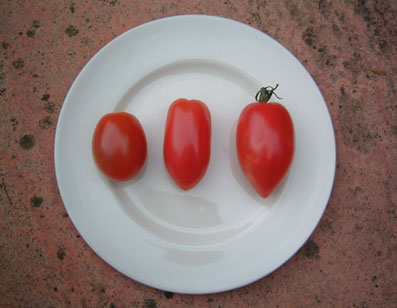
This is what happens if you plant seeds from F1 hybrids (known as F2 seeds). As the genes start to segregate, every plant ends up with a different fruit shape! Whoopee!

As my three Pink Jester tomato plants ripen I'm becoming increasingly convinced that the original Pink Jester I saved the seeds from was an F1 hybrid. Look at the variability between the ripe fruits of the three plants.

Plant 1 has rounded oval fruits, exactly as Pink Jester should have, but they are more red than pink. Plant 2 has the deep pink colouring exactly right but with an elongated shape more like a San Marzano plum tomato, and slightly on the small side. Plant 3 has wide topped pointy-ended heart-shaped fruits with a lovely deep pink colour, slightly flamed with orangey red, and the fruits are significantly bigger.

But wait a minute ... I've been growing these tomatoes from the same original batch of seed for five years ... how come I never noticed the variability before? Well, I did have one plant with elongated fruits one year, but I didn't think anything of it. I knew a lot less about plant breeding then. And because my growing space is limited I often only grow small amounts of any one variety. Over the course of those five years I've grown two or three Pink Jesters each year, and the total so far is about twelve. Of those twelve plants, three have had elongated fruits. Now that's starting to look like a Mendelian ratio, if the rounded fruit gene is dominant over the elongated fruit gene. Twelve is still a very small sample, so it's hard to draw any conclusions, but it's a start.

I think it does show that it's worth growing seeds from F1 hybrid tomatoes though. I have three very lovely plants here, all different, all lovely in their own right, and each capable of becoming a new and unique variety. All I have to do is save seeds from the one(s) I like best and keep growing those for a few generations, weeding out any that don't match. It's likely that most will come true from seed if I simply save the seeds from these fruits, because tomatoes are self-pollinators and their genes are very stable compared to most plants.

Ripe fruits on Pink Jester 1

There are other differences between the plants too. Plant 3 has large blistered leaves (not very attractive) but the fruits go through particularly beautiful colour changes as they ripen (I showed the peachy colours in a pic in a recent post). Plant 2 has fruits with extra-smooth skins, and slightly shorter trusses. Plant 1 has a determinate growth habit ... it's formed a small bush only one and a half feet high, while the other two plants are sprawling upwards. And it's not just the appearance that's different either. Plant 2's fruits have a significantly better flavour than the others, very rich and mellow, with soft flesh. Plant 3 has the same wonderful flavour in its juicy areas but it has thicker and crunchier flesh, which dilutes the flavour a little. Plant 1 has tasty fruit too, but it's not the same as the others.

I'm actually going to save seed from all three of these plants because they each have qualities that I like. I can decide later which (if any) are worth pursuing long term.

Semi-ripe fruit on Pink Jester 3 going through a lovely orangey phase

Towards the end of the tomato season you often see weird things appearing. As the plants run out of energy and the weather becomes less clement, some of the flowers don't form or pollinate properly, and the result can be some odd aberrations in fruit shape. Here's one example: I've spotted a few double flowers on my Tangella plants in recent weeks, where the flower was wider than normal and had two completely separate pistils (resulting in a double tomato, if both are pollinated). Even more curious was a flower which produced a very wide, flat ribbon shaped pistil. And now that the fruit is swelling it seems that it wasn't a ribbon shaped pistil at all, it was multiple pistils fused together. The result is a series of tomatoes fused together, or one very wide and very pleated tomato, whichever way you look at it. Unfortunately I don't think there's enough left of the growing season for this one to reach maturity, but I'll keep it going as long as I can.

Multiple fused tomatoes on Tangella make a weird puckered beauty

Another oddity (which unfortunately has already fallen off the plant) is this three-horned fruit from Pink Jester 3.

It looks more like a dragon than a tomato.

Sunday, 13 August 2006

Today in the garden ... pollination fun

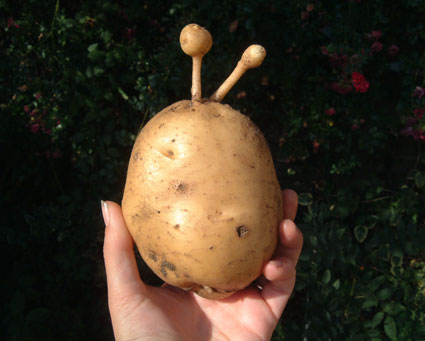
Evidence that Marfona potatoes have been infiltrated by aliens?

I've just harvested the remainder of the Marfona potatoes, having let them mature to baking size, and bloody delicious they are too, especially with a bit of melted cheese on them. In addition to some whopping spuds there were lots of baby new potatoes just starting to form (some of which I've planted up as they're too good to waste) plus a few more ripe potato apples for seed. They're very generous plants.

Alan Romans in his Potato Book describes Marfona laconically as "the slug's favourite". And he ain't kidding. I've found tubers which are completely hollowed out, and I'll certainly spare you the sight of the ones that have been adopted as community housing for woodlice. But ... invertebrates love Marfona for the same reason I do – it's the moistest and waxiest of baking spuds and the flavour is gorgeous. I wouldn't be without it, however many I have to toss into the compost bucket with a cry of "eeeuuurgh!"


I learned to string onions yesterday, thanks to Greenmantle and the instructions he put up on his blog. I'm quite pleased with that. They're Hysam onions and probably the best I've grown yet.

I've been doing a lot of hybridising this week, trying to get the knack of hand-pollinating tomatoes (success!) and French beans (urgh!) so that I can write up the instructions here. I've never pollinated tomatoes before so I wanted to try it out first before writing it up to be sure I was doing it right. And the first couple of lots I did all fell off without turning into tomatoes, which shows how much I know about it. But I think I've now found what I was doing wrong, so I'll post the instructions here shortly. I hope this stuff is of interest to some of you out there. I would love to think I've encouraged people to have a go at hand-pollination and amateur plant breeding because I think it's really important, and it's a lot of fun. It's a great shame that the vast majority of gardening books don't even mention it ... while at the other end of the scale much of the useful practical information is buried in academic papers and you need a degree in biology just to work out what the hell they're on about. Most of what I know came from Carol Deppe's book and from getting out there with a scalpel and trying it for myself. I'm still learning all the time. I'm just pollination crazy and I'll hybridise anything that's biologically possible just for the hell of it.

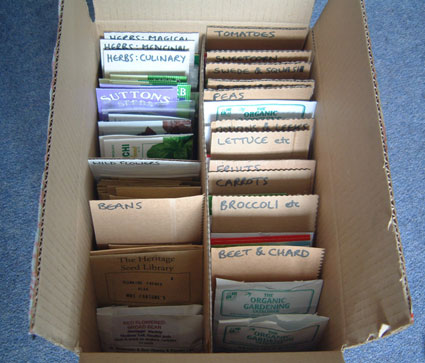
I also love seeds and we're now getting into seed collecting season, which is one of my favourite times of year. I already have stuff drying on window sills all around the house, and am getting through huge numbers of little manila envelopes. I try to be disciplined about labelling things these days. I'm the most disorganised person in the whole of the west country, so nobody was more surprised than me when I suddenly created this boxed filing system one day last year on a momentary whim, after years of distributing my seed packets round every cupboard in the house and tucking them into bookcases.