Showing posts with label Heritage Seed Library. Show all posts

Thursday, 27 June 2019

A trial of ludicrously ancient tomato seeds


This year I decided I wanted to grow some more of a tiny globular red tomato called Tomatito de Jalapa which was given to me years ago by my friend Patrick Wiebe. This is a blight-resistant variety, at least to some extent, which grows quite well outdoors in the UK, and I also love the taste of it, and the tiny, almost perfectly spherical tomatoes. It's not a normal garden tomato, it's a species of wild tomato from South America which is not (to my knowledge) commercially available. Therefore it's quite rare, and you can't buy its seeds in the shops.

When I grew it in the past, I saved seeds from it. Of course I did. But I'm buggered if I know what I've done with them. Somewhere there must be a box of home-saved tomato seeds hiding in a corner of my incredibly well organised house, because there are other varieties I'm missing which I know I've saved seed from. Anyway, when I was sowing my tomato seeds this year, I couldn't find them. I did, however, still have the little baggie of seeds which Patrick originally gave me, and which he'd sensibly labelled with the year they were produced: 2009. So these are 10-year-old seeds. The received wisdom in many gardening books is that old seeds won't germinate, or will produce only feeble plants, but I know this to be bollocks. So I put a bit of compost in a tiny flowerpot and sowed one of Patrick's decade-old seeds just to see whether it would grow. As you can see in the photo above, it did.

I dug out a couple of other geriatric seed packets from my box which I wanted to resurrect. One was an unidentified variety which I call Café Rubik, because I filched the original single cherry tomato from a café in Cheltenham called Café Rubik, in April 2010, after having it arrive on my lunch plate and deciding it was probably the best tomato I'd ever tasted. It must have been an F1 hybrid, whatever it was, because it segregated into three different fruit colours the first time I grew it. That doesn't put me off, of course ... I love to see a bit of segregation so that I have the option to select something new and unique. So Café Rubik the F2 still lives, the seed from that single original tomato (plucked from a salad, no less) still germinating after nine years, long after the café itself has closed down.


Another one I decided to grow out was this ancient packet which I got as a freebie from the Heritage Seed Library. Salt Spring Sunrise, a Canadian heritage variety. God knows how old these seeds are; they're not dated, and I don't remember what year I was sent them. It could easily have been as long ago as 2007. And while the others I sowed had at least been stored in airtight grip-seal bags, these were just in a plain brown paper envelope, stashed in a cardboard box in the spare room. Anyway, I sowed two of these seeds, and one germinated. Initially it did struggle to free itself from its seed husk, and when it finally emerged from the soil it had ripped both its cotyledons clean off! It was left with a pair of green stumps. I didn't think there was much hope of it surviving, but after sitting there fattening up the green stumps for a couple of days, it began to grow its true leaves – and very quickly recovered.


Inspired by the longevity and resilience of these seeds, I thought it might be interesting to do a more formal germination test on some of my other tomato seeds, to find out just how old or craply handled they have to be before they stop germinating. As I never throw anything away, I had no shortage of ludicrously outdated specimens to choose from. I selected six packets of varying ages, which included some purchased seed and some I'd saved myself. Here they are:


Some of the bought seeds were from Association Kokopelli and some were from Terre de Semences, which is what Association Kokopelli was called before it became Association Kokopelli. I haven't purposely singled out this supplier, I just chose them because they're the oldest seeds I have in my collection. The ripest vintage was a pack of Boondocks produced in 1998, which makes them 21 years old at the time of sowing. Close on its heels came the millennium-era seeds of Canabec Rose; a 16-year-old pack of Peacevine Cherry from 2003, and some Anna Russian from 2007. Bringing up the rear were two packs of my own seeds: an F3 derivative of a variety called Pink Jester which I originally bought from a supermarket and saved seeds from, and the special beta-carotene rich orange variety Caro Rich, which I hadn't even saved properly – they were just scraped out of the fruit onto a piece of kitchen roll and left to dry. These seeds are 13 and 11 years old respectively.


The test was not all that scientific. I filled a small 6-module tray with compost, and on 3rd May I sowed two seeds of each variety in the front row (the younger ones), and four each of the varieties in the back row, since the older ones were less likely to germinate. These are very small sample sizes, but I didn't want to sow too many just in case they all grew! I'm emotionally incapable of murdering seedlings which are surplus to requirements, so if I'd ended up with a dozen plants I'd have had to find room for them all somehow in the garden.

The tray of seeds was kept on the windowsill in my music studio, which has a radiator under it, and this was on fairly often as the weather was so bloody cold. This bottom-heated windowsill is brilliant for germinating tomato seeds and it didn't take too long for the first germination.

And the first one up after 10 days was ... Caro Rich!


Then came Pink Jester F3, a couple of days later. Both the seeds of that one germinated, while with Caro Rich it was just one. At 11 years old, Caro Rich was the freshest of all the varieties I sowed, but it was very interesting to me to see it germinating so readily, given that the seeds had been saved in the crudest way. The proper way to save tomato seed is by the fermentation method, which is what I would normally do and recommend, and the simple method of lobbing them onto kitchen roll and letting them dessicate into a disgusting scabby crust is widely frowned upon as a bad way to save tomato seeds. For one thing they stick irretrievably to the kitchen roll, so when you want to sow them you have to tear around them and sow them with some of the kitchen roll still attached. There's also the matter of the germination-inhibitor chemical which tomatoes naturally produce within their gel, which stops the seed from germinating while the gel is there. The fermentation method removes this very effectively; the kitchen roll method doesn't. Though you could argue that at 11 years old, any biochemical inhibitors had probably degraded anyway. I also stored the kitchen roll sheet in a sealed plastic bag after it was fully dried, so that might have helped to preserve it. But still, it was interesting to see this seed germinating normally in spite of everything.

I'd still recommend the fermentation method for most tomato seed-saving, but if you really can't face doing it, or haven't got time, or it's a tiny quantity of seed which is too fiddly to ferment – you should be fine just to splat it onto a paper towel, and still expect to get a decade's worth of viability out of it.

Following these initial germinations I didn't get any more. I kept the trial going for around a month, but nothing else showed up. I took the tray out to the greenhouse and potted up Caro Rich and the two Pink Jester seedlings, all three of which are growing on well. I don't generally find that plants from old seeds are inferior to plants from fresh seeds (though I'm sure some commercial seed companies would like people to think that). They may be slightly slower to germinate and have less available nutrient within the seed to get them through the germination process, but once they've established themselves with a root and a shoot they usually grow pretty normally. The really old seeds in my trial didn't germinate though. Maybe some of them would if I sowed a larger sample. But for now, I forgot about the rest of the modules as I got into my busy season, and they stayed on the top shelf in the greenhouse. Until, seven weeks after I sowed the seeds, I found this:


Yes, it took its time all right, but Anna Russian germinated, at 12 years old. This is a phenomenon that most tomato growers have probably come across, even with much fresher seeds than these: a tray which fails to germinate is cast aside, only to be found sprouting quite happily several weeks later after being completely abandoned and neglected. Sometimes tomatoes just inexplicably won't sprout until they're ready, and they won't be rushed.

Sadly, the day after this photo was taken, Anna was razed off at soil level by a snail. So I won't be growing any of that variety this year. But still – it germinated.

One important observation I made with all of these antique seeds, and not just Salt Spring Sunrise which had the most extreme case of it, is that they were all very prone to getting the seed husks stuck on their heads when they first emerged from the soil. This is not surprising, as the older the seed is, the more it dries out and shrinks. It might be a good idea to try to reconstitute the seed with a bit of moisture before sowing it, to help avoid the problem of seedlings getting completely stuck and unable to release themselves, but I haven't done any experimenting to find out how best to do that. Maybe an overnight pre-soak would be enough.

The message of all this, in summary: don't immediately assume that a packet of old seeds is no longer viable – at least give it a go.

Sunday, 27 March 2011

Tomatoes of past glory

OSU Blue Fruit
OSU Blue Fruit tomato. Not yet commercially available (to my knowledge), this is a breeding line of purple-black tomatoes developed at Oregon State University in the US. The fruits ripen to a deep coal black but are perhaps at their most beautiful during the ripening phase when they take on some magnificent purple tones. The flavour is decent enough, although work is still being done to improve it. And no, they are not genetically modified: the colour was achieved through traditional breeding methods by combining three genes found in South American wild tomatoes.

I have been rather quiet on the blogging front haven't I? The reason is that I'm now working full time for a small publishing company, and also writing a book about potato breeding which will be available in late summer or early September. The book will answer all your questions about growing from TPS and potato seed saving, and to the best of my knowledge will be the first book of its kind on the subject. It's all very exciting and enjoyable, but as you can imagine I am immensely and obscenely busy, and working some very long hours.

Today however, I'm closeted indoors as it's the first warm and sunny weekend of the year and that inevitably means the neighbours are having a barbecue. There's nothing like the stench of burning flesh to send me scuttling back into the house with all the windows shut; so here I am, and may as well do something useful like posting some of the tomato pictures I took last year and didn't get round to using for anything. All of these were grown in the greenhouse unless otherwise stated.


Darby Striped Pink/Yellow
Darby Striped Pink/Yellow. This came from the Heritage Seed Library and is an absolute corker. It's actually an English-bred tomato, from the breeding work of Lewis Darby at the Glasshouse Crops Research Institute in Littlehampton in the 1950s and 60s. Dr Darby also produced the well-known striped variety Tigerella (a variety which I've seen described around the internet as a poor performer, which has not been my experience of it at all - it would seem that it grows better in the UK than in the US, which has led many American gardeners to be disappointed with it). Anyway, this Pink/Yellow line was never released as a commercial variety, which is a shame, because it is fantastic. The flavour is exquisitely rich and fruity, the texture is just right, the yields are very generous and the rounded fruits are a lovely deep pink-red with yellow stripes ripening to orange. It's definitely one I will grow again, and it has such a lot going for it.


Tangella
Tangella. Another of Dr Lewis Darby's creations, this bright orange tomato was released commercially and enjoyed some popularity in its day, but was subsequently deleted from the National List and is now rare. Once again, it was the Heritage Seed Library which supplied me with seeds. I don't rate the flavour of this one as highly as the Pink/Yellow variety above; it's milder and mellower, although it does have a tang to it. It is very firm on the outside but has a very soft texture in the flesh, bordering on the mushy when fully ripe. But it is a nice variety, and the colour is absolutely gorgeous ... a vibrant deep orange all the way through and probably high in carotenes. The fruits come out at a variety of sizes and are a rounded apple-shape, and being bred in England, it is very happy with the UK climate.


Tomatito de Jalapa
Tomatito de Jalapa. Another one I'd recommend. This tiddly tiny cherry tomato was given to me by Patrick Wiebe at Bifurcated Carrots, but previously came from Frank Van Keirsbilck in Belgium. The thing that makes it special is that it's supposed to have blight resistance. Others who have tried it have had mixed results, some finding it blight-resistant and others not, with an additional observation that it needs to be deprived of any kind of feed or fertiliser in order to work its anti-fungal magic. My own experience was that it was blight tolerant rather than blight resistant as such. I grew it outdoors with full exposure to the elements, and gave it no fertiliser or special treatment. I also grew a normal non-resistant variety beside it as a 'control' ... not very scientific, but it gave me something to compare it with. Tomatito de Jalapa held off the blight better than the control plant did, and succumbed at a much slower rate, and although it did become infestans-infested, what was interesting was that the blight didn't get into the fruits, even when the stems they were growing on became blighted. Thus the plant was stricken with blight but I was still able to go on harvesting the fruits for some while - unlike the control plant, whose fruits rapidly became inedible. So this is definitely one to try if you want to grow outdoor tomatoes and be fairly confident of getting a crop. Having said that, the blight was a bit later in 2010 than it has been in previous years, so it remains to be seen how it will cope in a "bad" blight season. However, there's more to a variety than disease resistance, and Tomatito de Jalapa has a lot to recommend it. The small fruits are absolutely delicious - sharp and fruity - and borne on long trusses which ripen beautifully in the English outdoors. Productivity certainly didn't suffer much for the lack of fertiliser. So although the tomatoes are tiny, you get a constant supply over a long period, and overall yield is high. I'll certainly grow it again.


Essex Wonder
Essex Wonder. Popular in the 1930s as a market garden variety developed especially for the glasshouse industry in Essex, this is another "deleted" variety rescued from near extinction by the Heritage Seed Library. This crop was grown outdoors, which wasn't really ideal for it, but it coped. I've had better results growing it in a greenhouse in the past. It's a classic tomatoey tomato; in other words it's almost perfectly spherical, bright red, and has a nice old-fashioned tomato flavour. The size varies considerably, as does the thickness of the flesh, and the gel around the seeds is distinctly green.


Anna Russian
Anna Russian. An oxheart-type tomato. Oxhearts tend to be large, strawberry shaped and immensely fleshy, with few seeds. They also tend to be a bit on the bland side, and that's where Anna Russian is a glorious exception, being very rich and flavoursome. The fruits are a deep dark rosy pink with a mildly ribbed surface, and bright red inside. As they're so fleshy (and tasty) they work extremely well in slices and would probably be good in sandwiches. Yields are pretty respectable - higher than you'd think from the rather floppy plants - and early maturing. Despite the name I believe this variety comes from the US, though it may well have been taken there by Russian immigrants. My seeds came from Association Kokopelli in France. Sorry there's no bottle-top for scale in this picture, but the fruits are of quite variable size.


Pink Freud F4
Pink Freud F4. One of my own little projects which I'm quite pleased with. Now in an F4, it produces masses of miniature shiny silky Roma-plum tomatoes on large trusses, dark pink before ripening to deep red. The flavour is fabulous, and they are equally good raw or stewed up into a luxurious sauce. They also have incredible keeping properties, and ripe fruits can be left in the kitchen (unrefrigerated) for weeks on end with no loss of quality. I've no idea who its parents were, it arose from saving and selecting seed from a punnet of F1 hybrid tomatoes I bought in Marks and Spencer's in 2002. A great example of why you should ignore the received wisdom that saving seeds from F1 hybrids is a waste of time. On the contrary, "doesn't come true from seed" is another way of saying "has lots of exciting diversity". So if you grow any F1 hybrid tomatoes, either from seed packets or supermarkets, do try saving their seeds and see what surprising and delightful goodies they throw up for you.


Pugliese Green
Pugliese Green. Perhaps this should be re-christened Pugliese Red. I was given the seeds by Jeremy Cherfas of Agricultural Biodiversity, who is living in Italy and bought the fruits at a local shop. They are thought to be a locally-developed variety from the Puglia region of Italy (the heel of the boot). I grew them in 2009, allowed them to ripen to a full vibrant red, and was absolutely knocked out by how good they tasted. Really one of the best-flavoured tomatoes I've ever tasted. But when I blogged about it last time, Jeremy informed me that this isn't how they are eaten in Italy. As I should have guessed from the fact that he called them Pugliese Green, they are supposed to be eaten while they're still a bit green. So this year I tried it. And yes, they are indeed very tasty while green-ish. But I still maintain that the really knockout flavour develops when they are fully ripe! It's also remarkable how rapidly they ripen. One minute they're sitting there with no more than a blush of red, and the next day when you go to check them they are bright as a post-box. The fruits are medium sized, firm to the touch, and take the form of slightly flattened globes. The photo shows a couple of fruits in the intermediate semi-green stage as well as the full red. Take your pick. The fact remains that this is a very fine tomato, whatever colour it is when you eat it. Thanks Jeremy.


Isis Candy
Isis Candy. Popular in the US but pretty much unknown over here (I bought the seeds a few years ago from an American seed company), this is a little treasure, and actually originated in Eastern Europe. It's a small tomato, but not small enough to call a cherry; it's very rounded and elegantly symmetrical, globe-shaped but distinctly flattened. It's thin-skinned and very juicy, and has a really lovely sharp tangy flavour. It's also very beautiful, passing through many shades of orange, pink and red, sometimes in marbled combination. A regular favourite.


Green Zebra
Green Zebra. A green-when-ripe stripey tomato bred by Tom Wagner in the US and released in the 1980s through his TaterMater seed company. It can now be found in catalogues worldwide, and is widely grown and well loved. Fruits are a decent size and exquisitely striped, with more of a mottled pattern underneath. People often ask how you know when it's ripe, and the answer is that the lighter stripes change to a golden colour, which is quite distinctive when you see it. You can also give the fruits a little squeeze if in doubt. It does taste slightly different from a red tomato, and has quite a sharp, acidic tang.


Banana Legs x Green Tiger F1
Banana Legs x Green Tiger F1. Another of my own breeding projects, this time from a cross I made between one of Tom Wagner's creations, Banana Legs, and a Marks & Spencer's commercial variety, Green Tiger (not to be confused with Green Zebra above). Banana Legs is a light yellow elongated tomato with silvery stripes and a distinct nipple on the end, while Green Tiger is a perfectly spherical, smooth and shiny tomato with deep burgundy red flesh and dark olive-green stripes over its red skin. What I find fascinating about this F1 hybrid is that it's in almost every way an exact intermediary between the two parent types. It's got silvery-green stripes (not very clear in this photo as they stand out more when unripe), and the shape is an extended globe with a small nipple. This half-way blend fascinates me because it's not something that happens in my pea-breeding projects. With peas, the dominant genes assert themselves completely in the F1 hybrid, with recessive traits completely hidden until they start segregating out of the F2. I'm not a tomato breeder, I only have an occasional casual dabble, so it intrigues me to see how differently the genes express themselves in tomatoes. It's results like this which illustrate why it took so many thousands of years for humans to understand the processes of genetic inheritance, assuming wrongly that it was a simple "blending" process, and it also perhaps shows why it was with peas that the great breakthrough of understanding was made. Anyway, I could go on about how beautiful and high yielding this hybrid was, and that the flavour was pretty decent - but it doesn't really matter what traits it has, because I cannot preserve it in this form. Every seed is an F2 with a different genetic shake-up, so presumably when I sow them I will start getting segregation for the various parental traits rather than this half-way mix. But we shall see.


Something else interesting about my 2010 tomato crop which I will only talk about briefly as I need to do some more experimentation before I conclude anything. I took the slightly strange decision not to feed any of my tomato plants, but just to grow them au naturel, as it were. The inspiration for this was an incident in the 2009 season when I became so busy I had to abandon some tomato plants in the greenhouse - only to find months later that they were fruiting beautifully despite having no water or fertiliser, and also in immaculate blight-free health, even though blight was rampaging through the garden outside. This experience set me thinking, and then when Patrick gave me the Tomatito de Jalapa seeds with the instruction not to feed the plants as their blight-resistance only works if they aren't fed, something went ker-chinggg in my head.

So in 2010 I grew my greenhouse tomatoes without any fertiliser whatsoever, and I only watered them when they were really desperate. The results really astonished me. The plants didn't grow anywhere near as big as they would do with a "normal" feeding and watering routine, and so I suppose they produced fewer fruits too, but in terms of the number of fruits which were edible ... the yields were the highest I've ever had. This is because all the fruits were perfect - immaculate, healthy and blemish free. I had no blossom-end rot, I had no splitting (except very late in the season), I had no mouldering and squishing, and most remarkably I HAD NO BLIGHT. There was plenty of blight outside, it killed all the potatoes and the outdoor tomatoes. But the greenhouse tomatoes had none at all. It may be that they were just lucky, or sufficiently sheltered, but I don't think so ... I think they were so happy and healthy they managed to fight off all nasties. It's as if the lack of feeding enabled them to fulfil their natural potential instead of being forcibly plumped up into oversized bloaters. Another possibly significant factor: because the plants only grew to about 6ft and didn't sprawl like triffids all the way up to the ceiling and out the roof, it wasn't necessary to do much pruning at all. I just nipped out a couple of sidebuds when the plants were young and then left them to it. I'm wondering if the non-pruning also helped to keep them healthy, because this is exactly what the great Dominique Guillet asserts in his book The Seeds of Kokopelli. He reckons pruning is nothing short of tomato-abuse, and believes very firmly that the lack of pruning in his tomato crops is what keeps them blight-free.

Lots of food for thought and further experimentation here. If anyone else has any experience with growing tomatoes without fertiliser, or is perhaps brave enough to experiment with it in 2011, I'd love to hear about it.

Thursday, 1 April 2010

Major Cook's Bean

Major Cook's bean

Some of you may be growing this treasure of a bean this year, as it appeared in the 2010 Heritage Seed Library catalogue - along with a little quote from me because I'm one of the Seed Guardians who looks after this variety. The advantage of being a Seed Guardian meant I got to try it two years before it appeared in the catalogue, and I've already written a detailed review. There hasn't been much point in me promoting it until now because it wasn't available until this year, and I couldn't offer it in any personal seed swaps because the stock I have belongs to the Heritage Seed Library and all the seed I produced went back to them.

If you chose this variety then you are in for a treat. I rarely, if ever, proclaim anything to be the "best ever" or single any one thing out as my ultimate favourite, because there are so many varieties that have merits in different areas, and diversity is in itself a blessing. But this is the exception - Major Cook's Bean is the best bean I've ever grown, and I fell completely in love with it. It is the bean that has everything.

Genuine multipurpose beans are a rarity. In most cases, there is a trade off between pod quality and bean quality, and you have to decide which you prefer when you choose a variety. Major Cook's Bean is an exception. It has the most exquisitely fat succulent pods with a gourmet flavour and absolutely no trace of fibre whatsoever, so the pods stay sweet and edible even when they're fairly mature. At the same time (even on the same plant) you can harvest mature beans which also have a gourmet flavour and a silky texture and which don't break up when you cook them.

Major Cook's bean

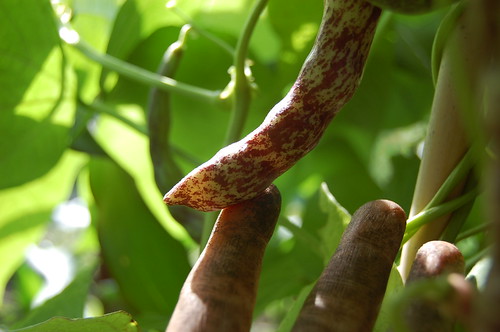
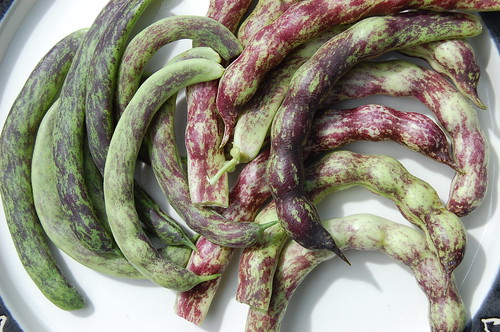
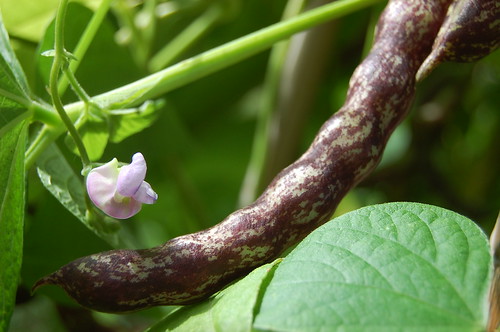
The pods are quite curious looking as they have a strong curved shape and are mottled with purple-maroon. To start with the pods are flat and the mottling is quite blue. As they mature they become spectacularly knobbly, and the colour changes to a rich burgundy maroon. What is unusual is that the pods are still delicious after they've gone knobbly. The knobbles are caused by the complete absence of fibre inside, so the pods shrink around the shapes of the beans. The pods are also incredibly thick-walled and juicy, which adds to the knobbly effect even more. They have a strong flavour, but it's sweet and rich and delicious, and the texture is smooth and succulent - and as if that wasn't enough, they are absolutely stringless! Instead of going fibrous when left to mature completely, the inside of the pod develops a soft white layer of fluff, like you get in broad beans, and the outer colour turns almost solid dark maroon.

Like all red/blue/purple streaked pods, the colour is not retained on cooking because the pigment (anthocyanin) is water-soluble. It does turn the cooking water a lovely deep blue-green!

If you eat the whole beans rather than the pods, you are in for another treat. They will stay intact in a casserole and the texture is buttery and silky, and the flavour rich and sweet.

Major Cook's bean
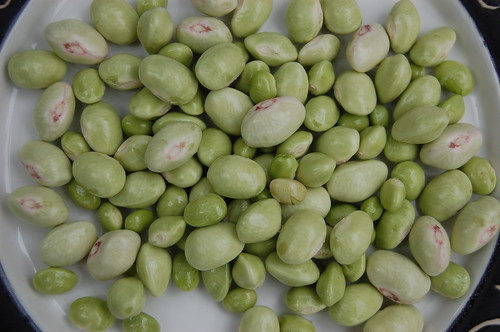
Fresh shelled beans. With the benefit of hindsight, I wouldn't harvest them this young. It's a waste of the good pods. The beans are at their best when fully mature and will eventually dry down to a creamy white with maroon speckles.

As a garden plant, Major Cook's Bean is not the most elegant but it more than makes up for it with its vigour. In my garden it has been completely untroubled by any pests, and although quite a few snails took up residence in its voluptuous foliage they didn't seem to do it any damage. The yields were stupendous. Even without regular picking (since I was growing it for seed I only picked a very few pods before maturity) it produced a totally mad number of pods and kept on going well into the autumn. The leaves are very large, bright green and coarse, and feel rough to the touch. They have large stipules and are prone to composites with four or five leaf lobes instead of the usual three. The flowers are mauve and quite pretty. When the pods are produced and the plants are covered with their burgundy-streaked crescents, they look much more attractive.

The catalogue description gives a little of the bean's history. It was donated to the Heritage Seed Library by Mr Luxton, who got them from his father in 1960. Mr Luxton senior had worked for the Commonwealth War Graves Commission and was given the bean by a colleague, Major Cook. The catalogue suggests this happened in the 1920s but this has now been corrected - it was actually the 1950s.

In my original review I thanked Major Cook "whoever he may be" for his discernment in selecting this bean and preserving it for the future. Well I now know a bit more about who he was. I was recently contacted by his son Phil, who told me this:

"Major Cook was my father. Trained at Kew, London, where he was a Student in 1939. His first job was to train people to grow their own food as part of the war effort. Then he joined up in the Army in 1940, to be sent to various Arab nations on various missions for 5 years.

By 1945 he was a Major. He was tasked by the Commonwealth War Graves Commission with building the Cemeteries in Normandy, France, after the landings, and later to assist in rebuilding the 1st world war cemeteries in France.

Living in Albert, Somme, where Mr Harold “Lucky” Luxton was his right hand man. Also where I and my sister also grew up, from 1952 until 1970. We remember Mr. “Lucky” well.

The bean was probably much older however and could have come from Major H.V.Vokes, who was the first Horticultural Officer for the Commonwealth War Graves Commission in 1920. (He was an uncle of Major Cook). The bean may even be older, in that Major Cook’s grandfather was also an experimental horticulturalist, he was Alderman F. Vokes, Sheriff of Southampton, UK, winner of over 1100 cups/awards for horticulture and there is a flower park named after him near the docks in Southampton."


Major Cook's bean
Major Cook's Bean may originally have been developed by his grandfather, Alderman Vokes

I was intrigued to learn that Major Cook had lived in Albert on the Somme, because it's a place with a very special significance to me. I went there in 1996 during a pilgrimage to the battlefields, originally on the trail of Wilfred Owen who is among my very favourite poets, but it led on to other things. After visiting Albert I had some very strange and powerful dreams, and when I got home it all splurged out in the form of a play set in the WW1 trenches. The play got picked up by a professional theatre producer and premièred at the Grace Theatre in Battersea, London, in 1998. That's my little claim to fame - and for a while it looked like I had a literary career in front of me. Three years later I came out with a novel also set in WW1, with large parts of it set in Albert, but by that time my agent had sodded off (as agents do) and I wasn't able to place it anywhere. But that's a whinge for another day.

What's even more curious is that Phil's message arrived at the very same time I was scanning my Somme slides, as part of an ongoing effort to digitise my archive of film photographs taken during the 20 years before I went digital. I was literally right in the middle of sorting out the Albert pictures.

Albert became an iconic town during the first world war. It was an important strategic base and control centre for British troops, and consequently became a target for heavy bombardment. What was ironic was the town's motto Vis Mea Ferrum - my strength is in iron - adopted during the heyday of its local iron foundry, and which had something of a hollow ring to it by 1916 when heavy iron artillery shells had pounded most of the town to rubble. The basilica in the market square was topped by a gilded statue of the virgin holding the infant Jesus, his arms outstretched, high above her head. In early 1915 the tower was struck by a shell and the golden virgin lurched over, but remained attached to a tangle of metal which kept her suspended over the town square as if she was on a clockspring. She looked as if she was trying to hurl herself and the baby Jesus into the rubble below. Or blessing the chaos, depending how you look at it. It was a deeply striking image which was visible for miles around, and a superstition soon arose that whichever side shot her down would lose the war. Consequently she stayed up - despite more than three years of relentless bombardment in which the rest of the basilica was pulverised. The superstition turned out to be unfounded: it was the British artillery who finally shot her down in 1918 when Albert was briefly taken over by the Germans and there was concern that the tower would be used as an observation post. The statue was never found.

After the war the town was rebuilt, and the basilica reconstructed with a new (upright) madonna. Even now it's not hard to find the lingering scars … pockmarked bricks on the lower walls of buildings everywhere you look.

Somme mural, Albert
The town of Albert, Somme, where Major Cook was based. I took this photo while I was touring the battlefields in 1996. It shows a commemorative mural of the skydiving madonna, and the rebuilt basilica with the new statue on the top.


Golden virgin on the lurch
This first world war postcard shows what the basilica and golden virgin looked like in 1915, after a year of bombardment. You can imagine what state it was in by the end of the war.

During his time in Albert after WW2, Major Cook was superintendant of all the CWGC cemeteries in the Somme area. He gardened on a bombed out factory floor and operated a no-dig system (with compost and chicken/rabbit manure) which kept him self-sufficient in vegetables. He was an accomplished horticulturalist who collected and experimented widely, keeping a careful note of where each plant had come from. Another of his credits is the discovery of the Golden Leylandii, which he found growing in one of the cemeteries as a result of a natural hybrid. He promoted the use of evergreens in the CWGC cemeteries after the wipeout from Dutch Elm Disease.

As for Mr "Lucky" Luxton, whose family maintained the bean for the next 50 years and donated it to the Heritage Seed Library, he was a veteran of WW1 and spent most of his life with two bullets lodged in his chest. He'd survived a pelting of machine-gun fire which had hit him in the chest four times. Two of the bullets were removed but the other two were too close to his heart and had to stay there.

Dantzig Alley
One of the cemeteries formerly cared for by Major Cook and Mr Luxton, photographed in 1996. The CWGC cemeteries are laid out as gardens, with immaculately maintained flower borders along the front of the graves. This is Dantzig Alley cemetery near Mametz, a few miles from Albert. Behind the wall are cornfields which were once the battlefields of the Somme.

My thanks to Phil for making the effort to get in touch and tell me about his father's work.

Sunday, 28 September 2008

Goddess tomatoes and seasonal joys

A plethora of newly harvested heritage beans

With all the crises I've been dealing with over the summer, the garden has been badly neglected this year. To the point where I'd be embarrassed to let anyone see it, even a non-gardener. I've managed to look after the crops OK, but I didn't keep on top of the weeds earlier in the season and they've got themselves well entrenched. And I had to steel myself to go out there and start dealing with them today, because I'm making a change to my gardening method this year.

Normally I allow the garden to biodegrade gracefully in its own time over the winter. It's partly laziness and partly hippy idealism. My reasoning is that by leaving a tangle of last year's decaying crops on the land over winter I'm providing shelter for overwintering insects, seeds for birds to eat, and ground cover to protect the soil, and by January it's all nicely broken down and easy to dig in ... a nice bit of organic matter to enrich the soil. But in the last couple of years it hasn't worked out so well because it also provides the perfect overwintering conditions for slugs and snails, whose numbers have erupted out of control over the course of two wet summers. So I'm afraid this year I'm clearing it all and the wildlife will have to find somewhere else to shelter. I'm hoping the birds and frogs will quickly gobble up the snails, or else they'll bugger off into next door's garden (where he doesn't actually grow anything so they won't bother him).

But I do have quite a task on my hands. It's a case of: Hmmm, I'm sure there are some gooseberry bushes somewhere over here under these swathes of long grass. I'll just carefully insert a gloved hand and OOOOOOOWWWWWW FUUUUUUUUUCK! Oh yes, there's one.

One thing that will directly benefit the wildlife (birds, mice and slow worms anyway) is the continued incapacitation of the Ginger Peril. We had another crisis recently when his bandage slipped and reopened his operation wound, which had to be stitched up again. And of course it had to happen on a Sunday, requiring a trip to the emergency out-of-hours vet, who charged £113 for a temporary bandage to last him until the morning. It also meant an extra two weeks in the cage, bringing his confinement time to 6 weeks. But he does look cute in his little plastic bonnet.


Most of the harvest is safely gathered in now. The last of the bean crops are now drying indoors, as seen below. The dark curvy ones on the left (and shelled out in the bowl) are Major Cook's Bean, which I'm growing for the Heritage Seed Library as part of their Seed Guardians scheme, and which has been so spectacularly prolific it's going to cost a small fortune to post it back to them. Look out for it in next year's catalogue, it's a corker. I've posted a full review of it here. In the middle are the dried out pods of the similarly abundant Poletschka (thanks Celia) and to the right some green-yellow San Antonio from the Heritage Seed Library, which also did well for me.


The area you see here spread with beans is the bed in the spare room. Needless to say we don't have many guests to stay at this time of year.

You will notice that I harvest bean pods for seed-saving as soon as they're mature, and dry them indoors rather than leaving them outside to dry on the plants, as is often recommended. The reason for that is the unpredictable weather, which can ruin an otherwise excellent crop if the rains decide to come down heavy in September. This year they haven't, and September has turned out to be better than August, but I wasn't taking any chances. It does no harm to harvest them at this earlier stage, as the plants have already given them as much nourishment as they're going to get. It is important though to keep them well ventilated, ideally by spreading them out so they aren't touching, and turning them regularly. If you don't, they can easily go mouldy.

And no harvest would be complete without a parade of weirdness. And so I proudly present my Threefold Goddess Tomato. She's taken her time to ripen, but here she is.

The bottle-top is for scale (gave me an excuse to crack open a beer anyway)


She is the Divine Feminine expressed in fruit. She is essentially three tomatoes fused together in harmonious symmetry, born out of one flower with an unusually wide stigma, and endowed with various crevices and hollows which look a bit ... erm ...

Anyway, she was the first fruit produced by an exotic variety called Orange Strawberry which I grew in my greenhouse. It's an oxheart type, which means it's large, heart-shaped (normally it is, honest) and exceptionally fleshy inside with very few seeds. It's really a cooking tomato, and has a wonderful flavour when cooked as well as this glorious bright orange colour. See here for a full review. Not one you'll find in garden centres ... I got my seeds from Association Kokopelli.

Thursday, 3 April 2008

Seed Guardians

A really unusual pea ... Irish Preans, which is possibly a cross-species hybrid

This year I've volunteered as a Seed Guardian for the Heritage Seed Library. I've been meaning to do it for a while, but wanted to do some informal seed swapping for a couple of years first to make sure people were happy with the seeds I produced and I wasn't getting any unexpected cross-pollination problems. The Heritage Seed Library grow a lot of their own seed to distribute to members but they're also hugely reliant on volunteers to grow seed on their behalf.

It's a pretty straightforward process to become a Seed Guardian. You write to HSL and tell them you want to volunteer. They send you a set of instructions for saving seed for various types of plant. And then in March they send you their list of "orphans". You can choose up to three varieties to become a guardian for ... this year's orphan list has 12 beans, 8 peas and 10 tomatoes. And they do let you choose which ones you want to look after (on a first-come first served basis), which is nice, and send you descriptions for each variety so you can make an informed choice. Some of the varieties are things already available in the HSL catalogue, others are new acquisitions or things which haven't been listed for a few years.

There is a sense of responsibility in taking on a guardianship role ... and it is important to ensure the purity of the seed you send back to them. But it's not the end of the world if you have a crop failure, they keep spare stock of everything. Neither do you have to commit yourself to producing vast quantities ... and you are allowed to eat some of it. They welcome feedback on the flavour and cooking qualities.

Here are my three charges. Irish Preans in the top photo is thought to be a hybrid between a pea and a broad bean. I didn't know such a thing was possible, but I don't see why not. They're different species, but they are distantly related and wide crosses like this are sometimes possible. This one was developed at an unnamed crop research institute in Ireland. The seeds are larger than most peas and are dark olive green and slightly oval, so they do look a bit like tiny broad beans ... at least they resemble some of the older, smaller types of broad bean, and unlike most peas they have a black hilum. Very curious.

Very wrinkly and slightly elongated ... the seeds of Gravedigger

I've also taken on a pea called Gravedigger. That's probably not its real name, if indeed it ever had one, but it came to the Heritage Seed Library from someone who got it from a retired farmer who in turn had got it from a gravedigger. In the absence of any other provenance, HSL varieties often get named after either the person who donated them or the earliest known person they can be traced back to. So there you go.

Finally, I have a climbing French bean called Major Cook's Bean. This one has never been available commercially, it's an heirloom which was originally bred by a First World War officer. I've got a strong connection with WW1, having written a play and a novel about it, so I couldn't pass up the opportunity to grow this. Major Cook worked for the Commonwealth War Graves Commission after the war and gave the bean to a colleague, whose family have diligently kept it going since 1920. Amazing really.

So hopefully these three varieties will be listed in the HSL catalogue for 2009 ...

Major Cook's Bean

Monday, 28 January 2008

Heritage Seed Library and Irish Seed Saver Association

Don't those look yummy? Bright orange Tangella tomatoes, which the Heritage Seed Library sent me as a freebie lucky dip. (Photo taken in 2006)

This is not the first time I've plugged the Heritage Seed Library, so excuse me if you've heard all this before. But I thought I'd mention it now because this is the last chance to join HSL if you want to get seeds for this year. Their deadline for seed requests is 1st March 2008.

The purpose of the Heritage Seed Library is to make rare and non-commercial vegetable varieties available to domestic gardeners and to encourage seed saving and biodiversity. Their main focus is on British and European varieties but there are a number of things in their catalogue from further afield too. This is vitally important work because of the unfortunate and short-sighted laws in Europe which forbid the sale of unregistered vegetable seeds. It's actually illegal to sell seed of any variety which isn't on your country's National List. As registration on the National List costs a lot of money and requires the variety to be uniform and standardised (which a lot of heirlooms aren't) the List is made up almost entirely of commercial varieties of interest to farmers, many of which, frankly, are rubbish in the garden ... or just plain boring. If you've ever wondered why garden centres always sell the same old boring selection, that's why. Old-fashioned garden varieties and family heirlooms have been vanishing at an alarming rate over the last 40 years, right across Europe.

A rare Irish pea variety, Clarke's Beltony Blue, from the Heritage Seed Library. (2007)

It therefore falls to the charitable organisations and concerned individuals to rescue and distribute as many non-commercial varieties as they can. Most European countries have their own seed saver organisations. It may seem a bit mad to suggest that anyone would actually be prosecuted just for selling vegetable seeds, but that's exactly what happened in France, where the government's 'fraud squad' ruthlessly crushed the seed saver charity Terre de Semences after they started selling seeds in garden centres. Undeterred, they resurrected themselves as Association Kokopelli and continue to distribute 1200 varieties of amazing heirlooms, under constant threat of persecution.

All the seed saver charities have their own ways of working. With the Heritage Seed Library you pay an annual subscription of £20 and they send you a catalogue of about 200 rare vegetables (from the 800 or so they have in their collection). You can join from outside the UK but it costs £5 extra. You choose any six packets you want, and you can also opt to have a seventh packet as a "lucky dip". You can specify substitutions just in case any of your chosen varieties are out of stock, but in my own experience I've always been sent exactly what I asked for.

Now, I know some people baulk at the cost of joining and it certainly isn't the cheapest way to acquire seeds. But the varieties they offer really are special, and many of them are unavailable anywhere else. I've consistently been delighted and amazed by the things I've had from them. Six choices may not seem a lot either, and I must admit I agonise over my selections because there are so many things in their catalogue I'd love to grow. But to be honest it does me good, because it forces me to think very carefully about each variety ... exactly why I want it and what I expect to get from it.

Other seed saver organisations work differently, and one I can highly recommend is the Irish Seed Saver Association (ISSA). They have some lovely stuff, from Tipperary Turnip (which is actually a swede) to a tomato called Auld Sod. One advantage is that their catalogue is open to all ... you don't have to be a member to buy seeds from them.

You can even take part in their breeding projects if you want. Such as Jo's Purple Podded climbing bean, which comes with a hand-written label asking if you could please send back some seeds from the best and purplest plants you get.


I discovered the delights of ISSA following an appeal for help. A musician friend asked if I knew anywhere she could get seeds of James' Longkeeping onion, as she knows someone who's desperately trying to get hold of it. An English market garden favourite for nearly 200 years, ubiquitous in seed catalogues and mentioned in popular gardening books, it seemed to suddenly disappear. The bloke who wants it says he's been looking for it for 15 years, to no avail. It's his favourite ever onion which he grew for many years before it vanished, "sweet like an apple if you eats 'em raw, and keeps for ages", and he's never found another one as good.

I like a challenge like that, and I soon found the reason for his problem. James' Longkeeping was deleted from the National List in 1993. So it's unlikely to have been offered for sale anywhere since then. No matter how popular or commercial a variety is, deletion from the National List can send it plummeting towards extinction in no time at all.

I searched around all the specialist heritage seed suppliers and couldn't find it. Even the Heritage Seed Library aren't offering it at the moment, and their members have been putting in a few requests for it in the "wants" list. But eventually I did find it, nestling among the rare and curiously named vegetables in the ISSA catalogue. ISSA seems to be the only source for it at the moment.

It brings it home to you how easily these old varieties can be lost, and how important this charitable conservation work really is.

Saturday, 12 January 2008

Whatever happened to the great garden pea?

A diversity of peas. These are all heritage types which I grew in my garden in 2007.
Top row, left to right: Corne de Belier, Salmon-Flowered, Ne Plus Ultra.
Middle row: Golden Sweet, Magnum Bonum, Kent Blue.
Bottom row: Champion of England, Carruthers' Purple Podded, Alderman.


Probably the first named variety of pea was the Hastings, which has its earliest reference in a poem of the mid-1400s, followed a century or so later by the Rouncival which sprung from the Hospital garden of St. Mary of Roncesvalles in Charing Cross. But for many centuries peas were primarily an agricultural crop, and didn't feature significantly among garden vegetables. They were also subject to a class divide, young green peas being mostly the reserve of the wealthy, while ordinary people had to make do with the starchy over-mature stuff, or dried peas boiled into soup and pease pudding.

The early varieties were probably quite coarse by today's standards, closely derived from the field pea. Sweeter and more refined peas made their way to England from the continent in the mid-17th century. These would mainly have been French varieties, as the French had made huge advances in pea breeding at that time, plus the highly expensive Sandwich pea which originated in Holland and was established in the town of Sandwich by Dutch settlers. By the early 18th century the pea had become a popular garden plant and a fashionable delicacy, and new varieties proliferated.

They proliferated so much, in fact, that it all got pointless and confusing. Dozens of new varieties were almost impossible to tell apart. Richard Bradley, writing in 1724, complains "I have often wonder'd at the Indiscretion of some People, who Delight in giving cramp Names to Plants, and make it their Business to multiply Species without Reason, as if a Fruit would be the better for a Name." Nevertheless the trend continued and reached a peak in the mid- to late 19th century. By this time peas were so popular that vegetable seed catalogues featured them in pride of place at the top of the list, with all the other vegetables listed alphabetically behind them.

Ironically it was during this boom period that almost all of the older pea varieties were lost, including the Rouncival, the Sandwich, the Spanish morotto and a once ubiquitous English early-maturing type called the Hotspur. So great was the demand for the new sweeter varieties, the centuries-old staples just disappeared. In 1855 Charles McIntosh regards the Charlton Hotspur (sounds more like a football team than a vegetable) in his Book of the Garden as "too well known to require description, having been in cultivation for upwards of a century." Yet within a couple of decades it had vanished forever.

Catalogues and books of that period don't always mention the colours of flowers or pods, but generally the newer more refined peas were white-flowered. Older varieties of pea were more likely to have bi-colour pink and maroon flowers, showing their descent from the coarse and starchy field pea. Even today, I've yet to find a bi-coloured pea which tastes as sweet as a white-flowered (though I find the bi-colour ones have other good qualities uniquely their own).

If the pea was the must-have vegetable of 19th century England and the seed-buying public couldn't get enough of it, there was no shortage of dodgy seed merchants looking to cash in on it. Fancy new names were given to existing varieties to give them more market appeal, and miniscule variations of type were launched as brand new varieties. Deceptions really came to a head with the arrival of the Egyptian or Mummy Pea, which claimed to have been grown from seeds found inside a hermetically-sealed jar taken from an Egyptian mummy-pit, and preserved in a viable condition for 3000 years. Excited customers who paid a premium for this amazing rarity were rather deflated to find it was strangely identical to the bog-standard British marrowfat pea they were already growing in their gardens.

By 1850 the Royal Horticultural Society had had enough and conducted its own trials. In their experimental gardens Mr Thompson collected together 235 popular varieties and carefully grew them under controlled conditions. From those 235 he concluded that only 27 could realistically be described as distinct and useful varieties, and of those 27, only 11 were really worth growing.

This is the list of the final eleven, taken from Charles McIntosh's The Book of the Garden:

- o - x - o - x - o - x - o - x - o - x - o - x - o - x - o - x - o - x - o - x -

1. Prince Albert — From 2 and a half to 3 feet, according to soil; a white-seeded pea, forming with Kent's early, early hero, early Warwick, early May, and a lot of others, a section of which the true early frame is the type, and comprising our earliest sorts; moderate croppers; pods contain from eight to ten peas each.

2. D'Auvergne — 4 feet; seeds white; remarkable for its long crooked pods, and the great number of moderate sized peas each pod contains; one of our best for second or general crops. This is identical with Richardson's eclipse and Torwoodlea, two Scotch synonymes.

3. Dancer's monasterу — 4 and a half feet; seeds white; a good profitable sort for a second or general crop; peas of moderate size, rather above medium.

4. Bishop's new long pod — 2 feet; seeds white. A most abundant bearer, producing a succession of pods during most of the pea season. Like all dwarf peas of its class, it requires a rich soil, and from 4 to 6 inches between the seed in the line. We have had this pea producing a good supply for three months in succession. It is one of the most valuable sorts for small gardens, and for domestic use: its only fault in large establishments is the large size of the peas, but, although disliked by cooks on that account, it is much prized by them for many purposes. It originated with the late Mr David Bishop, author of "Casual Botany," and is a hybrid between Bishop's early dwarf, a pea of only 1 foot in height, and one of the marrowfats, carrying in itself the characters of both its parents.

5. Fairbeard's surprise — 5 and a half feet; seed bluish; a profitable sort for a second or general crop. Pods thick, roundish, containing from seven to nine peas of excellent quality; the same as Fairbeard's early surprise.

6. Victoria marrow — 5 and a half to 6 feet; seed bluish; an excellent sort for a general crop. Pods nearly 4 inches long, generally in pairs, containing from seven to eight large peas each; one of our very best peas.

7. Bedman's imperial —3 feet; seed large; bluish green; called also Bedman's dwarf imperial; very similar to Flack's dwarf victory; perhaps scarcely worth growing as distinct sorts. Very prolific; peas large; excellent for green-pea soup.

8. Flack's new large victory — Seed large; bluish green; 3 feet. Mr Thompson makes this distinct from the last. It seems to us to be a distinction without a difference. There would be, however, no loss in growing both these excellent peas under different names—much less, at least, than scores of others. Pease generally six in a pod, and of excellent quality.

9. Knight's tall marrow —6 to 7 feet ; seed large ; wrinkled or indented when dry; white. Often called Knight's tall white marrow, to distinguish it from Knight's tall green marrow. Originated with the late Mr T. A. Knight (vide sect. PROPAGATION BY SEED). Very much esteemed for its productiveness and fine flavour. Like all the tall marrows, only fit for a large garden, and then to be grown in single rows, at a great distance apart. Adapted for general crops. Pods large—from seven to nine peas in each; known also as Knight's late, Knight's tall green marrow, Knight's tall blue marrow.

10. Fairbeard's champion of England—5 to 6 feet ; seed large ; wrinkled when dry ; bluish green. One of the best of the wrinkled marrows, and well adapted for general crops, as well as early ones, being about as early as the Charlton. From seven to eight large peas in a pod.

11. Knight's dwarf marrow — 3 to 4 feet. There are two varieties of Knight's dwarf marrow, differing, we think, only in the colour of the dried seed, the one being white, the other greenish. However, either is valuable for a general crop. The bluish green variety appears to be preferred by Mr Thompson. Like all the marrows, the seeds are large. Pods large, containing six peas in each, and of excellent flavour; quite sugary.

- o - x - o - x - o - x - o - x - o - x - o - x - o - x - o - x - o - x - o - x -

To the best of my knowledge, Prince Albert and Champion of England are the only ones that have survived to the present day. They're both very rare and can only be obtained through seed savers organisations.

McIntosh conducted his own trials in the large gardens of Dalkeith House in 1850 and 1851, comparing 100 varieties, and finding 23 worthy of mention. Even in those days, the commercial varieties involved a trade-off in flavour: "Bishop's new long-podded, Thurstone's reliance, Hair's dwarf mammoth— all first-class pease for profitable culture—must not be calculated upon to afford a supply for mouths genteel." His results are attached below in a separate post, listing all the varieties he considered to be worthy and all those he thought were duplicates. Sadly only a tiny handful of the peas he describes are still known to be in existence.

"There is one section of garden pease called sugar-pease, the pods of which have the inner film wanting, or much less tough than usual. The pods in this section are used with the young seed within them, and are cooked and eaten the same as French or kidney beans." Mangetout and sugarsnap peas were not then in general usage, being considered too tender for the British climate, but McIntosh noted their benefits and recommended that they should be widely adopted.

Most of the tall varieties of pea have disappeared from today's catalogues, because tall peas are no use to farmers, and farmers are the main focus for seed companies. (If you thought the varieties sold in garden centres were actually designed for gardeners ... er ... I'm afraid that just doesn't happen.) Some of the worthy types from the late 19th century, like Magnum Bonum, Laxton's Exquisite, Duke of Albany, Alderman, Lincoln and the Gladstone have survived through the efforts of gardeners and seed saver organisations, but most of the peas McIntosh was evaluating in the 1850s have simply vanished.

But are all these lost varieties totally gone? They may have disappeared from the catalogues, but diligent gardeners have always saved their own seed and some of the long-vanished types (or at least derivatives of them) may have survived in the hands of individuals. I've been thinking about this a lot as I continue to collect amazing and unusual peas from the Heritage Seed Library. Many of the vegetables offered by the HSL are of unknown provenance. They're often named after the person who donated them or the locality they've been grown in. Very often there's no known history behind them, other than the last couple of generations of gardeners. I'm convinced that some of them are survivors or derivatives of older types which have officially been "lost".


Blue flowers and scimitar-shaped pods of Kent Blue

Take Kent Blue for example. Donated to the Heritage Seed Library by a family from Sevenoaks in Kent who had grown them since the 1940s, this pea is of unknown origin but looks to me like a relic of a very old variety. It's clearly related to the field pea with its small blue flowers and strange knobbly pods, which grow in a scimitar-shape and sometimes buckle and twist as the peas swell. You can see from the photo at the top of this post that its seeds are very distinctive. Tiny and round, variably coloured and heavily speckled with midnight blue. It really is very unlike all other garden peas, even the Victorian ones. Scimitar-podded peas were, however, well known in England for many centuries before being "lost" in the late Victorian era.

Likewise the bizarre Salmon Flowered pea occasionally offered by the HSL (unnamed and of unknown origin) may be descended from an earlier sort. Its broad thick stem and funny little bunches of pods all growing in a tuft at the top of the plant look totally unlike any other pea I've ever seen. But this type of "tufted" or "crowned" pea was apparently quite popular in the 17th century.

Salmon Flowered, bearing all its flowers at the top.

Matching up the HSL's unnamed survivors with earlier named varieties is probably impossible to do with any degree of certainty. But in a sense it doesn't really matter. If a variety is still carrying on some of the genes from earlier lost varieties then it's still contributing some vitally important biodiversity. Peas in particular are not renowned for their diversity (compared with things like tomatoes and beans which come in various shapes and colours) so anything which shows itself to be different from the homogenised commercial pea is a thing to be nurtured and appreciated.

Sunday, 6 January 2008

Heritage vegetable review
Pea: Carruthers' Purple Podded


Age: unknown. Saved as a family heirloom.
Background: From Co. Down, Northern Ireland
My supplier: Heritage Seed Library
Pros: fantastic flavour, beautiful flowers, beautiful pods, high yields, very vigorous
Cons: the pea moth's favourite

According to the Heritage Seed Library catalogue, this is an heirloom pea from County Down, donated to them by Patrick Carruthers who got it from an old family gardener about 25 years previously, and has grown it ever since. They also mention the beautiful flowers.

Tall and vigorous (it grows to about 6ft), Carruthers' Purple Podded has a slightly olive green shade to its leaves and produces a splash of bright magenta in each leaf axil, and to a lesser extent on the backs of the leaves. So it looks quite decorative even before it flowers.

It was the earliest flowering of all my heritage peas in 2007. After the cream and pink buds it has dainty lantern-like flowers borne singly on very long curved stems. Very pretty. The flowers are large with a distinctive hooked shape in the calyx and a long elegant red-flushed spur at the back, very like an Art Nouveau lantern. They also have a decorative swirly red pattern on the front of the calyx, which is something to distinguish Carruthers' from most other purple podded varieties (I've only ever seen this on the Irish varieties). The top petal is pink maturing to mauve, with patterns of fine darker streaks, and a glowing maroon wing petal underneath. As they die off they turn blue. All the purple peas have these lovely changeable bi-colour flowers, but this is one I found myself standing around and staring at. A lot.


Seriously, the flowers are as good as an old-fashioned sweet pea (albeit not scented) and with its enormously long curvy stems I think this one would appeal to flower arrangers as well as vegetable gardeners.

The pods are a reasonable size with a lovely deep violet-purple colour. They glow translucently in the sun, taking on a dusky dark purple in lower light. Eaten raw at the young stage they are very juicy and crunchy (and the purple colour goes right the way through them) but have a slight bitterness.

Beautiful at all stages, the pods mature to a deep violet purple slightly masked by a greyish bloom on the surface. This rubs off very readily to show the pod's true colour ... if you so much as touch a pod you will leave behind dark fingerprints. The surface goes quite leathery at maturity. Although the pod itself is purple right through, it has a fibrous layer of bright green on the inside. This creates a beautiful effect when you hold an empty pod up to the light ... as intense and vibrant as a stained glass window, but with the colours swirled and blurred like watercolours.

The peas inside are an olive green colour, large and very tightly packed, approximately eight to a pod. They go slightly square and chunky as they press against each other in the pod.


The fresh peas taste surprisingly sweet for a purple ... the best I've tasted. The flavour is mild, but it's the sweetness that dominates. They have a slightly coarser texture than a modern green pea but that's actually rather nice ... and there's none of the earthiness or bitter aftertaste you so often get with purples. This is truly a superior variety and deserves to be much more widely grown.

Mr Carruthers who donated the pea to the Heritage Seed Library says they can be frozen straight from the pod without the need for blanching. I haven't tried this ... they taste so damn gorgeous straight off the plant they don't get anywhere near the freezer.

Yields are very generous and the plants produce masses of pods.


You may have to be vigilant if you want to save this one for seed, because I found it to be more susceptible than most to pea moth. The pods look so beautiful, the last thing you want is to pop them open and find two or three little maggoty chaps gazing back at you. The tell-tale sign of an unhatched pea moth in residence is a brownish sunken patch on the surface of the pea. If the surface has a small round hole or a sideways tunnel chewed out of it then the larva has pupated and will be wriggling around the inside of the pod somewhere. It's a small green-white grub with a dark head. Dispose of it as you will, because it will probably chomp lumps out of some more peas if it's left on the loose.

I should point out though that this review is based on a single growing season, so I can't be sure what caused this crop to attract more than its fair share of pea moths ... it may just have been unlucky or planted in the wrong place.

Even when the plants have completed their life cycle and started to die off, their beauty takes on a new phase. The leaves fade to a golden yellow flushed with rose, and the magenta in the leaf axils and stems becomes very deep and intense. The overall effect is very striking as the green gives way to all these other shades, and makes a beautiful contrast with the pods.

Autumnal colours as the plants reach the end of their season.

While I haven't finished trialling all my purple podded peas yet, so far this one easily stands out as the top choice for flavour. It's probably top choice for looks too, and possibly also for yield.

To my knowledge the Heritage Seed Library is the only source for Carruthers' Purple Podded, and as far as I'm concerned it's worth joining the HSL just for this variety alone, though unfortunately it isn't listed in the 2008 catalogue. I can probably give out a few packets of mine for others to try if anyone's interested, but they'll have to be small amounts.

Sunday, 23 December 2007

Heritage veg summary 2007

Next year's seeds of Kent Blue peas, starting to develop purple speckles as they dry out

This year had such a bizarre growing season, with too much spring heat, extremes of wet throughout the summer months, and not enough light whatever the weather ... not to mention the mildew and the worst (and earliest) attack of blight I've ever seen. It wouldn't be fair to do proper reviews of most of the crops I grew this year. Some were clearly not in a position to provide their best.

I did still collect a lot of notes though, and here's a general summary of my crops for 2007, divided up according to their merits (in my own subjective opinion). It doesn't include the many varieties which had a total or near total crop failure, such as the tomatoes, which had only two survivors from the 20 varieties I planted and a total yield of 7 fruits. It also doesn't include anything I already reviewed last season.

Some of these varieties will get full reviews which I'll post in the new year, but most won't – they'll have to be grown again in another season and reappraised.

I hope you find these notes useful in choosing what to grow, but there's always a possibility your experience with any of these vegetables could be different from mine. Feel free to compare notes if you agree or disagree with any of the things I've said.

Rouge Crapaudine ... an antique elongated beetroot


SUPERSTARS:

Beetroot: Rouge Crapaudine
Seed source: Thomas Etty Esq
The root is a matte dark red on the outside, slightly darker than most beetroot, and the inside is a very beautiful intense dark blood red. It's one of the oldest beetroot varieties around, listed in catalogues in the 1850s. Unlike a conventional beetroot it's long, thin and tapered, basically shaped like a carrot. The flavour is sweet, refined and not too earthy, and exquisitely tender when cooked. I grew it as a novelty but it's instantly become a favourite on its own merits.

Potato: Salad Blue
Seed source: Waitrose
Vigorous grower with a dark blue flush on the stems. The flowers are a purply-sky blue and absolutely beautiful. It flowers early and for a long period and is a delight to have in the garden. Salad Blue is emphatically not a salad potato. It's pretty floury. But it makes the most fabulous roasties. Soft-textured and exquisitely flavoured ... and BLUE! Beautiful to look at and full of healthy anthocyanins. When fresh the potatoes are dark blue skinned with blue-purple flesh, and much of the colour is retained after cooking. Can also be used to make mauve mash ... and very tasty it is too. Not the highest yielder by modern standards but well worth it for all its other qualities.

Pea: Carruthers' Purple Podded
Seed source: Heritage Seed Library
This is my clear favourite of all the purple-podded peas I've trialled (with Mr Bethell's Purple Podded a commendable second). It's a winner on flavour and beauty. Tall, vigorous (about 6ft) and early, it has dainty lantern-like flowers in two-tone maroon and pink. Pods are a reasonable size with a lovely deep violet-purple colour. Eaten raw they're very juicy but have a slight bitterness. Peas inside are an olive green colour, large, square and about 8 to a pod. Fresh peas taste surprisingly sweet for a purple (bear in mind purple podded peas always taste less refined than a good green variety) and are very nice raw from the pod. They have a slightly coarser texture than a modern pea but that's actually rather nice. This is truly a superior variety. Its one fault? It seems to be the pea moths' favourite too.

Pea: Magnum Bonum
Seed source: Heritage Seed Library
This is among the tallest peas I've ever grown, quite readily reaching 7ft and beyond. It's vigorous too, and you get a lot of pods. Similar in appearance to other 19th century tall peas, with pure white (not cream) flowers. One of my plants produced two flowers per node, but the others didn't. Magnum Bonum is the only pea I've found so far about which I can say "tastes as good as Alderman", my flavour benchmark. It's very sweet, possibly a tiny bit less sweet than Alderman, but with a richness and refinement in it. Definitely one of the best choices for flavour, and it yields well too. It does lose the sweetness when fully mature though, so there is a "just right" time to harvest it.

Magnum Bonum peas in flower


EXTREMELY GOOD, HIGHLY RECOMMENDED:

Beetroot: Egyptian Turnip Rooted
Seed source: Thomas Etty Esq
Very decorative in the garden, with bright emerald green leaves veined with deep red. It grows almost entirely on the surface of the soil, so at least you know how big it is before you harvest it ... none of that feeling of "beet deflation" when you excitedly pull one out of the ground and find a tiny stumpy root on it. Flavour is excellent and nicely balanced without too much earthiness.

Pea: Salmon-flowered
Seed source: Heritage Seed Library
Oddest pea in the garden, for sure. Looks like a cross between a culinary and a sweet pea, but could be anything. 4ft tall, it has very wide succulent stems and clusters of flowers all in a solid bunch at the top. The flowers are truly gorgeous ... a very dainty and pretty two tone pink, quite unlike any other pea I've grown. They bloom more or less all at once, so it looks absolutely stunning for a few days and then it's gone! Green pods develop rapidly, all sticking out in a big bunch at the top of the plant. You don't get many peas in 'em ... 4 to 6 seems about normal, and they aren't terribly big, but they're very sweet and flavoursome. As a bonus, if you save it for seed the pods go an unusual rosy colour as they dry out. Yields were relatively low, but it's such a great thing to have in the garden, I didn't care.

Pea: Kent Blue
Seed source: Heritage Seed Library
It may be premature to review this as I didn't get a chance to do a proper taste test (most of it was kept for seed), but it's too interesting to leave off the list. It's not a vigorous pea or a very high yielder. Flowers, produced in pairs, are small but have a beautiful two-tone velvety blue colour, with dark veins. Unique and very pretty. Pods are green, and small, and go extremely knobbly as the peas inside start to mature, and may even start to bend and fold. You can certainly see very clearly how well the peas are developing and you can count the bumps. The raw peas are quite firm and mealy and the skins are chewier than you'd get on a modern pea, but they have a very rich and full flavour with an overriding sweetness. When dry they become speckled with purple.

Climbing bean: Caseknife
Seed source: Beans and Herbs
An old variety from before 1820, which climbs and climbs seemingly to eternity. It ain't a beauty. The leaves are gnarled and the pods dull green and kind of lumpy and ugly, although they start off flat and knife-shaped. I didn't bother trying to eat them as green beans. But boy the shelled beans taste good ... fresh, dried or partially dried (I'm not fussy). They're white kidney type beans, not especially smooth or shiny or glamorous but they have a lovely firm texture when cooked. Caseknife needs tall supports but it's full of character and flavour.

Purple podded pea, Desiree


GOOD, BUT ... :

Beetroot: Golden
Seed source: Organic Gardening Catalogue
Different from other varieties in its rich orange colour, which is apparent right from the earliest seedling stage. The stems of the plants are golden yellow and the leaves a lush bright green. Root size is a bit on the small side though and the flavour is OK but not as refined as the red varieties.

Potato: Highland Burgundy Red
Seed source: Waitrose
Less vigorous than some and slower growing, with thin, fine foliage and a dusky reddish tinge on the stems. It's not the most graceful looking plant in the garden but it does have nice flowers. They're pure white, fairly small but dainty and frilly and borne in clusters. Tuber colour on the outside is a bright rich crimson, maturing to burgundy. They're slightly erratic in shape, often kidney shaped and tapering towards one end. Inside, there's a band of normal potatoey colour under the skin, but the bulk of the flesh is strongly infused with burgundy red, right through to the middle. It cooks to a rose pink and makes a lovely novelty mash. Growing conditions may be a factor, but I found it to be a bit coarse and dry in texture and the flavour was unremarkable.

Pea: Desiree
Seed source: Real Seed Catalogue
A purple podded soup pea, is probably the best description. The flowers are very pretty, and the pods are broad and a very dark purple colour. It doesn't really work as a mangetout unless you eat it very young, as the pods become very leathery. By the time they reach maturity the pods are so thick and leathery it's a job to tug them off the plant! Peas inside are green and so large they sometimes burst the pods. Shelled out and eaten raw, they aren't impressive ... the flavour is bland, the texture chewy. But when you cook them they are absolutely delicious, and have a lot more substance to them than a modern pea. Less versatile than other purples, but very good at what it does.

Pea: Ne Plus Ultra
Seed source: W Robinson
One of the old, tall Victorian peas, with flowers an especially bright pure white. Not much cop as a mangetout as the young pods taste quite bitter, but it's meant as a shelling pea. It soars to about 7ft, has an elegant form and the large pods are borne on long stalks and look very fine. The peas themselves are well packed into the pod, averaging 8 to 10 per pod. Pick them young and the flavour is pretty damn fantastic. But as they begin to reach a mature size they go starchy and firm of texture ... the sweet and tender stage is soon passed.

Potato in flower, Highland Burgundy Red


DUDS:
Beetroot: White Beetroot
Seed source: Real Seed Catalogue
This isn't actually a heritage variety itself, but a modern strain of the very old Albina Vereduna. It's a white beetroot, as you might have guessed, but above-ground parts go green with exposure to the sun. Grows vigorously and doesn't 'bleed' when cut. I wasn't impressed with the flavour though. It's very sweet, but it's not a very refined sweetness, and has a bitter undertaste which (to me) made it less palatable than a red beetroot. It is, however, rather more appreciated by ants and wood lice, who delighted in gouging great holes in most of my crop.

Salmon-flowered pea ... the strange pod clusters which follow the flowers. Notice how thick the main stem is.