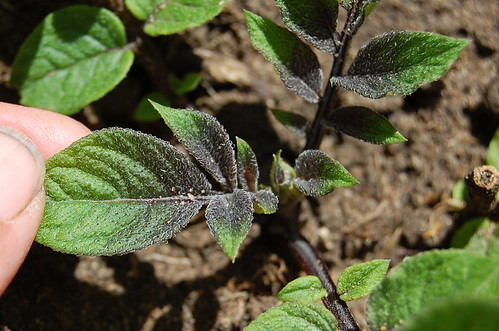
Showing posts with label Potatoes. Show all posts

Monday, 30 August 2010

Shetland tattie dreams

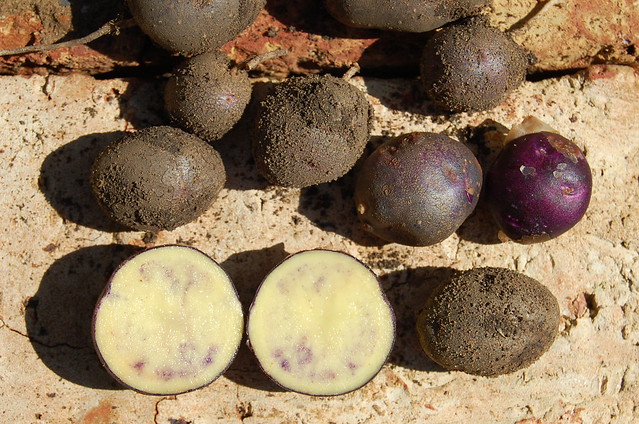
Shetland Black tatties, newly dug

Shetland Black
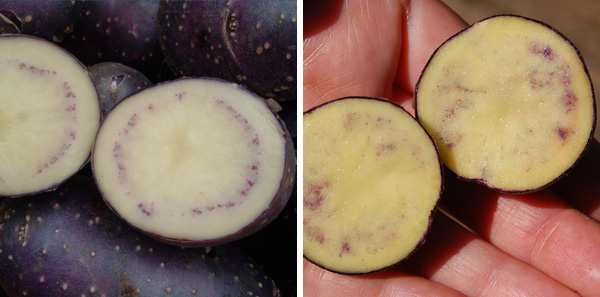
A few years ago I bought some Shetland Black potatoes from Waitrose and they were very tasty. They were intriguing looking things … small, elongated and a muted shiny black with pale corky spots on the skin and a 'netted' surface. Inside they had a distinctive purple ring set into the pale yellow flesh. I saved a few and planted them. They grew pretty well, so I wrote a review of them.

A short while after writing the review, I had a message from Jon who lives in Shetland. Did I know, he asked, that the Shetland Black sold in Waitrose is not the same as the Shetland Black grown by the crofters on the islands? Well no, I didn't. And when he kindly offered to send me a sample of the "real thing" it was not something I was going to turn down.

A box duly arrived with a generous stash of "real" Shetland Black tubers, and I saw what he meant. They are certainly similar to the commercial ones, in that they are black-skinned and yellow-fleshed with a trace of purple inside. But they are rounder in shape, with deeper eyes. The flesh is a stronger yellow, and instead of having a simple purple vascular ring, the purple is more diffuse and spreads into the flesh, although it still has about the same amount of purple overall. The skin is a softer charcoal black, with a slight coarseness and a few pale speckles but none of the distinctive 'corky spots' or netting of the commercial type. When the tubers sprout, the sprouts are purple rather than the glossy black of the commercial version. It is, as Jon put it, "subtly yet profoundly different".
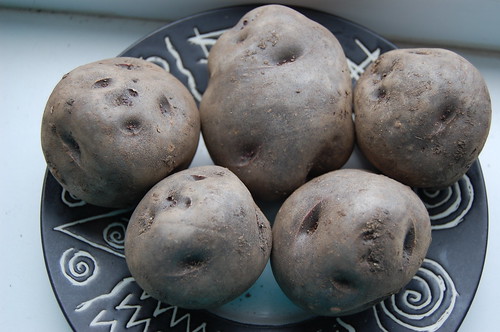
Shetland Black potato
The Shetland Black potatoes from Shetland, as grown by Jon.

And while I find the commercial Shetland Black very well flavoured, the flavour of the local version is really outstanding. It has an exceptionally rich, strong, old-fashioned flavour with no bitterness in the skin, and the flesh is dense and smooth. The flavour is excellent when boiled and the potato holds together well without breaking up … if the outer skin is undamaged it keeps its purple colour. It also makes nice roasties, albeit rather dense ones with a thick skin. But then I guess that isn't an issue if you peel them … it's just one of my personal funny little ways that I never, ever peel potatoes.

Interestingly, Alan Romans mentions in his Potato Book that the version of Shetland Black conserved in the National Collection is considered by many Shetlanders not to be "right", and the authentic local version is described as larger and rounder with deeper eyes - exactly what I have here. Jon tells me that even within Shetland there are several more variants, some with a paler skin colour.

Naturally I was intrigued to see how the plants compared to the ones I'd already reviewed.

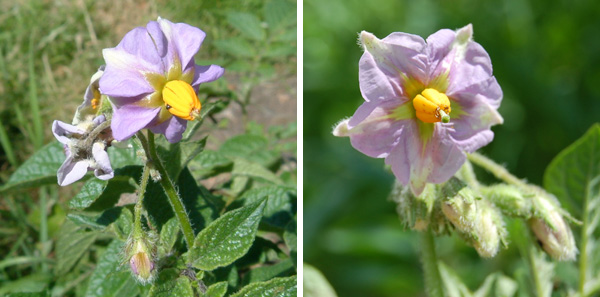
Standard Shetland Black on the left, "real" Shetland Black on the right.
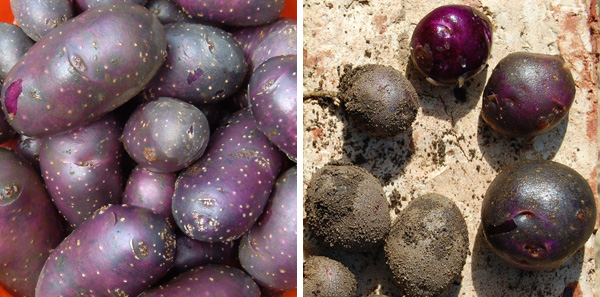
Two variants of Shetland Black

Two variants of Shetland Black

Two variants of Shetland Black
Darker skin, yellower flesh, rounder tubers. The flowers do look fairly similar, but the difference not visible in this picture is that the one on the left is a rarity! This is the only decent specimen I've ever seen on the standard Shetland Black, it's usually a saggy specimen with wonky anthers or none at all. Whereas the one on the right flowers profusely.

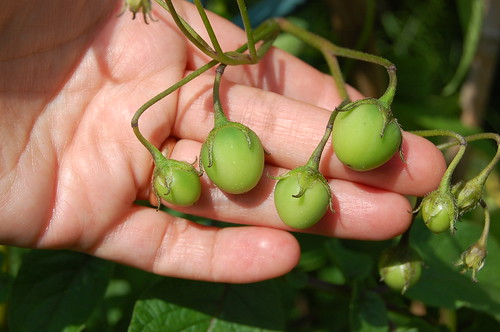
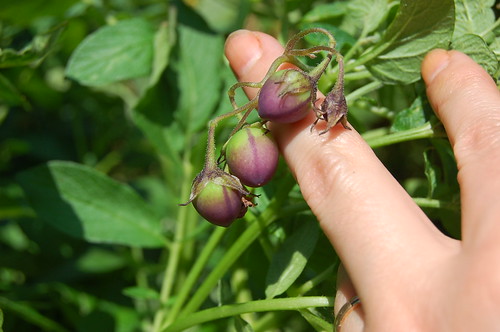
"Real" Shetland Black produced very large voluptuous plants with big, dark green leaves, again quite different from the standard Shetland Black which tends towards the straggly end of the spectrum. To my delight, its flowering habits are also very different. It produces masses of blooms, large, elegant and mauve-petalled, borne over a long season. The real delight for me though is that it is a natural berry setter, loading itself up with large purple and green mottled fruits. In fact it's a potato breeder's dream. It has fertile pollen which can be used to pollinate other varieties and make hybrids. It will also accept pollen from other potato varieties to make more hybrids. And it is self-fertile, so I can also use it to pollinate its own flowers and reshuffle the contents of its own genepool without crossing it with anything else. To put this in perspective, the number of cultivated potato varieties which are fully male/female fertile is thought to be around 4 or 5%. Among the 95% of others which have compromised fertility is the commercial Shetland Black, which rarely flowers at all, and when it does its rather half-arsed mauve and white blossoms quickly drop off without producing any berries.

So I have been using "real" Shetland Black as both a male and female parent in my breeding programme this year. This is a good thing for me, because it brings interest and diversity. But it's also a good thing for Shetland Black, because one of the surest ways to conserve heritage vegetables is to pass their genes forward into new recombinations. Next year I will be able to sample such joys as Shetland Black x Salad Blue, Shetland Black x [Mandel x John Tom Kaighin], Highland Burgundy Red x Shetland Black, Marfona x Shetland Black, Congo x Shetland Black and possibly others. Plus of course the self-pollinated Shetland Black x Shetland Black, which will be interesting in itself. Potatoes can show a trace of inbreeding depression from self-pollination because nature really made them to be an outbreeder and they're not supposed to be self-fertile (the mechanism for preventing it got screwed up when they acquired their doubled genome). But in practice, self-pollinated seeds often produce really sturdy plants, just as vigorous as a hybrid would be. There's enough genetic diversity in the potato's tetraploid makeup to allow for a healthy bit of internal reshuffling.
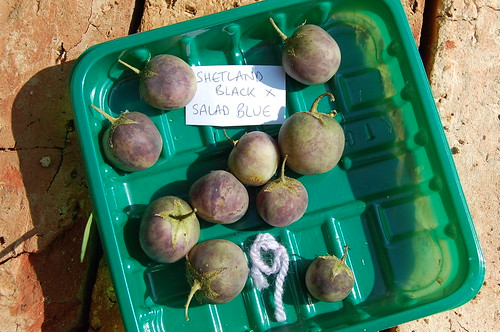
Shetland Black berries

My guess, and I must emphasise that it is only a guess, is that the commercially available Shetland Black could be derived from this local version, as the high fertility makes it very easy to save and share seed from it, either self-pollinated (in which case it's a simple reshuffling of the same genetic material) or a cross with something else. The reason I think the local one is probably the older of the two is because of its deep eyes. Shallow-eyed potatoes are a relatively modern innovation, prized for ease of peeling, and although the deep eyes of the local variety are not proof of antiquity, the shallow eyes of the commercial version certainly suggest a more modern origin. And also, the commercial Shetland Black has such low fertility it would be extremely difficult to breed anything from it.

The crop of Shetland Black I grew this year produced tubers somewhat smaller than the ones Jon originally sent me, but made up for it by producing absolutely masses of them … the yield overall was high. My guess is that they will adapt within a year or two and start producing the full size ones. On the whole, the plants seem to be very happy growing down here.

Part of what I wanted to find out was how well the Shetland tatties would adapt to being grown this far south. To any Americans and Australians reading this, the British Isles probably seem very small, and relatively speaking they are, but all the same there's a huge difference between the clement lush greenery of south-west England and the rocky windblustered Shetlands so many miles out in the Atlantic Ocean, far beyond the northernmost tip of Scotland. Shetland potatoes are adapted to thin peaty soil overlaid on solid rock, which is naturally acidic and supports a very different range of plants from the deep sandy loam of Cheltenham, which is naturally infused with limestone.

At one time Shetland had quite a range of unique local potatoes, bred for the particular needs of the soil and climate and maintained through many generations, helped no doubt by the extreme remoteness of this group of islands. Potatoes are known to have arrived in Shetland in the 18th century and formed a very major part of the islanders' diet. In the past, whaling boats from Shetland travelled as far as South America, where potatoes are native, and it's just possible that they picked up some spuds on their travels which differed from those already doing the rounds in England and mainland Scotland. Unfortunately many of these unique local varieties are now lost. Jon says that many older people on the island remember a red potato called Marrister Red which appears to have vanished, and also one called Yell Blue. He was, however, able to send me a sample of a rare and precious survivor among traditional Shetland tatties, which hails from the really tiny island of Foula.

Foula Red
Foula is a fascinating place with a beautiful landscape - the islanders have a truly lovely website devoted to its heritage. It measures only three and a half miles by two and a half miles - you could probably walk its entire length in an hour, if it wasn't for the spectacularly steep slopes - and a population of around thirty people. It has the highest sheer sea cliffs in Britain, plunging straight down more than 1000ft. It has prehistoric stone rings and scattered shipwrecks. And remarkably for such a tiny and sparsely populated island, it has its own sheep and its own potato.
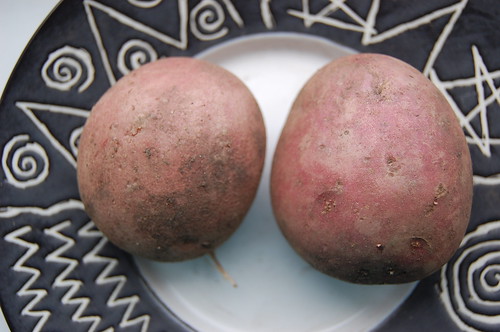
Foula Red potato

It's difficult to explain just how rugged this potato has to be in order to survive as a viable food crop in Foula. Shetland weather can be very extreme. When in 1936 the island became the setting for a film starring John Laurie (later of Dad's Army fame), the camera crew were astounded by the sight of water in a mill loch being blown 300ft into the air by the force of the wind. But when they tried to film this spectacle they found the wind so strong neither they nor the camera could stand up in it, and they ended up having to crawl back to base on their hands and knees. Magical and inspiring the landscape may be, but this is not a good environment for growing vegetables. The traditional solution to this problem is to grow them in plantie crubs - small circular enclosures made of stones and turf, where the walls are high enough to prevent the plants from being blasted away and a decent layer of soil can be maintained to supplement the thin squishy peat which constitutes the island's natural topsoil.

The Foula Red potato is rounded, sometimes slightly kidney-shaped, with very shallow eyes and a pink-red skin, having a slightly rough matt surface. The flesh inside is a pale yellow, and it doesn't have internal colouring like its Black counterpart. The sprouts are pale pink and the plants grow into fairly large sprawling specimens with unusually large and flat leaves, dark green and with a rosy blush on the leaf stems.

It does have one major drawback though. It is almost laughably low yielding. The spuds are a decent size, but four or five tubers per plant is as much as they can offer. They look so promising as you grub around the base of the plant and unearth the first voluptuous brick-red tuber, since the largest one is usually at the top. And so you eagerly scrabble through the earth to find the rest of them and … er … there aren't any.

The crofter who gave Jon the tubers said that it's traditionally a low-yielding variety and it's quite normal to get such a miniscule crop. The reason it was worth cultivating was that it showed better blight resistance than other varieties grown on the islands, and therefore ensured at least some harvest during bad blight years … an important consideration in a community traditionally dependent on its own food production.
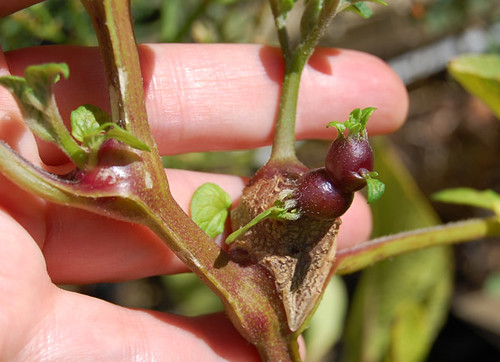
Foula Red forming stem tubers
Foula Red is a natural survivor. This plant had its stem damaged by snails, and responded by making stem-borne tubers.

Well, when I grew my Foula Reds for the first time in 2009 they came up happily enough and made fine plants, but were almost immediately struck down by blight! Really complete, devastating blight which killed them in a couple of days. What was most strange was that they were the only plants in the garden to succumb … all my other potatoes were fine. This doesn't mean, however, that Foula Red has been wrongly labelled as blight resistant. The fact is, blight is an incredibly fast-mutating fungal disease and even the most resilient potatoes become vulnerable over time. Since the arrival in Europe of two mating types of blight which quickly got loved up, the version of the disease we are currently blighted with is a new supersonic strain which raises merry hell and simply didn't exist here before the late 1970s. Foula Red may well have had good blight resistance, but the goalposts have moved.

So anyway, fearing I'd lost this precious rare potato, I searched the soil and found a few tiny baby tubers that had just started to form. They were barely bigger than peas. But I kept them safe over winter, and in spring they sprouted, and remarkably, have given me six fine healthy plants in 2010. And this time, they have survived long enough to give me their proud harvest of a couple of tubers each.

My English-grown Foula Reds made it to full size, and are as big as the ones Jon originally sent me. The one thing that is different though is the skin texture. As you can see, the big one in the photo has got the same smooth roughness of the originals but many of the others have a crazed surface where the outer skin is sloughing off, very rough to the touch. I assume this is down to soil differences, though I'm not expert enough in potato behaviour to know what causes it.
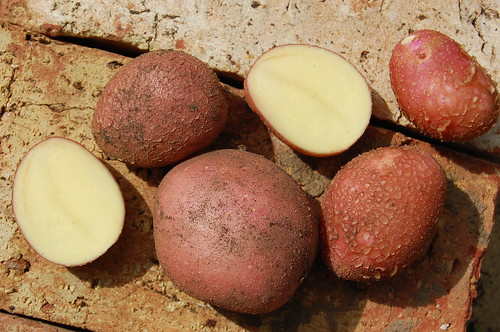
Foula Red

And having sampled the taste of them for the first time, I found the flavour really excellent. It's quite similar to Shetland Black in old-fashioned richness, but it's milder and sweeter. The texture is lovely, dense but refined. Worth growing as a delicacy.

It might seem a bit odd to want to keep growing a variety which is both low-yielding and blight susceptible, especially as it's also quite slow maturing which makes the blight more of an issue. But I think something has been lost in the modern culture of wanting to maximise everything. Potato breeding focuses primarily towards larger yields, which is great, but there is still a kind of magic in only having enough to make an occasional treat. If the Foula Reds only produce enough potatoes for a couple of meals, fine - those meals are a special event. And there's also the fact that it's a rare type with no commercial potential and very limited distribution, which creates more of an imperative to take care of it. Local, heritage and landrace varieties shouldn't be judged by the same criteria as modern commercial ones. Foula Red may not win any accolades for its bounty or disease resistance, but it survives on an island with boggy soil and 100mph gales. Who knows when those genes for climate resilience might come in useful, or how important they might one day be for our future food security?

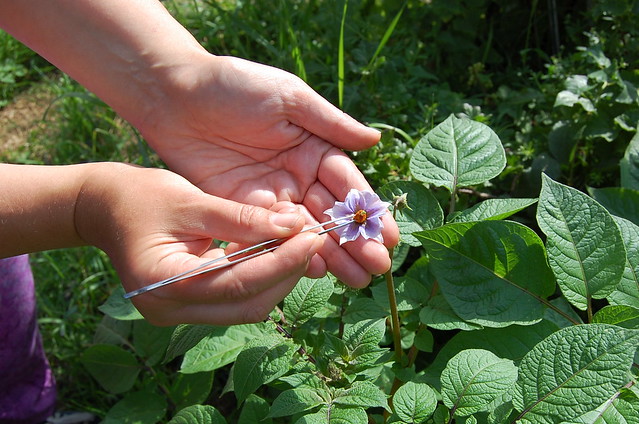
Something else I noticed, unless it's just the shock of adapting to a new climate: Foula Red is a late bloomer. Most potatoes start to flower around the time they set tubers, and Foula Red duly produced a couple of apologetic looking bud clusters which promptly aborted before they even thought about opening. Then it made its tubers, and then … when the tubers were already full size and the season was nearly over, it began to flower properly. Not all the plants produced flowers, only the two biggest ones, but they were a lovely surprise. Very pretty, elegant flowers in a light mauve with bright yellow anthers. They were a joy to behold. More for the sake of scientific study than any serious hope of finding anything, I plucked an anther and prodded it to see if there was any pollen in it. There were veritable plumes of it! Masses and masses of pollen. In fact, left to dehisce naturally it was dumping big white splodges of powder on the leaves underneath. It's pretty rare for potatoes to produce pollen in that kind of abundance. Excitedly, I dabbed some of it on the pistils of its own flowers, and on one or two other potatoes which were still flowering, which wasn't many at that late stage in the season. To my delight, every dabbing resulted in a plump healthy berry. So Foula Red, as well as Shetland Black, belongs with the 4% or so of cultivated potatoes which have complete male/female fertility.
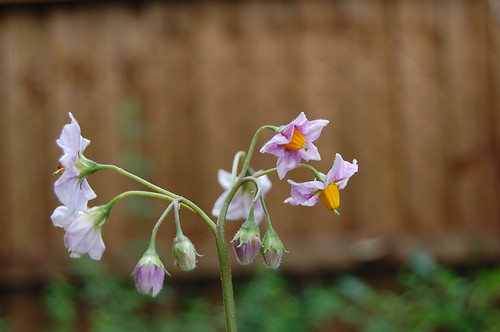
Foula Red blossoms
Foula Red flowers

This is really good news. As with Shetland Black, it will allow me to make new varieties from it (if I can find a partner for it which flowers at the same time). But more importantly, it is a huge help in ensuring the variety's future survival. Tubers have a finite lifespan, and any variety which can't produce its own seed (i.e. most of them) is difficult to maintain long term. Foula Red's ability to produce TPS, either by itself or by contributing its genes elsewhere, will enable it to regenerate. Of course being tetraploid (I assume Foula Red is tetraploid) the seeds from self-pollinations will not come "true" to the variety in every detail but they are nevertheless a recombination of the same genes. And who knows, they might even throw up a variant with decent yields. Ha.

So thank you very much Jon. And all credit to the crofters of the Shetland Isles who know a good tattie when they see one.

Sunday, 27 June 2010

How to breed your own potatoes

Hybridising potatoes

Breeding new potato varieties is easy. You can hand-pollinate potato flowers in far less time than it'll take you to read this article, but I'm going to attempt a reasonably thorough explanation, so I hope you find it helpful.

Potato breeding is done through sexual reproduction, i.e. pollinating flowers to produce berries which contain true seeds (TPS).  Normally when you plant potatoes you propagate them from tubers, confusingly called seed potatoes but which are not actually seeds, but root cuttings. You can't cross tubers. They can only reproduce themselves as they are. Occasionally a plant may produce a spontaneous mutation but it doesn't happen often enough to be useful as a breeding method. Flowers are the way to go, because they give you the option to combine and reshuffle genes from the parent varieties of your choice.

There's a lot to be grateful for in the anatomy of a potato flower. Hand-pollinating them is very easy. The flowers are large and easy to work with, and the individual parts are easy to manipulate.

What's not so easy is making careful plans and predictions for what you might get out of it, and that's because potatoes are tetraploid. If you've no idea what I'm talking about then have a look at my previous post about TPS for a simplified explanation. To give a one-sentence summary: a tetraploid has double the amount of genetic material that a normal (diploid) organism has, which is a bit like inheriting traits from four parents rather than two. Tetraploids are a quirk of nature but in potatoes they are a very successful one, and the vast majority of cultivated potatoes in Europe and North America are tetraploid.

You may still come across the occasional diploid. Mayan Gold and its associated varieties are diploid, and those who are growing TPS from Tom Wagner may have a few diploid lines from him. Diploid potatoes can be recognised by a tendency to have smaller and less fleshy leaves, but the most distinctive feature is the berry. A diploid potato berry has a distinctively pointed end, kind of strawberry shaped, while tetraploid berries are more rounded and tomato-like. If you're feeling experimental you can try crossing a diploid with a tetraploid. At best you will only get a few viable seeds out of it, but it's a brilliant way of introducing new diversity into potatoes. At some point soon I will give it a whole article of its own, as it's too elaborate a subject to go into here.

Potato berries
Potato berries (these are tetraploid ones) in development.

However, assuming the potatoes you want to cross are tetraploid, since most of them are, it's very difficult to predict what the resulting offspring will be like because of the genetic variability involved. With tetraploids, the convenient order of the Mendelian ratio is thrown out the window and replaced by something more akin to a gene tombola. F1 hybrids are not uniform as they are in most other types of breeding project. If you grew a lot of offspring from your cross you'd find that many traits show continuous degrees of variation through the population, rather than segregating into Mendel's either/or groups … which happens because there are so many different ways the alleles can arrange themselves. To quote a research paper by Scotland's premier spudmeisters, Meyer et al (1998) "[Tetraploid] inheritance implies the random pairing of four homologous chromosomes at meiosis, and in a highly heterozygous outbreeding species results in a large number of possible allelic combinations at a single locus. In the most extreme case, eight different alleles could segregate independently in a population, resulting in 36 possible genotypic classes in the progeny." In other words, potatoes naturally have a mixed up genepool (from outbreeding) and when they pollinate and set seed those alleles can arrange themselves in any order - with each different combination having a unique effect on how that trait is expressed. And we're just talking about an individual locus here … the same is happening at every other locus throughout the whole genome. Yowza!

In short, tetraploids are complex and contain a lot of genetic material which can be immensely variable. Scientists doing genetic research on potatoes often choose to work with diploid lines instead, because tetraploids make such a muddle of their data it's hard to interpret anything.

So where does that leave you as a home gardener or small-scale farmer wanting to develop your own potato varieties? It leaves you in a position where you may as well have fun, experiment, use your imagination, be creative. As the results can't easily be predicted, you don't actually need to know anything about genetics. Think more along the lines of what you might get if you cross this colour with that colour, or this flavour with that shape - and then be prepared to be surprised!

One piece of misinformation I see spread all over the internet is a belief that you won't get anything worthwhile out of a home-made potato hybrid because producing just one good variety takes thousands of plants and many many years. This myth has arisen from under the slow-grinding wheels of the potato industry, which does work like that. Sure, if you want to breed a variety which will be listed in all the catalogues and sold in Tesco's and will make you rich from the royalties, your chances are very slim. The selection criteria for commercial potato varieties are immensely restrictive - and largely at odds with what most gardeners would want. Commercial breeders may well churn through (and reject) 200,000 seedlings to find one with commercial potential, then spend the next eight years doing field trials with it before it's ready for release. But don't let that put you off. You can breed a good variety within two years - easily. The majority of your home-made potatoes will be worthwhile, at least decent enough to eat and enjoy and feel proud of. A few will be exciting and wonderful. Even if you're only working with a very small patch of garden, you will almost certainly get some tubers that are worth saving and growing on next year.

The beautiful thing about potatoes is that it only takes two seasons to get a completely stable new variety. So it's actually quicker than most other vegetables. You make a pollination the first year and produce the F1 seeds, which are all unique individuals because of the genetic diversity. The second year you grow plants from those seeds and they make tubers. If you like the tubers, you simply propagate them by saving and replanting them. As the tubers are basically root cuttings of the parent plant (clones) they are genetically identical. There's no arsing about trying to make F2 and F3 hybrids (unless you want to) or years spent roguing out unwanted recessives. Once you've got something interesting, it's instantly a new variety.

Pirampo x Khuchi Akita F3
Hybrid potato grown from TPS. This is one of Tom Wagner's hybrids, an F3 of Pirampo x Khuchi Akita. The parent varieties are Bolivian landraces, and are diploid.

If you've dipped a toe into plant breeding before, you'll know that plants tend to be either inbreeders or outbreeders - though that's more of a sliding scale than a polar absolute. Potatoes are really a bit of both. The natural status of potato is outbreeder. The various (diploid) landrace species from which cultivated potatoes are derived have a self-incompatibility mechanism which prevents them from pollinating themselves. The majority of diploid varieties are self-incompatible, although there are exceptions. This forces them to hybridise and mix their genes up in every generation, hence the wondrous diversity found among diploid landraces. However, when potatoes went tetraploid the compatibility barrier got screwed up somewhat. Many tetraploid potatoes have sterile pollen which can't fertilise anything at all, but others can fertilise themselves as well as each other. So they're designed to be outbreeders, but in practice a lot of flowers simply get knocked up by their own pollen.

Which gives you a choice: you can make hybrid seeds by crossing two different varieties, or you can make self-pollinated seeds which are the product of just that one variety.


Choosing parents: hybrid or OP?
Both are worth experimenting with, but for different reasons.

When a potato plant sets berries naturally without your intervention, it's most likely that it self-pollinated, but it may also have made hybrids with other potatoes flowering nearby, and you may have a mixture of selfed and hybrid seeds in the same berry. This is called open pollination (OP) … and the results are basically pot luck.

Making a deliberate hybrid is the most usual way to breed a new variety, as it introduces a lot more diversity. The basic method is to emasculate the flower to stop it from pollinating itself (which you don't even need to do if it's one of the many varieties with sterile pollen) and fertilise the female part of the flower with some pollen from a different variety. The offspring will be very varied, but that's the fun part and you should also get some hybrid vigour which makes for healthy and abundant plants. The only problem with this is that so many varieties of potato are poor berry setters, so not all varieties can be hybridised.

If you want to grow seeds from one specific variety it can be as simple as saving naturally pollinated berries from it, but if you want to be sure of getting self-pollinated seeds, it's easy enough to do (as long as it's one of the fertile varieties). Just dab a flower with pollen scraped from its own anthers, or other flowers on the same plant, or from other plants of the same variety. Bear in mind though that you will not get a true-breeding offspring of the parent variety by doing so. As potatoes are very heterozygous and have four lots of genetic material to throw around with cheerful abandon, even when they're self-pollinated they segregate into many different phenotypes. If you grow self-pollinated seed from Salad Blue, for example, you will not end up with a lot of spuds which look like Salad Blue. You will get varying shades of blue flesh, some much lighter than the original, some darker, and a few with pinky skin. If you grow selfed seeds from Congo, another blue variety, you may end up with a baffling range of purples, pinks and pure snowy whites, with considerable variation in tuber shape. What's happening is that all the genetic material which has been funnelled into the variety from various ancestors is segregating. Recessive traits emerge which weren't apparent in the variety you started with. If you grow enough self-pollinated offspring, you can start to build up a picture of the variety's pedigree, as many of the ancestral characteristics magically come back to life. So it can be a really fascinating thing to do.

Seedling from Salad Blue OP
A seedling grown from self-pollinated seed of Salad Blue. It's the only plant in the batch which has this striking black tinged foliage and black stems. I'm hoping it'll produce some dark tubers to go with it.

It's important to remember though that nature designed potatoes to be outbreeders, and if they self-pollinate they may show some degree of inbreeding depression. Only a bit though. As most spuds have such a rich and diverse genepool they can get away with a certain amount of inbreeding, but you may find self-pollinated seeds grow less vigorously than hybrids. That's not a problem and shouldn't put you off trying self-pollinated seed … but it's better to sow a few more than you need and then select the seedlings which show the most vigour and whoomph.


Variety differences
Differences in the fertility of individual varieties will most likely dictate what crosses you make, and how you do them. Over many years of being propagated by tubers, cultivated potatoes have moved away from the idea of flowering and producing seeds, and many of them can't be bothered to do it any more. Ironically for such a naturally variable and heterozygous plant, a historic lack of genetic diversity is thought to be the cause of the potato's fertility issues. The vast majority of modern cultivated potatoes are descended from one single Chilean spud, which had what is known as T-type cytoplasm, a genetic predisposition to making offspring with infertile pollen. Over the years many of these semi-infertile lines have been selected deliberately, as the male-sterility makes the process of hybridising them much easier. Consequently an awful lot of modern spuds have infertile pollen, and some are female-sterile too. Some can't be arsed to flower at all, and just dump their buds as soon as they appear. There are things you can do to force a reluctant variety to produce flowers, but it's a lot of hassle which I won't go into here, and from the point of view of future breeding work it makes more sense to choose varieties that at least show some willingness to come up with the goods.

I wish I could give a simple list of which variety does what, but I only know about the ones I've grown and observed myself, and it can vary from garden to garden anyway. Different countries have different varieties - import restrictions have affected exchange of material - so the ones I work with in the UK may not be available to people in the USA (just as most popular US varieties are strangers to me). So you will have to experiment with whatever you have available. As far as I can see, varieties fall roughly into four categories.

Some potatoes are very fertile and make excellent male or female parent varieties. Salad Blue is the Cassanova of the potato world - it only has to look at another potato and a berry starts swelling. You can usually tell a fertile variety because it naturally sets its own berries in profusion. Desirée is another very fertile one, and so is Mayan Gold, although the latter is a diploid so it needs to find the right kind of partner, or get lucky mating with a tetraploid.

Most cultivars fall into the male-sterile or almost-male-sterile category - these are the ones which flower happily enough but don't tend to set berries. Highland Burgundy Red is a good example of this, as is British Queen. It gamely produces a mass of dainty little flowers but in years of growing it I've never had a single berry. Give it a dab of pollen from a fertile variety though, and it sets berries very readily. So it makes an extremely good female parent. The advantage of male-sterile varieties is that you don't have to emasculate them, which makes it much quicker and easier to hand-pollinate them. Some varieties which appear to be male-sterile may actually be female-sterile. So it's worth trying the pollen on another variety to see if it will take. The disadvantage of using these partially sterile varieties is that it perpetuates the poor fertility of potatoes. If you want to do Solanum tuberosum a real favour in your breeding projects, select the progeny for good berry production. Because good berry production is what will keep its genetic heritage alive, as well as enabling some much needed new diversity to come in.

Then you have what you might call the awkward buggers category. These include Pink Fir Apple (syn. Rose Finn Apple) which not only has male sterility issues, it often can't be bothered to set a berry even when it's given fertile pollen. What usually happens is that the flower opens happily enough and you carefully pollinate it two or three times and on the third day the whole bloody thing drops off. Or worse, it starts to set a berry and then it falls off before it's mature. It pays to try again though, because there's a good chance that one of the pollinations will take eventually, when the plant is in the right mood and the planets are in the right alignment or there's an 'r' in the month. It's a pain in the backside to have to keep pollinating more flowers, but bearing in mind that each berry can easily produce 100 seeds or more, it only takes one successful pollination to give you loads of future breeding material - so it's worth persevering. Again, with a variety like this you don't need to waste time emasculating. I just go through the whole crop each day dabbing fertile pollen on every stigma I can find and saying "come on, set a bloody berry you sod!"

And finally you have the total refuseniks. There is a wonderful Victorian potato called Witch Hill which is reputed to be one of the best flavoured potatoes around - it is truly delicious. I would love to use it in breeding work. But every year the flower buds appear, and just as they're starting to look promising they drop off. All of them. Little dessicated posies cast to the ground. Now, unless it changes its mind, I cannot breed from it. If a variety won't flower, there is no breeding possibility, it's as simple as that. I could grow fields of the stuff and hope for a spontaneous somatic mutation, but that may never happen. Witch Hill is a genetic dead end. This is why breeders like Tom Wagner select breeding lines from varieties which are good berry setters. If a variety won't flower or won't set berries, it has no future.

The annoying thing is, Witch Hill did flower for me a couple of times when I first got it (it came to me as a laboratory-grown microplant) but I hadn't got into potato breeding at that time so I didn't think to make any crosses with it. D'oh!


Hybridising potatoes: the practical bit
Let's be grateful for small mercies: potato flowers are nice and simple and easy to work with. They are 'perfect' flowers which contain both male and female parts.

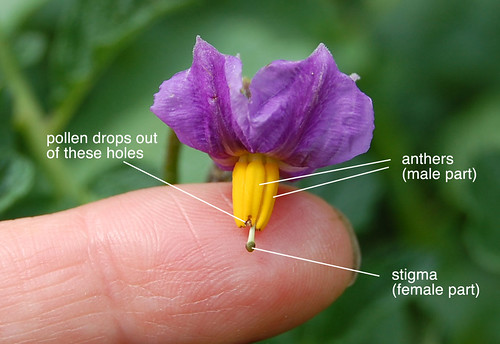
Anatomy of a potato flower
Anatomy of a potato flower. Each of the anthers is a double sac, both halves containing pollen. When the anthers mature they develop little holes in the ends (like a salt cellar) and the pollen falls out onto the stigma.

The Mayan Gold blossom shown above is fairly typical, but there are variety differences in the exact shape of the flower. Some have a long style where the stigma protrudes some way out of the flower (be aware that a sticky-outy stigma has more chance of being cross-pollinated by passing insects than one where the stigma is hidden away). Some produce a neat little fused anther cone, others produce a rather grotty collection of misshapen anthers which don't hold together properly. Some (like Pink Fir Apple) do weird things where anthers and petals morph into one another. None of this matters - the principle is the same. You'll get to know the individual character of the flowers in your own garden as you work with them.

In order to control what pollen fertilises the flower, you have to stop the flower from fertilising itself, so that means removing the male parts of the flower before they mature. As I explained above, with some varieties you don't need to do this - if the variety produces sterile pollen or none at all, you can save yourself the trouble. The instructions shown here are for if you have a fertile variety or want to be sure of getting hybrid rather than selfed seed.

Potato flowers are produced in cymes - bunches of flowers which open consecutively, 2 or 3 at a time. The flowers last two to four days but tend to close up in late afternoon. The anthers develop holes in their tips when they're ready to dehisce, though they're not very glamorous - in fact they look more like some insect has had a go at them. Potato pollen is white, powdery and very fine. The stigma is receptive for about 2 days and the period of pollen shedding also lasts about 2 days. Fortunately for the garden dabbler, the female part tends to become receptive just before the pollen starts to shed, so you have a window of opportunity to intervene.

The best time for hand-pollination is in the morning when pollen is most abundant, and when the temperature is fairly cool. But I wouldn't worry too much about this, it works at other times too.

If you're using a variety with infertile pollen, or you aren't bothered about the chance of a few self-pollinated seeds, you can skip steps 2 to 4.

Potato hand-pollination 1
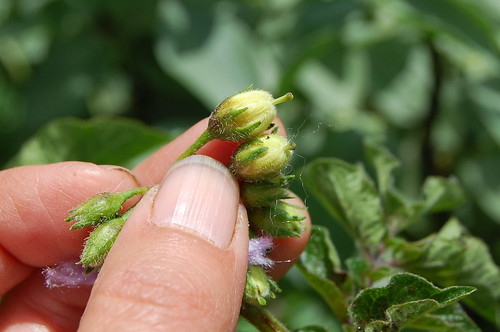
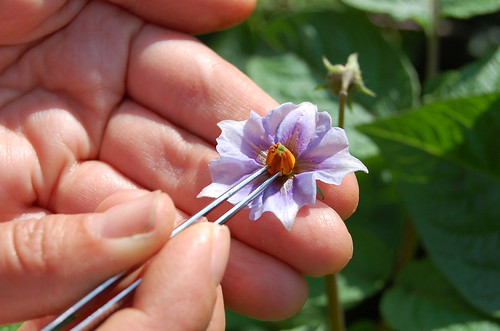
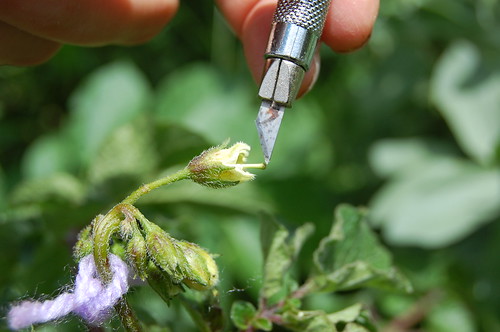
Step 1: Having chosen the variety you want to use as the female parent, find a blossom at the right stage. Potato pollen can be shed quite early, before the flower opens, so emasculation has to be done while it's still at the bud stage. What you're looking for is a nearly-ready bud where the calyx (outer green bit) has started to open but the petals are still shut. This is a variety with a sticky-outy stigma, but with many varieties it will still be hidden inside the petals. Doesn't matter either way, although a sticky-outy like this inevitably carries a small risk of picking up stray pollen from elsewhere.

You may notice a strand of mauve wool poking out underneath. I tied this around the stem of the flower (or in this instance the whole cyme, as I'm going to hand-pollinate all of them) as a marker, so I can be sure I know which ones I've hand-pollinated. I use a different colour of wool to indicate different pollen fathers.


Potato hand-pollination 2
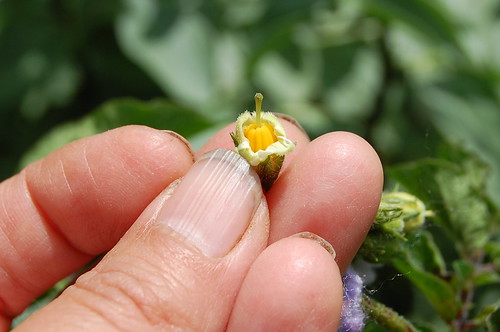
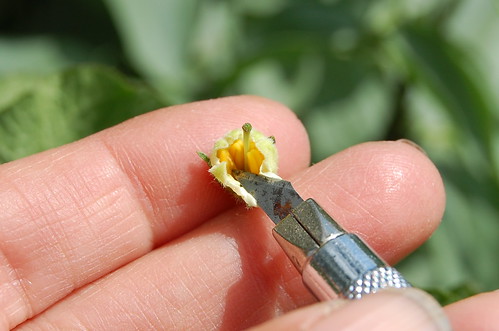
Step 2: Peel back the petals and you'll find the anthers inside. They are still immature at this stage - with no holes in the ends. If they do have holes and are shedding pollen, try a slightly younger bud instead!


Potato hand-pollination 3
Step 3: Using a blunt scalpel blade, tweezers or similar, pull/scrape the anthers off, being very careful not to damage the style - the central stalk with the stigma at the end.


Potato hand-pollination 4
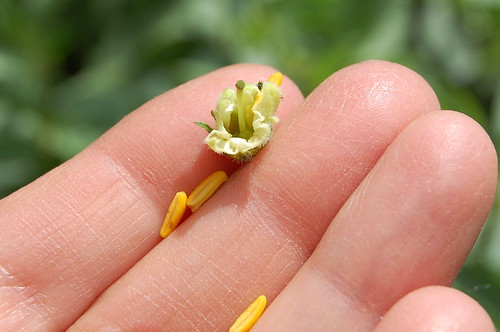
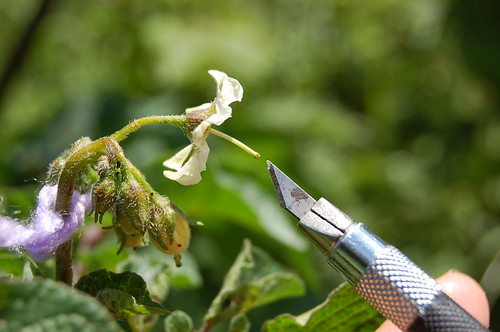
Step 4: After removing all the anthers you're left with a denuded female part, ready to be pollinated with the pollen of your choice.


Potato hand-pollination 5
Step 5: Next find the flower you want to use as the male parent. Choose a blossom which is newly opened, as those are the ones most likely to have a good pollen stash (the ends of the anthers should be open at this stage). Pull off a single anther using tweezers/scalpel/fingers.


Potato hand-pollination 6
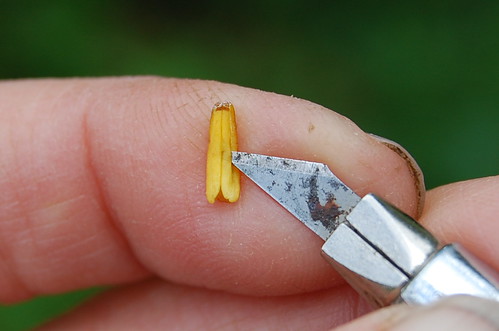
Step 6: When you turn the anther over you'll see it has a seam down the back, separating the two pollen sacs. Additionally, each individual sac has a little slit down its centre. Carefully slip the tip of a blunt scalpel blade through the slit and slide it along. Note that the slit should be open so you can insert the blade freely ... you want to avoid cutting into the anther if you can. 

If there is pollen inside, you will see it on the tip of the blade. It's a very fine white powder. If you don't see any white powder, try another anther from a different flower. You don't have to collect all the pollen at once ... just scrape out enough to dab on the female flower, and use the rest for more pollinations. (When the first sac is empty you can do the same with the other side. You can often pollinate ten or a dozen flowers from the pollen in a ripe anther like this.)


Potato hand-pollination 7
Step 7: Armed with your pollen-tipped scalpel, go back to the bud you just emasculated and dab the pollen powder onto the stigma - which is the knobbly-bobbly thing at the end. The stigma is mildly sticky when it's receptive, so you should find the pollen grains sticking to it quite readily. No need to make a song and dance with it - just a gentle dabbing so as not to risk damaging the stigma.


Potato hand-pollination 8
Step 8: The next day, go back to the same flower and pollinate it again with pollen from another fresh anther. The stigma remains receptive for around two days in total but you don't know exactly when that is, so for best results give it a pollen dab on three consecutive days. You'll notice that the petals have opened on this flower now, although it looks a bit weird as it has no anthers. Once the petals have closed and wilted a bit, you can assume it's no longer receptive.


Potato hand-pollination 9
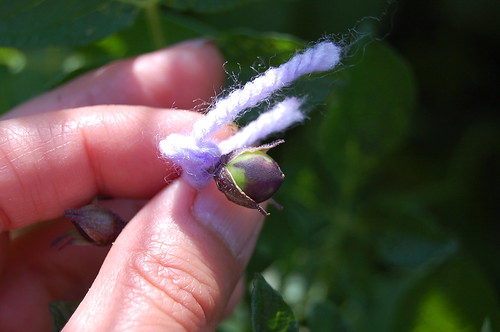
Step 9: The berry starts to form. Yay!


From this point on, patience is the order of the day. Potato berries seem to mature painfully slowly. Try to resist the temptation to prod and poke them, you don't want them to fall off as they dangle clumsily on their alarmingly scrawny stalks. After about four weeks you need to watch for them dropping off naturally. Ideally, tie a little cloth or paper bag over them at this stage so that they are caught safely if they drop. Alternatively, be very vigilant, and ready to rummage about on the ground if you notice them suddenly go AWOL. Fortunately they don't taste nice enough for animals to be interested in them, at least not in the way of UK garden wildlife, so they're unlikely to be carried off, but you don't want to chance it.

One key factor about potato berries, significantly unlike tomatoes (to which they're closely related), is that the seeds carry on developing even after they've detached from the plant, and the berries will stay firm for months. This has several advantages. For one thing it takes the pressure off you to extract the seed from them ... you can leave them until you've got the time and inclination, even weeks or months down the line. Secondly it means that all is not lost if the berry is dropped too early or the plant dies prematurely. This is very significant in the light of the blight problems we are all besieged with. The plants can be struck down by blight, wither and rot - and the berries will still survive. Save the berries and let them mature, and as long as you clean them thoroughly they will yield perfectly healthy seed.

The topic of cleaning and processing TPS from the berries is to be the subject of a separate post. In the mean time, go out and make some berries!

With thanks to Tom Wagner and friends at the TaterMater forum for advice and suggestions (any errors are entirely my own responsibility).

Friday, 7 May 2010

Now this is good customer service ...

Potato minitubers

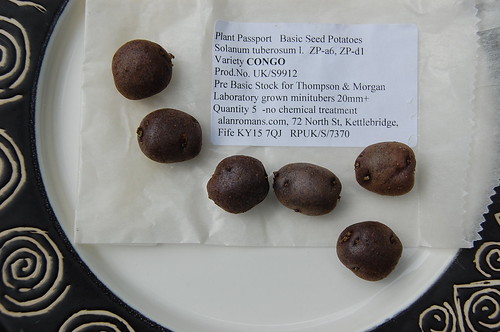
Always looking to explore unusual heritage varieties and seek out material for breeding experiments, I was pleased to see that AlanRomans.com were stocking minitubers (that is, small laboratory-grown seed potatoes) of an old and hard to find blue potato called Congo. I'm interested in Congo because it's blue-fleshed - blue all the way through - and I have a strong interest in vegetables that bear this colour pigment because of its nutritional benefits as well as its glorious beauty. As well as being historically interesting and quirky, Congo has a reputation for being a good berry setter. That would make it an excellent variety to experiment with in breeding work, because it would ensure a good supply of TPS. I could have some real fun crossing it with other varieties, but also growing out its own self-pollinated TPS, which would in itself yield some interesting segregation for different traits (if you've read my article about TPS below, you'll know that the tetraploid arrangement of the potato genome gives it something of the nature of a genetic fruit machine).

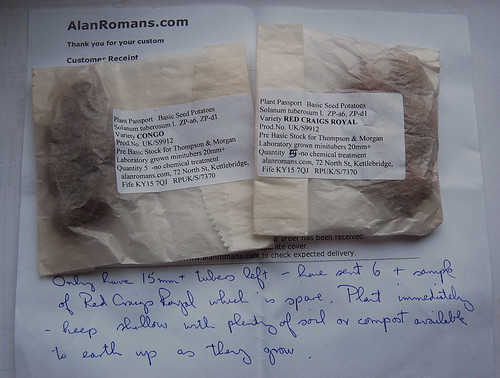
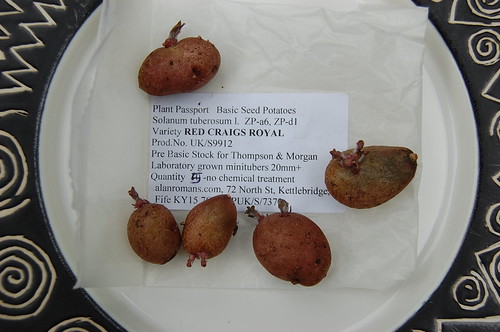
So I ordered a pack of five Congo minitubers - not the kind of quantity that would give a good yield for the dinner table, but plenty enough to get the variety established in my garden and see what it has to offer. When my order arrived a couple of days later it contained not one minituber pack but two. The handwritten note explained that they only had 15mm-ish tubers left in stock rather than the 20mm-ish ones they preferred to supply, and so they sent me 6 rather than the 5 I ordered. Additionally, they sent me a pack of 5 minitubers of another rare and special variety, Red Craigs Royal, as a freebie. The Red Craigs Royal tubers had already started to chit and were at a stage where they really needed to be planted. This is really good customer service - it's a great way to keep people like me happy, because I get to add another precious heritage spud to my inventory and ensures that I will want to order from them again next time, and it shows that their attitude to heritage varieties is well motivated, in that they would rather give unsold stock to a good home.

As far as I'm aware, nobody in the UK is doing more than Alan Romans in conserving and promoting heritage potatoes. You may have seen these varieties making an appearance in Thompson & Morgan's catalogue, and in Waitrose - but all that is down to him. And it's not a simple case of reintroducing them on a whim either ... the laws and regulations relating to the sale of seed potatoes (and culinary ones) are complex and restrictive, and he's had a heck of a lot of bureaucracy to struggle against. It wouldn't be legal to sell field-grown potatoes to gardeners without an expensive process of certification, and minitubers are his latest solution to this obstacle. They are produced in a laboratory environment from disease-free plants held in vitro. Although they are small, they can be grown on and will soon build up a decent yield. The sterile environment in which they're produced may make them a little vulnerable when you plant them in the unfettered ravages of the soil, but they seem to cope and I've managed to grow laboratory-raised plants under organic conditions without too many problems. The bottom line is, if it wasn't for the laboratory process these rare and interesting varieties simply wouldn't be available at all.


Red Craigs Royal minitubers
Red Craigs Royal minitubers. The original Craigs Royal was introduced in 1947, bred in Scotland from a cross of Craigs Defiance x Gladstone. This red-skinned sport appeared in Perthshire in 1957 and quickly became extremely popular for its good yields and excellent flavour - only to be plunged into obscurity a few years later as the market moved on to other things. It's a second early type with a floury texture. As for its usefulness in my breeding projects, well, I'm not sure what to expect because the European Cultivated Potato Database lists it as a poor producer of berries but also as having high fertility pollen.


Congo minitubers
Congo minitubers. They don't look very exciting at the moment, but they are full of potential. There is a degree of confusion over this variety because there are two Congos. This blue-fleshed one is of British origin, thought possibly to have been created by a shepherd in the Scottish borders in the late 19th century. The other Congo is from Sweden and has white flesh (edit - or maybe not!). As if that wasn't confusing enough, there are suggestions that the blue version has many synonyms and may be known around the world as All Blue, British Columbia Blue, Russian Blue, Himalayan Black and McIntosh Black, amongst others - though they may be variants rather than identical clones. Congo is a very late maturing variety - so here's hoping the blight pestilence will be merciful.

Thursday, 29 April 2010

Sowing potatoes from TPS

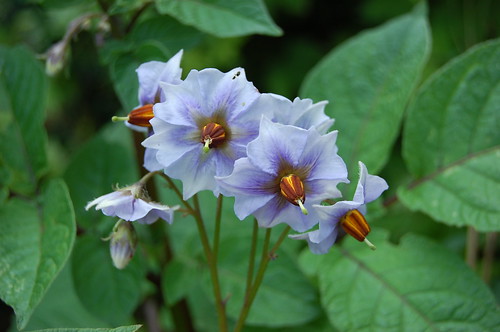
Salad Blue potato flowers
Flowers of Salad Blue, one of the few potato varieties which produces copious quantities of true seed.

I have a very exciting new project underway. My good friend Patrick sent me some true potato seed - generally called TPS - from legendary potato-tomato breeder Tom Wagner. Tom was the founder of TaterMater Seeds in the 1980s, is the creator of the Green Zebra tomato and various others which are now ubiquitous in seed catalogues, and now dispenses his wisdom on the TaterMater messageboard. These potato seeds are from various hybrid and open-pollinated lines in Tom's ongoing breeding work and it's a real privilege to have them.

Not many people grow potatoes from TPS, and there's a few reasons for that. It's not as quick and easy as chucking a few shop-bought tubers in the ground … although the long term rewards are greater. The seeds are not readily available either. I've never seen them for sale anywhere, and you generally have to save your own.

First I should explain what I mean by true seed. When you buy a bag of spuds for planting, they are normally sold as seed potatoes. But it's a bit of a misnomer really. A seed potato (i.e. a tuber) is a root cutting - or clone to use the US term - of the original plant. Tubers are genetically identical to each other, as they only reproduce by mitosis - that is, they are a vegetative extension of the parent plant. Although spontaneous mutations can and do happen, they're uncommon enough that you are pretty much assured of getting a harvest that exactly matches the tuber you planted.

TPS is not the tuber, but the actual seeds - which come from the plant's flowers and fruits. As seeds are produced by sexual means, a coming together of egg and pollen from different flowers or different plants, they represent a genetic recombination. In other words, they are not genetically identical to the parent plant. They are newly created individuals.

If you sow these seeds they will grow into unique new potato plants, and produce their own tubers. The tubers will be small the first year, and will need to be replanted the following season to produce decent sized yields. So it takes two years, but then you go on growing it from tubers as you would any normal potato, and you effectively have a new variety. Potatoes raised from true seed are generally free of virus and disease (at least for the first couple of years).

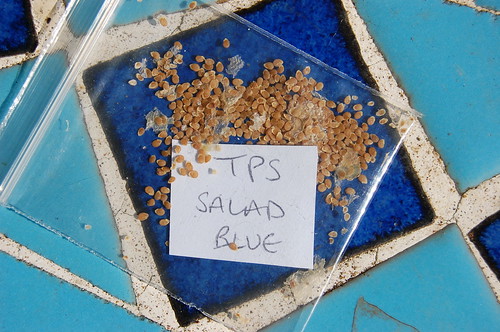
True potato seed, Salad Blue
True potato seed, extracted from the berries of Salad Blue. The seeds look rather like tomato seeds, but smaller and smoother.

Potato varieties don't come true from seed, so you never know exactly what you're going to get. Conventional wisdom has it that any plant that doesn't come true from seed is not worth sowing. But to me, and probably most people reading this blog, the unpredictability is exactly what makes it interesting! Even if you sow seeds which were self-pollinated, you can end up with a lot of variation.

A lot of people don't realise that potatoes produce fruits, for the very good reason that most of them don't. Domesticated potatoes have got so used to reproducing through root cuttings - tubers - that they can't be arsed to make viable flowers any more. Some don't flower at all, while some make flowers with sterile pollen, and the flowers just drop off. But every now and then you will find plants which set berries. It's mostly a variety thing, although environmental factors also play a big part. The berries look like small green tomatoes, sometimes with a blush of blue or purple. Some potato varieties produce berries very freely. Salad Blue (pictured above) is a prolific and reliable berry bearer. As is Mayan Gold below.

Mayan Gold potato seedballs
Potato berries on Mayan Gold. This variety is a hybrid of Solanum phureja, a little different from yer common or garden spud, which is Solanum tuberosum. The berries are slightly strawberry shaped - indicating that this species is diploid - whereas most potato berries are more rounded, but the same principles apply.

I'll leave the explanation of extracting and saving TPS for another post, as there are no berries around at this time of year. I will also hold off giving a more detailed genetic explanation, as I'm still on a learning curve with that myself. But what I should explain, briefly, is the reason potatoes grown from TPS are potentially so variable.

The cells of most plants (and humans for that matter) have pairs of chromosomes, in which each gene is inherited in a simple either/or relationship. This arrangement is known as diploid. When a diploid organism reproduces, each parent contributes a single chromosome, and the two join together to make a new chromosome pair. Somewhere along the line, nature had a bit of a freakout with potatoes. Instead of reducing down to one chromosome per parent, an unreduced pair of chromosomes managed to get it together with another unreduced pair. The result is a tetraploid - an organism with four chromosomes instead of the usual two. This basically means it contains two complete genomes - and twice as much genetic material.

Most of the potatoes we know and love today are tetraploid. Although it's a freak of nature, it's quite a beneficial one as tetraploids tend to be bigger and more perfectly formed than their diploid equivalents. If you're interested in how it works and why it's useful, I recommend the Polyploidy Portal for a readable explanation. For the benefit of this post however, I'm going to simplify it to its most basic level. When you make crosses with a 'normal' diploid species, the potential genetic recombination at each allele is very like what you would get if you toss two coins. Plenty good enough for some interesting combinations. With potatoes, however, it's more like the effect of tossing four coins. An exponential increase in the number of possible outcomes. This is why potatoes are so variable when grown from true seed! It's a genetic pile-up bursting with magical possibility.

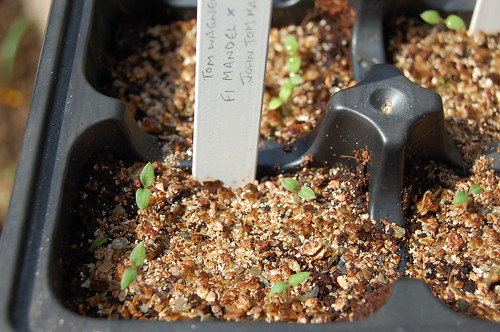
Mandel x John Tom Kaighin F1
TPS seedlings from Tom's seeds. These are an F1 hybrid between Mandel, a Swedish potato renowned for its flavour, and Tom's own variety John Tom Kaighin, which has been bred for flavour and blight resistance. Neither of these varieties is readily available in the UK. There is a good chance of some excellent flavoured spuds from these seeds, most likely with yellow skin and yellow flesh, and some fingerling types.


How to sow TPS
When Tom Wagner visited the UK last year he gave a lot of advice about how to grow potatoes from TPS. Much of this was captured in a series of videos which you can watch or download on Patrick's blog. What I'm attempting to do here is distil some of Tom's basic instructions into text form - but you can find a lot more detail (including a demo of how to extract the seeds from the berries) in Patrick's videos.

TPS can be sown in spring from mid-March onwards, in any kind of tray or module, and any kind of seed compost. It doesn't need to be a deep module. In this respect, TPS is the opposite of peas. I sow my peas in deep containers so that they produce a deep root run. With potatoes that isn't what you want, because the aim is not to produce lots of root under the seed, but to earth up the young plant as it grows and encourage it to produce roots along the stem. So effectively, you are encouraging the roots to develop upwards rather than downwards!

Potato seeds are small, and so are the emerging seedlings. So you don't want to bury them too deeply. Sow them thinly on the surface of the compost and either press them in or give them a very light covering. I used vermiculite to cover mine, as it helps to keep them moist. Even then I used only a tiny sprinkling, and scooped out the very fine, dusty vermiculite from the bottom of the bag where there are fewer big chunks.

Once you have sown the seeds, keep them warm and damp. As with all small seeds, it's safest to water them by lightly spraying the surface of the compost or using a very fine rose on a watering can. If you're not careful you can wash the seeds away. You can put the tray in a polythene bag or under clingfilm to keep the moisture in, but Tom doesn't recommend this as it increases the likelihood of mould forming on the compost.

Bolivian landrace hybrid F3
Another of Tom's hybrids which I'm growing at the moment. This is an F3 from Pirampo x Khuchi Akita. These are Bolivian landraces whose tubers look quite different from modern conventional potatoes … in fact I've never seen anything like them in Europe, so I'm very excited by the possible diversity in this hybrid. Pirampo is pink, and Khuchi Akita is purple skinned and crescent-shaped. Tom made this cross to introduce a bit of historic diversity into the potato genepool. The parent landraces are diploid, but can be crossed with other potato varieties to make tetraploids with lots of diversity.

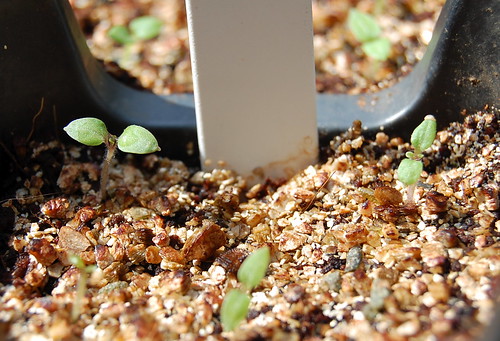
Most of the seedlings will germinate in 5-10 days. But it's not necessarily a bad sign if they take longer. Like tomatoes, they can be fickle about germinating, and will pop up when they decide the time is right - sometimes weeks after sowing.

If you're used to the big chunky shoots that potatoes produce when grown from tubers, you may be surprised - alarmed even - at how small and delicate the TPS seedlings are when they emerge. Although they look similar to tomato seedlings, they are significantly smaller. Have faith - they will grow!

Something else they have in common with tomatoes (and peppers) is seed husk retention. Some seedlings emerge with the seed husk still clamped over their heads. You don't need to worry about this though, because potato seed husks are paper thin, and much less of a problem than the tougher tomato and pepper husks. As tiny as the seedlings are, they will soon tear their way out of their helmets without any need of human intervention.

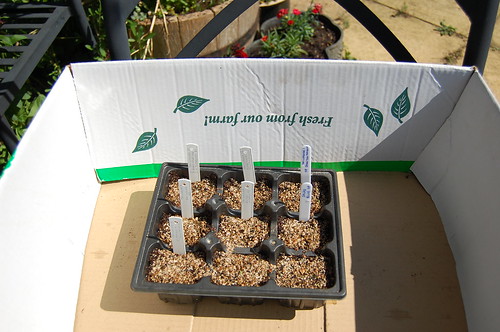
Potato seedlings need sunlight
My tray of potato seedlings enjoying a bit of outdoor sunbathing. As they are still young and delicate, I put them in a box to keep the wind off them.

One piece of advice that Tom wanted to make very clear is the importance of sunlight on the young seedlings - by which he meant direct outdoor sunlight and not a greenhouse or sunny windowsill. The reason for this is that potatoes evolved in a part of the world where light is very intense and the air very thin, and so they are dependent on the ultraviolet light that can only be got from direct exposure. If there's a day when the sun is shining (and of course that is a big 'if' in the United Kingdom, but never mind) it's worth putting the potato seedlings outside in the sun, even just for a couple of hours. That way, they develop into strong sturdy plants rather than stretching out and going leggy. However they are still quite delicate at this early stage in their life cycle so you need to stop the spring winds from blowing across them. Placing the seed tray in a larger box, as shown above, should give them the protection they need while still allowing them to sunbathe in the open. If the weather is rubbish when the seedlings emerge, well, there's not a lot you can do about that, but it's a case of making the most of whatever sunlight there is.

I'm going to deal with transplanting in a later post, when my plants reach the appropriate stage and I can take some photographs. In the mean time, I can grow them in these modules until they're a couple of inches tall. The principle of transplanting is the same as that for tomatoes … they benefit from being transplanted at least twice and being buried up to the top set of leaves each time. Because potatoes, like tomatoes, are very efficient at producing feeding roots along their stems. This is, of course, why tuber-grown potatoes are earthed up as they grow. Although the TPS seedlings are tiny, the earthing up method is still the most effective way to grow them.

More anon.

Looking to grow a potato variety that is available in the UK and likely to set berries?
This list is based on a quick search of the European Cultivated Potato Database, but don't rely on it too much. The ECPD takes its data from available research - but you may find differences when you grow the spuds in your garden!

If you want a good chance of berries, try these varieties:

Cara

Desiree
Marfona
Maris Bard
Maris Piper
Mayan Gold
Pentland Dell
Salad Blue
Valor

Friday, 15 February 2008

Potato sprout colours

Seed tubers of Mayan Gold. Its shape tends to be more elongated than most potatoes. I can see a "lewd vegetables" post coming up later in the year when I harvest this lot ...

Oh gawd, I've got waaaaaaay too many potatoes this year. And just as I was chiding myself for overstocking to such a ridiculous extent I somehow managed to buy some more.

Well, I couldn't help it. I was in Dundry Nurseries outside Cheltenham (which as you may recall is Gloucestershire's mega spud emporium) just to buy some local eggs and a packet of pepper seeds (red bull's horn from Franchi, if you want to know) when I saw they had some Mayan Gold seed potatoes in stock. Last time I went it was on their list but they were still waiting for the stock to be delivered. I'm curious about this newly released spud and have been quite keen to road test it. It's a bit more expensive than other potato varieties but Dundry's price is lower than Thompson & Morgan's and they let you buy smaller quantities (I got 12). I don't know how special it really is, because when I search on the internet I find the majority of "information" about it is tainted with marketing bollux and I'm afraid I'm terribly cynical about celebrity chefs.

From what I can gather Mayan Gold was bred by the Scottish Crop Research Institute using an accession of Solanum phureja, a wild potato species found in Peru, as opposed to the usual Solanum tuberosum. The marketing claims it's an ancient variety, but I notice they've slapped Plant Breeders Rights on it, so presumably it's not that ancient. But anyway, a bit more genetic diversity in European spuds has got to be a good thing. Mayan Gold has elongated tubers with yellow flesh and sometimes a purple splodge on its rear end, although when you buy it as seed tubers it does of course just look brown and muddy. It's alleged to be high in carotene, which would account for its yellowy colour, but reading through the marketese it's not clear whether it contains beta-carotene (provitamin A) or one of the many other less nutritionally useful carotenes.

Unable to contain my curiosity, I cooked and ate one of the tubers. Now, it wasn't exactly a prime tuber nor a fresh one, so it wouldn't be fair to judge it on this one sample, but I have to say the taste was bland and the texture extremely dry and floury - the exact opposite of the advertised buttery texture and gourmet flavour. Really nothing special at all, just like an ordinary mediocre-flavoured spud. However, I'll reserve judgement until I've grown it myself and eaten it fresh ... it could be very different. Potatoes (and some other root vegetables) are a bit funny like that, they can vary enormously in different growing conditions and in different years, and will change even further during storage. I've tasted shop-bought Salad Blue potatoes which had all the charm of stewed sawdust, whereas the same stock grown in my garden had an outstanding flavour. Conversely, my home-grown crops of Marfona have never matched up to the exquisite flavour I've so often found in the mass-produced commercial packs in Tesco's.

Anyway, good old-fashioned Solanum tuberosum has a lot going for it, including some attractive variations in sprout colour.

Kestrel

British Queen

Shetland Black

Sharpe's Express

Salad Blue

Highland Burgundy Red

Friday, 18 January 2008

Bless the independent local nurseries

People around here know what goodies to expect when "spuds are in" at Dundry.

I recently read something in the Guardian which made me shudder. A top UK businessman was quoted as saying that British garden centres are "ripe for consolidation". That's right, gardeners are under threat from the same mass-market homogenised blandness that afflicts the nation's High Streets.

Not that that's anything new in itself, there has been a creeping commercialisation of gardening suppliers for some years, and a great many small independent garden centres have been swallowed by large national chains. Some have had no choice, as it gets more and more difficult for small businesses to survive.

It seems to me that it's never been more important to sponsor the independent nurseries and local businesses. You know, those small and slightly weatherbeaten places with hand-painted signs at the roadside, which you often drive past and wonder what they're like but never bother to stop at.

Luckily for me there are lots of small nurseries in my area, a relic of Cheltenham's long history as a centre of plant-raising. Here's one of my most local, in a rural spot a couple of miles outside Cheltenham. Dundry Nurseries and Garden Centre doesn't look especially glamorous from the outside but it's wonderful. I discovered it by accident three years ago when I was out with a friend in the car and we took a wrong turning. As we were turning round in their car park we thought we may as well stop and have a look. And what a pleasant surprise it was. It's a smallish family-run nursery with friendly staff but it's as well-stocked as most of the larger garden centres, and it happens to be the Potato Capital of Gloucestershire.

Chitting some Marfona spuds from Dundry.

I'm used to being shown a choice of ten or so varieties of seed potato. But Dundry are potato specialists and I counted no less than 111 varieties on display in their shop. That's pretty incredible by today's standards. And they'll be offering over 150 varieties at the Potato Weekend they have organised for 19th and 20th January. What's even better, they will sell you literally any quantity you want. Rather than being lumbered with a pre-packed 3kg bag you can mix and match smaller quantities of lots of different varieties. And if you just want one or two tubers to try out in a pot, they're quite happy to sell you that. Yesterday I picked up seven tubers of the heritage variety Sharpe's Express for the princely sum of 75p.

They also sell locally grown vegetables and fresh local eggs, which is a great bonus.

So next time you drive past one of those small scruffy roadside nurseries with the whited-out glasshouses, why not stop and have a look? They may not have a kiddies' play area or a tea-shop, but you never know what else you might find.

Any other bloggers want to do a little feature on their favourite local nursery?

Tuesday, 1 January 2008

Heritage vegetable review
Potato: Shetland Black


Age: unknown, but probably early 1900s
Background: Native to the Shetland Isles. Traditionally said to have been picked up in 1588 from a Spanish Armada shipwreck, but there's no firm evidence of its existence before the 1920s.
Supplier: not readily available as seed tubers, except from Alan Romans
Pros: sturdy, quirky, colourful and full of substance
Cons: chewy skin and dry flesh won't appeal to everyone

Have you ever tried searching for buried sheep turds in a mound of soil? No, I thought not. But you'll at least get an idea of what that feels like if you grow Shetland Black potatoes. Because that's exactly what its tubers most resemble at harvest time. They are unfortunately so well camouflaged against the soil it can make harvesting quite a long and laborious task. It's very easy to put a fork or trowel right through them without seeing them until it's too late.

But once you've found them all and given them a scrub up, they look very handsome. The intense purple you see in the photo above only lasts for a short time after harvest, before maturing to a dull dark purple-black ... or more precisely a brown-black outer skin with a purply glow coming through from underneath. It is a rough-edged beauty and the skins are netted and covered in pale brown freckles, some of which are large enough to be more like little corky patches, but they are attractively different nonetheless.

They look quite groovy at planting time too because their sprouts are a glossy jet black, very distinctive and unusual. Once they're planted and the foliage starts to develop they look more normal and potato-like, but still with some dark colouring in the stems. Flowers are mauve and white, but this is another potato that only flowers when it feels like it and tends to be a bit half-hearted about it.


I grew two batches of Shetland Black in 2007. Although it's billed as a Second Early, the first lot I planted very early, in March when there was still a lot of frost about. I wasn't sure they'd survive in the frozen ground, but they just bided their time and came up when they were ready. The crop was trouble free and I got an early harvest of fine potatoes. The second batch started off well but when the blight came it totally massacred the crop in no time at all. The 2007 blight was exceptionally bad, but even so Shetland Black had no defence against it at all.

Yield wise, Shetland Black doesn't produce massive amounts, but it's about average for a heritage potato. The tubers are also smaller than a modern variety, and a slightly erratic shape, kind of oval but often thin at one end and bulbous at the other. When you cut the tuber open, the flesh inside is a pale creamy yellow colour with a ring of purple. The purple ring is more pronounced in some tubers than others. It looks beautiful raw but sadly the colour doesn't survive the cooking process. The purple in both the ring and the skin becomes a murky grey-brown. There's also a slight darkening of the flesh with this variety, which some people find offputting although it doesn't in any way affect the eating quality. It's quite a common thing in heritage potatoes, but we've all got unused to it because the supermarkets have focused on providing us with varieties bred to stay perfectly white after cooking.


There are several ways of cooking Shetland Black. It's a very floury potato, and quite a dry-fleshed one at that. You can boil it, if you don't mind the result being a bit grey and murky-looking, and possibly slightly disintegrated. My husband (who does the Sunday dinners in our house) recommends boiling them for no more than 15 minutes. Baking or roasting is much better, and it makes especially lovely roasties. I should point out that I absolutely never peel potatoes, so I can't vouch for what it's like if you boil or roast it without its skin. The dryness of the flesh means you'll probably want to eat it with gravy or some other source of moisture. This variety also has an exceptionally thick skin. Again this is a common trait in these older potatoes, but Shetland Black is thicker skinned than most and takes a bit of chewing.

The flavour is quite subtle, with the rich earthiness of a typical heritage potato but not as strong as some. It's a very good flavour, but rather mild. However it is very good at absorbing flavours from sauces and gravy, so that helps.

Overall, Shetland Black is great if you want a proper old-fashioned potato with plenty of substance to it. Not so good if you want something dainty for a salad. It's tough, rugged, eccentric and not hugely versatile, but if you don't mind its little quirks you'll find it's full of its own character. I certainly like it enough to keep growing it. It's as sturdy and rugged as a fisherman's woolly jumper, and just what you would expect from a spud belonging to the beautiful windswept Shetland islands, so far north of northern Scotland.

I've found that home-grown Shetland Black tastes better than shop-bought, but if you're in any doubt about whether this spud is for you it might be worth buying some to try first. It's available in Waitrose, possibly the only UK supermarket which supplies and promotes quirky heritage potatoes, but they only sell it when it's in season (autumn and winter) so grab some while you can!

Until recently this rare variety was only available to gardeners in the form of microplants, but things are improving and potato hero Alan Romans is now offering them as seed tubers. Hooray!

Saturday, 29 December 2007

Heritage vegetable review
Potato: Witch Hill


Age: uncertain, but tentatively dated to 1881
Background: Probably originated in the English Midlands. Also known as Snowdrop
My supplier: Organic Gardening Catalogue (microplants)
Pros: a flavour benchmark, good performer, nice looking spuds, early enough to escape blight
Cons: none that I noticed

I've been waiting a few years to be able to review this because I had to buy it as microplants (seed tubers are not generally available for unlisted heritage potatoes like this) and I had a lot of trouble getting the microplants to survive. It's now had its third full season and only now am I in a position to taste the darned thing properly.

Was it worth it?

Yes.

Witch Hill is generally classed as a Second Early but its significantly earlier than most other Second Earlies. That was a very useful characteristic this year when we had an exceptionally early attack of blight ... it was one of the few varieties which managed to produce a full yield before the lurgy struck.

It did very well in the garden, producing vigorous plants with bright green foliage. My crop didn't flower this year ... it produced a few buds but they soon dropped off. But last year it showed itself to possess very pretty and dainty white flowers. Some potatoes are a bit fickle in this respect and only flower when they feel like it.

The potato itself is very presentable looking, with a smooth goldy-cream skin and near white flesh. It has brown freckles but is otherwise quite smooth and shiny. The shape varies, but is usually somewhere between rounded and kidney shaped. Size is also variable, from bite-size to baker-size. Yields are pretty good for a variety of this age and the skin is much thinner and less chewy than yer average heritage spud.


Witch Hill is good as a general purpose potato because its dry matter makes it adaptable to lots of different cooking methods. It makes exceptionally nice roasties with melt-in-your-mouth softness. It makes smooth lump-free mash with minimal mashing action. It has a shorter cooking time than average potatoes (if there is such a thing as an average potato) but will go a bit mushy if overboiled, so needs a bit of vigilance.

The thing that makes this potato stand out from the crowd is its flavour. It's not easy to put into words, and really I just have to say it just tastes very potatoey. It's got a richness and complexity to it though. Potatoeyness elevated to a higher level of refinement, I guess. And it has a really smooth texture too, which is quite an important quality in a floury potato. Witch Hill is ultra floury, but it doesn't have that coarse dryness you often get in floury spuds. It's the ideal floury spud for people (like me) who normally only like waxies.

Definitely a superior variety and worth seeking out, although it's rare enough that it's a bit of a pain to get hold of.

Sunday, 23 December 2007

Heritage veg summary 2007

Next year's seeds of Kent Blue peas, starting to develop purple speckles as they dry out

This year had such a bizarre growing season, with too much spring heat, extremes of wet throughout the summer months, and not enough light whatever the weather ... not to mention the mildew and the worst (and earliest) attack of blight I've ever seen. It wouldn't be fair to do proper reviews of most of the crops I grew this year. Some were clearly not in a position to provide their best.

I did still collect a lot of notes though, and here's a general summary of my crops for 2007, divided up according to their merits (in my own subjective opinion). It doesn't include the many varieties which had a total or near total crop failure, such as the tomatoes, which had only two survivors from the 20 varieties I planted and a total yield of 7 fruits. It also doesn't include anything I already reviewed last season.

Some of these varieties will get full reviews which I'll post in the new year, but most won't – they'll have to be grown again in another season and reappraised.

I hope you find these notes useful in choosing what to grow, but there's always a possibility your experience with any of these vegetables could be different from mine. Feel free to compare notes if you agree or disagree with any of the things I've said.

Rouge Crapaudine ... an antique elongated beetroot


SUPERSTARS:

Beetroot: Rouge Crapaudine
Seed source: Thomas Etty Esq
The root is a matte dark red on the outside, slightly darker than most beetroot, and the inside is a very beautiful intense dark blood red. It's one of the oldest beetroot varieties around, listed in catalogues in the 1850s. Unlike a conventional beetroot it's long, thin and tapered, basically shaped like a carrot. The flavour is sweet, refined and not too earthy, and exquisitely tender when cooked. I grew it as a novelty but it's instantly become a favourite on its own merits.

Potato: Salad Blue
Seed source: Waitrose
Vigorous grower with a dark blue flush on the stems. The flowers are a purply-sky blue and absolutely beautiful. It flowers early and for a long period and is a delight to have in the garden. Salad Blue is emphatically not a salad potato. It's pretty floury. But it makes the most fabulous roasties. Soft-textured and exquisitely flavoured ... and BLUE! Beautiful to look at and full of healthy anthocyanins. When fresh the potatoes are dark blue skinned with blue-purple flesh, and much of the colour is retained after cooking. Can also be used to make mauve mash ... and very tasty it is too. Not the highest yielder by modern standards but well worth it for all its other qualities.

Pea: Carruthers' Purple Podded
Seed source: Heritage Seed Library
This is my clear favourite of all the purple-podded peas I've trialled (with Mr Bethell's Purple Podded a commendable second). It's a winner on flavour and beauty. Tall, vigorous (about 6ft) and early, it has dainty lantern-like flowers in two-tone maroon and pink. Pods are a reasonable size with a lovely deep violet-purple colour. Eaten raw they're very juicy but have a slight bitterness. Peas inside are an olive green colour, large, square and about 8 to a pod. Fresh peas taste surprisingly sweet for a purple (bear in mind purple podded peas always taste less refined than a good green variety) and are very nice raw from the pod. They have a slightly coarser texture than a modern pea but that's actually rather nice. This is truly a superior variety. Its one fault? It seems to be the pea moths' favourite too.

Pea: Magnum Bonum
Seed source: Heritage Seed Library
This is among the tallest peas I've ever grown, quite readily reaching 7ft and beyond. It's vigorous too, and you get a lot of pods. Similar in appearance to other 19th century tall peas, with pure white (not cream) flowers. One of my plants produced two flowers per node, but the others didn't. Magnum Bonum is the only pea I've found so far about which I can say "tastes as good as Alderman", my flavour benchmark. It's very sweet, possibly a tiny bit less sweet than Alderman, but with a richness and refinement in it. Definitely one of the best choices for flavour, and it yields well too. It does lose the sweetness when fully mature though, so there is a "just right" time to harvest it.

Magnum Bonum peas in flower


EXTREMELY GOOD, HIGHLY RECOMMENDED:

Beetroot: Egyptian Turnip Rooted
Seed source: Thomas Etty Esq
Very decorative in the garden, with bright emerald green leaves veined with deep red. It grows almost entirely on the surface of the soil, so at least you know how big it is before you harvest it ... none of that feeling of "beet deflation" when you excitedly pull one out of the ground and find a tiny stumpy root on it. Flavour is excellent and nicely balanced without too much earthiness.

Pea: Salmon-flowered
Seed source: Heritage Seed Library
Oddest pea in the garden, for sure. Looks like a cross between a culinary and a sweet pea, but could be anything. 4ft tall, it has very wide succulent stems and clusters of flowers all in a solid bunch at the top. The flowers are truly gorgeous ... a very dainty and pretty two tone pink, quite unlike any other pea I've grown. They bloom more or less all at once, so it looks absolutely stunning for a few days and then it's gone! Green pods develop rapidly, all sticking out in a big bunch at the top of the plant. You don't get many peas in 'em ... 4 to 6 seems about normal, and they aren't terribly big, but they're very sweet and flavoursome. As a bonus, if you save it for seed the pods go an unusual rosy colour as they dry out. Yields were relatively low, but it's such a great thing to have in the garden, I didn't care.

Pea: Kent Blue
Seed source: Heritage Seed Library
It may be premature to review this as I didn't get a chance to do a proper taste test (most of it was kept for seed), but it's too interesting to leave off the list. It's not a vigorous pea or a very high yielder. Flowers, produced in pairs, are small but have a beautiful two-tone velvety blue colour, with dark veins. Unique and very pretty. Pods are green, and small, and go extremely knobbly as the peas inside start to mature, and may even start to bend and fold. You can certainly see very clearly how well the peas are developing and you can count the bumps. The raw peas are quite firm and mealy and the skins are chewier than you'd get on a modern pea, but they have a very rich and full flavour with an overriding sweetness. When dry they become speckled with purple.

Climbing bean: Caseknife
Seed source: Beans and Herbs
An old variety from before 1820, which climbs and climbs seemingly to eternity. It ain't a beauty. The leaves are gnarled and the pods dull green and kind of lumpy and ugly, although they start off flat and knife-shaped. I didn't bother trying to eat them as green beans. But boy the shelled beans taste good ... fresh, dried or partially dried (I'm not fussy). They're white kidney type beans, not especially smooth or shiny or glamorous but they have a lovely firm texture when cooked. Caseknife needs tall supports but it's full of character and flavour.

Purple podded pea, Desiree


GOOD, BUT ... :

Beetroot: Golden
Seed source: Organic Gardening Catalogue
Different from other varieties in its rich orange colour, which is apparent right from the earliest seedling stage. The stems of the plants are golden yellow and the leaves a lush bright green. Root size is a bit on the small side though and the flavour is OK but not as refined as the red varieties.

Potato: Highland Burgundy Red
Seed source: Waitrose
Less vigorous than some and slower growing, with thin, fine foliage and a dusky reddish tinge on the stems. It's not the most graceful looking plant in the garden but it does have nice flowers. They're pure white, fairly small but dainty and frilly and borne in clusters. Tuber colour on the outside is a bright rich crimson, maturing to burgundy. They're slightly erratic in shape, often kidney shaped and tapering towards one end. Inside, there's a band of normal potatoey colour under the skin, but the bulk of the flesh is strongly infused with burgundy red, right through to the middle. It cooks to a rose pink and makes a lovely novelty mash. Growing conditions may be a factor, but I found it to be a bit coarse and dry in texture and the flavour was unremarkable.

Pea: Desiree
Seed source: Real Seed Catalogue
A purple podded soup pea, is probably the best description. The flowers are very pretty, and the pods are broad and a very dark purple colour. It doesn't really work as a mangetout unless you eat it very young, as the pods become very leathery. By the time they reach maturity the pods are so thick and leathery it's a job to tug them off the plant! Peas inside are green and so large they sometimes burst the pods. Shelled out and eaten raw, they aren't impressive ... the flavour is bland, the texture chewy. But when you cook them they are absolutely delicious, and have a lot more substance to them than a modern pea. Less versatile than other purples, but very good at what it does.

Pea: Ne Plus Ultra
Seed source: W Robinson
One of the old, tall Victorian peas, with flowers an especially bright pure white. Not much cop as a mangetout as the young pods taste quite bitter, but it's meant as a shelling pea. It soars to about 7ft, has an elegant form and the large pods are borne on long stalks and look very fine. The peas themselves are well packed into the pod, averaging 8 to 10 per pod. Pick them young and the flavour is pretty damn fantastic. But as they begin to reach a mature size they go starchy and firm of texture ... the sweet and tender stage is soon passed.

Potato in flower, Highland Burgundy Red


DUDS:
Beetroot: White Beetroot
Seed source: Real Seed Catalogue
This isn't actually a heritage variety itself, but a modern strain of the very old Albina Vereduna. It's a white beetroot, as you might have guessed, but above-ground parts go green with exposure to the sun. Grows vigorously and doesn't 'bleed' when cut. I wasn't impressed with the flavour though. It's very sweet, but it's not a very refined sweetness, and has a bitter undertaste which (to me) made it less palatable than a red beetroot. It is, however, rather more appreciated by ants and wood lice, who delighted in gouging great holes in most of my crop.

Salmon-flowered pea ... the strange pod clusters which follow the flowers. Notice how thick the main stem is.