Sunday, 11 April 2010

Report on the Luna Trick F3 crop


This post comes with a little explanatory video (12 minutes running time) as an introduction to my Luna Trick pea project. It's the first time I've made one of these, so do let me know if it's useful.

Luna Trick is a new pea variety I'm working on. It's an exquisitely tasty edible-podded pea with pale golden yellow moon-shaped pods - named for my music partner Daniel Staniforth who has a music project called Luna Trick.

The project originally started as an attempt to breed a yellow sugarsnap pea. In 2007 I crossed Golden Sweet, a unique heritage golden-podded mangetout pea, with a modern sugarsnap pea, Sugar Ann. The result was a spectacular range of unexpected colour and flavour diversity - but sadly no yellow sugarsnaps. My chance of getting a yellow sugarsnap in the F2 generation was one in sixteen (a double recessive combination), but none showed up in that particular batch. I had yellow mangetouts and green sugarsnaps, but that was it. However one mangetout plant did stand out from all the rest for its elegant beauty, high yields, juicy golden yellow pods and truly exquisite flavour. This plant, which was numbered YSS 25, became the prototype for Luna Trick.

In 2009 I grew out 35 seeds from this one plant. I was hoping to get more plants of a similar type. And so I did - and a lot more besides!
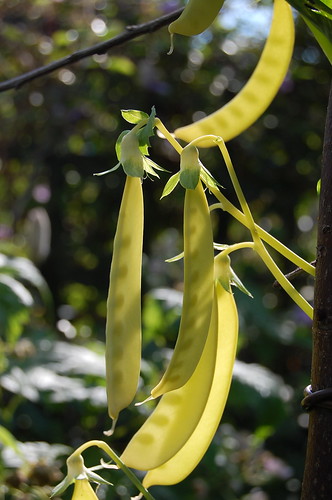
Luna Trick F3 young pods
The first Luna Trick yield. Golden yellow moon pods, exquisitely sweet and completely fibreless.

Hybrid vigour in peas is something I've often wondered about. I've often heard it said that hybrid vigour exists only in outbreeding plants, if indeed it exists at all, which is still a subject of debate. Peas are inbreeding plants - very inbreeding - and so you might expect them not to gain much vigour from being hybridised. However my experience is that peas do have a bit of a wahey in their size and growth when you hybridise them. It varies, but it's usually apparent in one way or another. And it may be the reason why Luna Trick turned out a lot taller than expected.

The parent varieties were 5ft tall and 1ft tall respectively. Under normal circumstances, I would expect most of the offspring to be around 5ft tall, as that's the dominant form - with about one in four defaulting to the recessive 1ft size, and maybe the odd intermediate. As it turned out, the dwarf types were nearer 2ft, and voluptuously chunky. Whereas the tall types - well frankly they didn't want to stop.

Daniel, in whose honour the peas are named, is a big bloke. He's 6' 4". I never thought the plants would get as tall as him, but they did.
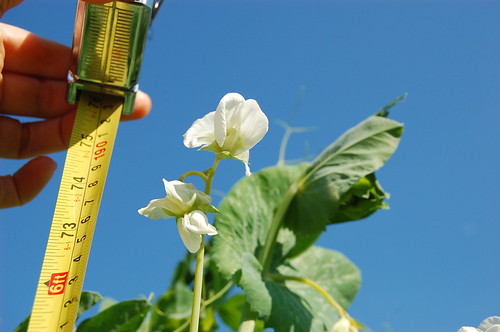
Luna Trick F3 outgrows its patron
The F3 crop reaches the same height as Daniel. I wasn't able to measure it after this point because my arms aren't long enough.

Most of the plants weren't going to stop there either. They just kept going, way beyond the 5ft tall frame I'd optimistically provided for them. I had to ram some extremely tall and sturdy poles into the ground all around the frame and wrap masses of garden twine around them to hold everything together. And still the plants kept growing. I couldn't even reach the tops. They were probably a good 8ft by the time they started slowing down.

But apart from this, they behaved very well and did everything I hoped they would do. I'm very optimistic indeed that they will turn out to be a wonderful variety. Not only that, they are TWO wonderful varieties. The original YSS 25 protoype plant was a mangetout type - but growing its offspring revealed the presence of a hidden recessive sugarsnap gene, and a large number of the F3 plants turned out to be sugarsnaps. Beautiful, crescent-podded, golden yellow sugarsnaps! So I got exactly what I had wanted when I made the original cross - in addition to developing Luna Trick as a mangetout type. A wonderful, beautiful and very much appreciated gift.

The key trait in Luna Trick is flavour. I'm aiming for it to have the same flavour as YSS 25, which stood out from every other plant in the F2 batch and was among the most refined mangetout flavours I've ever tasted. Very sweet and juicy, but there's a lot more to it than that - it had a rich and refined complexity to its flavour and no trace of bitterness. YSS 25 was good enough that you would want to eat its full size pods straight off the plant. A salad mangetout, effectively, because it tastes so good raw you really would have no incentive to cook it. I think a yellow mangetout which tastes good enough to include in a salad, even at full size, would be a very nice thing to have.

At the moment I'm getting a mixture of single pods and double pods - some plants produced one or the other but in many cases there was a mixture of both on the same plant. I'm not quite sure how this trait works - it is clearly partly genetic but I'm not sure whether there are environmental factors involved too, or a complex interaction of genes, because it doesn't follow normal patterns and ratios. Consequently I'm just not worrying about it for the moment. Two pods per node is often deemed more desirable but I tend to find that the two pods have fewer peas in them compared to the single ones, so I'm not convinced it actually matters that much either way.
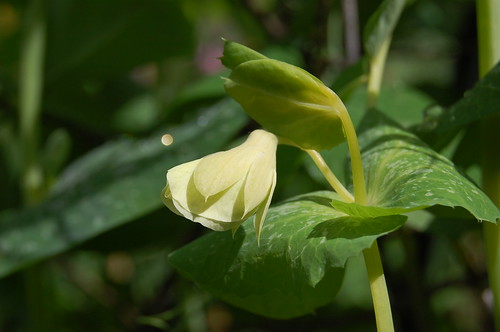
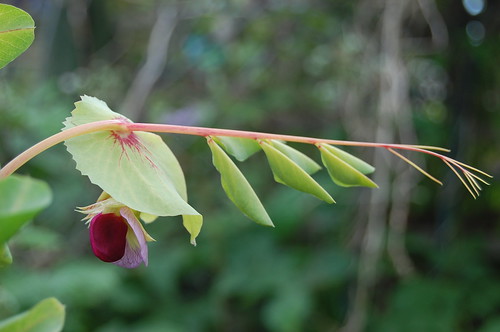
Luna Trick F3 bud
A single flower bud. This is an unusual colour combination in peas - a white flower with a creamy blond calyx (the pixie hat bit).


To summarise the F3 characteristics ...


Luna Trick is stable (true-breeding) for:

Yellow pods - a very simple recessive gene is responsible for this, called gp. In order to express yellow pods, the Luna Trick prototype must have had the stable gp gp genotype. Which is fine by me. It holds only gp genes, so all its offspring will be gp gp too.

There is, however, some variability in how persistent the yellow colour is. One of the weaknesses of the parent variety Golden Sweet is that its pods tend to green up as they reach maturity, so only the young pods are truly yellow. Some of the Luna Trick F3 plants shared this tendency, but others were notable in their ability to stay yellow right up to the time they were harvested for seed. Presumably this is a genetic variable - though I don't yet know how it works - and I will select for it at the F4 stage.

Edible pods - a slightly more complicated trait, as there are two genes involved in the reduction of fibre in the pod, p and v, both recessive. They work in slightly different ways, and you need both of them to get a really good fibreless pod. I have my suspicions that Golden Sweet only has one of them, as it tends to go a bit gristly at maturity. However, Sugar Ann has them both - and now Luna Trick has them both too. There was no trace of fibre in any of the pods in the Luna Trick F3. Hurrah!

White flowers - peas need a dominant gene called A in order to "switch on" anthocyanin production. Without it, they cannot produce any purple pigment in the leaves, stems, flowers, seeds or anywhere else. Luna Trick has inherited the recessive a a genotype from Sugar Ann, and therefore cannot produce colour pigments. White flowers it is then.

Cream calyx - the flowers all have a cream calyx (sometimes with green mottling) rather than the more conventional green. This is a true-breeding trait because it's directly related to the yellow pods. It looks absolutely gorgeous with the white flowers and really gives this variety an extra beauty factor in the garden, adding to its luna blondness.


Luna Trick is still segregating for:

Height - I'm selecting for tallness, which is the work of a dominant gene called Le (internode length). The cross with Sugar Ann will have introduced the recessive type le into the mix. Although the Luna Trick prototype was tall, it had the recessive shortie gene lurking in its genome … and by a simple Mendelian ratio I ended up with dwarf types in about a quarter of the F3 plants. With a bit of luck the F4 generation should take care of this. By growing out several plants from each of several lines, I'm hoping to be able to identify the lines which produce only tall plants, and which are therefore likely to have the desired Le Le genotype.

Pod type - the prototype Luna Trick had large mangetout type pods, which represent the dominant form. However, squirrelled away in its genome was the recessive gene n, inherited from Sugar Ann, which gives sugarsnap type pods. Consequently about a quarter (or just over actually) of the F3 plants were sugarsnaps. I was overjoyed by this, as yellow sugarsnaps were the original intent when I made the cross. The way this gene works is to thicken up the pod wall, giving it its chunky and succulent 'snap' characteristic. To compensate for this thickening, sugarsnap pods tend to be slimmer. Although this genetic difference is simple and made by a single gene, it effectively creates a separate new variety.

The recessive nature of gene n means that any sugarsnap lines I follow up will be true breeding for sugarsnap pods, as they will be genotype n n. The mangetout Luna Trick, on the other hand, will continue to throw up the odd sugarsnap from recessive genes hidden away, and I'll have to eradicate those through repeated selection.

Even within the mangetout type, differences in pod size and shape are apparent. The ideal I'm looking for is a fairly wide crescent shaped pod, but some are narrower and some are extra wide, and some are not quite so crescent-shaped.

Flavour - this is the most important factor, and I would have liked it if all the offspring had tasted as good as the prototype - but only some of them did. I know very little about the genes involved in pea flavour. The combinations are very varied, and so I assume a number of genes have a bearing on it. Sugar content obviously is a major factor, but it's not the be-all and end-all. Some peas taste very sweet but are still quite bland, others have a rich and interesting flavour but aren't particularly sweet. There is also a kind of 'soapy' taste which peas are prone to which seems quite independent of the other flavour variables. The flavour variability in the Luna Trick F3 was quite considerable. They ranged from something akin to nectar of the gods to something bordering on bitterness. Some were just bland. Overall though, the vast majority tasted substantially better than Golden Sweet - and the best ones were truly exceptional. So I'm confident of creating a flavour benchmark with Luna Trick - it's just going to take a bit of careful selection.

Seed colour - the Luna Trick prototype was heterozygous for seed colour, producing both the dominant cream seeds and the recessive green ones. Some of the resulting F3 plants were homozygous for green seeds, but the lines I'm most interesting in following up happen to be heterozygous ones, so the variability will continue in this coming generation. I'm not too bothered about this. I might select one colour or the other if it becomes easy to do so, but I don't see any harm in having the variability. It would be unacceptable in a commercial variety to have mixed cream and green seed, but I don't see why not. One of the compensations of public domain plant breeding is that you're not bound by rules and conventions.
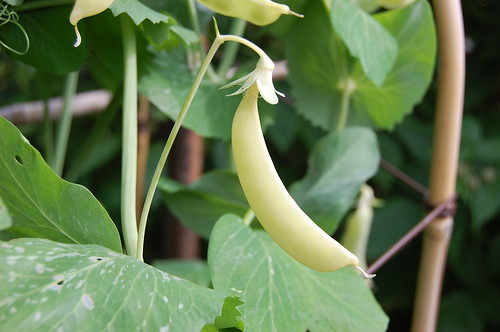

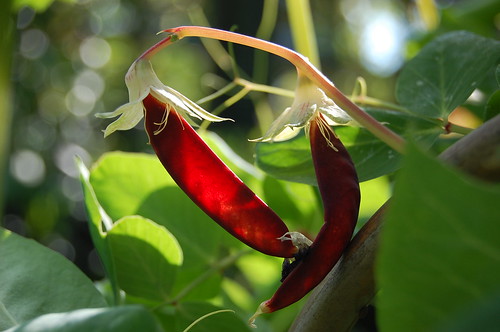
Luna Trick F3 pod
Sugarsnap version of Luna Trick. I will develop this type separately and make a new variety with a different name.

Luna Trick does have a potential weak spot which may be genetic or environmental or a combination of the two. The peas have a tendency to split their skins when ripe - much as ripe tomatoes do when they're over-watered. This isn't a problem when you want to eat them, but verily 'tis a bugger when you are saving them for seed. In the F3 crop, some plants suffered badly from it and some had no problem with it at all. So I am selecting the ones that didn't have the problem - kind of by default, because the ones that have split will not make good seed for replanting. If it's a genetic issue, selecting against it should soon eradicate it. If it's environmental (affected, for example, by how much water the plants get at a particular time) then no amount of selecting will make any difference. So far this seems to be the only flaw though in an otherwise wondrous variety.
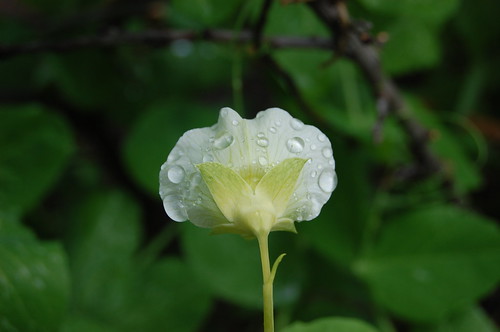
Luna Trick F3 bloom
Rain on Luna Trick blossom.

So what now? The F4 crop in 2010
I've already sown 100 seeds for this year's selection work - 50 mangetouts and 50 sugarsnaps - and these are the ones shown in the video above. Germination was 100%.

I'm working on the mangetout and sugarsnap versions as completely separate varieties, and at some point the sugarsnap one will get its own name. Some sugarsnap types will continue to show up among the mangetouts in this generation. I'm also seeing height variability, which is apparent even at the seedling stage.

I've chosen F4 seed from the best six plants of the mangetouts and the best six plants of the sugarsnaps. In the F3 there was one plant, called LT10, which stood out from all the others - it was the tallest, highest yielding, most beautiful and had the holy grail flavour I was looking for. So I'm growing more of those than any other, hoping that I can stabilise it pretty much as it is. But by growing out a few other good lines alongside it, I'm hedging my bets in case LT10 turns out to have any unexpected flaws - and also learning more about the genetics involved, by observing the ratios for different traits in different lines.

With the sugarsnaps, there was no obvious standout plant in the F3. Some were better for flavour, some for pod shape or colour, some for stringlessness ... so I've just selected the six that looked most promising and will see what I get.

All in all though, I'm very excited and optimistic about Luna Trick.

Sunday, 4 April 2010

Red-podded pea update: the F3 crop

Red-podded pea F3

The unexpected discovery of the 'formula' for red-podded peas was the most exciting thing to happen in the garden in 2008. Without even meaning to, I'd created something unique and special and was very excited about what it might evolve into. Following all this excitement and expectation, its progress in 2009 was frustrating to say the least.

To recap briefly: I was working with two crosses, both involving a purple shelling pea with a golden yellow mangetout, with the aim of breeding a new purple mangetout variety for The Real Seed Catalogue. One of these crosses was Golden Sweet x Carruthers' Purple Podded, and among the F2 plants (the generation where all the genetic recombination happens) I found one single plant with deepest, richest blood red pods.

Red-podded pea F3

Beauty is not enough though, as spectacular as it is. Commercial seed catalogues are already rife with things which look good but don't taste particularly special. So much so, you could be forgiven for assuming there is a tradeoff between beauty and flavour (which there isn't) and that pretty vegetables will inevitably taste rubbish. I don't want that to happen with my red-podder. I want it to taste as good as it looks, otherwise there really is little point in it.

The original red-podded F2 plant was, unfortunately, a normal shelling pea with a fibrous membrane inside the pod. What I need is an edible podded version - which means a pod which doesn't produce a gristly inner membrane. The absence of fibre is actually achieved by the combination of two unrelated genes, both recessive. Golden Sweet, the 'mother' of red-podder, is a mangetout and has at least one of these genes, if not both. So even though red-podder itself had fibrous pods, there was a pretty good chance that it would be heterozygous at that locus - carrying a hidden recessive gene for edible pods. In fact, by the rule of Mendelian segregation it had a two in three chance of producing some edible pods, and only a one in three chance of being all gristly and inedible. Until I grew the next generation, I had no way of knowing whether it was heterozygous for that trait (carrying some variability) or homozygous (true breeding).

Red-podded pea F3

So in 2009 I grew the F3 plants. As the red-podded phenotype was only really asserted in one plant in my F2 crop, my F3 crop was based solely on the offspring from that one plant. The plants were absolutely stunningly gorgeous. Most of them had deep red pods, though some were coming out as plain yellows, and they all had wonderful rich colouring on the stems and tendrils, and attractive calyx markings. When the sun shines through the red pods they are out of this world.

Alas, growing the F3 revealed that red-podder is homozygous for gristly pods. In other words, it cannot produce edible pods. Homozygosity is a blessing for stabilising the traits you want. But when a trait you don't want is homozygous, you're stuffed. I could grow the offspring of my red pea for the next 100 years and probably never see an edible pod among them. The genes for edible pods are not there. It has only the genes which breed true for solid, yukky, gristly fibre.

There are five things I can do about this:

1. Stand in the middle of the garden and shout "BOLLOCKS!" in a really loud voice.

2. Go back to the F2 generation and grow out the rest of the seeds (I have about 20 left) in the hope of finding another red-podded phenotype but with edible pods.

3. Go back to an earlier generation still, the F1 seeds, and grow out some more of those. These plants will all look the same, all boring, with no red pods. But they will produce a fresh abundance of F2 seed, which I will be able to sow next year and that will give me a much better chance of an edible red-podded phenotype in the event that option 2 above doesn't yield anything.

4. I can switch to another line of F3 seed, even though none of them are proper red-podders. For example, I do have an F3 which is edible podded and produces yellow pods with a red blush. It's possible that if I grow out enough of its offspring I might get something with a stronger red. It should at least breed true for edible pods, which is half the battle. Even if it doesn't produce a decent red, it might make a nice variety in its own right - kind of peachy auburn!

5. I can grow my remaining seed from the red-podded F2 and cross it with something else. To retain the red pods I would need to cross it only with yellow podded peas - and mangetout ones at that. The most obvious thing would be a backcross to Golden Sweet, but I can go one better than that. My Luna Trick line, although not yet stabilised, is bred from Golden Sweet but is a huge improvement on it. A cross with that would give me an excellent chance of improving red podder's flavour as well as its pod structure. The other obvious cross to make is with option 4 above, which already has most of the right genes.

Red-podded pea F3 bud

Apart from option 1, they will all take some time - at least a year and probably more - to get the results I want. But no matter, I have got all of them underway now. We'll see what 2010 brings.

Thursday, 1 April 2010

Major Cook's Bean

Major Cook's bean

Some of you may be growing this treasure of a bean this year, as it appeared in the 2010 Heritage Seed Library catalogue - along with a little quote from me because I'm one of the Seed Guardians who looks after this variety. The advantage of being a Seed Guardian meant I got to try it two years before it appeared in the catalogue, and I've already written a detailed review. There hasn't been much point in me promoting it until now because it wasn't available until this year, and I couldn't offer it in any personal seed swaps because the stock I have belongs to the Heritage Seed Library and all the seed I produced went back to them.

If you chose this variety then you are in for a treat. I rarely, if ever, proclaim anything to be the "best ever" or single any one thing out as my ultimate favourite, because there are so many varieties that have merits in different areas, and diversity is in itself a blessing. But this is the exception - Major Cook's Bean is the best bean I've ever grown, and I fell completely in love with it. It is the bean that has everything.

Genuine multipurpose beans are a rarity. In most cases, there is a trade off between pod quality and bean quality, and you have to decide which you prefer when you choose a variety. Major Cook's Bean is an exception. It has the most exquisitely fat succulent pods with a gourmet flavour and absolutely no trace of fibre whatsoever, so the pods stay sweet and edible even when they're fairly mature. At the same time (even on the same plant) you can harvest mature beans which also have a gourmet flavour and a silky texture and which don't break up when you cook them.

Major Cook's bean

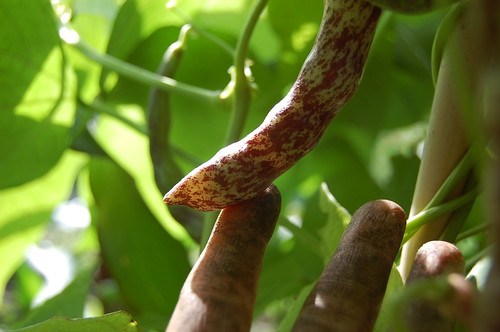
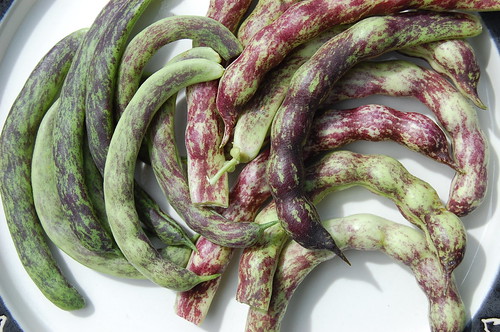
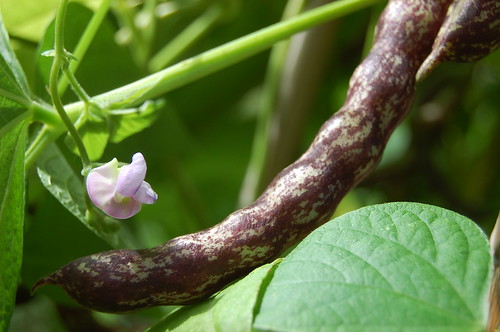
The pods are quite curious looking as they have a strong curved shape and are mottled with purple-maroon. To start with the pods are flat and the mottling is quite blue. As they mature they become spectacularly knobbly, and the colour changes to a rich burgundy maroon. What is unusual is that the pods are still delicious after they've gone knobbly. The knobbles are caused by the complete absence of fibre inside, so the pods shrink around the shapes of the beans. The pods are also incredibly thick-walled and juicy, which adds to the knobbly effect even more. They have a strong flavour, but it's sweet and rich and delicious, and the texture is smooth and succulent - and as if that wasn't enough, they are absolutely stringless! Instead of going fibrous when left to mature completely, the inside of the pod develops a soft white layer of fluff, like you get in broad beans, and the outer colour turns almost solid dark maroon.

Like all red/blue/purple streaked pods, the colour is not retained on cooking because the pigment (anthocyanin) is water-soluble. It does turn the cooking water a lovely deep blue-green!

If you eat the whole beans rather than the pods, you are in for another treat. They will stay intact in a casserole and the texture is buttery and silky, and the flavour rich and sweet.

Major Cook's bean
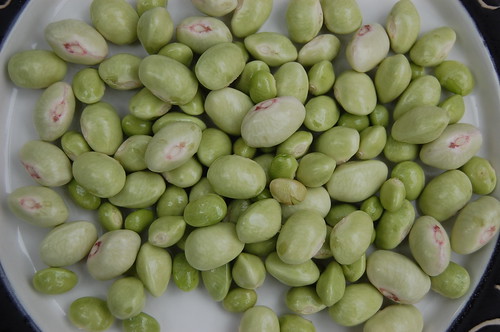
Fresh shelled beans. With the benefit of hindsight, I wouldn't harvest them this young. It's a waste of the good pods. The beans are at their best when fully mature and will eventually dry down to a creamy white with maroon speckles.

As a garden plant, Major Cook's Bean is not the most elegant but it more than makes up for it with its vigour. In my garden it has been completely untroubled by any pests, and although quite a few snails took up residence in its voluptuous foliage they didn't seem to do it any damage. The yields were stupendous. Even without regular picking (since I was growing it for seed I only picked a very few pods before maturity) it produced a totally mad number of pods and kept on going well into the autumn. The leaves are very large, bright green and coarse, and feel rough to the touch. They have large stipules and are prone to composites with four or five leaf lobes instead of the usual three. The flowers are mauve and quite pretty. When the pods are produced and the plants are covered with their burgundy-streaked crescents, they look much more attractive.

The catalogue description gives a little of the bean's history. It was donated to the Heritage Seed Library by Mr Luxton, who got them from his father in 1960. Mr Luxton senior had worked for the Commonwealth War Graves Commission and was given the bean by a colleague, Major Cook. The catalogue suggests this happened in the 1920s but this has now been corrected - it was actually the 1950s.

In my original review I thanked Major Cook "whoever he may be" for his discernment in selecting this bean and preserving it for the future. Well I now know a bit more about who he was. I was recently contacted by his son Phil, who told me this:

"Major Cook was my father. Trained at Kew, London, where he was a Student in 1939. His first job was to train people to grow their own food as part of the war effort. Then he joined up in the Army in 1940, to be sent to various Arab nations on various missions for 5 years.

By 1945 he was a Major. He was tasked by the Commonwealth War Graves Commission with building the Cemeteries in Normandy, France, after the landings, and later to assist in rebuilding the 1st world war cemeteries in France.

Living in Albert, Somme, where Mr Harold “Lucky” Luxton was his right hand man. Also where I and my sister also grew up, from 1952 until 1970. We remember Mr. “Lucky” well.

The bean was probably much older however and could have come from Major H.V.Vokes, who was the first Horticultural Officer for the Commonwealth War Graves Commission in 1920. (He was an uncle of Major Cook). The bean may even be older, in that Major Cook’s grandfather was also an experimental horticulturalist, he was Alderman F. Vokes, Sheriff of Southampton, UK, winner of over 1100 cups/awards for horticulture and there is a flower park named after him near the docks in Southampton."


Major Cook's bean
Major Cook's Bean may originally have been developed by his grandfather, Alderman Vokes

I was intrigued to learn that Major Cook had lived in Albert on the Somme, because it's a place with a very special significance to me. I went there in 1996 during a pilgrimage to the battlefields, originally on the trail of Wilfred Owen who is among my very favourite poets, but it led on to other things. After visiting Albert I had some very strange and powerful dreams, and when I got home it all splurged out in the form of a play set in the WW1 trenches. The play got picked up by a professional theatre producer and premièred at the Grace Theatre in Battersea, London, in 1998. That's my little claim to fame - and for a while it looked like I had a literary career in front of me. Three years later I came out with a novel also set in WW1, with large parts of it set in Albert, but by that time my agent had sodded off (as agents do) and I wasn't able to place it anywhere. But that's a whinge for another day.

What's even more curious is that Phil's message arrived at the very same time I was scanning my Somme slides, as part of an ongoing effort to digitise my archive of film photographs taken during the 20 years before I went digital. I was literally right in the middle of sorting out the Albert pictures.

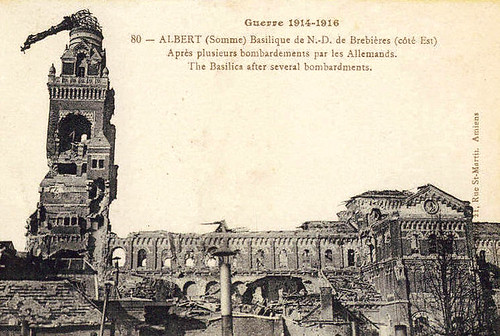
Albert became an iconic town during the first world war. It was an important strategic base and control centre for British troops, and consequently became a target for heavy bombardment. What was ironic was the town's motto Vis Mea Ferrum - my strength is in iron - adopted during the heyday of its local iron foundry, and which had something of a hollow ring to it by 1916 when heavy iron artillery shells had pounded most of the town to rubble. The basilica in the market square was topped by a gilded statue of the virgin holding the infant Jesus, his arms outstretched, high above her head. In early 1915 the tower was struck by a shell and the golden virgin lurched over, but remained attached to a tangle of metal which kept her suspended over the town square as if she was on a clockspring. She looked as if she was trying to hurl herself and the baby Jesus into the rubble below. Or blessing the chaos, depending how you look at it. It was a deeply striking image which was visible for miles around, and a superstition soon arose that whichever side shot her down would lose the war. Consequently she stayed up - despite more than three years of relentless bombardment in which the rest of the basilica was pulverised. The superstition turned out to be unfounded: it was the British artillery who finally shot her down in 1918 when Albert was briefly taken over by the Germans and there was concern that the tower would be used as an observation post. The statue was never found.

After the war the town was rebuilt, and the basilica reconstructed with a new (upright) madonna. Even now it's not hard to find the lingering scars … pockmarked bricks on the lower walls of buildings everywhere you look.

Somme mural, Albert
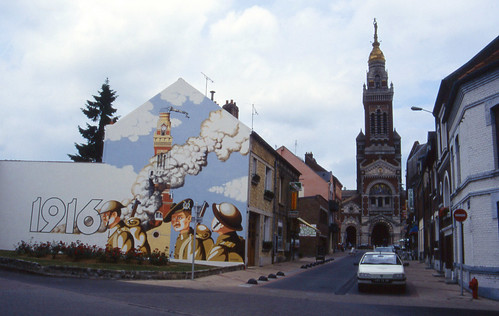
The town of Albert, Somme, where Major Cook was based. I took this photo while I was touring the battlefields in 1996. It shows a commemorative mural of the skydiving madonna, and the rebuilt basilica with the new statue on the top.


Golden virgin on the lurch
This first world war postcard shows what the basilica and golden virgin looked like in 1915, after a year of bombardment. You can imagine what state it was in by the end of the war.

During his time in Albert after WW2, Major Cook was superintendant of all the CWGC cemeteries in the Somme area. He gardened on a bombed out factory floor and operated a no-dig system (with compost and chicken/rabbit manure) which kept him self-sufficient in vegetables. He was an accomplished horticulturalist who collected and experimented widely, keeping a careful note of where each plant had come from. Another of his credits is the discovery of the Golden Leylandii, which he found growing in one of the cemeteries as a result of a natural hybrid. He promoted the use of evergreens in the CWGC cemeteries after the wipeout from Dutch Elm Disease.

As for Mr "Lucky" Luxton, whose family maintained the bean for the next 50 years and donated it to the Heritage Seed Library, he was a veteran of WW1 and spent most of his life with two bullets lodged in his chest. He'd survived a pelting of machine-gun fire which had hit him in the chest four times. Two of the bullets were removed but the other two were too close to his heart and had to stay there.

Dantzig Alley
One of the cemeteries formerly cared for by Major Cook and Mr Luxton, photographed in 1996. The CWGC cemeteries are laid out as gardens, with immaculately maintained flower borders along the front of the graves. This is Dantzig Alley cemetery near Mametz, a few miles from Albert. Behind the wall are cornfields which were once the battlefields of the Somme.

My thanks to Phil for making the effort to get in touch and tell me about his father's work.

Friday, 26 March 2010

No I haven't given up

OSU Blue Fruit tomato
OSU Blue Fruit tomato. Verily 'tis a black fruit, but red in the middle.

Last year I had to leave most of my garden fallow and take a year off. It was really a case of too many things happening at once - mostly good things, but nevertheless I got left behind with my workload until it was no longer possible to catch up. So I just focused on getting the pea trials done and a couple of the more important breeding projects, and the rest of my gardening year got shelved. There was no time to write up stuff for the blog - I only just managed to keep on top of the data collection for the trials and experiments. All the non-essential gardening went on hold, and most of the garden was left unplanted, seeds left unsown. Because I was finding it so difficult to do any gardening of my own, I dropped out of the online community … because I found it a bit depressing to see all the goodness I was missing out on. So I apologise if you have been used to seeing my comments on your blogs and have not heard from me for a while.

So what have I been doing instead? Well the main thing I was doing was recording and releasing my second album, Seven Star Green. Which has just had a spectacularly glowing review in the prestigious fROOTS magazine. I should explain that we release our music on our own label, which means we have to do all the promotional work ourselves - which is a grim, tedious, time-consuming and often demoralising slog! It's really because of this that I didn't find the time to commit to the garden in 2009. Daniel and I also launched an additional music project, Alchymical Muse, which is slightly more arty and uses our voices in combination - not just in English but in Gaelic, Occitan, Langue d'Oïl (medieval French) and even our own made up languages. (We just enjoy making things difficult for ourselves.) We're working towards a debut album release for that but it's a little way off yet.

Among the things I was able to grow were four or five varieties of tomatoes, including the amazing coal-black variety OSU Blue Fruit, shown above, which is still under development at Oregon State University in the US. I also conducted a trial planting of around 30 varieties of pea, which involved a lot of note-taking and photographing. The Luna Trick pea project was a huge success - in fact I got twice as much out of it as I'd hoped for - and will be the subject of its own post in the near future. Less easy was the red-podded pea project. A growout of the seed from the original plant yielded some wonderful beauty of colour but alas, none with edible pods. Which leads me to conclude that it doesn't have the necessary genes, and if I'm going to make any progress with it I will have to try a different tack. That will have to include crossing it with something else to introduce the two recessive genes needed for edible pods, and going back to the previous F2 generation to see if there are any other red phenotypes with a more promising genepool. Another setback was an invasion of seed-eating mice who depleted my available seedstock quite drastically. Again, I will write up more about this project when I have time. But here's a piccy from the 2009 crop.

Red-podded pea F3
Red-podded peas: F3 plant in flower. It has the most beautiful buds of any pea I've seen.

I've not been able to take part in seed swaps this year, for two reasons. Firstly my seed stocks are very depleted, and much of what I have got is older seed, which will have to be germination-tested before I can send it to anybody. Secondly, I already have a backlog of seeds which people have sent to me in previous years, and I've already got more than I can realistically hope to grow with the time and space I have available. Every year my breeding projects take up more and more space, as well as the increasing number of growouts I need to do with varieties I've already collected in order to maintain them. So the traditional seed swap model is not practical for me any more - it's not that I don't want the seeds people have to offer me, I simply have nowhere left to grow them! I guess the solution is to set up a system where people who want seeds from me can just pay for the postage rather than sending seeds in return. I can probably do that with a PayPal button but I haven't had time to do it yet.

You may notice that the blog has a new design. Well, 'design' may be too strong a word because Blogger has a pretty rubbish range of templates to choose from compared to the likes of Wordpress. My main www.daughterofthesoil.com site was designed from scratch in Dreamweaver, which gave me a lot more control but it's also a lot more work to do updates, so sticking with one of the Blogger templates is the only viable option for the blog. The main thing that bothered me about the previous design was the black background and the white text. I originally chose that layout to showcase my photographs, because there's no doubt in my mind that most photographs look their best against a black background. But the opposite is true of text - it can be quite wearing on the eyes to read white text on a black background. And much as I like to show off my photography, the legibility of the text is more important. I'd been thinking about changing it for a long time, but it didn't look too bad on my computer so I didn't worry too much about it. But then just before Christmas my trusty old G5 finally popped its chips and I had to replace it. Now equipped with a shiny new iMac (whooo) I went to have a look at my blog and uuuurrrrgh! Websites always look different on different screens and with different browsers, but I was astonished how drastically different the blog looked on the iMac compared with my old computer. The font was much heavier and it made the column width appear narrower - just cramped and hard to read. So, now we have a white background for better legibility, and a flexible column width which I hope will enable it to adapt to different screen sizes without going weird. The removal of the column width restriction also enables me to post slightly larger pictures, and hopefully that'll make up for the loss of the black background.

Nigro Umbilicatum
One of the thirty or so rare peas I trialled in 2009

I'm experimenting with hosting my images on Flickr instead of uploading them direct to Blogger. I like Flickr, it has a much better interface than the cackhanded Blogger uploader and it displays images better. Maybe only a nerd like me would notice the difference, but still. I have a whole load of other stuff on there too, from 18th century gravestones to pavement furniture (yeah I do have some weird hobbies) so there's plenty to look at.

I must also take this opportunity to pay tribute to Val McMurray, a very wonderful lady devoted to the cause of promoting endangered vegetable varieties, who sadly had to relinquish her battle against cancer earlier this week. Founder of a seedbank in Canada with her husband Dan, the energy with which Val collected, trialled, preserved and distributed seeds - especially tomatoes - was absolutely remarkable, not to mention her kindness and generosity in supporting other gardeners with advice and encouragement. She was a ray of light and an inspiration, and will be deeply missed, although her spirit thrives in gardens all over the world - in 24 countries - where she sent her seeds.

Wednesday, 18 March 2009

Pea: Luna Trick

Last year's F2 plant which became the prototype for Luna Trick

I have at least three or four plant breeding projects which will be ready for naming in 2009.

This is the first ... a new mangetout (snow) pea called Luna Trick.

Named in honour of my friend and music collaborator Daniel Staniforth, a shining inspiration who plays cello for me along with a seemingly endless range of other instruments; Daniel releases his own alt-rock music under the name of Luna Trick, so this beautiful moon-like pea is for him.

Prototype, photographed 2008

Luna Trick was bred from a cross of Golden Sweet x Sugar Ann. It was one of the obvious stand-out phenotypes in the F2 generation in 2008, producing a beautiful and abundant plant, though its greatest asset is its outstanding flavour (which must be carefully selected for in future generations). This is what the variety should look like when it's stabilised:

Growing vigorously to 6ft, it has distinctive yellow-green stems, and bears single rounded moon-white flowers on pale yellow stems so curvy they sometimes turn right over and bloom upside-down. The calyx is cream when young but at maturity turns moon-white with green mottling. Pods are pale yellow, quite large and succulent. As they mature they take on a porcelain-like translucence and the small peas can be seen inside, 8 or 9 per pod. Being a mangetout type, Luna Trick is completely fibreless and the pods are edible at all stages. The absence of fibre helps give it its translucence but it also means that the pod cannot keep its flat shape at maturity ... the peas bulge through and the pod buckles and twists, taking on a crescent shape. The really special feature is the pod flavour, which is exquisitely sweet, and a major improvement on its yellow-podded parent. The flavour has a full and rounded character as well as being sweet, and the thickish pod walls are unusually juicy. Even at a large size they can be eaten straight off the plant with no trace of bitterness. The peas themselves are not huge but very abundant, and sweet enough to be worth eating in their own right, raising the possibility of this being a dual-purpose variety. The one fault the peas have is a tendency for the skins to split if watered too heavily or erratically (either by me or the English weather).

The absence of any fibre inside the pod makes it impossible for it to stay flat. It's a bit weird-looking, but I rather like it. The pods also turn porcelain-translucent as they mature, so you can see the peas inside.

Although this pea has got its name this year, that doesn't mean it's ready for general release ... it will probably need at least another year's work. The basic format of a breeding project goes like this: two varieties are crossed together to make an F1 hybrid. The F1 seeds are all mixed together and don't get a name or a number ... there's no point, as they all look pretty much the same. The only purpose of the F1 generation is to provide as much F2 seed as possible. The F2 generation is where the magic happens ... as all the genes in the lottery get re-shuffled randomly and create enormous differences between siblings. So I treat each F2 seed as a unique individual and give it its own identifying number. Once I've decided which of the resulting F2 phenotypes are worth pursuing, the number is then applied to all subsequent generations so I can keep track of its lineage. In this instance, the plant I wanted to keep was one called YSS 25 - quite simply plant number 25 in my Yellow Sugar Snap project (which so far has produced just about every imaginable phenotype except a yellow sugar snap, but never mind). So at the end of last season I collected all the seeds from YSS 25, and these are now F3 seeds. Although they will display a certain amount of variability they should mostly follow the blueprint set in the previous generation, so they don't get their own individual numbers ... they are collectively labelled YSS 25 F3, and are now the basis for a new variety. It needs to keep its number so I don't lose track of its pedigree, but you can see why I prefer to call it Luna Trick.

2009: new seedlings just starting to sprout. This is the F3 generation

It's still early days on this project, but I'm hopeful that Luna Trick will be among the first of the new pea varieties to be released. Why? Because most of its desirable traits are made by recessive genes. Recessives are the joy of a plant breeder's life because they are so easy to stabilise. For example, the yellow pods are made by a recessive gene called gp (golden pod). I can deduce that the Luna Trick prototype carried a perfect matched pair of gp genes ... because if it didn't it wouldn't be able to express yellow pods. If it had only one copy of gp it would default to green pods, with the yellows just showing up in a proportion of its offspring. The fact that it was yellow-podded means I can be fairly confident that all its offspring will be yellow-podded, because it has only gp genes to pass on. The same is true of many of its other traits ... it has matched pairs of recessive genes for fibreless pods (two genes), white flowers (one gene) and for sweet flavour (two or more genes), so I can expect it to have high levels of stability for all these traits. These characteristics are joyfully easy to predict.

Some of the variability is also predictable. Tallness is a dominant trait in peas, made by a gene called Le. The original Luna Trick plant was tall, but it was bred from a cross between a tall pea and a dwarf one so I don't yet know whether it has one copy of the Le gene or two. If it has inherited two, it will breed true for tallness. If it has only inherited one (which is statistically more likely) then I can expect to see the recessive dwarf gene show up in a quarter of the offspring, and I will have to keep selecting the tall ones for several generations until the dwarves stop showing up.

Fortunately with peas you can recognise tall and dwarf phenotypes very early on, while they're still young seedlings. This is because the difference between a tall pea and a short one is simply down to internode length ... the amount of stem it makes between each set of leaves ... which starts to show itself when the plants are only a few days old. Thus I should be able to "rogue out" any shorties before I even plant them in the garden. Though I will probably plant them separately from the others and keep some seed from them, just in case I ever want to create a short version of the variety. (My breeding work focuses on tall peas as they are wonderful and deserve a renaissance after being woefully neglected for the last 100 years, but some people do like dwarf peas so I'll keep the options open.)


You can also see from this picture that it has variability in the seed colour, and comes in cream or green. The colour of a pea seed is made by the cotyledons (seed leaves) hidden inside. The dominant cotyledon colour in peas is yellow/cream ... and clearly Luna Trick has inherited this ... but it has also inherited a recessive gene catchily called i, which produces green cotyledons. (Put into technical terms, it's heterozygous at the i locus.) I could select one colour or the other ... the green ones, being recessive, will breed true for greenness, while the dominant cream ones may be hiding recessives within them and will show some further variability. But I'm actually not fussed either way ... the seed colour is not especially relevant in this project, so I'm planting them all without selection. If I was a commercial plant breeder I would probably want to select more rigorously to get a uniform product ... but I'm not, so I'm more interested in maintaining a healthy bit of genetic diversity.

Having made all these predictions, "expect the unexpected" is the mantra of any gene-reshuffling endeavour. It's likely that I'll find some unforeseen variability in the twenty-five or so plants I'm growing in this generation. Some will be caused by hidden recessives making their presence felt, and some will be caused by pleiotropy (genes which have more than one function) and unexpected synergies between newly combined genes. But that's OK ... for me it's one of life's greatest joys to see these new plants emerge into the world, each one subtly unique, and see what gifts they have to offer.

More information about pea genetics can be found in the JIC Pisum Gene Database.

Tuesday, 6 January 2009

Rootrainers and bog roll tubes: some thoughts


I don't often endorse commercial products, and even less often patented ones. It's even more unusual for me to spend sixty quid on plastic flowerpots (I'm still checking my pulse). But as a former cardboard-tubeholic sceptical of overpriced plastic I've been won over by the usefulness of the Rootrainers system. Although I was in denial about it for a couple of years (clinging to my bog rolls) there's no question that the crops I raise in Rootrainers do significantly and consistently better than the ones grown in anything else. Consequently I've decided to blow my Christmas money on a few extra trays of them for this year's pea extravaganza. I still save bog roll tubes through some obsessive compulsive disorder but I'm going to have to find some other use for them (overwinter nests for giant bees?)

There was a discussion on this blog a while back about whether the chemicals used in bog roll tube manufacture leach out into the soil and harm the plants. Since then I've been looking carefully at how well my bog roll grown peas have been getting on and although they usually do all right once they're planted out there certainly seems to be an issue with germination. I normally get close to 100% germination from my home-saved peas but when sown in a lavatorial cylinder, germination flushed down to 50-70% with very erratic emergence. Some didn't show themselves until about three weeks after sowing. Particularly badly affected was the breeding project from which the red-podded pea later emerged. More than half the F2 seed I sowed was lost to poor germination, and some of those might have been useful red phenotypes ... I can't afford to lose that many. Later in the year I sowed some more seeds from the same batch in Rootrainers, and got full germination in just a few days.


I know there are a few arguments against using Rootrainers. They are expensive. Patented products carry a premium and I'm often wary about what I'm actually paying for. But while I'm deeply opposed to the patenting of genes and plant varieties, when it comes to protecting genuinely useful (non-living) inventions that took a lot of work to design it's a bit different. If you look closely at the design of a Rootrainer 'book', how snugly it fits together and how the shape of every nook and cranny has been meticulously engineered to nurture the plant's roots and aerate them without letting the compost fall out, it's obvious that someone who knew what they were doing has put a lot of thought into it. They are a bit fiddly to clean and put together and (the big ones at least) seem to consume frightening amounts of compost, but what can I say? The plants they produce are among the best I've ever grown.

Rootrainers were developed in Canada for the tree propagation industry. Forestry is not so big in the UK but they are beloved here by sweet pea growers for the deep root runs they provide. I've never seen them specifically recommended for culinary peas, but as Pisum and Lathyrus grow in a similar way and have similar needs I thought it was worth a go. And it was.

I should point out that not everybody would benefit from growing peas this way. If you're growing seeds from a big packet you got at the garden centre you might as well save yourself the bother and direct-sow them in the ground, accepting that some will be eaten by birds or mice and can easily be replaced if necessary. Or use lengths of guttering, which also works well. But I grow a lot of stuff which isn't replaceable ... rare heirlooms and my own breeding projects. Very often I only have 10 or 20 seeds or less of any given type and can't risk direct sowing. For this kind of thing Rootrainers are invaluable.

Rootrainers are hinged plastic 'books' which fold in half to make very deep modules (up to five inches), and sit in a plastic frame all wedged together. It's the wedging-in that holds everything rigid, so if you take a couple out the rest will either fall over or spring open unless you wedge some other small object in there. But all the same it's useful to be able to slide out individual rows, which you can't do with a conventional module tray. And there's no sagging when you pick them up either. The sides of the books are grooved, which neatly trains the roots of seedlings down in a straight line. Each cell has an opening at the bottom which allows the roots (but miraculously not the compost) to emerge through the bottom and be 'air-pruned', which encourages the seedling to make more roots, which also grow downwards in perfect straight lines. At planting-out time the books can be lifted out of the frame and opened, and the rootball (or rootwedge, more like) will slide out with very little root disturbance. And more importantly, with very little top disturbance either. Peas have incredibly fragile stems which are easily broken when planting out (to compensate for this vulnerability they are exceedingly good at surviving injury, but it's much better to avoid damaging them) so it's good to use modules which you don't have to tip upside down or tap or squidge the bottoms of.


The aeration underneath makes a huge difference to the health of the plants and the drainage is really well balanced, so any watering from the top drains straight through and watering from the bottom (which I find works better) soaks up quickly. They retain moisture far longer than normal modules but because of the good aeration I hardly ever have any problems with mould or with seeds rotting in the soil - a very common problem with peas sown in bog roll tubes.

One thing about Rootrainers (and bog roll tubes for that matter) which I find useful is that there's no need for potting-on. The root run is so deep it keeps the plants surging away until they're big enough to plant out. With peas it is important to plant them out before they get too big, especially tall varieties. If you leave them too long their tendrils grab hold of their neighbours and it's a right sod to separate them. They also flop over and bend the stems so a bit of care is needed to get the best out of module-sown peas. All the same, the reliability of growing them this way is well worth it. When using full-sized Rootrainers (5" deep, 32 cells) I sow two peas in each module, so I get 64 plants per tray. I don't thin them, because peas are sociable plants and like climbing up one another. I plant the pairs out into the garden when they're a few inches tall and they grow away like rockets.

Since I'm stocking up on new Rootrainers this year I'm going to try the smaller-celled version, which is very slightly shallower, uses a lot less compost and has 50 small modules per tray instead of 32 big 'uns. I think these will be ideal for sowing peas individually, which is what I want to do with some of my breeding projects.

Last year I tried sowing sweetcorn and climbing beans in Rootrainers, and they all did extremely well too.

As I say, the advantages of Rootrainers are likely to be useful to some people and not others, depending on what you grow and how you like to do it. But so far for me they've proved themselves a good investment, and they do last for years. I've used them with coconut coir (very light and airy, good in every respect but the plugs tend to fall to bits when planting out), peat-free multipurpose compost, and a John Innes seed compost (makes a nice sturdy plug but it's very heavy and some of the sandy particles get washed out the bottom).

On the subject of giant bees, I was out in the garden on New Year's Day and I met with a huge bumble bee the size of a guinea pig. Well all right, it wasn't quite that big but it was pretty damned enormous. It was buzzing around listlessly in the frost looking confused. I don't know what's going on with bees at the moment.

Sunday, 21 December 2008

Welcome home, little peas

Twelve British peas which are either extinct or rarely seen outside gene banks in the UK, now here on my windowsill awaiting trial in 2009. You can already see the diversity in this little lot.

Christmas came early in the Soil household. This collection of peas was generously sent to me this week by Dave "American Gardener" Thompson at Worldwide Seed Trader. Dave is in the process of setting up a seed order business with the largest range of varieties offered by anyone, anywhere. An ambitious goal, you might think. But he's already well on the way to achieving it, because I can honestly say he has the largest collection of vegetable varieties I've ever seen. It's mind-boggling. He reckons he has "1000 varieties of peppers, 1000 of beans, and hundreds of everything else". Pop along to the Homegrown Goodness forum and have a look. Dave has been looking for volunteers to take seeds and grow them, and give him feedback and/or seed increases. You can even choose what you want to trial, if you don't pass out from lack of oxygen while reading the list.

I nearly had to reach for the smelling salts myself when I saw his pea list. Not just because there were so many of them, but because half-familiar names kept jumping out. Names of peas I'd read about in Victorian and early 20th century gardening books, but which have long since vanished without trace. May Queen, Battleship, Webb's Stourbridge Marrow.

I immediately picked out 17 or so varieties which I either knew to be of British origin or which I thought likely to be and which are difficult or impossible to obtain in the UK. I suspect there are many more, when I get a chance to research them. Some stood out because they include British placenames, while others preserve the names of well known nurseries and pea breeders of the 19th century. Veitch's of Devon, Carter's of Raynes Park, Sharpe's of Sleaford and Webb's of Stourbridge. Creations by Thomas Knight, Thomas Laxton, William Hurst and William Fairbeard.

Fairbeard created the much esteemed Champion of England in 1843, and most of his other varieties I assumed were lost. Fairbeard's Nonpareil was one I'd heard of but didn't know it still existed. Laxton bred some of the best tasting peas (Alderman) and earliest (Alaska). The Heritage Seed Library and Irish Seed Savers Association are maintaining some of his varieties but Laxton's Omega is one I've never seen outside 1870s gardening manuals.

After making my list of peas for trial, I scuttled over to the Pisum database at the John Innes Centre and looked them up. And lo, only four of these 17 varieties are held in the JIC collection. If the JIC don't have it, not many other people will either. This is very, very rare and precious stuff indeed.


Should we be surprised that a whole bunch of heritage peas which are all but extinct in their country of origin should turn up in a private collection in the US? Probably not. There was a huge market for British pea varieties in America in the late 19th and early 20th centuries. All the popular varieties favoured by gardeners and market growers over here were shipped out to the states and sold widely. Sometimes their names were changed for the US-market, such as the super-early pea (still popular in the US) known as Alaska which is a selection of Laxton's Earliest of All, introduced in the UK in 1881 and no longer available here. But most still carry their original names.

Over the years they've dropped out of the mainstream catalogues on both sides of the Atlantic and become scarce. Here in the UK, we were clobbered by the most dunderheaded EU legislation which not only failed to recognise the value of heritage varieties but made it illegal to distribute them. From the 1970s onward, our vegetable biodiversity has haemorrhaged. It's not surprising that so many of the varieties familiar to British gardeners a century ago have disappeared. In the US, however, the heirloom seed movement has always thrived. Marginalised by market forces, it chugs along beneath the radar of mainstream gardening but carries on its important work through small businesses and various formal and informal networks. All those old British peas, thoughtlessly discarded by the British ministries who didn't understand their cultural and genetic value, have been carefully maintained from year to year by gardeners in America.

I'm immensely grateful to Dave for sending me these peas for trial. And to all those people who cared enough to keep them from total extinction.

The first step is to grow them and evaluate them and find out exactly what they are. I will collect information and pictures to send back to Dave, which will help him in developing accurate and meaningful descriptions of them for his seed business. But a longer term benefit (once Dave has had a chance to distribute them through his seed company) will be the repatriation of some of Britain's long lost genetic heritage, because I'll take whatever steps I can to ensure their continued survival here.

The British stuff is just the tip of Dave's pea iceberg. He's sent me a number of other rare and special things, including some purple-podded breeding lines with unusual genetic traits to make use of in my own breeding projects. Look at the lovely seedcoat markings on this one, Musus. The markings suggest it's probably a field-pea but it supposedly has red-splashed pods. Just don't try googling for it because Google rather unhelpfully assumes that you meant to type "mucus" and comes up with all sorts of hits you really didn't want to see.


Another treasure I'm looking forward to growing next year is the umbellatum type, sometimes known as the Mummy pea on the basis of a common 19th century scam where gardeners paid a small fortune for seeds falsely claimed to have come from Egyptian tombs. (This claim is still doing the rounds and ironically the myth has survived more robustly than the "mummy vegetables" themselves.) This type of pea has a weird top-heavy shape, producing very wide thick stems and bearing all the flowers and pods in a crown-like clump at the top. At one time they were given their own species name, Pisum umbellatum. But this has now been dropped as it turns out that they are botanically the same as normal Pisum sativum peas, and their radically weird appearance is simply down to fasciation (broadening) of the stem, which is a recessive genetic trait. Umbellatum-type peas are now almost unknown outside gene banks, although I unwittingly picked one up from the Heritage Seed Library a couple of years ago (Salmon-Flowered) which whetted my appetite for them.

Two umbellatum types, Mummy White which I assume is white flowered, and Umbellata which I have no information about but from the speckling of the seedcoat it looks to have the genetic wherewithal to make purple colouring. Below those, Nigro-Umbilicatum whose name presumably refers to the fact that it has a black hilum, an unusual trait in peas.

Meanwhile, if you think you can help Dave with his seed increases or future trials, then hie thee to his blog at Worldwide Seed Trader.

Monday, 15 December 2008

Here from the Heritage Seed Library Catalogue 2009?

Climbing beans from the HSL ... Poletschka (mauve beans in green pods) and Purple Giant (white beans in purple pods)

I just wanted to say hello and welcome to anyone who's arrived here after seeing me in the new Heritage Seed Library catalogue. This blog is about heritage vegetables and seed saving (which kind of go together anyway because most heritage veg seeds can't be bought commercially) biodiversity and breeding new vegetables using the rich heritage veg genepool ... not to make profit but to create new varieties for the public domain. And I have a companion website at www.daughterofthesoil.com which includes reviews of heritage vegetables and other useful information.

Like a lot of HSL members I'm concerned by the control big business has over the food chain and the resulting loss of biodiversity. But there is a lot that individual gardeners can do to help which make a real difference. You'll find information on the blog about saving seeds, and also about how to breed your own new vegetables, which you can do even in a small garden, with no specialist knowledge or experience.

First up, I'm not anybody special or an expert in anything. I'm just a gardener who enjoys growing things. I have no qualifications whatsoever as a plant breeder, I don't even have an O-level in biology. I learned everything I know from a book and from experimenting in the garden.

I started growing vegetables in 1998 and began keeping notes about my garden in 2004 purely for my own use. I never thought for a moment anybody else would be interested. Then in 2006 I bought some rare local apple trees from a specialist grower, and although he was very knowledgeable the grower wasn't able to tell me very much about the varieties I'd selected. Nobody else knew much about them either, he said, and that wouldn't change until somebody grew them and shared the information. That was the revelatory moment when I realised that even the most ordinary of gardeners can make a genuinely useful contribution to the available knowledge. Instead of sitting here waiting for the "experts" to tell us stuff, we can try things for ourselves and share the results. I set up Daughter of the Soil as a first step towards that.

Slice of Caro Rich tomato, which is very tasty and contains many times more pro-vitamin A than the average tomato

And the lack of available information was certainly a yawning gap. When I joined the Heritage Seed Library the first thing they did was send me a freebie packet of seeds. It was a bean called Kew Blue. I sowed the seeds and they grew into very pretty purple-flushed seedlings. I posted a picture of them on my blog. But I wanted to know more about them. Were they meant for eating as fresh beans, or for shelling out? How tall do they get? What do they taste like? What colour are the pods? I wanted to see pictures. So I did the obvious thing and googled it. To my astonishment, Google came up with only three hits, one of which was my own blog! None of the hits gave me the answers I wanted. And the photo on my blog was apparently the only photograph of Kew Blue on the whole of the internet!

Things are improving at a rapid rate with more and more people sharing info online, but it can still be frustrating. Sometimes there's no information at all. Other times it appears at first that there IS lots of information, but when you click on the link you find the descriptions on different websites are word-for-word identical. It's not independent information, it's cribbed from a sales catalogue. While that may be better than nothing, catalogue descriptions are of limited use because they just bang on about how great the variety is. They won't tell you the useful things you want to know like how it differs from other varieties or whether it will suit your own personal tastes or growing conditions. They won't tell you about any limitations or disadvantages it has. I found this information vacuum incredibly frustrating.

So that gave me the idea to write reviews of heritage vegetables. Every time I grew a variety I would take notes and photographs and write up a review with as much information and detail as possible. My reviews are not authoritative and they may not always agree with the experiences of others, but they are independent. I don't sell seeds and I'm not sponsored by anyone who does, so I can present a completely unbiased evaluation of each variety, describing its strengths and weaknesses with honesty. This, I hope, is far more useful than a regurgitated sales pitch.

In just a couple of years things have changed enormously. Many people (including many Heritage Seed Library members and members of other seed saving organisations around the world) are now blogging about their experiences with different varieties, and the amount of available USEFUL information is booming. Power to the bloggers! This is an important and very positive revolution in gardening.

I would encourage anyone to start up their own gardening blog. Don't be put off (as I was initially) by a modest assumption that nobody will be interested in what you have to say. Whatever you're growing and however you're growing it, somebody out there is interested. Even your failures are worth sharing. When my runner beans did very badly in 2006 I assumed I'd done something wrong, until I discovered from other blogs that people across the UK were having the same problems and it was just a bad year for runners. Blogging is easy too. All the major host sites such as Blogger and WordPress provide easy-to-use templates. So publishing your words and pictures on the internet doesn't require any knowledge of web design, and it doesn't cost anything.

The number of gardeners who now have blogs has grown steadily over the last couple of years, and a natural thing to evolve from this is a global online seed swap. With the support of Patrick in Amsterdam who hosts and maintains the website, the Blogger Seed Network is a fantastic source of seeds (and tubers) for just about anything, many of which are incredibly hard to find anywhere else. You don't have to have a blog to take part in trades ... it's open to everyone. This network is already proving to be special and important, hugely increasing the flow of seed material and diversity around the world. It supplements the work of the HSL and other seed saving organisations, bringing members into direct contact with each other.

One of my home-made pea hybrids with bicolour pink and white flowers

Heritage vegetables are only one side of what I do in my garden and write about on this blog. My other little crusade is to reinvigorate the lost art of amateur plant breeding.

100 years ago, pretty much every gardener did a bit of plant breeding ... even if it was only by selecting the best plants to save seed from each year. Our ancestors didn't have any understanding of genetics, but that didn't stop them achieving great things through trial and error and a bit of observation. The British nurseryman T.A. Knight is most likely the person we have to thank for our modern peas. Until the 1820s all peas were starchy and bitter. Knight spotted a single wrinkled seed among his crop of smooth, round seeds. He was curious about this oddity, and planted it. Knight noticed that the wrinkled peas tasted sweeter than smooth ones, and began selecting them as a basis for new varieties. He had no idea that sugars shrink more than starches do and that the wrinkliness is a result of a higher sugar content. There was also very little understanding in his day about the laws of inheritance, and it was well over a century before the discovery and naming of the two recessive genes responsible for wrinkly sweetness in peas. He was simply an observer whose sharp eye and enquiring mind helped change the course of culinary history.

Knight's story is an important illustration of why you don't actually need a degree in genetics to be a plant breeder. You can do it on any scale and it can be as simple as observing and selecting. It can be as simple as allowing an accidental cross to grow to maturity instead of roguing it out, or saving and sowing seed from a commercial F1 hybrid to get a galaxy of segregating variations, whose pedigree you may never know but they will still be lovely. Armed with a very basic understanding of genes, however, you can get stuck into more precise experiments. The notion that new varieties can only be developed by crop scientists and requires field-scale trials is nonsense. Anybody can do it.

Which leads to the question, why would you want to? Aren't there enough varieties already out there? Actually no. Despite the proliferation of new releases in the gardening catalogues each year, genetic diversity in food crops is dwindling at a scary rate. "New" varieties are often little more than marketing. And as most of the seed companies' business comes from commercial growers and not gardeners, the number of new varieties being developed for gardeners is close to zero. That's why gardeners are lumbered with nearly all dwarf peas (designed for ease of mechanical harvesting) when tall ones give much better yields, crops which ripen all at once when we'd prefer a steady supply over several weeks (again, for mechanical harvesting), and thick-skinned fruits (to withstand packing and transport). The rapid move towards F1 hybrids is another harmful trend, giving seed companies increasing control over what we grow. F1 seed is overpriced, overhyped, and doesn't come true from seed the following year ... so if you want to grow the same thing again you're obliged to go back and buy it again instead of saving your own seed. (Call the companies' bluff by sowing the seeds from hybrids and select the best plants each year to make an open-pollinated version.)

Add to that the problems caused in Europe by the short-sighted legislation in the 1960s, when in an attempt to thwart rogue traders the Common Catalogue was introduced across Europe to standardise vegetable seeds. It's illegal to sell seeds of varieties which are not listed in the Common Catalogue and inclusion on the list requires an outlay of hundreds of pounds for each variety. The result, over the last 40 years, has been a disastrous loss of biodiversity in every food crop across the entire continent. This is of course why the Heritage Seed Library exists (along with its many sister organisations across Europe) and why its work continues to be so important.

Purple and green sploshed and speckled peas, an unexpected result from a cross between a heritage pea and a modern one.

Back garden plant breeding is not just a rewarding hobby, it's an urgent imperative for the survival of our biodiversity. I hope that by sharing some of the basic information on how to do it, I might inspire others to give it a go. The varieties you order from the HSL each year make great candidates for home breeding projects, as they have a rich and varied genepool and often have traits which you'd never find in a modern commercial variety. Breeding from heritage varieties can produce spectacular results and it doesn't harm the variety in any way, as it's "as well as" not "instead of" maintaining the original strain as a pure variety.

Nature's way is abundance, she likes to mix things up, and there are plenty of genes to go around. Have some fun!

Friday, 12 December 2008

Jean Charles de Menezes: a carnival of perjury


A gardening blog is not the place for a political commentary but I'm making this exception in the light of the Jean Charles de Menezes inquest which concluded today. I think the jury did their best to return the fairest verdict available to them, but the inquest, and the coroner who oversaw it, are a national disgrace.

I'm sickened and appalled by this corruption of justice and feel it's important to say so publicly.

I don't know how widely reported this incident has been outside the UK, so in case anyone doesn't know what it's about, it concerns a young Brazilian electrician in London who was shot in the head several times at point blank range by police officers who mistook him for a terror suspect.

Three years on, the coroner at his inquest barred the jury from returning a verdict of unlawful killing ... denying them their legal right to make their own minds up and effectively giving the police immunity from being held accountable.

What's more, the police appear to have told fibs to the court. All the civilian witnesses agreed that the police didn't give Jean any warning at all before executing him. But the officers saw fit to perjure themselves by claiming they did. The jury made it clear they didn't believe the police, but they were powerless to indict them for manslaughter.

So this poor man was killed by the state without so much as a by your leave and it's not manslaughter? Well I dunno what the hell else you call it. If the trigger had been pulled by anyone other than a serving police officer then they'd be on trial for murder. And you can't defend a murder charge by saying you meant to kill someone else.

I remember at the time of the shooting they initially justified their "mistake" by claiming that Jean vaulted over the barriers into the tube station and that he was wearing a bulky jacket which might have had a bomb under it - contrary to the accounts by other witnesses. Well, now that the CCTV images have been made public it's clear that neither of those things was true. The police have been lying about this case from day one.

The government have been whittling away at our rights and freedoms for years on the pretext of making us all safer, and somehow the anti-terror powers only seem to get used on the wrong people and for the wrong reasons (like the anti-war protesters here in Gloucestershire who had their collars felt under Section 44 of the Terrorism Act). You can now be arrested for making peaceful protests anywhere near the Houses of Parliament. Personally I believe the terrorism threat has been exaggerated as an excuse to pass bad laws, but that's another issue. I have nothing but contempt for the current British government and the illiberal intolerant ideology of Jacqui Smith, our po-faced hag of a home secretary.

So the de Menezes family have not had closure or justice. I hope they'll find the strength to keep fighting for it.

For now, the message being sent out by this blighted coroner is that it's acceptable for the police to blow someone's head off in a public place on the off chance that they might be a terrorist.

Well it isn't.