Showing posts sorted by relevance for query luna. Sort by date Show all posts

Sunday, 11 April 2010

Report on the Luna Trick F3 crop


This post comes with a little explanatory video (12 minutes running time) as an introduction to my Luna Trick pea project. It's the first time I've made one of these, so do let me know if it's useful.

Luna Trick is a new pea variety I'm working on. It's an exquisitely tasty edible-podded pea with pale golden yellow moon-shaped pods - named for my music partner Daniel Staniforth who has a music project called Luna Trick.

The project originally started as an attempt to breed a yellow sugarsnap pea. In 2007 I crossed Golden Sweet, a unique heritage golden-podded mangetout pea, with a modern sugarsnap pea, Sugar Ann. The result was a spectacular range of unexpected colour and flavour diversity - but sadly no yellow sugarsnaps. My chance of getting a yellow sugarsnap in the F2 generation was one in sixteen (a double recessive combination), but none showed up in that particular batch. I had yellow mangetouts and green sugarsnaps, but that was it. However one mangetout plant did stand out from all the rest for its elegant beauty, high yields, juicy golden yellow pods and truly exquisite flavour. This plant, which was numbered YSS 25, became the prototype for Luna Trick.

In 2009 I grew out 35 seeds from this one plant. I was hoping to get more plants of a similar type. And so I did - and a lot more besides!
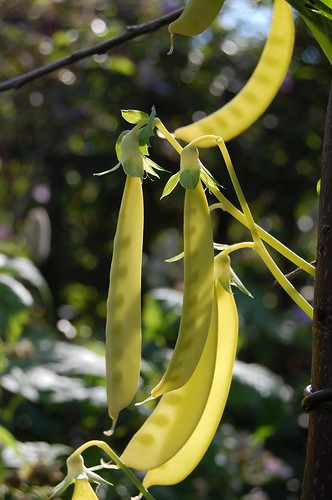
Luna Trick F3 young pods
The first Luna Trick yield. Golden yellow moon pods, exquisitely sweet and completely fibreless.

Hybrid vigour in peas is something I've often wondered about. I've often heard it said that hybrid vigour exists only in outbreeding plants, if indeed it exists at all, which is still a subject of debate. Peas are inbreeding plants - very inbreeding - and so you might expect them not to gain much vigour from being hybridised. However my experience is that peas do have a bit of a wahey in their size and growth when you hybridise them. It varies, but it's usually apparent in one way or another. And it may be the reason why Luna Trick turned out a lot taller than expected.

The parent varieties were 5ft tall and 1ft tall respectively. Under normal circumstances, I would expect most of the offspring to be around 5ft tall, as that's the dominant form - with about one in four defaulting to the recessive 1ft size, and maybe the odd intermediate. As it turned out, the dwarf types were nearer 2ft, and voluptuously chunky. Whereas the tall types - well frankly they didn't want to stop.

Daniel, in whose honour the peas are named, is a big bloke. He's 6' 4". I never thought the plants would get as tall as him, but they did.
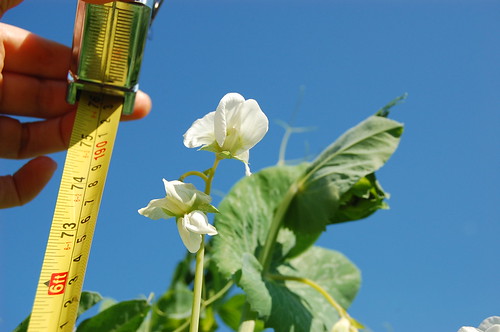
Luna Trick F3 outgrows its patron
The F3 crop reaches the same height as Daniel. I wasn't able to measure it after this point because my arms aren't long enough.

Most of the plants weren't going to stop there either. They just kept going, way beyond the 5ft tall frame I'd optimistically provided for them. I had to ram some extremely tall and sturdy poles into the ground all around the frame and wrap masses of garden twine around them to hold everything together. And still the plants kept growing. I couldn't even reach the tops. They were probably a good 8ft by the time they started slowing down.

But apart from this, they behaved very well and did everything I hoped they would do. I'm very optimistic indeed that they will turn out to be a wonderful variety. Not only that, they are TWO wonderful varieties. The original YSS 25 protoype plant was a mangetout type - but growing its offspring revealed the presence of a hidden recessive sugarsnap gene, and a large number of the F3 plants turned out to be sugarsnaps. Beautiful, crescent-podded, golden yellow sugarsnaps! So I got exactly what I had wanted when I made the original cross - in addition to developing Luna Trick as a mangetout type. A wonderful, beautiful and very much appreciated gift.

The key trait in Luna Trick is flavour. I'm aiming for it to have the same flavour as YSS 25, which stood out from every other plant in the F2 batch and was among the most refined mangetout flavours I've ever tasted. Very sweet and juicy, but there's a lot more to it than that - it had a rich and refined complexity to its flavour and no trace of bitterness. YSS 25 was good enough that you would want to eat its full size pods straight off the plant. A salad mangetout, effectively, because it tastes so good raw you really would have no incentive to cook it. I think a yellow mangetout which tastes good enough to include in a salad, even at full size, would be a very nice thing to have.

At the moment I'm getting a mixture of single pods and double pods - some plants produced one or the other but in many cases there was a mixture of both on the same plant. I'm not quite sure how this trait works - it is clearly partly genetic but I'm not sure whether there are environmental factors involved too, or a complex interaction of genes, because it doesn't follow normal patterns and ratios. Consequently I'm just not worrying about it for the moment. Two pods per node is often deemed more desirable but I tend to find that the two pods have fewer peas in them compared to the single ones, so I'm not convinced it actually matters that much either way.
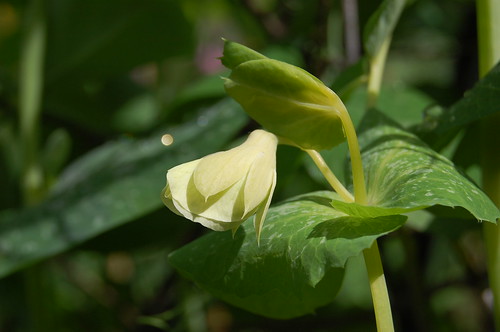
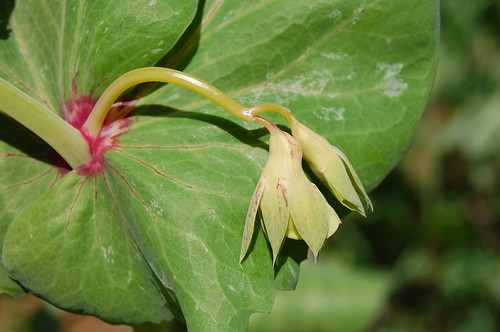
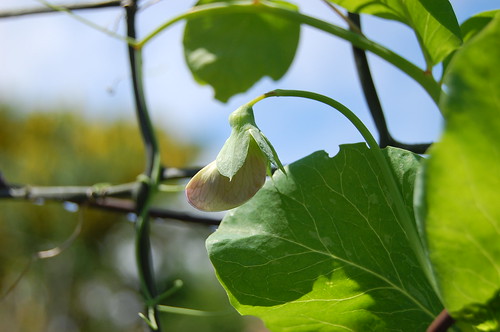
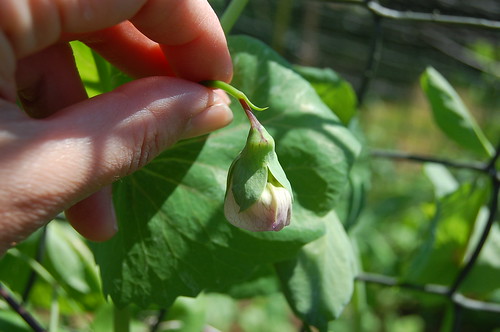
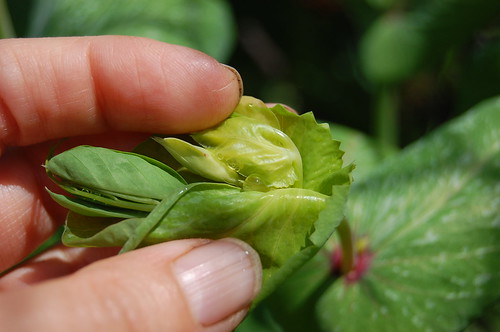
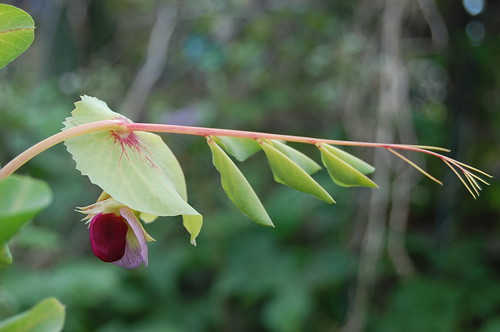
Luna Trick F3 bud
A single flower bud. This is an unusual colour combination in peas - a white flower with a creamy blond calyx (the pixie hat bit).


To summarise the F3 characteristics ...


Luna Trick is stable (true-breeding) for:

Yellow pods - a very simple recessive gene is responsible for this, called gp. In order to express yellow pods, the Luna Trick prototype must have had the stable gp gp genotype. Which is fine by me. It holds only gp genes, so all its offspring will be gp gp too.

There is, however, some variability in how persistent the yellow colour is. One of the weaknesses of the parent variety Golden Sweet is that its pods tend to green up as they reach maturity, so only the young pods are truly yellow. Some of the Luna Trick F3 plants shared this tendency, but others were notable in their ability to stay yellow right up to the time they were harvested for seed. Presumably this is a genetic variable - though I don't yet know how it works - and I will select for it at the F4 stage.

Edible pods - a slightly more complicated trait, as there are two genes involved in the reduction of fibre in the pod, p and v, both recessive. They work in slightly different ways, and you need both of them to get a really good fibreless pod. I have my suspicions that Golden Sweet only has one of them, as it tends to go a bit gristly at maturity. However, Sugar Ann has them both - and now Luna Trick has them both too. There was no trace of fibre in any of the pods in the Luna Trick F3. Hurrah!

White flowers - peas need a dominant gene called A in order to "switch on" anthocyanin production. Without it, they cannot produce any purple pigment in the leaves, stems, flowers, seeds or anywhere else. Luna Trick has inherited the recessive a a genotype from Sugar Ann, and therefore cannot produce colour pigments. White flowers it is then.

Cream calyx - the flowers all have a cream calyx (sometimes with green mottling) rather than the more conventional green. This is a true-breeding trait because it's directly related to the yellow pods. It looks absolutely gorgeous with the white flowers and really gives this variety an extra beauty factor in the garden, adding to its luna blondness.


Luna Trick is still segregating for:

Height - I'm selecting for tallness, which is the work of a dominant gene called Le (internode length). The cross with Sugar Ann will have introduced the recessive type le into the mix. Although the Luna Trick prototype was tall, it had the recessive shortie gene lurking in its genome … and by a simple Mendelian ratio I ended up with dwarf types in about a quarter of the F3 plants. With a bit of luck the F4 generation should take care of this. By growing out several plants from each of several lines, I'm hoping to be able to identify the lines which produce only tall plants, and which are therefore likely to have the desired Le Le genotype.

Pod type - the prototype Luna Trick had large mangetout type pods, which represent the dominant form. However, squirrelled away in its genome was the recessive gene n, inherited from Sugar Ann, which gives sugarsnap type pods. Consequently about a quarter (or just over actually) of the F3 plants were sugarsnaps. I was overjoyed by this, as yellow sugarsnaps were the original intent when I made the cross. The way this gene works is to thicken up the pod wall, giving it its chunky and succulent 'snap' characteristic. To compensate for this thickening, sugarsnap pods tend to be slimmer. Although this genetic difference is simple and made by a single gene, it effectively creates a separate new variety.

The recessive nature of gene n means that any sugarsnap lines I follow up will be true breeding for sugarsnap pods, as they will be genotype n n. The mangetout Luna Trick, on the other hand, will continue to throw up the odd sugarsnap from recessive genes hidden away, and I'll have to eradicate those through repeated selection.

Even within the mangetout type, differences in pod size and shape are apparent. The ideal I'm looking for is a fairly wide crescent shaped pod, but some are narrower and some are extra wide, and some are not quite so crescent-shaped.

Flavour - this is the most important factor, and I would have liked it if all the offspring had tasted as good as the prototype - but only some of them did. I know very little about the genes involved in pea flavour. The combinations are very varied, and so I assume a number of genes have a bearing on it. Sugar content obviously is a major factor, but it's not the be-all and end-all. Some peas taste very sweet but are still quite bland, others have a rich and interesting flavour but aren't particularly sweet. There is also a kind of 'soapy' taste which peas are prone to which seems quite independent of the other flavour variables. The flavour variability in the Luna Trick F3 was quite considerable. They ranged from something akin to nectar of the gods to something bordering on bitterness. Some were just bland. Overall though, the vast majority tasted substantially better than Golden Sweet - and the best ones were truly exceptional. So I'm confident of creating a flavour benchmark with Luna Trick - it's just going to take a bit of careful selection.

Seed colour - the Luna Trick prototype was heterozygous for seed colour, producing both the dominant cream seeds and the recessive green ones. Some of the resulting F3 plants were homozygous for green seeds, but the lines I'm most interesting in following up happen to be heterozygous ones, so the variability will continue in this coming generation. I'm not too bothered about this. I might select one colour or the other if it becomes easy to do so, but I don't see any harm in having the variability. It would be unacceptable in a commercial variety to have mixed cream and green seed, but I don't see why not. One of the compensations of public domain plant breeding is that you're not bound by rules and conventions.
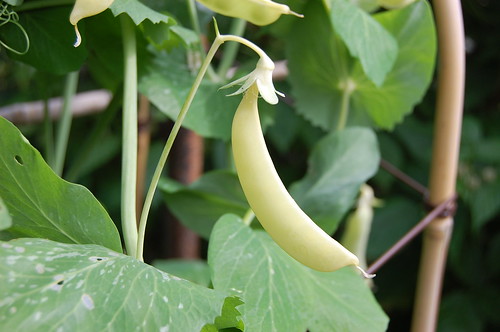

Luna Trick F3 pod
Sugarsnap version of Luna Trick. I will develop this type separately and make a new variety with a different name.

Luna Trick does have a potential weak spot which may be genetic or environmental or a combination of the two. The peas have a tendency to split their skins when ripe - much as ripe tomatoes do when they're over-watered. This isn't a problem when you want to eat them, but verily 'tis a bugger when you are saving them for seed. In the F3 crop, some plants suffered badly from it and some had no problem with it at all. So I am selecting the ones that didn't have the problem - kind of by default, because the ones that have split will not make good seed for replanting. If it's a genetic issue, selecting against it should soon eradicate it. If it's environmental (affected, for example, by how much water the plants get at a particular time) then no amount of selecting will make any difference. So far this seems to be the only flaw though in an otherwise wondrous variety.
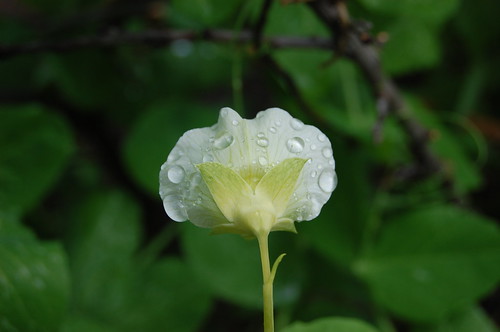
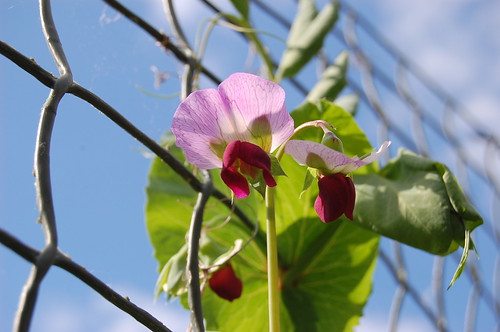
Luna Trick F3 bloom
Rain on Luna Trick blossom.

So what now? The F4 crop in 2010
I've already sown 100 seeds for this year's selection work - 50 mangetouts and 50 sugarsnaps - and these are the ones shown in the video above. Germination was 100%.

I'm working on the mangetout and sugarsnap versions as completely separate varieties, and at some point the sugarsnap one will get its own name. Some sugarsnap types will continue to show up among the mangetouts in this generation. I'm also seeing height variability, which is apparent even at the seedling stage.

I've chosen F4 seed from the best six plants of the mangetouts and the best six plants of the sugarsnaps. In the F3 there was one plant, called LT10, which stood out from all the others - it was the tallest, highest yielding, most beautiful and had the holy grail flavour I was looking for. So I'm growing more of those than any other, hoping that I can stabilise it pretty much as it is. But by growing out a few other good lines alongside it, I'm hedging my bets in case LT10 turns out to have any unexpected flaws - and also learning more about the genetics involved, by observing the ratios for different traits in different lines.

With the sugarsnaps, there was no obvious standout plant in the F3. Some were better for flavour, some for pod shape or colour, some for stringlessness ... so I've just selected the six that looked most promising and will see what I get.

All in all though, I'm very excited and optimistic about Luna Trick.

Sunday, 13 June 2010

Beautiful Luna Trick

Twilight Luna Trick F4

Everything's happening so fast in the garden at the moment I'm barely able to upload my photos onto the computer before they're out of date (however did I manage in the days when I had to send films to Bonusprint?) so I'm just going to chuck a few pictures of my Luna Trick F4 peas up here to show you how they're getting on.

I'm very happy with the way things are going with this variety. You may recall, dear reader, that I have two separate batches of F4 plants because last year's Luna Trick F3 segregated into mangetout (snow) types and sugarsnap types, and as I'm intending to develop them as different varieties I'm growing the two types separately. Or I thought I was. As it turns out I have sugarsnaps among the mangetouts and mangetouts among the sugarsnaps, so balls to that idea. The former situation was entirely expected - I knew some of the mangetout-podded plants I saved seed from last year would've sneakily closeted away the recessive n allele in their genome, ready to spring forth unbidden in future generations. This recessive allele singlehandedly creates the sugarsnap type simply by thickening the pod wall, transforming a wide flat pod into a slim, round, plump and juicy one. I love both types, so I'm open minded about what I get. But the recessive nature of this gene means that it will be hiding itself in a proportion of the mangetout plants for a generation or two yet, and I won't know which ones until I grow their offspring.

Luna Trick F4 blossom
Upside down flowers? Well why not.

The most promising F3 plant I had last year was one called LT10. (There's nothing arcane about this name, it was simply the 10th plant in my Luna Trick trial to get a label stuck on it.) It was a tall mangetout-podded plant with a divine flavour. And the gene gods were smiling on me, because when I started growing out the F4 it turned out to be the only one of my mangetout lines which was true-breeding for tallness, which is what I want. All the others had hidden recessive dwarfing genes lurking in them. If I save seed only from LT10's offspring and not from the other lines I should have no more trouble with dwarves. I supposed it would be too much to expect LT10 to be true-breeding for mangetout pods as well, and indeed it has presented me with a goodly smattering of sugarsnaps. They may well be good enough to contribute to the development of my sugarsnap line, but in the breeding of a stable mangetout line they are a pain in the backside.

While I was expecting to get sugarsnaps in the mangetout batch, I certainly wasn't expecting to get mangetouts out of the sugarsnaps - that was a complete surprise. A recessive trait is by definition true-breeding. It can only express itself when a matched pair of recessives get it together and there are no dominants involved to spoil the party. As the mangetout-pod trait is dominant it couldn't possibly be present, hidden, in any of the sugarsnap plants I saved seed from last year. So I was intrigued to see not one but several of the F4 sugarsnap plants developing mangetout pods. How could this be? Is there some other gene at play which suppresses the sugarsnap gene? Did the faeries dig my plants up and move them in the night? The solution became obvious when I looked at the identification tags of the plants concerned. They were all from the same parent plant, LT2. I'm growing ten of LT2's offspring, and the majority of them have mangetout pods, with a few sugarsnaps. While I hesitate to declare a Mendelian ratio on such a small sample size, it seems obvious that there is one and I made a mistake in classifying LT2 as a sugarsnap when it was nothing of the sort. Sometimes mangetout pods look a bit sugarsnappy. It's a relief to find such a simple explanation, and it's one of the reasons I number my plants at the F2, F3 and sometimes F4 stage - as laborious as it is, it enables me to track the pedigree of each individual, to find patterns in weirdness and resolve mistakes.

Luna Trick baby sugarsnap pod
The first Luna Trick F4 pod, still with its little petal nosebag on. This one is a sugarsnap type (honest).

Luna Trick F4 sugarsnap pod
The same pod five days later, now with a beautiful luna crescent shape.

In the last couple of days I've managed to do the first couple of taste tests, and so far they've all been very nice. Flavour is the most important thing I'm selecting for, apart from healthy vigorous plants which goes without saying. But I'm also looking out for crescent moon shaped pods, particularly among the sugarsnaps. I'm also mindful of the colour intensity. For the most part Luna Trick has a stronger and longer-lasting yellow colour than its yellow parent, Golden Sweet, but in last year's batch I did have some which faded to pale washy green a bit more quickly than I would like.

I'm also busy with the scalpel using Luna Trick for various hybrids, particularly as it represents a superior alternative to Golden Sweet, so rather than doing backcrosses to Golden Sweet in my Peachy and Red-Podded lines, I'm using Luna Trick instead. I'm making these crosses with both the mangetout and the sugarsnap types, which I'm hoping will give me a red sugarsnap as well as the decent flavoured red mangetout I've been coveting. I've also made some crosses with Salmon Flowered (the antique umbellatum pea) which is more of an experimental endeavour. What I have in mind is to extract the gene which makes the rosy pink flowers, which would look lovely on a yellow-podded pea. But my weird imagination also conjures up a vision of a yellow-podded umbellatum, crowned by a giant clump of sticky-outy golden sugarsnaps. What a spectacle that would be.

Luna Trick F4 pod
This is one of the mangetout type pods.

Sunday, 25 April 2010

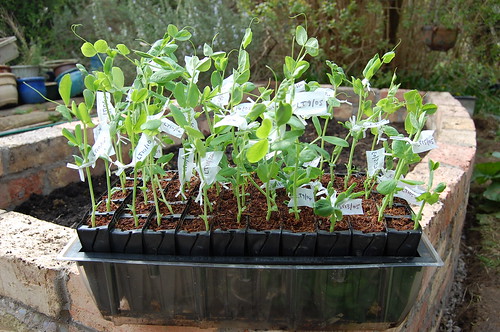
Luna Trick F4 seedlings go forth

Luna Trick F4 seedlings
Luna Trick F4 plants all tagged up and ready to plant out

Well both my F4 Luna Trick batches are now planted out in the garden - the standard version and the sugarsnap version. They were sown a couple of weeks apart, in the hopes that their development will be staggered somewhat and I will be less overwhelmed by the workload. Growing peas is not in itself much of a workload … they are independent little dears. But breeding projects have a habit of being very time-consuming, especially this one, because I'm being very careful about collecting individual data on each plant. It takes a lot of effort to label and track every single plant in the project and write down detailed notes for all of them. But it will save me time in the long run because I will be able to select more precisely for the traits I want - and it will teach me a lot about the genetics involved, and pea genetics generally. By labelling every plant with its own number, which includes a code for its specific pedigree, I can identify which lines are true-breeding for dominant traits such as tallness. I'll be able to see which pedigree lines are entirely made up of tall plants and save seed only from those, which should eliminate unwanted recessives very quickly. If I pooled the F4 seed and selected from the whole group, I wouldn't know which of the tall ones were hiding unwanted recessives. So although it would save me a lot of note-taking for this year, I'd be weeding out unwanted dwarf types for years to come.

Luna Trick F4
Luna Trick F4 plant, photographed today. This one is the offspring of LT10, which so far looks to be the only line which is true-breeding for tallness.

As these plants are so important to me, I take extra care with them. They have been raised in rootrainers, which in my experience are far more reliable than any other method for producing strong seedlings and healthy plants. The expense of rootrainers doesn't necessarily make them a good option for pea cultivation generally, but for me they are a worthy investment. The next important thing is soil preparation. I don't bother with fertilisers because peas don't really need them … they have a unique mechanism for producing their own. But what they do benefit from is a digging in of organic matter of some kind. Compost is good. Horse manure is excellent, but in the light of the disgraceful aminopyralid poisoning of Britain's grasslands, I'm not using manure in my garden at the moment. Removal of perennial weeds such as couch grass root is also important, because it's difficult to weed around peas once they get established.

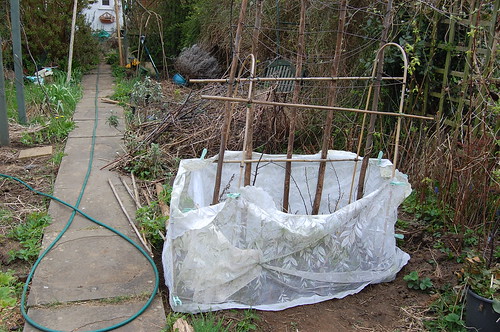
The other special care I provide them with is protection from the weather. Peas are hardy, and I'm not at all worried about the April frosts. The cold nights we're getting at the moment are bringing out some lovely red colour in the leaves of peas capable of producing red colour (which Luna Trick isn't) but it's not harming them in any way. What peas do suffer with though is the cold blustery winds that are so common at this time of year. Having said that, this year has been astonishingly warm and settled, so it hasn't been an issue. They are only really vulnerable to this when they're young and first planted out … the cold winds wither and damage the young growing tips. Once they've got established after a couple of weeks, they are a lot more robust. So what I do for precious peas when first planted out is set up a netted fabric screen round them. Horticultural fleece is the conventional choice, but the lovely old lady who lived in my house before me has saved me ever having to buy any. The house was festooned with about 30 miles of net curtains, which do an admirable job in taking the edge off the winds without losing too much sunlight. I'm growing Luna Trick in a frame made of bamboo canes, so it's the work of a moment to attach the net curtains round it with clothes pegs. I do have to be careful to lay a few unwelcoming heavy twigs around the outside as well, because my cat finds it amusing to charge into the net curtains at high speed.

Protecting pea seedlings the cheap way
Doesn't that look grand? Well all right, it looks bloody awful, but old net curtains are very effective at filtering the English spring breezes while the seedlings get established. I make no apology for the state of my garden ... the breeding and heritage conservation work is so time consuming I don't have time to make it look pretty as well.

I keep each of my breeding projects in their own personal filing containers, made from ultra high-tech re-used cat food boxes. When I picked up an empty box the other day for a new project I'm starting, it turned out not to be empty. Rattling around inside were about a dozen lovingly sorted and labelled bags of Luna Trick seed from the best of my F3 lines, and three unmarked whole pods left loose in the box. I'm afraid I do have this bad habit of failing to label things and then forgetting what the hell they were. These seeds were all harvested earlier in the season, when I was selecting the best plants and harvesting the pods as they matured. I remember harvesting them but don't remember shelling them and boxing them up, which serves me right for smoking too much weed in my youth. There were about twelve pedigree lines in labelled bags, including a load of extra seed from my best plant LT10 … so I've sown another fifteen of those. You can never have enough LT10 as far as I'm concerned. And by starting off another batch of them now, in addition to the ones sown about a month ago, I'm greatly increasing my window of opportunity to make crosses with them.

The loose pods were something of a mystery, but there had to be a good reason I kept them separate instead of bagging them up like I did the others. According to my pollination records, which can also be a bit sporadic when I'm busy, I did some crosses between the best Luna Trick F3 plants and one of the trial varieties I grew in 2009, Buerre Cosse Rouge. This latter is quite a special little variety because it has red-sploshed pods … not quite the deep consistent crimson I got in my red-podder project, but reasonably close to it. And it's a sugarsnap type. It does have some frustrating weaknesses though. The plants (in my trial at least) were tiny and not very strong, and the yields absolutely miniscule. It produced miniscule pods that have about three peas in them, and more often than not they withered and fell off before they reached maturity. I didn't even get to taste Buerre Cosse Rouge, because I was struggling to scrape together enough seed just to regrow it this season. In doing these crosses, I had in my head the idea that I might get some red-pod gorgeousness into the voluptuous sweet abundance of Luna Trick. There is a chance - only a chance mind - that these loose pods had been kept separate because they were hybridised ones.

Fortunately for me and my slack incompetence, I should be able to find out fairly quickly. My old friend gene A will help me out. It's the gene which switches on the colour pigment in peas. Luna Trick doesn't have it - it's true-breeding for the recessive a a genotype which cannot produce anthocyanin pigment. Buerre Cosse Rouge presumably has the dominant A A type, because it has lots of anthocyanin colour. Crossing the two will give me the a A genotype, in which the recessive colourless gene gets elbowed out. In other words, if the seedlings show any trace of red colouring, I will know they are from a cross. If they turn out to be the normal unpigmented Luna Trick type, then I'll know they weren't from a cross. Thus nature sometimes forgives us for poor labelling.

(The seedlings have now emerged and so far are not showing any obvious traces of anthocyanin. Arse!)

Wednesday, 18 March 2009

Pea: Luna Trick

Last year's F2 plant which became the prototype for Luna Trick

I have at least three or four plant breeding projects which will be ready for naming in 2009.

This is the first ... a new mangetout (snow) pea called Luna Trick.

Named in honour of my friend and music collaborator Daniel Staniforth, a shining inspiration who plays cello for me along with a seemingly endless range of other instruments; Daniel releases his own alt-rock music under the name of Luna Trick, so this beautiful moon-like pea is for him.

Prototype, photographed 2008

Luna Trick was bred from a cross of Golden Sweet x Sugar Ann. It was one of the obvious stand-out phenotypes in the F2 generation in 2008, producing a beautiful and abundant plant, though its greatest asset is its outstanding flavour (which must be carefully selected for in future generations). This is what the variety should look like when it's stabilised:

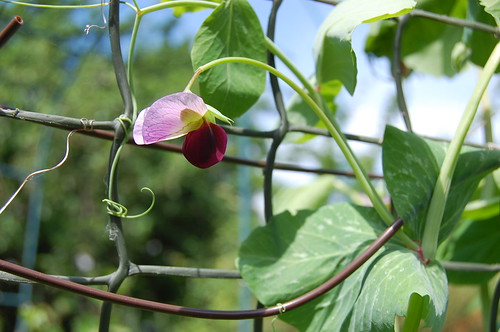
Growing vigorously to 6ft, it has distinctive yellow-green stems, and bears single rounded moon-white flowers on pale yellow stems so curvy they sometimes turn right over and bloom upside-down. The calyx is cream when young but at maturity turns moon-white with green mottling. Pods are pale yellow, quite large and succulent. As they mature they take on a porcelain-like translucence and the small peas can be seen inside, 8 or 9 per pod. Being a mangetout type, Luna Trick is completely fibreless and the pods are edible at all stages. The absence of fibre helps give it its translucence but it also means that the pod cannot keep its flat shape at maturity ... the peas bulge through and the pod buckles and twists, taking on a crescent shape. The really special feature is the pod flavour, which is exquisitely sweet, and a major improvement on its yellow-podded parent. The flavour has a full and rounded character as well as being sweet, and the thickish pod walls are unusually juicy. Even at a large size they can be eaten straight off the plant with no trace of bitterness. The peas themselves are not huge but very abundant, and sweet enough to be worth eating in their own right, raising the possibility of this being a dual-purpose variety. The one fault the peas have is a tendency for the skins to split if watered too heavily or erratically (either by me or the English weather).

The absence of any fibre inside the pod makes it impossible for it to stay flat. It's a bit weird-looking, but I rather like it. The pods also turn porcelain-translucent as they mature, so you can see the peas inside.

Although this pea has got its name this year, that doesn't mean it's ready for general release ... it will probably need at least another year's work. The basic format of a breeding project goes like this: two varieties are crossed together to make an F1 hybrid. The F1 seeds are all mixed together and don't get a name or a number ... there's no point, as they all look pretty much the same. The only purpose of the F1 generation is to provide as much F2 seed as possible. The F2 generation is where the magic happens ... as all the genes in the lottery get re-shuffled randomly and create enormous differences between siblings. So I treat each F2 seed as a unique individual and give it its own identifying number. Once I've decided which of the resulting F2 phenotypes are worth pursuing, the number is then applied to all subsequent generations so I can keep track of its lineage. In this instance, the plant I wanted to keep was one called YSS 25 - quite simply plant number 25 in my Yellow Sugar Snap project (which so far has produced just about every imaginable phenotype except a yellow sugar snap, but never mind). So at the end of last season I collected all the seeds from YSS 25, and these are now F3 seeds. Although they will display a certain amount of variability they should mostly follow the blueprint set in the previous generation, so they don't get their own individual numbers ... they are collectively labelled YSS 25 F3, and are now the basis for a new variety. It needs to keep its number so I don't lose track of its pedigree, but you can see why I prefer to call it Luna Trick.
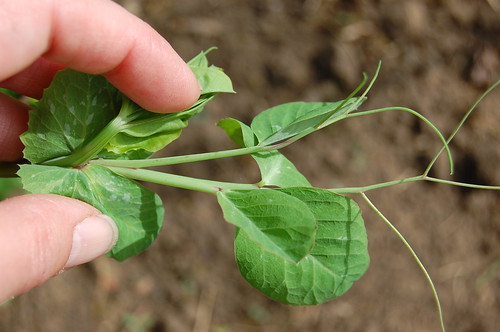
2009: new seedlings just starting to sprout. This is the F3 generation

It's still early days on this project, but I'm hopeful that Luna Trick will be among the first of the new pea varieties to be released. Why? Because most of its desirable traits are made by recessive genes. Recessives are the joy of a plant breeder's life because they are so easy to stabilise. For example, the yellow pods are made by a recessive gene called gp (golden pod). I can deduce that the Luna Trick prototype carried a perfect matched pair of gp genes ... because if it didn't it wouldn't be able to express yellow pods. If it had only one copy of gp it would default to green pods, with the yellows just showing up in a proportion of its offspring. The fact that it was yellow-podded means I can be fairly confident that all its offspring will be yellow-podded, because it has only gp genes to pass on. The same is true of many of its other traits ... it has matched pairs of recessive genes for fibreless pods (two genes), white flowers (one gene) and for sweet flavour (two or more genes), so I can expect it to have high levels of stability for all these traits. These characteristics are joyfully easy to predict.

Some of the variability is also predictable. Tallness is a dominant trait in peas, made by a gene called Le. The original Luna Trick plant was tall, but it was bred from a cross between a tall pea and a dwarf one so I don't yet know whether it has one copy of the Le gene or two. If it has inherited two, it will breed true for tallness. If it has only inherited one (which is statistically more likely) then I can expect to see the recessive dwarf gene show up in a quarter of the offspring, and I will have to keep selecting the tall ones for several generations until the dwarves stop showing up.

Fortunately with peas you can recognise tall and dwarf phenotypes very early on, while they're still young seedlings. This is because the difference between a tall pea and a short one is simply down to internode length ... the amount of stem it makes between each set of leaves ... which starts to show itself when the plants are only a few days old. Thus I should be able to "rogue out" any shorties before I even plant them in the garden. Though I will probably plant them separately from the others and keep some seed from them, just in case I ever want to create a short version of the variety. (My breeding work focuses on tall peas as they are wonderful and deserve a renaissance after being woefully neglected for the last 100 years, but some people do like dwarf peas so I'll keep the options open.)


You can also see from this picture that it has variability in the seed colour, and comes in cream or green. The colour of a pea seed is made by the cotyledons (seed leaves) hidden inside. The dominant cotyledon colour in peas is yellow/cream ... and clearly Luna Trick has inherited this ... but it has also inherited a recessive gene catchily called i, which produces green cotyledons. (Put into technical terms, it's heterozygous at the i locus.) I could select one colour or the other ... the green ones, being recessive, will breed true for greenness, while the dominant cream ones may be hiding recessives within them and will show some further variability. But I'm actually not fussed either way ... the seed colour is not especially relevant in this project, so I'm planting them all without selection. If I was a commercial plant breeder I would probably want to select more rigorously to get a uniform product ... but I'm not, so I'm more interested in maintaining a healthy bit of genetic diversity.

Having made all these predictions, "expect the unexpected" is the mantra of any gene-reshuffling endeavour. It's likely that I'll find some unforeseen variability in the twenty-five or so plants I'm growing in this generation. Some will be caused by hidden recessives making their presence felt, and some will be caused by pleiotropy (genes which have more than one function) and unexpected synergies between newly combined genes. But that's OK ... for me it's one of life's greatest joys to see these new plants emerge into the world, each one subtly unique, and see what gifts they have to offer.

More information about pea genetics can be found in the JIC Pisum Gene Database.

Monday, 31 May 2010

Please universe, may I have some edible red podded peas?

Purple mangetout pea F2
Golden Sweet x Carruthers' Purple Podded F2. First one to flower.

Today has been a perfect day for hand-pollinating peas. Warm and dry but not too sunny - which creates just the right conditions for pollen to spill its abundance and for stigmatic goo to be in the right mood to receive it. Even more usefully, it was completely breezeless with not so much as a leaf blade stirring. The bitter lessons of trying to hand-pollinate flowers that are thrashing about in the wind, not to mention walking across the garden with a precious blob of pollen on the end of a scalpel, have taught me that pollinations on breezy days are the stuff of futility. All the more so for those of us with waist-length hair, which is guaranteed to flap across your face at the very moment you were trying to deposit a miniscule dab of pollen onto a particularly wobbly and elusive stigma.

As the weather was so perfect for it, I was really hoping to get some useful pollinations done for my red podded pea project. Only trouble is, most of the flowers I want aren't ready. The true red podders aren't even producing buds yet, and my semi-red mangetout line, which I'm hoping to cross with the Luna Trick sugarsnap for some peachy-red snap pods, didn't want to play either. I found a prime pollen-bearing bud on it that was well past the usual stage for self-fertilisation but when I cut it open I found it stubbornly refusing to dehisce.

Red-blush peas about to flower
An F4 plant from my semi-red podded mangetout line, currently struggling under the temporary working name of Peachy, getting ready for some blossom action (but not yet).

So instead I did some pollinations I didn't really need using the flowers I had available. It is worth pointing out that my beloved Luna Trick pea is the result of just such a casual union, in which I used up the last of some Sugar Ann flowers to pollinate a few buds of Golden Sweet just because I was bored. It turned out to be an inspired combination. Today's efforts mostly involved Sugar Snap flowers as females, pollinated with some of my purple F2 plants which may or may not turn out to be any good. I used the opportunity to take some close-up photographs of the pollination process. It's my fourth attempt to take such pictures. Thing is, you really need three hands for it, or an assistant who knows what they're doing. I have neither, so Plan B was to stick the camera on a tripod and use the self-timer for some very cumbersome hands-free photography, which resolved the three-hands issue but gave me some more challenges in trying to get it to focus in the right place when there's negligible depth of field. Anyway, if any of them are any good I'll add them to my previous pea-breeding tutorial.

The hand pollinations are just one aspect of what I'm doing on this crimson seeking project. Since my pièce de résistance in the red podded pea department stubbornly refused to yield me any fibre-free pods, I've been looking at alternative ways of getting them. Which now involves several simultaneous endeavours.

Growing out the rest of the F2 seed from whence the original came. This is the biggest hope. The particular combination of genes I need are a minority class which will only show up in a small proportion of the F2 offspring. I need the yellow pod gene (recessive), two purple pod genes (both dominant) and two fibre-thwarting genes (both recessive). I can't be arsed to look up in a Punnett Square what the actual chances are and calculate the number of plants I need for 95% probability … I'm content to know that it may take a lot of plants in order to deliver the holy grail. This year it's down to luck anyway, as I have only a small amount of F2 seed left and so I can't grow lots of plants. Even the seed I do have is of poor quality because it was grown from a late summer crop (I used to have this trick of growing two consecutive generations in one season to double the speed of my breeding work, but have since stopped doing it because the second crop yields weak seed at best, and at worst yields nothing and just wastes valuable breeding material). So I have about fifteen, maybe twenty plants, and they may or may not offer any red pods. The moment of truth is approaching, as the F2 plants have got flower buds.

Purple mangetout pea F2

Purple mangetout pea F2

They're very pretty buds, with the mauve blush that promises bicolour flowers. Both parent varieties had bicolour flowers, so I'm expecting to see it in all the offspring. The ones shown above are fairly typical and there are others similar, with more or less purple sploshing on the stems and leaves. But I can already categorically rule out any red pods from these two plants or any of the others currently budding. The reason? Green calyx.

Green calyx means green pods. I've noticed from my work with yellow podded peas that there is a direct correlation between the calyx colour and the pod colour. Yellow podded peas are always preceded by pale cream buds which turn into a cream calyx. Sometimes it has green mottling, and pink dapples, but the base colour is always cream. (Have a look at the picture of Peachy above and see how cream the calyx is compared to these F2 buds). I suspect the cream calyx/yellow pod may actually be coded by the same gene. If they are separate genes, they are certainly slapped together pretty tightly on the chromosome, and inherit together. It's not affected by flower colour - you can get white flowers or purple bicolour flowers on a yellow-podded pea, it's just the calyx and pod colour that are inseparable from each other.

When I say that green calyx means green pods, it may also mean purple pods … or partial purple. That's because purple podded peas are in fact green podded. I know that sounds weird, and I've had to explain it so many times on plant breeding forums it's obviously something a lot of people find hard to follow. If you look closely at a purple pod, the very tip where it attaches onto the plant is green. Break it open and it will be green inside. The purple pigment, no matter how intense it looks, is merely on the surface, and the base colour of the pod is green. This is also the reason why all purple podded peas turn green when cooked. The water-soluble anthocyanin pigment is just sitting on the surface and is washed away in hot water.

I admit it did take me a while to work this out. The first time I grew F2 seeds from this cross, it produced red, green, yellow and purple pods in varying proportions. I couldn't understand why a cross between a purple podder and a yellow podder yielded so many offspring with green pods. Neither of the parents appeared to have green pods so where did they come from? The simple answer is that the purple parent is green podded, with the green hidden under the layer of purple. In the great gene reshuffle, some of the offspring end up with green pods without the genes for purple overlay, and so they stay green.

The same principle applies to red pods. They are simply yellow-podded peas with a purple overlay, which combines visually to make deep red. It's not possible to have red pods unless the base colour of the pod is yellow. That's how I know the two buds shown above are not going to give me red pods. A red-podder bud will invariably have a cream calyx, not a green one.

While I shouldn't condone the practice of peeking inside unopened leaf clusters to look at bud colours, I naturally can't resist it. And it's been very encouraging. Because two of the upcoming F2 plants which are not ready to blossom yet are showing cream buds among distinctly yellowy foliage. Even when they're tiny, the cream colour is unmistakable. The cream buds don't necessarily result in red pods, some will just stay yellow, it depends whether the genes for purple overlay are also present. But they do open up the likelihood of it. Also, one of the cream buds is showing a speck of pink colour on the calyx. While I don't have a genetic explanation for it, I have noticed a strong correlation between pink markings on the calyx and red pods. So I'm feeling lucky with this one.

Cream buds ... red pods?
Maybe it's not very clear in this photo, but this developing bud has a cream calyx - ergo yellow pods. Also a tiny pink spot on the calyx which is a good sign.

It's still pot luck whether any of the plants in this small sample will give me exactly what I want, but the solution is in there if only I can grow enough F2 plants. Which brings me on to my convenient back-up plan …


Growing out more F1 plants to make new F2 seed. I still have a number of F1 seeds saved from when I made the original cross. The seeds are good, healthy mature ones too. I started off a batch of about ten F1 plants this year. The beauty of peas and their efficient self-pollination is that you don't need to do anything except grow the F1 plants and save seed from them. They are veritable F2 seed machines. Every pea they produce has a unique individual genome, its own personal reshuffling of all those genetic goodies. Somewhere among the reshuffles is bound to be the specific five-gene combination I'm looking for.

Purple/red mangetout pea F1
F1 hybrid of Golden Sweet x Carruthers' Purple Podded. Flowering like billy-o and hopefully making lots of nice F2 seeds for me.

What's interesting about these F1 plants is that they are showing massive hybrid vigour, or heterosis. It's a phenomenon brought about by having a mixed up genome, a by-product of heterozygosity. Its cause has always been something of a mystery, though I'm told that some recent research has put it down to an enhanced ability for photosynthesis. Whatever the reason for it, my own observation is that it only happens in certain crosses - though there are degrees of it. And it's for one generation only - you don't tend to see it in F2 plants. This has been especially marked in my current crop, because I sowed the F1 and F2 seeds from the same cross side by side in the same rootrainer tray, and they are now growing side by side out in the garden. And from the moment of germination, the F1 plants rocketed away from their F2 nephews. They grew faster, had thicker stems, established themselves in the outdoors quicker, produced substantially bigger leaves and grew taller. They were also earlier to flower - and still having a burst of surplus energy to get shot of, have thrown out a lot of sideshoots too. Pea sideshoots are usually feeble, spindly things, if they ever get going at all. These are nothing of the sort. They are full-size, chunky, vigorous new branches which look set to flower and make pods.

Something else peculiar about the F1 plants, or one of them at least. I've been writing about the leaf aberrations in my peas this year, which I'm beginning to conclude are probably weather related. I mentioned the fasciation (thickening of the stem) in one of my other hybrids, despite the fact that it's a trait caused by recessive genes. Well, now some spontaneous fasciation has occurred in one of these F1 plants. To my knowledge, there are no fasciation genes in this hybrid, which is not related to the other one - they are completely separate breeding lines. Which leads me to assume that pea fasciation is not solely genetic, and can arise as an environmental reaction. What's even more weird is that the plant in question managed to unfasciate itself by splitting into two stems. A single stem with a well developed sideshoot is one thing, but this is a pair of twin stems growing at the same rate in different directions, equal and opposite.

Purple/red mangetout pea F1
This F1 pea developed spontaneous fasciation (stem widening) and then split into two separate but equal growing tips. This is not normal for peas!

Edit: I've just done some homework on fasciation, following a link from Rhizowen's wonderful blog, and it seems that spontaneous fasciation from environmental stress is a well known phenomenon - actually more common than genetic fasciation. It's caused by damage to the growing tip by virus, bacteria, insect nibbling or frost - and a reversion back to normal growth is also common. In this case, frost is almost certainly the culprit.

Other avenues. I had just eight seeds left from my original red podded pea. I sowed them, and three fell victim to marauding gastropods. The five survivors are doing well though, and although there will be no edible pods among them, they will enable me to make some crosses. The priority will be to cross them with my two Luna Trick lines, which are genetically similar, being derived from the same original parent variety, but represent a superior form of it with good-flavoured and fully edible yellow pods. Another batch of twenty or so are on the go, thanks to my big haired friend Graham, who grew some last year and gave me back some seeds from the best of them. Again, they won't have edible pods, but they will be priceless for making crosses and might also make the basis for a red-podded shelling pea. Also of course there's the Peachy line which has edible pods which are part-red. That might turn into a variety in its own right, and will certainly be useful for making crosses with the pure red (if it ever gives me any pollen).

Friday, 26 March 2010

No I haven't given up

OSU Blue Fruit tomato
OSU Blue Fruit tomato. Verily 'tis a black fruit, but red in the middle.

Last year I had to leave most of my garden fallow and take a year off. It was really a case of too many things happening at once - mostly good things, but nevertheless I got left behind with my workload until it was no longer possible to catch up. So I just focused on getting the pea trials done and a couple of the more important breeding projects, and the rest of my gardening year got shelved. There was no time to write up stuff for the blog - I only just managed to keep on top of the data collection for the trials and experiments. All the non-essential gardening went on hold, and most of the garden was left unplanted, seeds left unsown. Because I was finding it so difficult to do any gardening of my own, I dropped out of the online community … because I found it a bit depressing to see all the goodness I was missing out on. So I apologise if you have been used to seeing my comments on your blogs and have not heard from me for a while.

So what have I been doing instead? Well the main thing I was doing was recording and releasing my second album, Seven Star Green. Which has just had a spectacularly glowing review in the prestigious fROOTS magazine. I should explain that we release our music on our own label, which means we have to do all the promotional work ourselves - which is a grim, tedious, time-consuming and often demoralising slog! It's really because of this that I didn't find the time to commit to the garden in 2009. Daniel and I also launched an additional music project, Alchymical Muse, which is slightly more arty and uses our voices in combination - not just in English but in Gaelic, Occitan, Langue d'Oïl (medieval French) and even our own made up languages. (We just enjoy making things difficult for ourselves.) We're working towards a debut album release for that but it's a little way off yet.

Among the things I was able to grow were four or five varieties of tomatoes, including the amazing coal-black variety OSU Blue Fruit, shown above, which is still under development at Oregon State University in the US. I also conducted a trial planting of around 30 varieties of pea, which involved a lot of note-taking and photographing. The Luna Trick pea project was a huge success - in fact I got twice as much out of it as I'd hoped for - and will be the subject of its own post in the near future. Less easy was the red-podded pea project. A growout of the seed from the original plant yielded some wonderful beauty of colour but alas, none with edible pods. Which leads me to conclude that it doesn't have the necessary genes, and if I'm going to make any progress with it I will have to try a different tack. That will have to include crossing it with something else to introduce the two recessive genes needed for edible pods, and going back to the previous F2 generation to see if there are any other red phenotypes with a more promising genepool. Another setback was an invasion of seed-eating mice who depleted my available seedstock quite drastically. Again, I will write up more about this project when I have time. But here's a piccy from the 2009 crop.
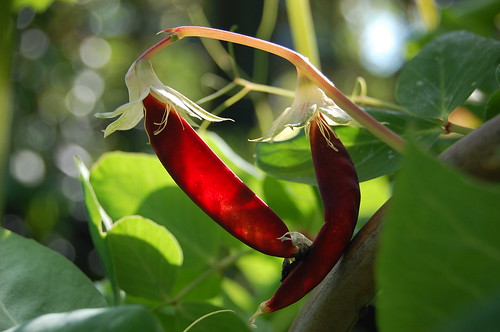
Red-podded pea F3
Red-podded peas: F3 plant in flower. It has the most beautiful buds of any pea I've seen.

I've not been able to take part in seed swaps this year, for two reasons. Firstly my seed stocks are very depleted, and much of what I have got is older seed, which will have to be germination-tested before I can send it to anybody. Secondly, I already have a backlog of seeds which people have sent to me in previous years, and I've already got more than I can realistically hope to grow with the time and space I have available. Every year my breeding projects take up more and more space, as well as the increasing number of growouts I need to do with varieties I've already collected in order to maintain them. So the traditional seed swap model is not practical for me any more - it's not that I don't want the seeds people have to offer me, I simply have nowhere left to grow them! I guess the solution is to set up a system where people who want seeds from me can just pay for the postage rather than sending seeds in return. I can probably do that with a PayPal button but I haven't had time to do it yet.

You may notice that the blog has a new design. Well, 'design' may be too strong a word because Blogger has a pretty rubbish range of templates to choose from compared to the likes of Wordpress. My main www.daughterofthesoil.com site was designed from scratch in Dreamweaver, which gave me a lot more control but it's also a lot more work to do updates, so sticking with one of the Blogger templates is the only viable option for the blog. The main thing that bothered me about the previous design was the black background and the white text. I originally chose that layout to showcase my photographs, because there's no doubt in my mind that most photographs look their best against a black background. But the opposite is true of text - it can be quite wearing on the eyes to read white text on a black background. And much as I like to show off my photography, the legibility of the text is more important. I'd been thinking about changing it for a long time, but it didn't look too bad on my computer so I didn't worry too much about it. But then just before Christmas my trusty old G5 finally popped its chips and I had to replace it. Now equipped with a shiny new iMac (whooo) I went to have a look at my blog and uuuurrrrgh! Websites always look different on different screens and with different browsers, but I was astonished how drastically different the blog looked on the iMac compared with my old computer. The font was much heavier and it made the column width appear narrower - just cramped and hard to read. So, now we have a white background for better legibility, and a flexible column width which I hope will enable it to adapt to different screen sizes without going weird. The removal of the column width restriction also enables me to post slightly larger pictures, and hopefully that'll make up for the loss of the black background.

Nigro Umbilicatum
One of the thirty or so rare peas I trialled in 2009

I'm experimenting with hosting my images on Flickr instead of uploading them direct to Blogger. I like Flickr, it has a much better interface than the cackhanded Blogger uploader and it displays images better. Maybe only a nerd like me would notice the difference, but still. I have a whole load of other stuff on there too, from 18th century gravestones to pavement furniture (yeah I do have some weird hobbies) so there's plenty to look at.

I must also take this opportunity to pay tribute to Val McMurray, a very wonderful lady devoted to the cause of promoting endangered vegetable varieties, who sadly had to relinquish her battle against cancer earlier this week. Founder of a seedbank in Canada with her husband Dan, the energy with which Val collected, trialled, preserved and distributed seeds - especially tomatoes - was absolutely remarkable, not to mention her kindness and generosity in supporting other gardeners with advice and encouragement. She was a ray of light and an inspiration, and will be deeply missed, although her spirit thrives in gardens all over the world - in 24 countries - where she sent her seeds.

Wednesday, 19 May 2010

Leaf weirdness

Well it was only a few days ago that I blogged about the likely genetic expression in my Alderman x Salmon-Flowered F1 pea. And already the plants are thumbing their noses at me and proving me wrong.

Let me begin my explanation by showing you a picture of their dad.

Salmon-Flowered pea
Salmon-Flowered pea growing in my garden in 2007. This is an umbellatum type pea which bears all its flowers in a clump at the top. This happens because the new stems formed at each successive leaf node fuse together and are drawn upwards into a big fat monster stem, for which the technical word is fasciation.

I mentioned that fasciation is caused by a very particular combination of three recessive genes. Because they're recessive, and they need to present themselves all together in order to do their thing, I wasn't expecting to see any sign of fasciation in the F1. I thought they would be masked by the dominant alleles of Alderman. Shows how much I bloody know about it.

Pea showing stem fasciation

Pea showing stem fasciation
Young Alderman x Salmon-Flowered F1 plant showing early but unmistakable signs of stem fasciation. In other words, it's going to be an umbellatum phenotype with a clumpy flower posy at the top.

I don't know why this is happening - I was expecting the growth habit to be more in keeping with the hybrid's mum, Alderman. Multiple-recessives do have interesting effects, but you see that in the F2 plants, not the F1. What's most odd is that I have some young Salmon-Flowered plants on the go at the moment and they are not yet showing anywhere near as much fasciation as this. Perhaps Alderman has one or more of the recessive fasciation genes hidden unexpressed in its DNA. Perhaps the recessives don't have an equivalent dominant allele and are able to express themselves freely. I haven't got a clue (suggestions welcome) so I'm just speculating. At any rate it's showing itself consistently in all the F1 plants.

Pea showing fasciation
Alderman x Salmon-Flowered F1. The leaf stems have divided and doubled themselves, a feature of umbellatum peas.

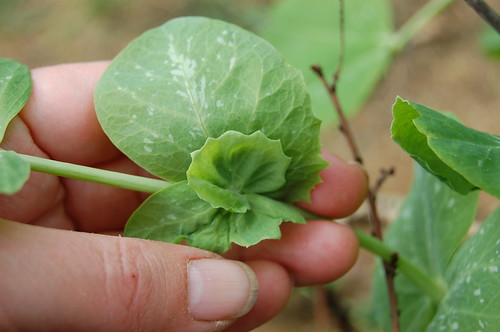
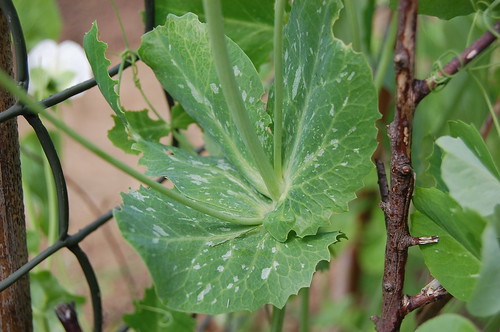
Meanwhile though, I'm seeing some leaf aberrations in my other peas too, and those are even more devoid of an explanation. It takes many forms and it's mostly happening among my hybrids, but not exclusively. I've no idea what causes these effects. Cold weather? Virus? Genetic mismatch? Mystical cosmic rays?

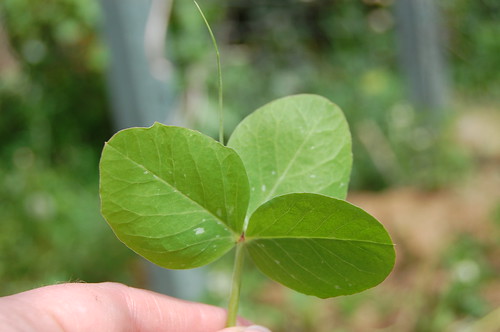
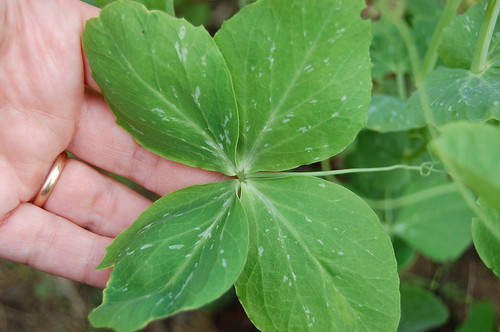
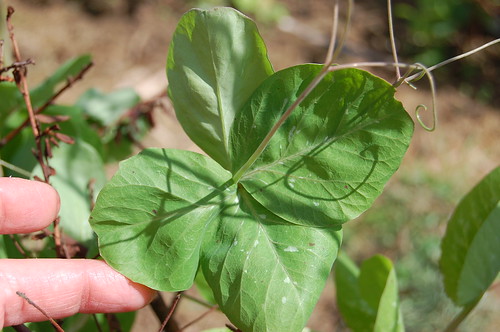
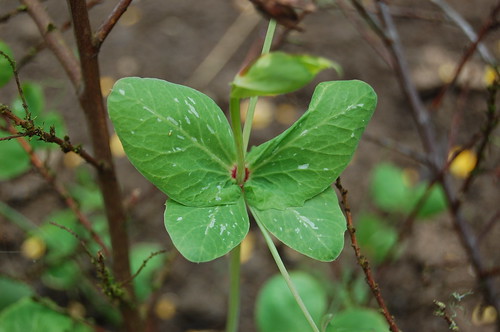
Pea leaves usually come in pairs, but here is a gallery of weirdness.

Pea leaf aberrations
Trefoil. Golden Sweet x Kent Blue F1.

Pea leaf aberrations
Quatrefoil. Magnum Bonum x Carruthers' Purple Podded F2.

Pea leaf aberrations
Another quatrefoil. This one is bearing one of its leaves upside down, and has two sets of tendrils, one on each side. Golden Sweet x Carruthers' Purple Podded F2.

Pea leaf aberrations
Quatrefoil at the main node, creating a butterfly effect. Red-podded pea (Golden Sweet x Carruthers' Purple Podded F5).

Pea leaf aberrations
Magnum Bonum x Carruthers' Purple Podded F2. This hybrid is the one that is showing by far the most leaf weirdness, with a number of the plants showing what I can only describe as a "cabbaging" effect … with surplus leaf growth bunching up around the growing tip, and sometimes even terminating the tip in a leaf-and-tendril dead end. But curiously, it is only affecting the plants that were grown from light-coloured (cream or green) seeds. I sowed the dark coloured seeds separately in the same tray and those are all normal.

Pea leaf aberrations
May Queen, an old English variety, with two leaf nodes fused together. Each node has a fully formed pair of leaves and a single flowering stem, but all squashed up together.

At least I haven't suffered any losses (yet) in the recent spell of unseasonal frost, except for a pot of bush basil which 'melted' overnight when the temperature got too low for it. Apart from that, I've been lucky - thanks to Cheltenham's sheltered climate and my garden being hemmed in by trees and houses. Garden pests have been taking their toll though. After an abnormally dry spring which kept the slugs and snails in hibernation for weeks longer than normal, a few days of heavy rain brought them all out and they were ravenously hungry. The Luna Trick F4 crop suffered some quite severe damage, with about a quarter of the plants gnawed down to stumps within 48 hours. The damaged ones will make new shoots, but it will set them back by several weeks. Sluggy bastards. I even had a potato haulm completely devoured in the space of two nights - gone and vanished without trace. The culprits for this damage tend to be either the large brown garden snails or the tiny keel slugs who live in the soil and are barely noticed at the crime scene.

The other garden pest damaging my peas at the moment is a ginger cat with a big arse. It's a funny thing about cat social mentality - he wants attention and doesn't care whether it's positive or negative as long as he's getting it. He enjoys cuddles but is really just as happy when I'm yelling and chasing him off with a broom. Since he discovered he can get lots of noises and arm-waving from me by crashing over onto my pea seedlings, he's taken to doing it repeatedly. And the more I go "aaaargh!" the more he does it. I'm trying to reverse-condition him by walking away and ignoring him, but it's easier said than done … when someone slaps their capacious backside down on baby F4 plants that represent four years' breeding work, sometimes you just have to leap around and shout.

Mez
The Arse of Doom

Sunday, 4 April 2010

Red-podded pea update: the F3 crop

Red-podded pea F3

The unexpected discovery of the 'formula' for red-podded peas was the most exciting thing to happen in the garden in 2008. Without even meaning to, I'd created something unique and special and was very excited about what it might evolve into. Following all this excitement and expectation, its progress in 2009 was frustrating to say the least.

To recap briefly: I was working with two crosses, both involving a purple shelling pea with a golden yellow mangetout, with the aim of breeding a new purple mangetout variety for The Real Seed Catalogue. One of these crosses was Golden Sweet x Carruthers' Purple Podded, and among the F2 plants (the generation where all the genetic recombination happens) I found one single plant with deepest, richest blood red pods.

Red-podded pea F3

Beauty is not enough though, as spectacular as it is. Commercial seed catalogues are already rife with things which look good but don't taste particularly special. So much so, you could be forgiven for assuming there is a tradeoff between beauty and flavour (which there isn't) and that pretty vegetables will inevitably taste rubbish. I don't want that to happen with my red-podder. I want it to taste as good as it looks, otherwise there really is little point in it.

The original red-podded F2 plant was, unfortunately, a normal shelling pea with a fibrous membrane inside the pod. What I need is an edible podded version - which means a pod which doesn't produce a gristly inner membrane. The absence of fibre is actually achieved by the combination of two unrelated genes, both recessive. Golden Sweet, the 'mother' of red-podder, is a mangetout and has at least one of these genes, if not both. So even though red-podder itself had fibrous pods, there was a pretty good chance that it would be heterozygous at that locus - carrying a hidden recessive gene for edible pods. In fact, by the rule of Mendelian segregation it had a two in three chance of producing some edible pods, and only a one in three chance of being all gristly and inedible. Until I grew the next generation, I had no way of knowing whether it was heterozygous for that trait (carrying some variability) or homozygous (true breeding).

Red-podded pea F3

So in 2009 I grew the F3 plants. As the red-podded phenotype was only really asserted in one plant in my F2 crop, my F3 crop was based solely on the offspring from that one plant. The plants were absolutely stunningly gorgeous. Most of them had deep red pods, though some were coming out as plain yellows, and they all had wonderful rich colouring on the stems and tendrils, and attractive calyx markings. When the sun shines through the red pods they are out of this world.

Alas, growing the F3 revealed that red-podder is homozygous for gristly pods. In other words, it cannot produce edible pods. Homozygosity is a blessing for stabilising the traits you want. But when a trait you don't want is homozygous, you're stuffed. I could grow the offspring of my red pea for the next 100 years and probably never see an edible pod among them. The genes for edible pods are not there. It has only the genes which breed true for solid, yukky, gristly fibre.

There are five things I can do about this:

1. Stand in the middle of the garden and shout "BOLLOCKS!" in a really loud voice.

2. Go back to the F2 generation and grow out the rest of the seeds (I have about 20 left) in the hope of finding another red-podded phenotype but with edible pods.

3. Go back to an earlier generation still, the F1 seeds, and grow out some more of those. These plants will all look the same, all boring, with no red pods. But they will produce a fresh abundance of F2 seed, which I will be able to sow next year and that will give me a much better chance of an edible red-podded phenotype in the event that option 2 above doesn't yield anything.

4. I can switch to another line of F3 seed, even though none of them are proper red-podders. For example, I do have an F3 which is edible podded and produces yellow pods with a red blush. It's possible that if I grow out enough of its offspring I might get something with a stronger red. It should at least breed true for edible pods, which is half the battle. Even if it doesn't produce a decent red, it might make a nice variety in its own right - kind of peachy auburn!

5. I can grow my remaining seed from the red-podded F2 and cross it with something else. To retain the red pods I would need to cross it only with yellow podded peas - and mangetout ones at that. The most obvious thing would be a backcross to Golden Sweet, but I can go one better than that. My Luna Trick line, although not yet stabilised, is bred from Golden Sweet but is a huge improvement on it. A cross with that would give me an excellent chance of improving red podder's flavour as well as its pod structure. The other obvious cross to make is with option 4 above, which already has most of the right genes.

Red-podded pea F3 bud

Apart from option 1, they will all take some time - at least a year and probably more - to get the results I want. But no matter, I have got all of them underway now. We'll see what 2010 brings.